Is P2E a detour for blockchain games?
Original author: Eva Wu, Mechanism Capital
Original compilation: Kxp, BlockBeats
The founders of many games actually failed to realize the original dream vision: "Over the years, players have spent their hard-earned money, But did not get any returns. The emergence of Crypto has changed this situation, all players can earn NFT and Token with real value in the game, and truly realize earning while playing. At the same time, the game can also benefit from this , and continue to succeed.”
Unfortunately, Crypto is not a panacea and does not bring benefits to everyone, so it is time for us to rethink The philosophy of "making money" in many short-lived game economies is gone. Previously, I divided Crypto games into two types: "earning first" and "playing first". Later, I will further explain these two concepts and discuss why "play first and earn later" is leading us astray , What kind of business model should "earning first" games be suitable for, and how to build the future of "playing first" games.
"Play before earning" is leading us astray

Once players identify the game of "play first, earn later" mechanism, they will naturally have unrealistic expectations, so that the original Token will continue to be under sales pressure. In my opinion, what game economists should really do is to re-examine the feasibility of "play first and earn later" games, instead of spending a lot of time thinking about how to optimize the capital pool, increase taxes, and deal with sales pressure. Therefore, rather than promoting the concept of "play first, earn later", game developers need to clarify its specific content, so as to avoid players from falling into unrealistic expectations, and at the same time enhance the stability of the game economy and develop the brand effect.
Provide permanent payment for players
For the game It is a wrong idea to say that most players can make money, because permanent payments are necessarily not sustainable.
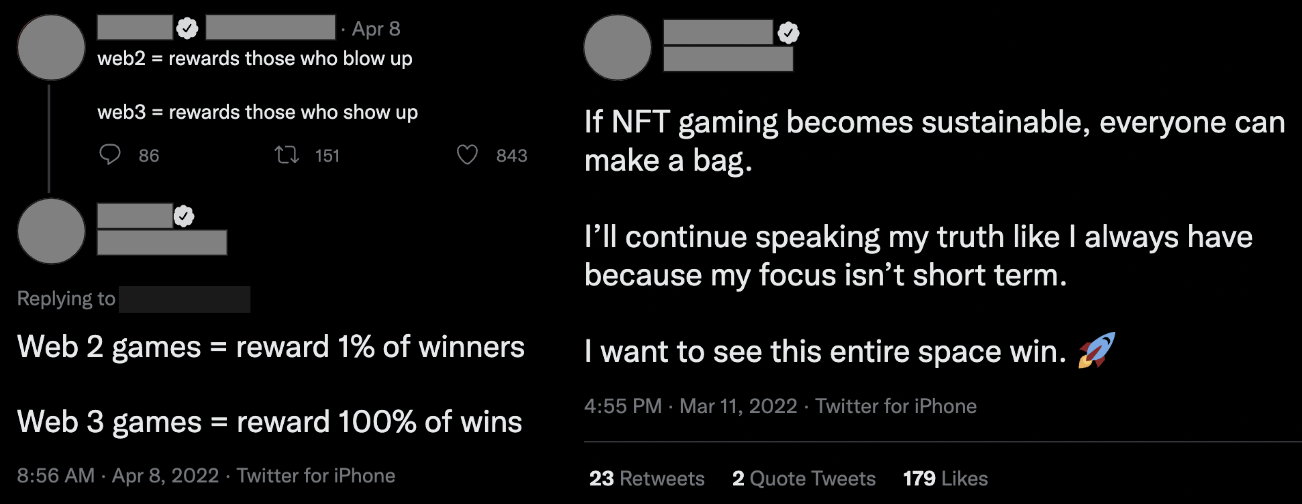
No matter how much capital pool is added, how much money is raised by Token or NFT, if the game has been paying most players If not, then the game economy will quickly lose balance. Whether it's video games, Crypto games or traditional games, you need to manage your financial income and expenditure. We have to admit that any game that issues Token or NFT uses some people's money to pay players. Lured by words like "gamer-owned," game creators have been overpaying early adopters with negative customer lifetime value as a way to build a loyal gaming community. Most of these early players are speculators and airdrop hunters. Most of them only invest for that early income. If they can’t net more money in the later stage, then they will leave the ecosystem, and this is why many money-making games are short-lived. . So not only are games overpaying for such players, but they are also scaring away those who really love the game. In addition, if the player's expected income is higher than his investment, is this part of the investment not an asset of the game but a liability? If this continues, game developers will keep losing money, and real Token/NFT investors will be late.
"Play first" or "Earn first"?
When making a game, founders must always pay attention to the difference between the initial concept and the final product. Many times, founders think that they have created a "play first" game, but in fact they have set up all the same marketing strategies as "earning first" games. However, we can judge by the proportion of tweets posted by the game account to see whether there is more content related to the game itself or more content related to Crypto. Game developers may all fall into such a misunderstanding: they think that the game can be made into a "earning first" game first, and then transformed into a "playing first". While this sounds attractive, in fact, if this model is followed, neither type of player will be satisfied. This is like those blockchains that want to be decentralized after they are created, which usually doesn't work.
A similar situation occurs with Free to Play games, which are either built to handle microtransactions, or built for entertainment, and then The latter is generally based on the former. For example, "Fortnite" started out as a completely free game, and the monetization mechanism was added after it became popular; while games like Farmville were created with monetization first, and then gameplay . But according to Brooks Brown, if a game is "earning first," it won't have much gameplay.
If the game wants to be successful in a short period of time, they may be more willing to develop a "earning first" Crypto game at the moment. However, if developers want to build a "play first" game, they either try to resolve the community's aversion to Crypto games, or make the game complete enough to attract the community to join. In the long run, using excessively high rewards to acquire daily active users is not a good thing for "play first" games.
The future of "earning first" games
For "money-first" games to be successful, "money generation" must be a top priority, because the process of people making money is itself the fun. Throughout history, people have always enjoyed the process of making money, and direct income has always ignited our passion, even if there are occasional small losses, we don't care so much.
In the near future, we may also see more Earn X projects imitating StepN. While it's true that these games didn't last long, games like Ponzi schemes are here to stay and attract attention. The reason is that these types of games tend to be more flexible and fun until you start losing money. In other words, these types of games allow you to have fun while making money. Also, each game has its own shelf life, and some games have a much shorter shelf life than others.
Games that have been around longer are more likely to follow tried and tested business models, such as those found in esports or casino games. Generally speaking, money-making games can survive as long as there is sufficient solvency. In-game funding may come from:
· Players who are willing to invest in rewards
· Sponsors who want to host tournaments
· Spectators who tip or place bets on the sidelines
· Other users who pay taxes
Both poker and competitive games Provide thinking direction for "earning first" games - this type of game can not only have social attributes, but also unlock competitive functions. That is to say, game companies can set up pots and hold competitions, players can make money by winning pots, coaches will be paid for teaching, technical personnel can earn income by manufacturing equipment, and speculators can also watch and bet on games. This economy is more stable because it creates an intuitive value exchange path between players, sponsors, and spectators. In this model, people can carry out various activities based on income and build a corresponding economy.
Where will the "play first" games go?
In the past year, we have been trying to make "earning money" a core competitiveness of "playing first" games, but it has not been successful. This is because, before we can prove that Crypto can add icing on the cake to traditional games, we have already developed in the direction of over-financialization. In this section, I'll share some high-level frameworks that hopefully will help us design more perfect game economies.
Traditional games VS money making games
First of all, in any The introduction of Token at any time will make the game have economic properties. Traditional games simulate our life game scenarios, but with boundaries and economic boundaries. The introduction of Token or NFT will break this boundary and connect the game with the real economy. For gamers who love money-making metagames, there should be the right to self-select games without being tricked into playing a specific game.
There have been attempts over the past year to combine these two genres of games, with less than satisfactory results. For example, Axie is a cute turn-based strategy game on the surface, but after integrating NFT and Token into the game, players only value the economics of the game. Axie eventually became a "earning first" game with a pyramid-style economic mechanism. Every player who joins needs to advance the cost of NFT, hoping to become a seller before others, and sell through SLP and Axies to make money. When economic factors are too closely integrated with the game, it will replace the fun of the game as the motivation for players to participate in the game.
Therefore, for For developers, they should consider the entertainment function and economic function of the game separately when designing games in the future, and integrate Crypto into the game in an innovative way, so as not to give it the upper hand.

The Pokémon card game is a good example, it is both a trading card game and a collectible earning game. The money game. Similarly, athletes can earn money by participating in sporting events without affecting the sport itself. If players decide where to move and how to hit the ball based on the different income for each action, then there is something unjustifiable. Players should focus on the sporting event itself, rather than on external factors such as money-this is what makes the "play first" game different from the "earn first" game.
Really serve the economy of the game itself
Play the game It is not the same thing as participating in the game. In the long run, innovation in Crypto games is not really about rewarding players, but about rewarding those who bring value to the game and players. In many ways, game creators act as central banks and treasuries, as they set reward schedules in much the same way central banks manage distribution of tax dollars. I make this analogy to let everyone see that if the game’s native Token is over-inflated, players will not have any advantage. With this in mind, game developers should only reward those participants that directly or indirectly bring economic returns and increase the GDP of their ecosystem. Currently, most game economies set aside 30-60% of the total token supply to reward every type of player in the ecosystem (see left chart). However, a dynamic economic environment should empower people to exchange goods and services with each other (see figure on the right).
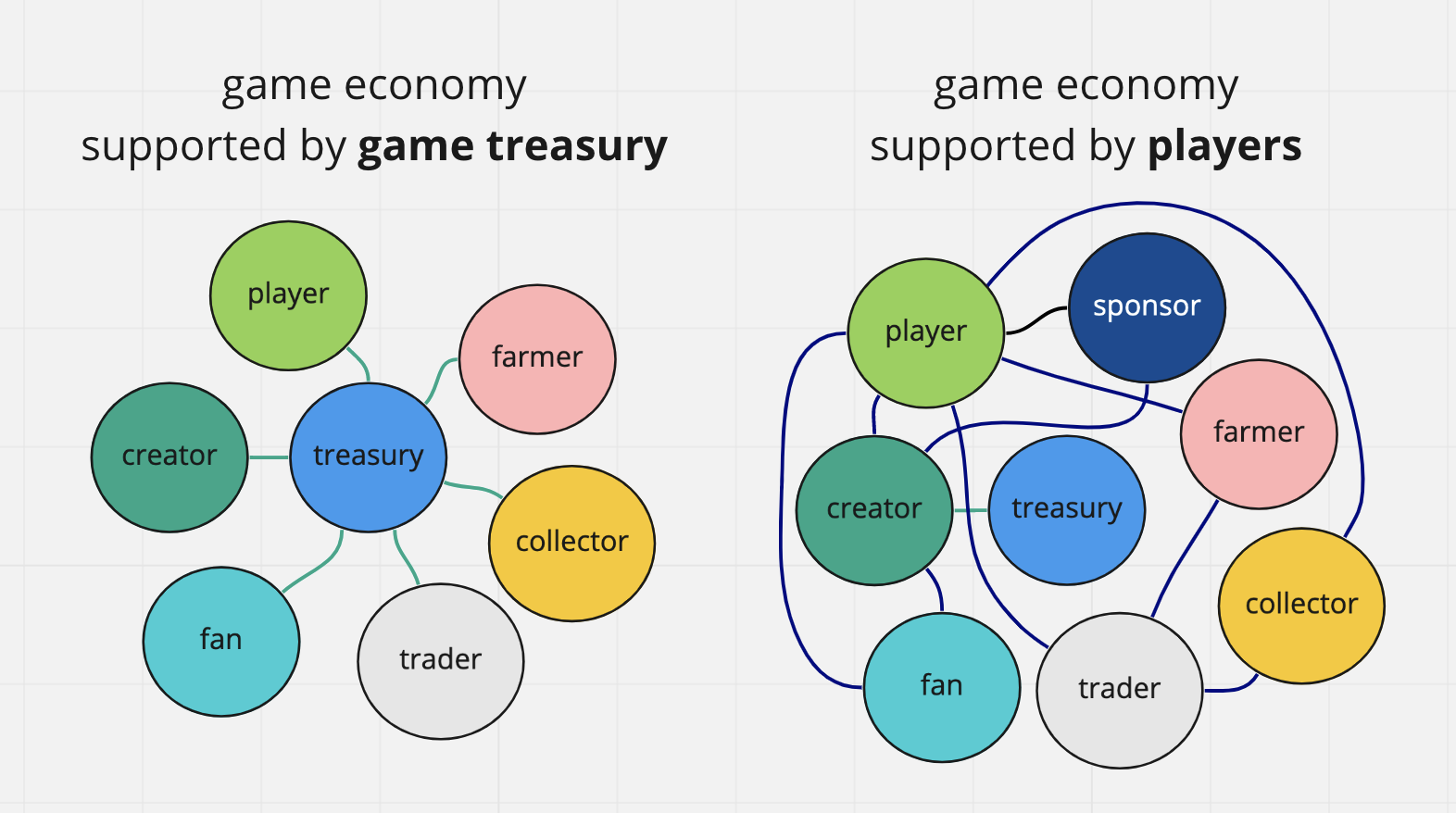
Instead of using treasury funds to mobilize the game economy, game developers should create an ecosystem for game participants Build a platform for creating and exchanging value. In this way, Token can become a real medium of exchange. For example, if the game wants designers to build different game worlds, then the system should reward them with the opportunity to share future revenue. Similarly, the game should not adopt the business model of "influence first and then make money", that is, the game pays the Internet celebrities, but should allow those influential Internet celebrities to gain a group of fans who voluntarily tip for them.
In this way, people can be rewarded multiple times in the process of creating virtual goods and services, instead of working hard for up-front and unsustainable income. In addition, The direct exchange method creates more earning opportunities for users who are willing to pay, and improves economic efficiency. Like other economies, the game economy is real and complex, and can only thrive under a good employment environment and revenue growth.< /p>
Summary
Last year, there was a A huge wave of retail and investor funds. As this market develops, we must not leave empty-handed. We must face our promises to promote the prosperity of this market. Now, we must take a serious look at "Play first and earn later" and permanent payment, clarify the role of Crypto in the game, and design a more complete game economy.
I hope this article helps game developers get out of the mess and rethink how they should build their Crypto games. In the course of my writing, I find myself being critical yet optimistic about the future. If you're building something and find yourself in this situation, I'd love to discuss and exchange ideas with you.
Original text link
Welcome to join the official BlockBeats community:
Telegram Subscription Group: https://t.me/theblockbeats
Telegram Discussion Group: https://t.me/BlockBeats_App
Official Twitter Account: https://twitter.com/BlockBeatsAsia

 Related Articles