Breaking the "walled garden", Web3.0 reshapes the social paradigm
Foresight Ventures: Breaking the Walled Garden and Reshaping the Social Paradigm with Web 3.0
Original author: Alice@Foresight Ventures, Foresight Research
The article based on
Web3 social networking requires more innovative crypto-native gameplay, rather than Web2 Copycat. The social paradigm shift will be a "platform-centric" to "user-centric" social Renaissance. The new narrative includes five key themes: the social graph, decentralized identity, privacy protection, composability, and tokenization. We are still in the early stages of the social paradigm shift.
社交赛道从下至上可划分成四个 Layers:数据层,协议层,隐私层和应用层。其中协议层最为核心。协议层长期看好能持续吸引用户产生新的关系、身份、荣誉的社交协议和基础数据网络。应用层看好能形成可持续 tokenomics 的社交应用。此外,灵魂绑定 Token (SBT)形成的社交关系或许可以兼顾可组合性与弱金融属性,将链上社交 Token 的核心价值回归到关系证明本身,成为真正有效的社交凭证。
What should a Web3 decentralized social network look like?
At present, many Web3 social products still follow the Web2 business model, but it is difficult to fight alone. What we need is not copycats like Web 3 Twitter, Web 3 Facebook, but more innovative native gameplay.
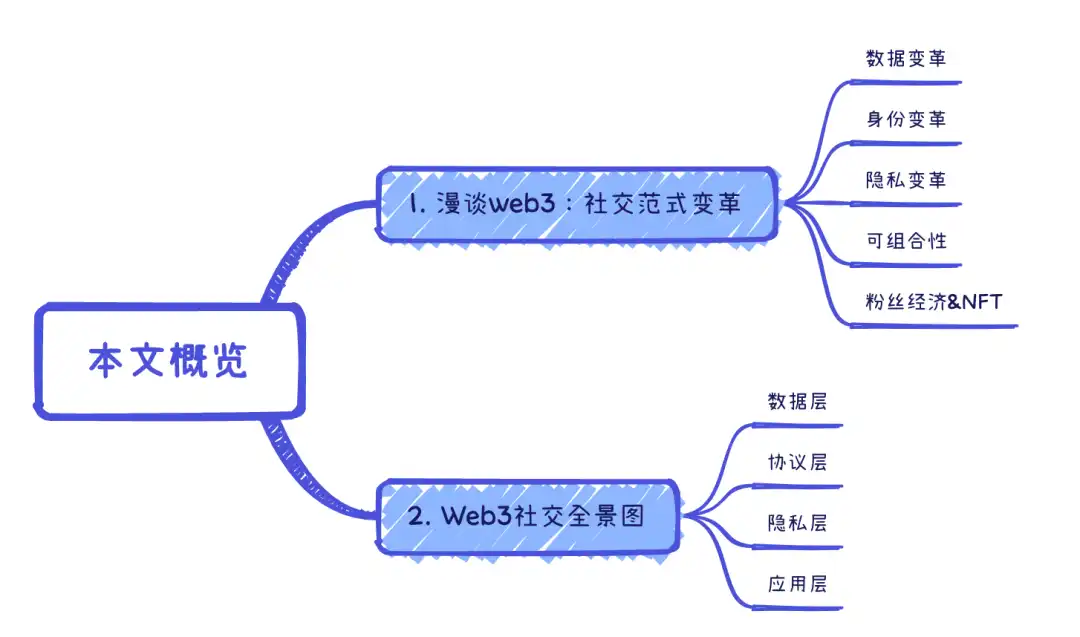
Rambling on the Web3 social paradigm shift
Web2 Everyone lives in a walled garden created by the social giants. The longer users stay in the walled garden, the better the walled garden creators get to know them, but once in another garden we must abandon all social relationships and data and leave the house. It will be possible to create a more just, free and equal Internet environment in Web3.
Just as the European Renaissance has brought about the transformation of humanistic thoughts from "god" to "man", the evolution of Web2 social networking to Web3 social networking will also be a vigorous social Renaissance from "platform as center" to "user as center".

笔者认为,社交范式变革的新叙事将包括五个关键主题:社交图谱、去中心化身份、隐私保护、可组合性、 Token 化。
1.1 Relationship Transformation: The social graph is returned to its rightful owners
In the Web3 narrative, the user social graph will no longer be monopolized by a single company but will remain intact in the chain.
Web3 social networking may be like social networking in the metasomes: you can see your wechat friends in World of Warcraft, like the hero in Ready Player One who keeps friends with his friends in different scenes, and even find soulmates through algorithms.

In fact, social graph data is not easy to obtain.
Forming a complete social graph requires powerful multi-source data cleaning, association and collection algorithms. And users' relationships cannot be analyzed purely from on-chain behavior, as much social information is still stored on off-chain servers. Finally, the social graph is often more than just a management of existing data. It needs to go a step further by developing product capabilities to guide users to form their own relational network data.
1.2 Identity change: traceability, no proof of decentralized identity
What exactly is Web3 social? The picture below answers this question in a straightforward way.
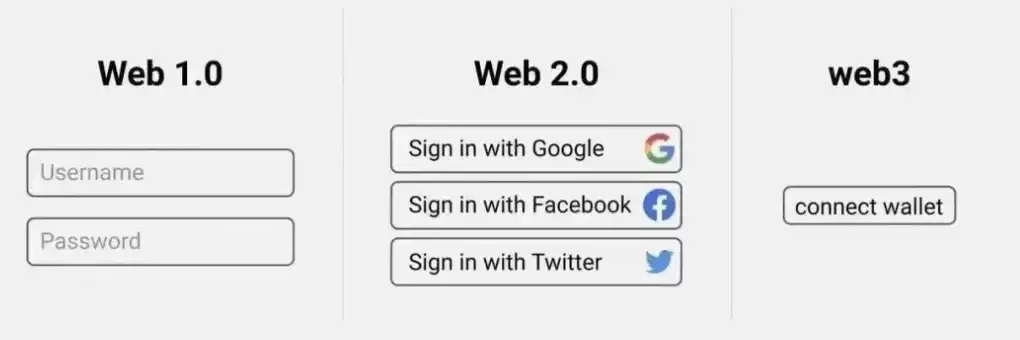
In the era of Web1 and Web2, we need to go through a cumbersome process to prove that we are account holders. Web3 simply signs a string using the wallet private key to prove the attribution of the address.
Decentralized identity (DID) will probably become the most important asset for Web3 users. The transparency and untampering of on-chain data establish the foundation of identity trust, while the cross-project reading and calling of Dapp data ensure the universality and composability of identity. Whether it is personal reputation, NFT holdings, financial loans, bills, identity certificates, licenses, passports, etc., can be transformed into unique on-chain information that the user has full control over, accessing all applications through an identity agreement.
For the project side, the core group of airdrop can be easily found in the cold start stage. For social DApps, decentralized identities can be used to create social and group relationships. The specific entry threshold can be automatically judged by reading the asset information and historical proof on the address chain without proof.
1.3 Privacy reform: Multiple accounts, information authorization, private computing, private transactions
The data on the chain is personal and readable to everyone, so you might think there's no privacy in that kind of openness?

Data privacy issues can be broken down into three layers: the social application layer, the interaction layer and the data storage layer.
In the social application layer, the solution is: multiple accounts and information authorization. Multiple accounts, which means different wallets can have different circles and identities. But if a DID can correspond to multiple wallet addresses, a more secure solution would be to let users choose which parts of the data in the social graph, the DID protocol, can be read publicly.
In the interaction layer, privacy computing protocol is introduced to ensure data privacy and security, so that data can be safely circulated in an "available and invisible" way.
At the data storage layer, the immutable and public nature of blockchain data contradicts privacy, and privacy issues become more complex. It is expensive and time-consuming to encrypt all accounts and transactions because data cannot be changed once it is linked. Mid-way Solutio may allow users to choose which parts of their data need to be protected in advance, instead of making their data public.
For information on Web3 privacy, you are recommended to read the in-depth article Foresight Ventures: understanding the other side of Web3. "privacy" is only covered here.
1.4 Composability: Composability is to software what compound interest is to finance
Composability will put cryptocurrencies at the forefront of a revolution in finance and other industries that will fundamentally change industries as much as the Internet and will open up a new world of endless possibilities.
We believe that "composability" includes several elements:
Software composability: The ability to "directly take assets or data generated by other protocols and then combine them with another protocol". Such continuous combination and combination, so that each innovation results become the starting point of the next round of innovation, the birth of a more powerful model in software combination. For example, a combination of loan agreements and social agreements can form a "social credit".
Data composability: New products no longer need to accumulate user data from scratch. Decentralized databases store user identity information, social graph, social history and other data in the same set of data models (such as Ceramic) for unified access and native interoperability by Dapps.
Identity composability: Dapp data can be read and invoked across projects, unlike Web2, which is stored in isolation on a centralized server, ensuring the commonality and composability of user identities in the on-chain world.
Detachable: Users should have the option to authorize only part of their personal information to specific and application protocols and to cancel access to third-party information at any time.
1.5 Token 化:为收益而来,为网络而留
If Web2 is "come for tools, stay for the web", then Web3 will be "come for revenue, stay for the web".
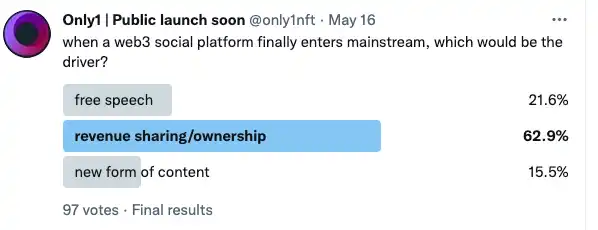
There are many interesting ways to share revenue in Web3 social applications that deserve long-term attention:
粉丝经济:Rally 帮助创作者发行粉丝 Token ,去掉中间商抽成。随着创作者人气上升, Token 价值也会上升,创作者和持币粉丝共享这一收益。
NFT of creative content: Mirror helps authors cast an article as NFT and initiate DAO crowdfunding. Each article NFT can be understood as a fund, everyone can hold a certain share, and the main income of the holder is the dividend of NFT turnover fees and the appreciation of share space.
NFT of social relations: Lens Protocol creates user social relations into NFT, which will increase in value as content NFT increases, forming a delicate symbiotic relationship between creators, users and content. Atem Network connects communities through NFT, where users can discuss, trade and co-govern.
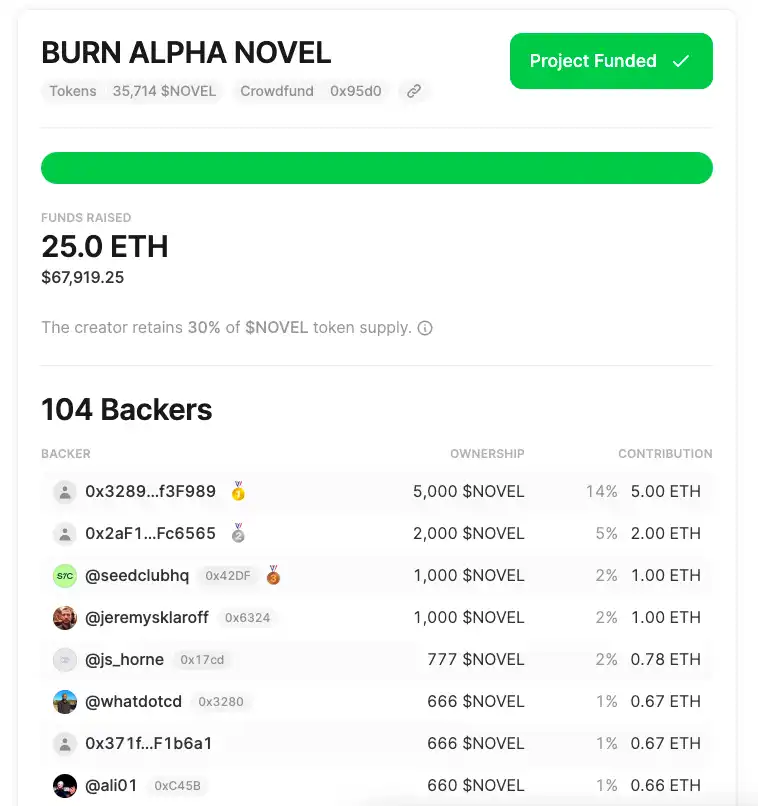
(Mirror article crowdfunding)
However, we can observe several common problems:
Most creators don't have enough fans to be motivated. Most of the tipping or NFT crowdfunding goes to the head projects, and the people who don't need money, the more money they get.
The profit of casting NFT by small and medium creators and users may not catch up with the Gas cost. The solution for nFT-driven applications in the future is likely to be L2 or Appchain in other public chains to bring costs down.
Web3 Social Panorama
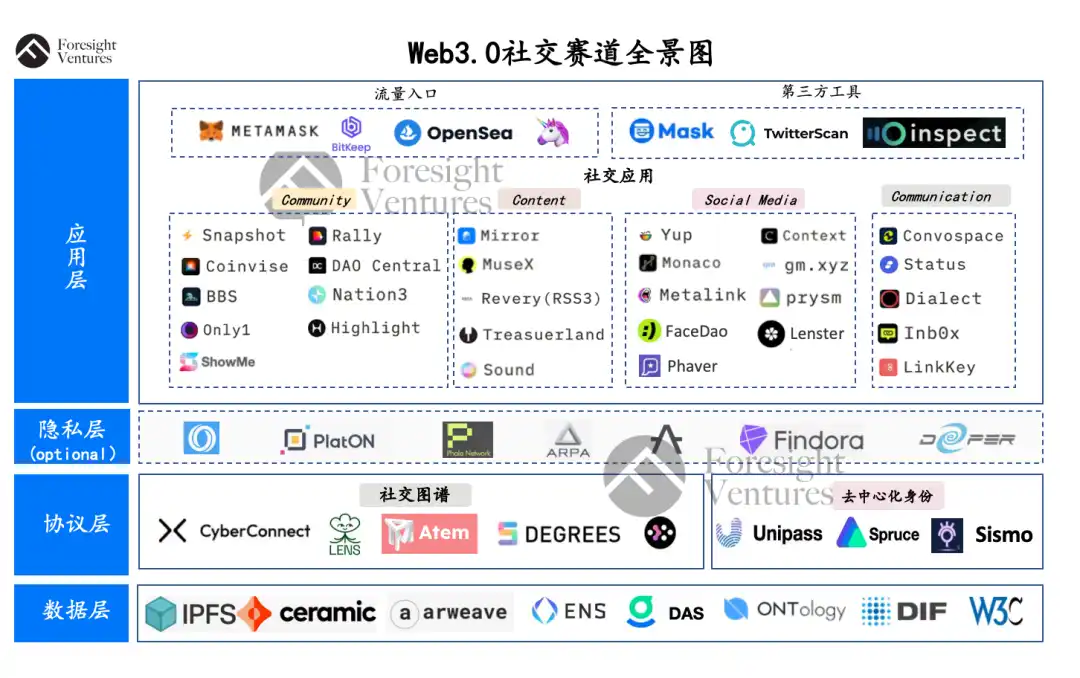
The author believes that social interaction can be divided into four layers from bottom to top: data Layer, protocol Layer, privacy Layer and application Layer.
2.1 & have spent The data layer
The data layer includes decentralized data networks and databases such as Arweave, IPFS, Ceramic, Kwil, etc., which are used to store identity data, social relationships and communication content on the user chain.
Due to incomplete on-chain data and low access efficiency, part of the data is still stored in AWS and other centralized servers. As more user data is linked, there will be a lot of room for decentralized databases.
Ceramic
Ceramic is a decentralized, cross-chain database service that can manage dynamic content data based on IPFS.
Ceramic solves the dynamic storage problem by storing streams of data and also provides very powerful embedded authentication mechanisms 3ID DID and IDX cross-chain identity protocols. There are several social projects being developed on Ceramic, such as CyberConnect, Web3 Twitter Orbis, The Convo Space, and more.
The influx of CyberConnect users led to Ceramic outages in December, and its high-concurrency solution has yet to be tested.
2.2 the protocol layer
The protocol layer mainly consists of decentralized identity and social graph protocols, which I believe will be the core layer of the social track. The main reasons are as follows:
Strong universality, no matter which social Dapp users use, users need to use social graph and DID.
The protocol layer has a strong scale effect, the future is likely to run out of one or several general network protocol.
Both social Graph and DID track are in the early stage of development. On the one hand, unified standards have not yet been formed within the industry. On the other hand, users' cognition is relatively shallow, and the competition pattern of the industry is not mature, so there is high investment value.
From a larger perspective, to build a truly free speech Internet we need protocols, not platforms. As discussed in Protocol, Not Platforms, doing protocols at least gives us the possibility of freedom, and doing Platforms falls back into the old discourse of walled gardens.
Recommended reading Protocols, Not Platforms: A Technological Approach to Free Speech by MIKE MASNICK
2.2.1 Social Graph
The popular projects in the social Graph track include CyberConnect, Lens Protocol and 5 Degree. The basic summary is as follows:
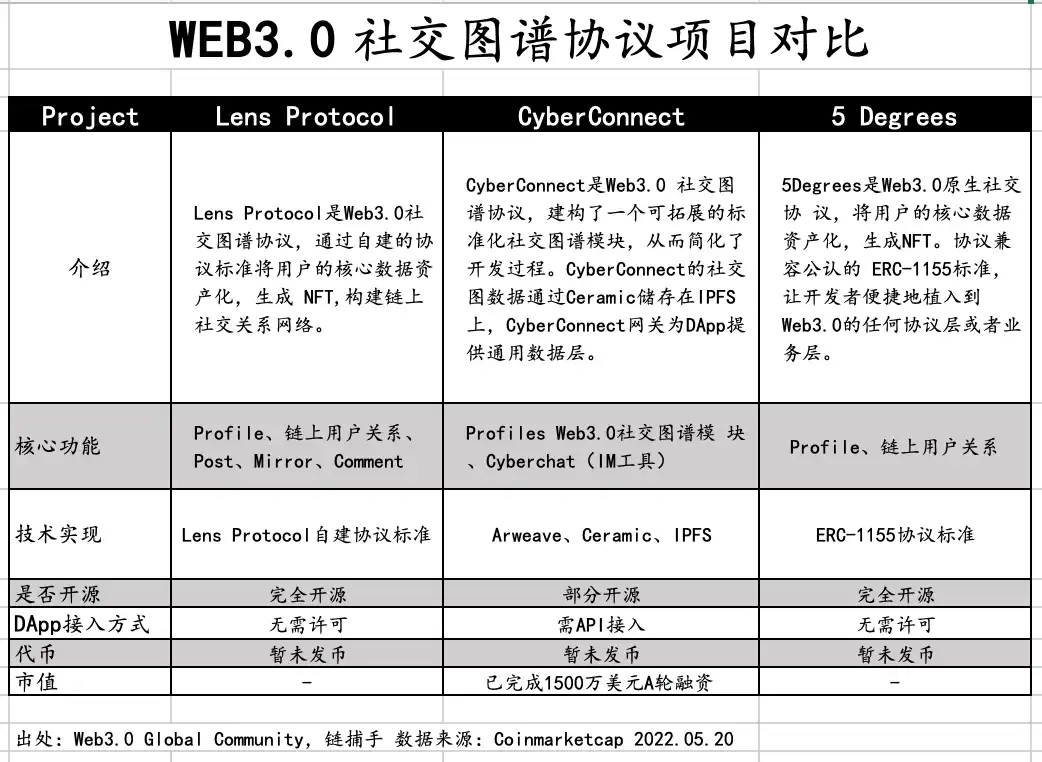
The three core products all support profiles and on-chain social relationships, while Lens Protocol and CyberConnect have extensions for content and communications. Let's compare the two:
CyberConnect
CyberConnect aims to aggregate on-chain data and off-chain data, providing a standard data layer. Developers can implement calls through the API. All the relational data of DID and the usage data of Dapp will be stored on IPFS through Ceramic Network. The advantage of this solution is that it is lightweight and pluggable. CyberConnect has over 1.4 million registered users and 70+ projects have implemented API access.
The downside is that the social graph is currently limited in what it can offer. Meanwhile, cost-free social graph read-write is prone to generate redundant data in access. Facebook's social graph has been plagued by Zynga in the past, requiring more balance between processing and accessing data.
Lens Protocol
Lens aims to be an open source social infrastructure that NFT all social relationships within an ecosystem to form a social graph. Lens also created its own protocol standards to attract developers to develop functional modules and applications based on them, more like a public chain ecosystem.
Lens advantages:
它是 Polygon 上的智能合约,模块间的可组合性非常强,生态内的应用可以共享社交内容、关系和模块组件;CyberConnect 是基于 IPFS 的协议,可组合性要差一些。Lens 将个人主页、内容、粉丝关系铸造成 NFT,具备较强的货币化空间和想象力,e.g: Lens 个人主页 NFT 一个月内地板价 10X,未来还会有更多的 NFT 发行活动。相较于 Deso 社交网络公链,Lens 的生态与经济体系更加开放,这对于社交网络而言非常重要。Deso 生态中的社交 App 均需要使用 DESO Token ,而出现明显流动性不足, 用户量较少。
Limitations of Lens:
From The perspective of The implementation, Lens is only a social connection, and there is a gap between The Graph and The data on The chain (most developers currently use The Graph). Lens also faces another problem, as it has to call up the Fox wallet to pay for Gas every time it interacts, which is not a smooth user experience, while CyberConnect saves content to IPFS, which is a better user experience.
Lens ecological construction mode is heavy, and it has high requirements on the market expansion ability of the project side. Lens is backed by the Aave team and is still in the testing stage, but the overall construction progress is good. The head projects include Phaver(Share-to-earn social application) and Lenster(decentralized forum), etc. Dapps can rely on the precise flow of Lens for fast cold startup. Lens's potential for future synergies with Aave's business is also worth watching over the long term.
2.2.2 Decentralized identity DID
Amber Group outlined the DID ecosystem in November 2021. DID is located in Layer3, which is the hub of the whole ecology.
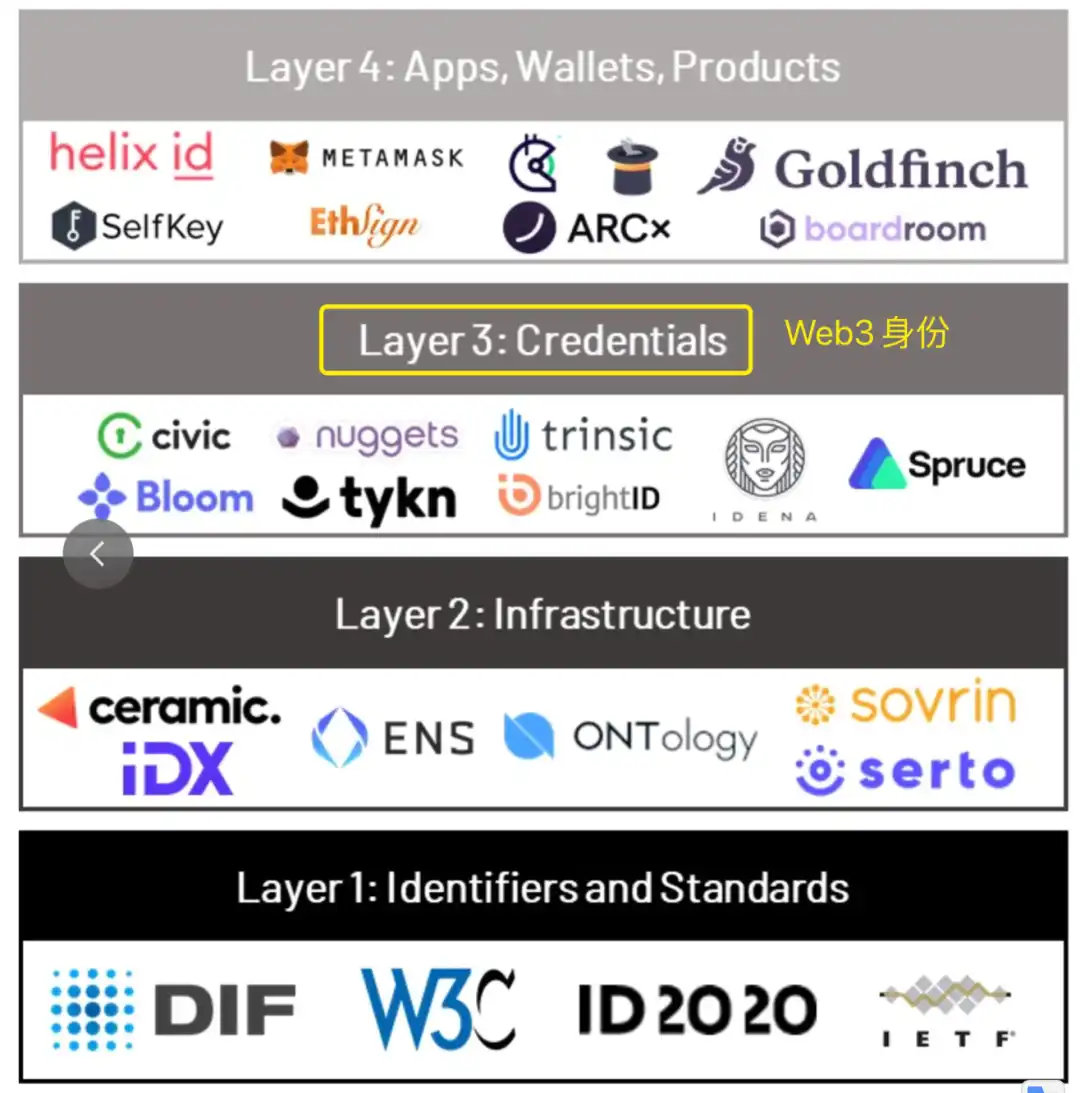
DID projects can be roughly divided into four tracks: off-chain identity authentication, on-chain identity aggregation, on-chain credit rating classification, and on-chain behavior authentication. It is worth emphasizing that the mature form of DID is not clear and there is no strict definition. Some projects are identity protocols, while others are credential networks or identity applications, and they focus on different application scenarios. In the future DID is likely to be a whole with various components.
A. Off-chain identity authentication
If this information can be authenticated and tied to an address held by a person who, say, graduated from Stanford, worked as an engineer at Google, and owns two homes in Silicon Valley, it will provide him with support for all sorts of activities on the chain, such as socializing and lending.
BrightID
BrightID is the poster child for human authentication, building a social identity network that now has more than 57,000 users. Users need to reserve a Zoom video conference, which ensures unique identity through face recognition and verification officer review.
Verite
Verite was launched on May 10 by Circle, UDSC's publisher, and KYC is one of the keys to its authentication. Details are subject to further disclosure by the project.
B. On-chain authentication
Such DID projects do not focus on offline situations, but rather manage identity information aggregated on the chain through the concept of "digital identity"
Unipass
Unipass is an example of this kind of project, and it does exactly that: With a Unipass ID, users can bind their email addresses, multiple ETH addresses, and connect to protocols such as Social Graph (CyberConnect) and information aggregation platform (RSS3) to become users' "One Pass" in Web3.
Spruce
Spruce is a digital identity system with a suite of products that provides support for user authentication, credentials, and storage, data decentralized access control, and interoperability between Web2 apis and Web3. Binding to Web2's existing platform accounts is a great identity enhancement solution for those who already have some influence in Web2.
C. On-chain credit scores
The beginning of this kind of project is very straightforward. Expand the Defi lending scene, find some realization of the credit mechanism of the financial industry in the real world in Web3.
ARCx
ACRx issues' DeFi Passport 'and quantifies its creditworthiness based on each DeFi Passport credit score. Compared with the first two types of DID projects, the on-chain credit rating classification project focuses more on users' "digital financial identity" and uses on-chain transaction data rather than their social data.
D. On-chain behavior authentication
The core logic of this type of project is to guide users to participate in activities and behaviors required by certain partners and issue them on-chain authentication.
Project Galaxy
Project Glaxy 严格意义上来说不是身份协议,而是一种凭证网络。用户连接钱包后即可生成一张「银河身份证」,根据地址的历史行为,自动贴上比如「Uniswap 交易员」、「OpenSea 交易员」等等认证。项目方与 Galaxy 交互会被收取费用,同时 Galaxy 也会给予对应的 curator(数据提供方) Token 奖励。
2.3 privacy layer
Privacy computing protocols are designed to allow data to circulate securely in "usable and invisible" ways. It mainly includes zero-knowledge proof, secure multi-party computing, federated learning based on modern cryptography, trusted execution link (TEE) and so on. Currently, well-known blockchain privacy computing networks include Oasis Network, PlatON, Phala Network, ARPA, Aleph Zero, Findora and Deeper Network.
At present, the practical application scenarios of private computing networks are also limited, because they are seldom adopted by industrial projects and some technologies are still immature. The explosion of social demand in the future may bring more users to private computing, but the investment priority of the private layer may not be as high as that of other layers. Because a user may only need a small amount of data privacy processing, and also need to meet the popularity of Web3 social needs + users' awareness of privacy protection + willing to pay for the three premises.
2.4 the application layer
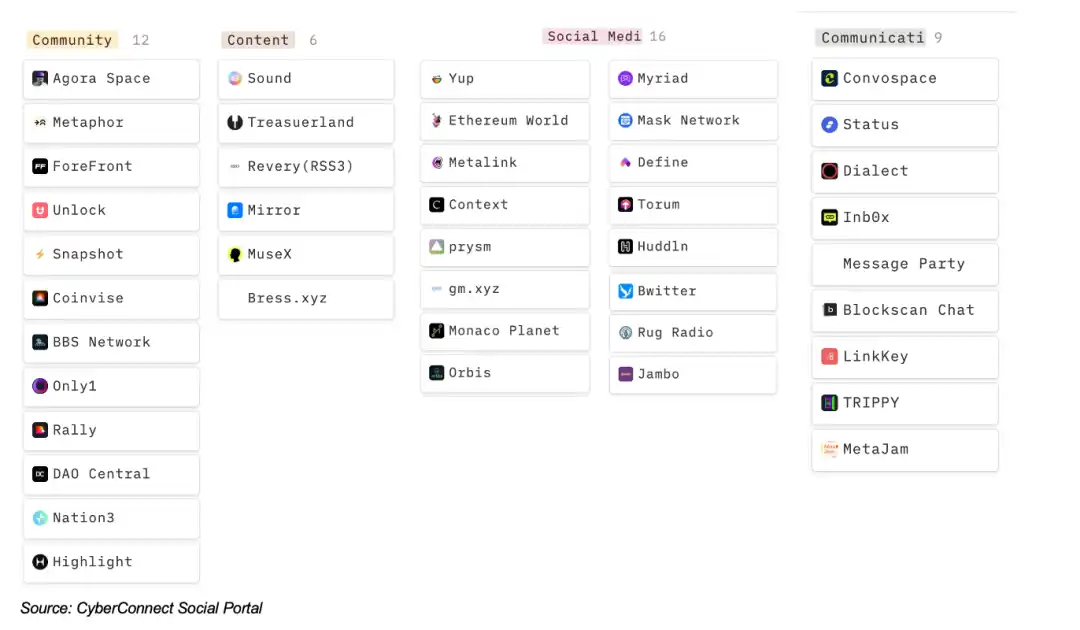
(Web3 Social Application Graph - By Social Form)
Low-barrier social apps could be the average person's way into the Web3 sea.
There are still no phenomenon-level products on the social track. The main problems are as follows: Many applications only have token acquisition scenarios, but lack consumption scenarios. Users are used to "mining and selling", which cannot form network effects. The unlimited flow of tokens to the secondary market has also contributed to the continued decline in prices.
The author believes that possible forms of social products are as follows:
Nft-based social applications. NFT Holder can join holder group. Users with high credit scores can directly find NFT buyers and sellers for P2P transactions, Swap and loans. A typical example is Atem Network, which hopes to form a community through NFT. Users can discuss, trade and jointly govern the community in their own NFT community.
Cross-platform cross-chain IM applications. Users can manage their relationships within the Gamefi, Dao, and NFT communities in a single Dapp, as well as keep track of which games their friends are playing and which NFT they have acquired through status updates.
Gamefi 打金的玩法。一个典型的例子是 Phaver, 是 Lens 生态中领先的 Share-to-earn 应用。用户可以通过改善他人体验获得 Token 奖励(发布优质内容,发掘优质内容,审核信息),消耗 Token 以提升自己的体验(内容质押、购买流量、订阅付费内容、铸造 NFT 等)。
基于 Defi 经历 or 个人投资成就的大 V 社区,类似雪球。用户可以将个人挖矿经历、投资成就展示在 profile 页,大 V 们输出优质内容获得 Token 奖励,也可以发行粉丝 Token 。
Dao based content social application. Relying on the DAO for community autonomy and content moderation, all revenue generated by the application will also be distributed to THE DAO members based on the governance proposal.
Investment Direction & NBSP;
The Web3 social track is in its early stages, and the competitive landscape is not yet clear. Social relations NFT, fan economy and other emerging business models deserve long-term attention.
Application opportunities: Look for social applications that can form good economic cycles and benefit sharing, such as Mirror. The core is to determine whether the product has enough enrichment effect and sustainable tokenomics to retain core users + quality creators and form an endogenous economic cycle.
Protocol-layer opportunities: Long-term prospects for protocols and data networks that attract users to create new relationships, identities, and badges of honor are both infrastructure for social data and c-side traffic entry points.
SoulBound Tokens' exploration of social networks: Today, the main solutions of social protocols are still around NFT or off-chain databases. The former has too strong financial attributes, while the latter has weak combinability due to lack of on-chain. Social relationships based on SoulBound Tokens may be able to combine composability and weak financial attributes. The core value of social Tokens on the chain can be proved by regression relationship and become truly effective social credentials.
The original link
Welcome to join the official BlockBeats community:
Telegram Subscription Group: https://t.me/theblockbeats
Telegram Discussion Group: https://t.me/BlockBeats_App
Official Twitter Account: https://twitter.com/BlockBeatsAsia