Bankless: 8 things that look good in a bear market

8 Projects I'm Bullish On This Bear Market
原文作者:David Hoffman
原文编译:Katie 辜,Odaily 星球日报
We've all been focused on falling prices lately, but don't forget that Web3 is under construction.
Bear markets enable ceos to think in terms of first principles and spend more time building technology that makes sense. With the influx of new crypto users, there are plenty of new areas to build. In 2021, the Web3 space went from zero to one. Now we need clear-headed and well-funded companies to follow the blueprint.
Today, I'm going to highlight eight projects that are at the forefront of the crypto world. They're working on some really cool products.
1. Obol Network -- Distributed Validator Technology (DVT)

Website:Obol.tech
Obol is the pioneer of distributed Validator technology (DVT). A DVT can run on multiple machines and clients at the same time, while still acting like a single validator on the network. DVT allows many computers to come online and allows all computers to participate in private key signing.
This technology could help create a competitive ETH pledge infrastructure and reduce network monopolies. Obol's goal is to make the uptime of validators more competitive while minimizing risk and leveling the playing field for the pledge network.
Obol use cases:
· THE DAO will not trust a single member to pledge ETH to its vault, but may trust a group of members to jointly run the validator and share responsibility;
· Members do not have 32 ETH individually, but can aggregate all ETH to build a shared node;
· Custodians may not entrust a customer's ETH to a single pledge carrier, but they may trust a carrier network that cooperates through Obol technology.
How Obol stands out:
1.Obol is integrated into every pledge agreement and consumer pledge software;
2. Each collateral service company and protocol (Coinbase Cloud, Lido, RocketPool) shares the validation risk through Obol and DVT;
3. The quantity and quality of liquid collateral derivatives (stETH, rETH, etc.) increased significantly and became competitive;
4.ETH Pledge players can compete through specialized and competitive services like Coinbase.
2. Li. FI -- an aggregator of L2 cross-chain bridge and DEX aggregator

Website:LI.FI
Links to "9 cross-chain Bridges, 15 male chains, and all DEX"
As DeFi grows over the long term, the number of assets and chains in DeFi will grow by an order of magnitude. Li.fi is building a network of liquidity between each asset on each EVM compliant chain.
Li. FI has DEX, DEX aggregator, and supports many EVM chains, such as Optimism, Arbitrum, Avalanche. Li.fi also establishes a number of cross-chain Bridges between all EVM chains. Because there are nine different cross-chain bridge protocols, and countless DEX, the trading routes from Chain A (asset X) = to chain B (asset Y) are dizzying.
Li.fi automatically selects the best trading route, with the most liquidity and cheapest fees, and allocates assets rationally at the lowest cost. Li.fi is a DEX aggregator built on top of a cross-chain bridge aggregator to simplify transactions.
How Li.fi stands out in DeFi:
1. Li. FI becomes a liquid mesh network between assets and chains in a world of infinite assets and multi-chains;
2. App-integrated li. FI gadgets can easily access capital flows throughout the crypto world;
3. The complexity of holding assets across multiple chains is eliminated;
4. Li.fi becomes the solution that guides all applications in all chains without losing money through high fees or all the way down.
3. Voltz -- Internet interest rate swap AMM

Website:Voltz.xyz
Voltz is an AMM (automated market maker) of interest rate swaps. Using Uniswap V3's liquidity engine, Voltz has set up an interest rate swap market. The Voltz protocol allows the use of leverage to trade interest rates. You can use "floating rate for fixed rate" or "fixed rate for variable rate".
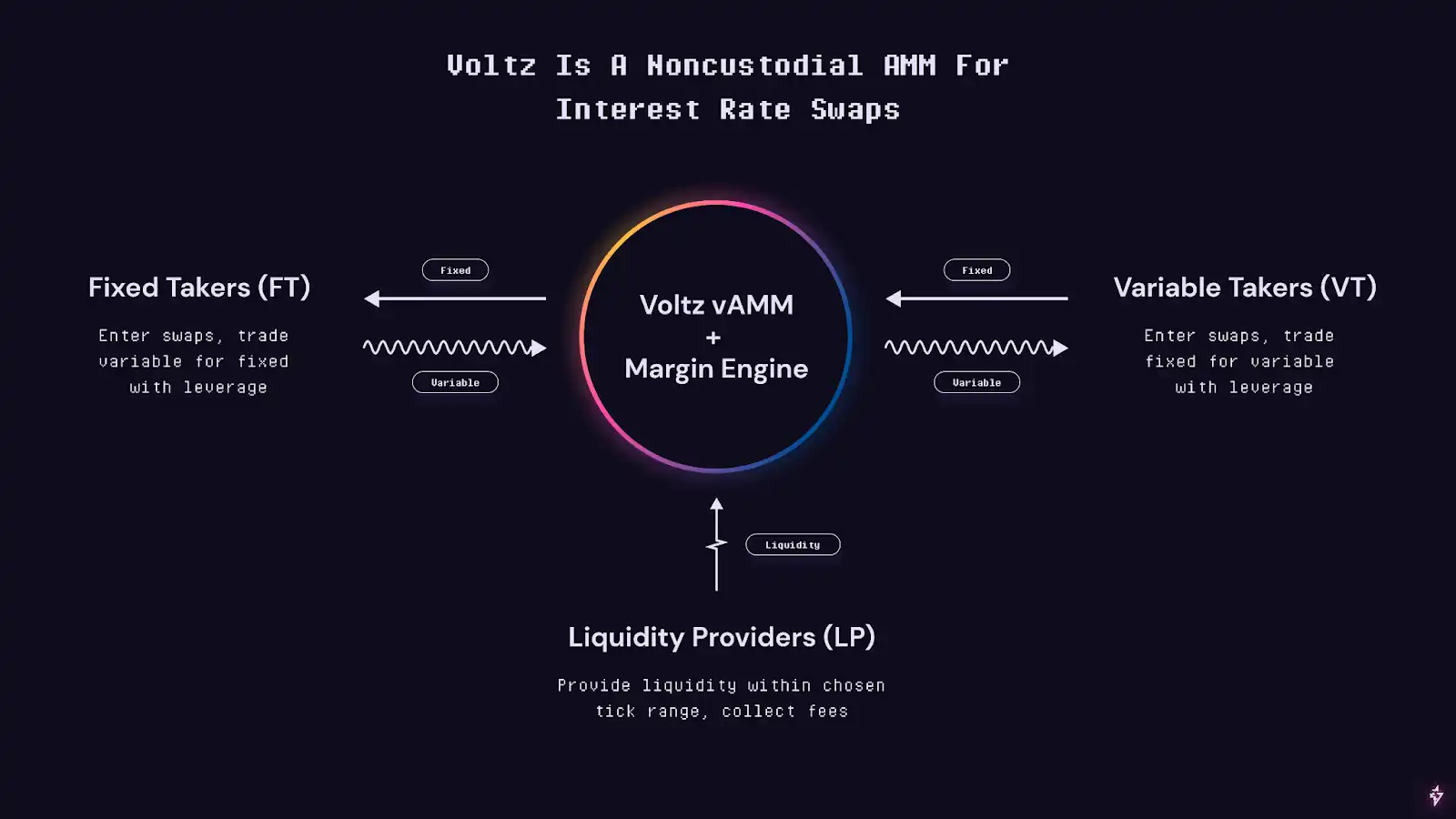
Yield is perhaps the most attractive aspect of cryptocurrencies, and Voltz provides an infrastructure to build more powerful and expressive financial products around yield-yielding assets.Compared with the original Internet bond market, the financialisation of the merged ETH has a lot of room to grow. Voltz is positioned to provide complex financial instruments around ETH or yield assets in DeFi.
How Voltz stands out among crypto derivatives:
1.Voltz opens a huge interest rate swap market to DeFi;
2. Create new markets that allow traders to combine interest rate exposure to any asset at variable rates of return;
3. The global interest rate market is no longer driven by central bank policies, but by DeFi supply and demand dynamics;
4. The long game. Voltz became a scalable derivatives protocol, extending beyond interest rate swaps and encryption to the global derivatives market.
4. Tracer -- Meta-protocol for derivatives
Website:Tracer.Finance
Tracer is a meta-protocol for derivatives. Derivatives are already a very popular product in the crypto space, but the current derivatives protocol does not unlock the full capabilities of DeFi. Tracer puts the entire core of DeFi into derivatives.
I think Tracer is the "Uniswap of derivatives". Uniswap can trade around any Token and Tracer can generate derivatives around any asset. Each TracerDAO product comes with a contract. With Tracer's contracts, any price or data can be converted into options, trades or future products.
How Tracer stands out among tokenized derivatives:
1.TracerDAO's tokenized derivatives can be combined in DeFi, greatly improving capital efficiency. Capital efficiency allows Tracer to capture TVL, and traders only need to invest $1 of capital in Tracer to make gains;
2.Tracer's contracts give the long tail of assets access to complex derivative products, enabling it to gain market share and attention from the broader crypto community (like Uniswap);
3. Fluctuations in the meta-universe become manageable, enabling DeFi's pool of funds, DAOs and individuals to take a long-term view;
4. Real-world commodities (water, oil, real estate) can enter global derivatives markets to create new financial products.
5. Blocknative -- real-time infrastructure for the "pre-chain" layer

Website:Blocknative.com
Before transactions are executed in the blockchain, they are in an edge state called a mempool, or pre-chain. The validator selects transactions from the memory pool, sorts them in a block, and then adds that block to the blockchain.
The memory pool is a crazy, chaotic, and highly hostile place, and Blocknative is working hard to illuminate its dark forest. Its product, gas detector, has become the new industry standard. Previous Gas rate detectors looked at the average Gas price of the most recent block to estimate the amount of Gas needed to execute the trading platform. This is a best guess at predicting future gas prices based on historical data.
Blocknative's gas fee detector looks at the gas charges for transactions in the memory pool from a blockchain perspective, reading future data.
Blocknative's gas rate detector demonstrates the true potential of blockchain -- the infrastructure for block producers to get a head start.
How Blocknative stands out in transparency:
1. The memory pool blockchain infrastructure becomes as complex as the actual blockchain resource manager infrastructure;
2. Participants earn income (ultimately, the pledgee of ETH benefits the most).
6. Euler -- Permissionless, minimally governed money market

Website:Euler.finance
Euler is a money market protocol like Aave, Compound, or Rari. While Euler faces stiff competition, it also has some unique highlights. Euler combines the asset availability of the Rari Fuse pool with the capital efficiency of a single shared liquidity pool model of Aave or Compound.
Exempting assets from loan or loan
Euler allows any asset that owns the ETH Uniswap V3 transaction pair to be lent. Euler uses Uniswap V3 as an asset price predictor and uses a time-weighted average price algorithm.
For money markets, an unauthorized listing of assets is very risky, and we don't want to use bad debt as collateral. Euler governance controls this risk through a fee layer. The Euler model greatly optimizes asset availability and capital efficiency in the lending field.
Improve the clearing mechanism
Euler uses a Dutch auction-style liquidation mechanism. In Compound and Aave trades, where liquidators get a percentage of the collateral, very large positions can generate huge returns for the liquidator, but not for large depositors.
Clearing costs are mostly fixed. The gas cost of liquidating a $100 million position is the same as that of a $1,000 position. The payment for Euler clearing starts at $0 and increases slowly until the liquidator steps in and accepts the payment. This would reduce the amount of excessive collateral demanded by depositors, as clearing penalties are minimised, thus improving the capital efficiency of the financial system.
How Euler stands out in loans:
1.Euler provides unprecedented lending opportunities for new assets;
2. Even assets that already have the opportunity to borrow can be found in Euler with higher utilization (and therefore higher fees);
3. In general, more assets have more opportunities in DeFi, increasing the net utility of the overall DeFi.
7. Aztec Network -- L2 Rollup with built-in privacy
Website:Aztec.Network
Aztec Network is a unique L2 Rollup that works as Zcash for Ethereum L2.
Aztec network acts as a privacy shield for ERC-20 Token transactions and other DeFi interactions. Once the deposit is included in a Rollup block, the user generates a set of UTXO notes that represent the number of tokens deposited.
Once the Token is on the Aztec network, all subsequent transfers are confidential and anonymous. The identities of the sender and receiver are hidden, the amount of the transaction is encrypted, and web observers cannot even see which asset or service the transaction belongs to.
Aztec Connect
Aztec Connect allows users to bring privacy-protected ZK assets from Aztec to Ethereum's public DeFi protocol.
Aztec Connect is essentially V/P/N for Ethereum users.Like V/P/N, Aztec Connect hides the originator of the transaction and provides sufficient protection for user privacy while reducing gas costs by batching user operations.
Disdisco. Xyz -- a private data package for the metasverse and the real world

Website:Disco.xyz
Disco opens up a whole new dimension in Web3. Will turn the financial metasomes (the world we live in now) into interesting metasomes (the land of dreams).
Disco is a meta-cosmic data package, a place to store social capital. You can store credentials for participating in the DAO, participating in the DeFi application, or completing an education course. Anything that can be verified can be put into your Disco package and become an object that the metasverse can interact with. With Disco packets, you can collect all the identities represented.
Disco packets are not subject to any set of private keys. Private keys that can freely exchange packets, unbind identities tied to individual Ethereum addresses, and remove them from the global ledger with maximum transparency.
The data layer between Web2 and Web3
Although Disco is a company that provides services for VCS and DID, Disco is just one product of many companies. Disco was the first platform to leverage these standards in Web3 impersonation. The more people that follow the standard, the bigger the network gets, sort of like ERC-20 and cryptocurrencies. Web2 protocols can also use this technique. These technical standards are based on cryptography, and since VC and DID are not chain-based, they can interoperate across the entire Internet stack.
With this technique, we can eventually shift the power structure of Web2 applications to a more user-centric one.
The original link
Welcome to join the official BlockBeats community:
Telegram Subscription Group: https://t.me/theblockbeats
Telegram Discussion Group: https://t.me/BlockBeats_App
Official Twitter Account: https://twitter.com/BlockBeatsAsia

 Related Articles