Explain the relationship between ETH and stETH in detail, unanchoring is not a failure
Original title: "Staking, pegging and other stuff"
Original author: Cobie
Original source: Cobie Substack
Original compilation: Kxp, 0x711 , BlockBeats
This article is based on the views of encrypted KOL Cobie on the Substack platform, and BlockBeats organizes and translates it as follows:
Information Disclosure
First of all, I need to remind you that the content of this article does not constitute investment Advice as I am not qualified to give financial advice and the content of this article is my own.
Secondly, I was previously involved in the construction of the Lido, and this project is a subject of this article. I no longer work for Lido, and certainly won't be writing this article for Lido. In fact, I contributed very early on to the project. It's been over a year since I contributed to Lido. I also didn't show this article to the Lido folks - because if they found some mistakes, I would have to edit the content.
Finally, I hold some LDO, ETH and stETH. So there's a good chance I'm biased. But I try to be as impartial as possible.
Introduction to Lido
This is my October 2020 Blog post introducing Lido published in May: Introducing Lido.
In short, this is a typical ETH pledge agreement. A staking pool that can provide pledged ETH Tokenized version (stETH).
For example, you pledge 1 ETH, and Lido gives you 1 stETH in return. Your ETH is staked with a validator from a set of node operators chosen by Lido. As that ETH earns staking rewards, your stETH balance automatically changes to match this beacon chain balance.
After the ETH developers finally release the merge and subsequent fork, stETH will be able to "unstake" and the original ETH can be redeemed.
Since Ethereum designed their staking a bit weirdly, and with the beacon chain launching at the end of 2020 and still no specific merge date, Lido has become very popular. This is the most popular way for users to stake ETH.
Anchoring of stETH
Life in stETH It trades close to 1:1 with ETH for most of the cycle.
The first few months of stETH have been very volatile, the price has been changing from 0.92 to 1.02 ETH. As liquidity increases, the stETH/ETH pair becomes relatively stable over time.
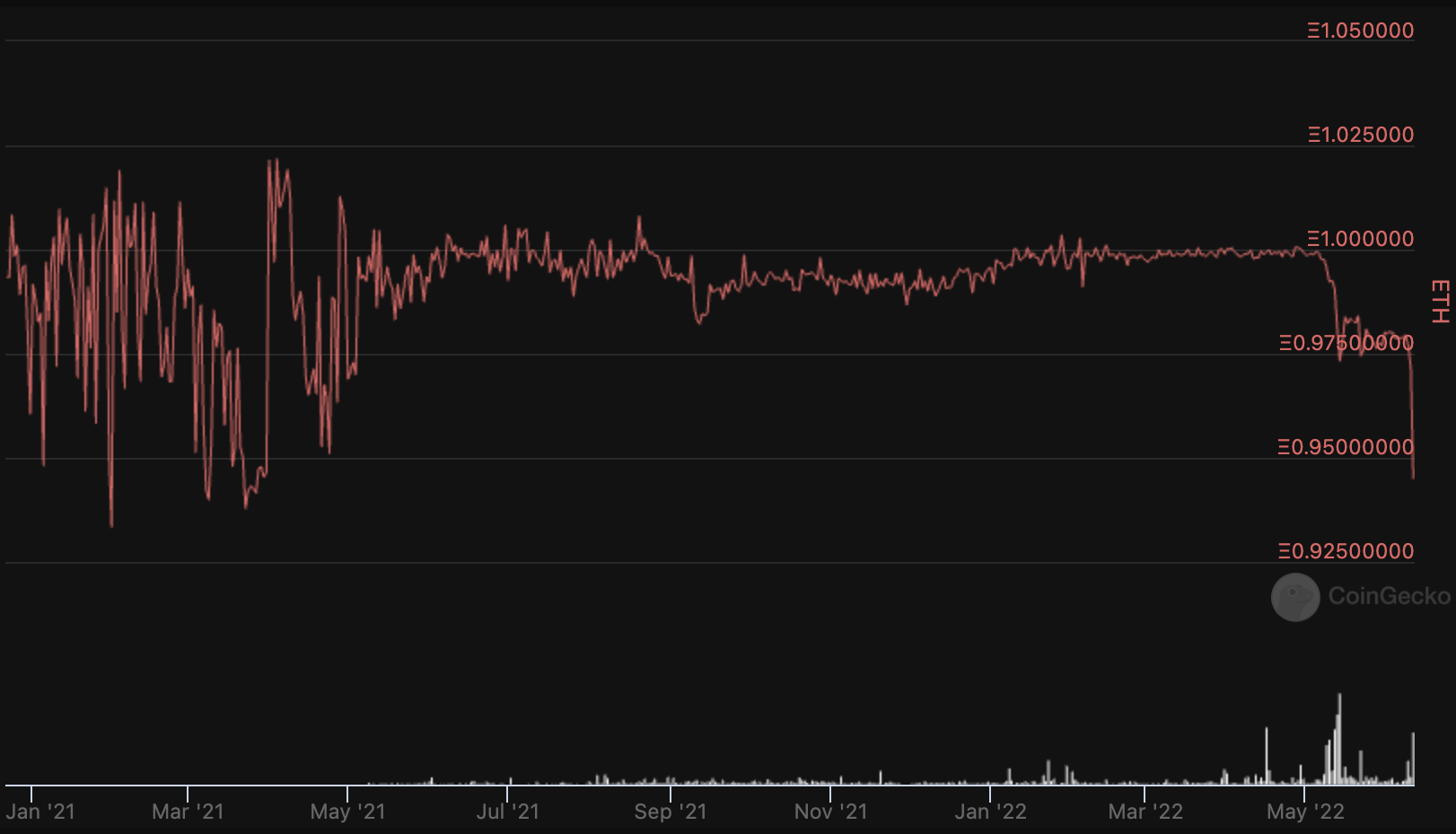
Then the UST unanchor happened, Luna crashed and stETH suffered a bit. During this period, the price of ethereum has fallen by about 50% - in fact, ethereum's price has fallen for ten consecutive weeks recently.
Maybe this is a very tightly pegged pair (or maybe because "pegging" is the latest PTSD buzz post UST), people Mistaking stETH as an "anchored" relationship with ETH. Of course, this is not true.
stETH is not pegged to ETH, nor does it need to trade 1:1 with ETH for Lido (or stETH) to work. The market price of stETH is determined by the demand and liquidity of pledged ETH.
Lido is not the only liquid staking protocol out there either. Looking at other less used and less liquid staking derivatives, it becomes clear that no 1:1 liquid staking market is expected:
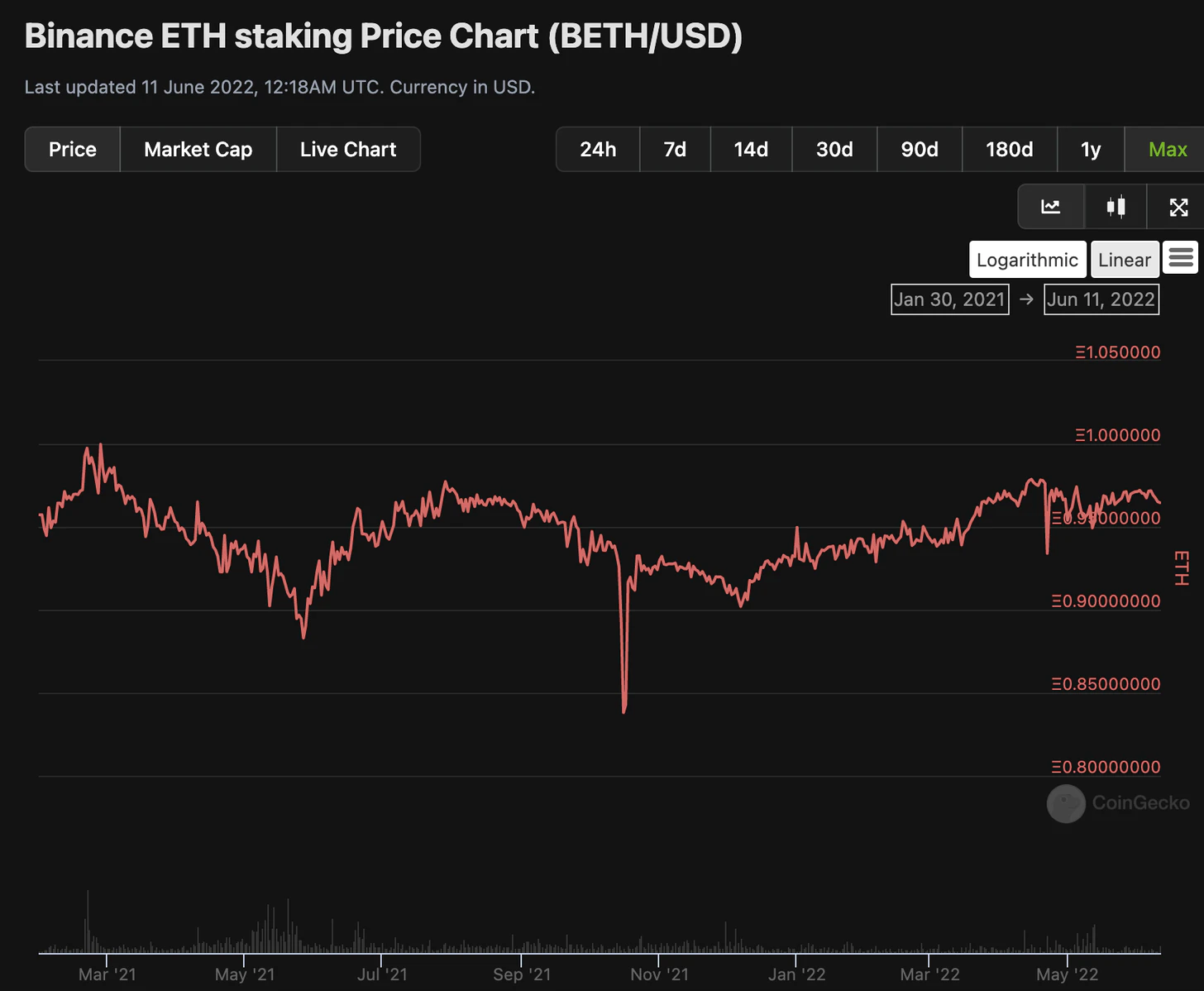
Binance’s BETH:
ETHC for Ankr:

The principle of these two pledged derivatives is similar to Lido. Ankr launched a little earlier than Lido, and Binance’s BETH launched a few months later. So they exist for roughly the same amount of time.
As you can see, there are basically no "anchor" transactions in their trading cycle. BETH once dropped to 0.85 ETH per BETH. AEHC once fell to 0.80 ETH.
Staking derivatives are not Stablecoins, not even "Algorithmic Stablecoins". Some have described them as more akin to Greyscale’s GBTC, or a futures market with unknown future delivery dates. I don't know the comparisons either. Essentially, it is the tokenized ownership of locked collateral. It is reasonable to trade at a price lower than the underlying asset it locks.
ETH for redemption, arbitrage and pricing pledge
You can pledge 1 ETH through Lido, and you can get 1 stETH immediately.
Therefore, stETH should never trade for more than 1 ETH. If stETH ever traded at 1.10 ETH, traders could simply mint 1 stETH for 1 ETH and sell it for 1.10 ETH - and they could repeat this for an easy profit until parity returns.
But when stETH is lower than 1ETH, there is no arbitrage opportunity.
Only after the merger and the transfer on ETH2 are enabled can any ETH liquid pledge tokens (stETH, BETH, RETH, AETHC, etc.) be redeemed.
Everyone is guessing when the merge will happen. If someone asked me to place a bet, I'd probably guess it's October of this year, but it's likely to be pushed to the end of the year or early next year. After the merge, there is still a fork waiting for the state transition. Who knows how long this will take, maybe 6 months after the merger.
Of course, there is a limit to the amount of ETH that can be unstaked at one time. If every ETH staked via any method was unstaked at the same time, the unstaking queue could take over a year to wait.
After all of this is done, liquid staking tokens will have arbitrage opportunities in both directions. Traders can buy 1 stETH for 0.9 ETH, then exchange it for 1 ETH, and repeat.
Nevertheless, even in a thriving bull market atmosphere, the price of liquid collateral tokens may still be lower than 1:1. The market price will likely depend on the percentage of return buyers need to hold risk during redemption/discharge - during which time sellers will weigh the impact of their own waiting period against the discount of selling immediately.
Currently, the lack of a redemption path has resulted in a liquidity discount.
In a bull market, demand for ETH is high. Buying stETH at a small discount is attractive because traders can see buying stETH for less than 1 ETH as a way to earn extra ETH. Additionally, the demand for liquidity is lower in a bull market. There is less selling pressure on stETH as investors are happy to hold their yielding assets.
However, in a bear market, the demand for ETH disappears and the desire for liquidity suddenly becomes apparent. The fall in long-term demand for these often highly reflexive assets has been particularly pronounced. More and more people want to exit their pledged ETH positions, and long-term locked assets are not as attractive as short-term ETH positions.
stETH's discount to ETH will depend on how much liquidity existing stETH holders need and the need to buy this collateralized ETH derivative at a discounted price.
Furthermore, some larger players have been expressing their liquidity needs by withdrawing from stETH recently.
Of course, there are other factors. Discounts can price smart contract risk, governance risk, beacon chain risk, "will a merger happen?" risk, etc. While these risks are more "constant" than variables of buyer/seller demand, the way people assess their importance may vary with Changes in response to changes in market fears.
Macro liquidity preference still appears to be the biggest variable, while news of the merger has so far not had much material impact on discounting.
Forced liquidation
Although many people have PTSD because of the UST incident, keep an eye on Seeing the price of stETH, but I think stETH should be another story.
The focus of discussion on stETH is now: who is being forced to liquidate?
Roughly, it should be divided into two groups:
1. Leverage Pledger;
2. A platform that needs to handle deposit redemption.
The first group of people can be identified on-chain.
Leveraged Stakers
Traders use Aave to leverage ETH, the process is as follows:
Buy ETH;
· Stake ETH as stETH (or buy stETH on the market);
· Deposit new stETH into Aave;
< p>· Borrow ETH with this deposit;
· Pledge this borrowed ETH as stETH;
p>
· Repeat the above process.
Products such as Instadapp set up "vaults" to handle these transactions, attracting sizable deposits for stETH reserve positions.

Unless traders can provide more collateral for these positions products, otherwise there will be an on-chain liquidation price. At the same time, if we want to deleverage these positions, we need to sell stETH for ETH, which will help the price of stETH.
Once the liquidation is triggered, these sellers who are forced to liquidate may make a substantial contribution to the price drop of stETH, further depressing the liquidation trigger point.
CeFi deposit withdrawal
The second group of people is Not so easy to identify.
Some rumors and on-chain research show that there are so-called liquidity problems in platforms such as Celsius. Of course, since Celsius is a “CeFi” company, we don’t have full knowledge of its financials or money management strategy.
So we can only speculate, not really know what's going on inside Celsius.
However, researchers speculate that the liquidity reserves Celsius reserves are no longer sufficient for large-scale withdrawals of users.


There is also speculation that Celsius has suffered losses in the DeFi business before. Celsius allegedly lost funds in StakeHound, Badger, and Luna/UST as follows:

Celsius conducts DeFi lending business, using customer deposits for liquidity mining to generate income. However, they may have lost part of their funds due to some loopholes. In addition, they also pledged a large amount of ETH (both using Lido and directly using illiquid pledge node operators), and these ETHs need to be pledged for half a year to one year. time of year.
For Celsius, even if the pledge is liquid, it is useless, because their position size is larger than the available liquidity of stETH.
If Celsius is forced to sell stETH in order to restore liquidity to user withdrawals, it may trigger a cascade of liquidation events. In fact, even the slightest sign of trouble could cause panic among the people, triggering a liquidation.
Again, this is speculation as we do not know the exact financials of Celsius, what tools were used, what client liabilities it had, etc.
While it is unlikely that Celsius will lose client funds entirely, it is theoretically possible that Celsius could have a situation where a user requests a withdrawal but these Assets are locked on the beacon chain by Celsius, and the unlock date is still far away.
For Celsius, they need to handle this kind of incident carefully. If they use these pledged tokens to borrow money to pay back customers, then this is nothing more than delaying the forced liquidation and making the final situation worse.
So, who will be the victim?
I would not lightly assert the future price action of stETH (or BETH, AETHC, RETH, etc.).
Instead, I think about who would be the victim in a worst-case scenario: imagine if people's fears about Celsius were realised, and on-chain Pledgers can no longer provide collateral, so who will suffer?
Obviously, Celsius and its depositors are the victims - Celsius either couldn't process withdrawals before the merger, or sold it at a low price to allow depositors to withdraw smoothly resulting in large losses.
(Digression: If I were the head of Celsius, I would probably sell the stETH position via private OTC at an appropriate discount to save reputation and maintain the public Confidence.)
Similarly, liquidity mining stakers will also suffer heavy losses due to position liquidation.
Those who want to exit their stETH position before the state transition on the beacon chain will also feel inconvenient: if a trader or investor staked ETH today ( or bought "discounted" stETH) and need to exit after 3 weeks or 3 months, then such an operation obviously does not guarantee that the price of stETH/ETH will be the same as it was at the beginning.
StETH holders who have not opened leverage can wait until the merger and other changes are over, and then complete the exit by releasing the pledge on the beacon chain, because each stETH has a 1:1 corresponding ETH on the beacon chain.
Is the 1:1 redemption guaranteed?
When Ethereum completes the merger and can release the pledge, 1 stETH, 1 BETH or 1 AETHC can be redeemed for 1 ETH respectively. So if you have 10 stETH today, you will get 10 ETH back eventually.
However, if the following two situations occur, the redemption process may not be so smooth:
1. Price cut——If you have 10 stETH today, and Lido verifiers have suffered a price cut, then this part of the loss will be distributed to every stETH holder. The amount of stETH will rise as the reward increases and decrease as the price cuts. It is also possible for 10 stETH to become 9.5 stETH after the price cut. At the same time, I think it's the same for Ankr. RocketPool requires validators to replenish additional collateral, so things may vary.
2. Critical Protocol Error - If there is a critical protocol error on Lido, RocketPool, Ankr or any platform, then this It may also have an impact on their pledged Token redemption.
Both of these things can happen because they always have been. However, on the beacon chain, undercutting is rare, and I think most liquid staking protocols have well-designed validator groups.
Of course, the agreement must have been strictly audited, but we still have more or less concerns.
While these are real risks, none of them appear to me to be likely to occur and do not increase over time or reduce.
In addition, there are some smaller risks, such as the delivery risk of ETH2 (will the merger happen, will it be soon happen?), and governance risks. But again, those risks haven't materially increased or decreased.
(Off-topic - if ETH2 is never delivered, one can guess what happens to the staked ETH. We may need to go through social consensus Restoration, since liquid staking derivatives only account for 1/3 of all pledged ETH, and every Crypto company and exchange operates ETH staking in some way. This will be a bigger problem than Token staking.)< /p>
Approaching state transition
In short, apart from these risks , when Ethereum offers unstaking, each liquid pledge "ETH" of any liquid pledge agreement will be redeemable for 1 ETH - regardless of the market exchange rate of stETH/ETH at that time.
For those who are willing to accept the risk of smart contracts and validators, this situation brings more possibilities: traders willing to hold stETH How long will it take to redeem ETH, and at what price will they step in?
As mergers and state transitions on the Beacon Chain get closer, arbitrage may become more attractive. Perceived price risk may be reduced with shorter redemption times - but this will still largely depend on traders' market sentiment towards USD prices.
Welcome to join the official BlockBeats community:
Telegram Subscription Group: https://t.me/theblockbeats
Telegram Discussion Group: https://t.me/BlockBeats_App
Official Twitter Account: https://twitter.com/BlockBeatsAsia

 Related Articles