How to build an open source project and make money?
Original title: "The Economics of Open Source"
Original author: BlockScience
Original compilation: Tan zhi Xuan's@DAOrayaki.org, DoraFactory
Open source software has always been misunderstood by most people as "free public goods", and this is generously presented to you by well-meaning Altruism has extreme preferences. While there is a grain of truth to this hypothesis, there is far more to it than we see. Not only is it a powerful force for progress in the IT industry, but, when done well, it is a unique competitive advantage that few private organizations can match. After some research, the DAOrayaki community will discuss open source economics from the following aspects.
1. How do you define open source software?
2. What is the history and impact of this development concept?
3. How is it doing financially and can it compete in a highly privatized industry?
4. Do the economics of open source projects make them attractive venture capital investments?

VC investment in open source projects increased year-on-year (Image source: Battery: https://www.scribd.com/document/536774580/Battery-Ventures-OpenCloud-Report-2021)
Define OSS
OpenSource.com defines it as follows:
Open source software is software with source code that anyone can examine, modify, and enhance. "Source code" is the part of software that most computer users have never seen; it is code that a computer programmer can manipulate to change the way a piece of software—a "program" or "application"—works. Programmers who have access to the source code of a computer program can improve the program by adding features or fixing parts that do not work properly.
The first thing you'll notice is that the word "free" is not included in the definition. Although most open source tools are free (we'll talk about monetization later), this definition centers around the availability of source code, and your contribution to the project as an independent developer, asking about it right. Open source project development actually started as a fringe activity, with ties to the ethos of the early Internet community.
History of OSS
Writing, sharing and patching code has become easier due to the expansion of the web. Furthermore, R&D in this area is largely funded by government (ARPANET) and academia (MIT and others), meaning that there is no preconceived notion of compensation or return for time spent on projects. Early projects like the Linux operating system and MySQL were built publicly, with a distributed developer community fixing bugs, improving the code base, and ultimately fostering the growth of an ecosystem.

RedHat started in 1993 open source project and an early success story (read the full success story here).
There have been plenty of open source project success stories, if not indirect interactions (including the above mentioned RedHat, in fact, you may have heard of many open source projects. However, when you imagine high-growth, bankable business models, open source projects are not the first model you think of. It is inherently counter-intuitive: you Build a public codebase where anyone can contribute, and then expect, perhaps organically, to monetize the above functionality. However, this was often cited as a major weakness at first, but has proven to be one in some cases Huge advantage: That's the community. Now, some private companies have adopted this strategy, namely Apple and Microsoft - but nothing can reduce the power, enthusiasm and attractiveness of the open source developer community. Let's see why it is So, and how it actually works in practice.
Economics and Competition in OSS
Open source projects have always been like weapons for villains to the developer community. Hackers who pay special attention to a certain project give their lives without expecting anything in return. They want to build something cool, maybe "stay the course", that is, if there is no open source equivalent software The company, the company will make a lot of money. But it's not all idealism and altruism, most of the early, defined open source projects built tools and frameworks for the modern enterprise. Infrastructure, analytics, hosting, middleware and data conversion - these functions are necessary for other things to work.
None Admittedly, they are only achievable in the context of open source project development: highly motivated and intelligent developers striving to achieve a functional outcome, not a vanity metric. But the truth is often that you can't eat away at what you get from participating in a That warmth and ambiguity you get from meaningful projects. The ethics and challenges of open source project compensation are well documented. However, from what I can gather, the largest and most successful projects are able to scale Scale, hire people, monetize, and in some cases even be able to do an IPO. Let's see how this works.
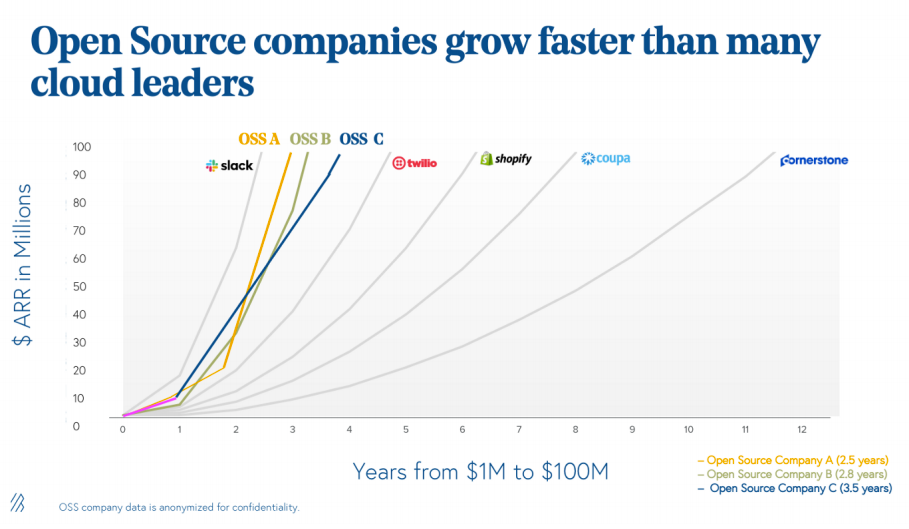
Source: Bessemer Venture Partners' plans: Open source projects
According to Peter Levine, a partner at a16z and a long-time advocate and leader of open source software, there are three ways to develop an open source project stage, there are also three key differentiators that can provide a competitive moat for private/proprietary software organizations:
Phase
1. The fit between the project and the community, that is, your open source project creates a development that actively contributes to the open source code base reader community. This can be measured by GitHub stars, number of commits, pull requests, or contributor growth.
2. Product and market fit, that is, your open source software is adopted by users. This can be measured by downloads and usage.
3. Value and market fit, that is, you have found a value proposition that customers are willing to pay for. Success here is measured by revenue.
Competitive moat
1. Enterprise customers don't want to be locked in by vendors
2. They want to buy from people who have written code
3. Big companies don't have your expertise
These stages are similar to An inverted version of what a typical startup aspires to. In most cases, founders identify a problem and build a solution that customers are willing to pay for. Once they develop a product, they test it in the market to find product-market fit. Finally, once they've built a solid customer base willing to pitch the product, they work hard to grow the community - a theme we touched on a few weeks ago. Open source software products and companies are designed with the community first. The next challenge is not finding supporters, but how to generate income.
Aside from community-driven enthusiasm, some key competitive moats are the open source software model unique. There's a clear path to monetization through this channel, perhaps because of their close relationship with enterprise companies (open source software powers the backbone of modern enterprise tools...). Enterprise companies like flexibility (aka no long-term contracts), developer-to-developer relationships (fewer sales hurdles), and experts to help with implementation, maintenance, and advice. But the preferred method of capturing this value has evolved over time.
1. The aforementioned RedHat case study was a pioneer in offering free software, but by offering Profitable support and services.
2. Later this approach was replaced by offering proprietary/enhanced features, kind of like a free model with a roadmap between public and private/paid Forks between access tools [eg: Elastic, Confluent]
3. Today, most modern open source companies make money through the SaaS model (surprise, surprise): Businesses utilizing its technology handle hosting, tooling, and operations [eg: Databricks].

OSS Pivot to Cloud scales faster than any previous model (Source: Battery Ventures)
Successful open source software projects have a pre-established community ( subject matter experts, developers who know how to use the product, and regular updates and documentation releases). This is attractive to any business that wants to incorporate source code into its own project and then hire developers to oversee it (or expect current developers to adopt it quickly). For an OSS company, it's a fine balance: your project is visible to everyone. In theory, the community could "fork" the project (cloning and forking the source code to build in a different direction), which could pose problems. You live by the community and you die by the community, but if you can thread the needle, you have a very powerful resource at your disposal. Historically, open source was seen as a commodity. In reality, it has become a key accelerator of business activity and business innovation.

Source: Open Source Business Forum (O4B). Open Source Business Forum (O4B) Prospects for OSS in the EU
Prospects for funding OSS
Some people think that open source projects are going through a moment of renaissance. It is deeply rooted in developer culture and now also benefits from macroeconomic tailwinds such as remote and distributed workforces, mass migration to SaaS, and early internet culture as observed through the lens of the cryptocurrency and blockchain communities. recovery. The exit path is a bit different than for a traditional private startup, but the opportunity is still there.
Additionally, it is well known that open source projects have become key strategic acquisition targets. MySQL was acquired by Sun Microsystems and then by Oracle; Salesforce acquired Heroku and Mulesoft; XenSource was acquired by Citrix; RedHat was acquired by IBM; Microsoft acquired GitHub. Furthermore, open source projects have expanded beyond the confines of pure gameplay architectures to all key verticals with significant advantages: fintech, edtech, cybersecurity, e-commerce, etc. Many examples are in the US, but it should be noted that there are also a large number of good open source project companies in our backyard (Europe). Aiven (recently hit a $3B valuation with Eurazeo funding), AI repository Hugging Face (just hit $2B after a recent funding round), MariaDB, SUSE, Strapi, Axion IQ, Elastic ($ESTC public stock) and GitLab, among others.

Source: The Future of a16Z - Open Source Code. From community to commercialization
As stated at the beginning of this article, venture capital investment in open source projects is increasing year by year Increase. It’s important to note that exit values are also increasing, with IPO and M&A activity more than tripling between 2019 and 2020 alone. So, what have we learned? Well, the first is that open source is not simply free software, and in fact, successful projects are able to hit revenue targets and exit at comparable multiples to traditional proprietary startups. An open source project is as much a philosophy as it is a go-to-market strategy—it's largely developer-centric—and requires careful, deliberate management and oversight to succeed at scale.
Finally, it embodies the movement for transparency, decentralization and building for good, This is representative of the current trend of the times. Even some of the world's largest companies are turning to open source to accelerate their R&D schedule and experiment at scale (Google has over 2,000 open source projects!).
While we do not have specific requirements around open source applications, we will be closely monitoring the market for Projects that align with our own investment thesis and have the potential to achieve value and market fit and unlock innovation for commercial products around the world.
Original link
Welcome to join the official BlockBeats community:
Telegram Subscription Group: https://t.me/theblockbeats
Telegram Discussion Group: https://t.me/BlockBeats_App
Official Twitter Account: https://twitter.com/BlockBeatsAsia