Vitalik et al. : Searching for the Soul of Web3 (ii)

原文标题:《 Decentralized Society: Finding Web3』s Soul 》
Original author: E. Glen Weyl, Puja Ohlhaver, Vitalik Buterin
原文编译: hahaho@DAOrayaki.org, DAOrayaki
"Tao is the essence of all things, the treasure of good people, and the protection of bad people."
Chapter 62 Lao Zi
Abstract
「去中心化社会:找寻 Web3 的灵魂」,是 Vitalik 等人的最新论文,本文讲述了如何通过灵魂绑定Token实现更丰富、更多元的生态系统即「去中心化社会(DeSoc)以及去中心化社会中的关键的可分解的产权和增强的治理机制」。因此,DAOrayaki 社区特翻译此文并组织多场 Podcast 深度分析。因全文过长,我们将会分上、中、下三篇发出。本文为该系列下篇,上篇请查看: Vitalik et al. : Searching for the Soul of Web3 The midsection please check:Decentralized Society: Searching for the Soul of Web3 (Chinese)
Chapter 7 Challenges in implementation
Privacy is a key challenge for DeSoc. On the one hand, too many public SBTs may reveal too much about souls, which makes them passive and subject to "social control". On the other hand, too many pure private SBTs will also lead to the correlation discount between private communication channels and social governance and coordination, which reflects the importance of incentive compatibility. Closely related to the issue of privacy is the issue of deception: souls may use private or other auxiliary channels to communicate, thus distorting their communal bonds. We cannot know all the possibilities and answers along the way, so we need to dig deep into the nature of these difficulties and chart a promising path for the future.
7.1 Private Souls
Blockchain's system is public by default, and any relationship recorded on the chain is immediately visible not only to the participants, but to anyone in the world. Having multiple aliases preserves some privacy: a family soul, a health soul, a professional soul, a political soul, each corresponding to a different SBTs. But if these aliases are superficial and outsiders can easily connect the souls, the consequences can be serious. So if nothing is done to protect privacy, the "naive" act of simply putting all SBTs on a chain can result in a lot of personal information being made public on a bunch of applications.
To solve the problem of excessive disclosure, there are many solutions with varying degrees of technical complexity and functionality. The simplest method is to use SBT to store the data off-chain, leaving only the hash value of the on-chain data.
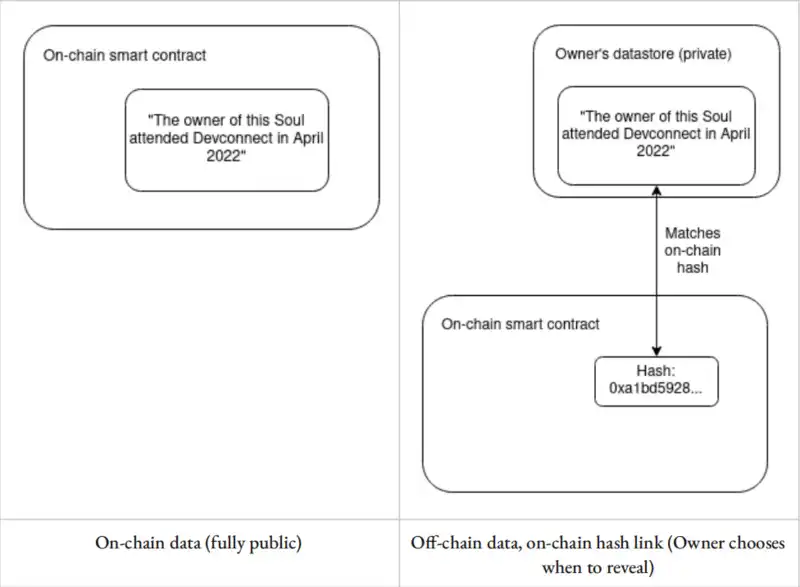
On-chain data (fully public) & NBSP; On-chain hash values (owner can choose when to display them)
It is up to individuals to choose how to store the data down the chain, and possible solutions include (I) their own devices, (ii) trusted cloud services, and (iii) decentralized networks such as InterPlanetary File System (IPFS). Storing the data down the chain gives us access to write SBT data to the smart contract, as well as separate access to read it. Bob can choose to display the contents of any of his SBTs(or any other data it stores) only if he wants to. This is a big step forward, and because most of the data needs to be processed by a small number of people, it makes the technology even more scalable. But to fully implement features such as protecting multiple privacy, you need to dig deeper into the relationships. Fortunately, many encryption techniques can help us with this.
There is now a powerful set of buildable modules that support the partial presentation of data information in new ways. It is called the Zero Knowledge Proofs, which are a branch of cryptography. Although zero-knowledge proofs are commonly used today for privacy protection in asset transfers, they also allow people to prove arbitrary statements without revealing anything other than the statements themselves. For example, in a world where government documents and other identifying information can be password verified, someone could prove statements like "I am a Canadian citizen, over 18 years old, have a university degree in economics, have more than 50,000 Followers on Twitter, and someone has not yet registered with the system."
Zero-knowledge proofs can be calculated on SBTs to prove features about a soul (such as that it has certain members). This technique can be further extended by introducing multi-party computing techniques (such as garbled circuit computing) that make the proof doubly private: the verifiers do not reveal who they are, and the verifiers do not reveal their verification mechanism. In this process, both sides are calculated together and only the information is output.
Another technique is to specify verifier proofs. In general, "data" is unreliable: If I send you a movie, I can't technically stop you from recording it and sending it to a third party. Methods such as digital rights Management (DRM) are of limited use and tend to be costly to users.
But the "evidence" is reliable in a way that if Amma wants to prove to Bob some property X of her SBTs, she can make a zero-knowledge proof of the following statement: "I hold SBTs that satisfy property X, or I have the access key to Bob's soul." Bob is convinced by this statement: because he knows he has not made the proof, Amma must actually hold SBTs satisfying property X, but if Bob passes the proof to Cuifen, Cuifen is not convinced: as far as he knows, Bob can prove it by accessing the secret key through his own soul. In this case, verifiable delay functions (VDFs) can be used to further strengthen the proof: Amma can show a proof that can only be made now with the required SBTs, but others will have to wait 5 minutes to make it. This means that while there is no choice between the different types of raw data themselves (perhaps copied and pasted), access to a credential of the data is possible. Just as traceability in blockchain transactions prevents someone from copying and pasting valuable NFT(and the original originator of witch attacks), SBTs can provide traceability in propagation, which at the very least reduces the value of data of uncertain origin (copy-and-paste).
These off-chain data and zero-knowledge techniques are compatible with negative reputations (embodied by SBTs) that are displayed even if the owner does not want them to be seen. Negative reputation includes credit history, outstanding loan data, negative reviews and complaints from business partners, as well as the degree of harmony with relevant social relationships as evidenced by SBTs. Blocks in the combination of the chain and related encryption technology may have a potential solution: smart contracts can force the soul will be negative SBTs merged into a data structure, such as storage under the chain of Angela merkel tree, any zero knowledge proof or garbled circuit calculation need to introduce this information, otherwise, there will be a visible in the data provided by the "gap", The verifier will be identified. The Unirep protocol is an example.
The point of these examples is not to show how encryption can be used to address all of SBTs's privacy and data rights issues. Rather, it Outlines a few examples to show the power of these technologies. An important future line of research is to determine the boundaries between different types of data permissions and the specific combination of technologies that are best suited to achieve the required level of permissions. Another question is what type of compound property regime is required for data governance and how to separate access rights (" USus "), construction rights (" Abusus ") and revenue rights (" fructus ").
7.2 Cheating Souls
If SBTs are the social basis for coordinating compound property, online goods and intellectual knowledge, it is feared that souls may enter the community through trickery or deception in order to obtain SBTs licensed governance or property rights. For example, if many application directions rely on SBTs that can represent the right to attend a meeting, then it may be possible to use those SBTs in exchange for bribes. Bribe enough people, and humans (and robots) create a false social picture split by (fake)SBTs. Just as DAOs can be bribed, so can souls and the on-chain voting mechanism they use. Conversely, SBTs can be mitigated if they are used to weaken collaboration. Why should we trust the SBTs possessed by souls to actually keep their social promises, rather than simply telling them how to play this "game"?
One view is that there is a "balance" between the different motivations for cheating. Souls self-measure and categorise the networks they find important, much as Harberger taxes work by balancing incentives to overvalue assets with incentives to undervalue them and arriving at near-accurate market valuations. Souls will want to have more SBTs in order to gain influence in their communities, and on the other hand, they will avoid SBTs in communities they don't care about, thus scoring lower on relevant metrics and thus increasing their influence in the broader governance of the web.
But it would be naive to think that the two motivations of gaining power and gaining influence always cancel each other out, or nearly so. There may be many communities that use systems other than SBTs to restrict access and governance. Alternatively, communities may issue private SBTs (contrary to our assumptions about openness) to shore up governance power, while inducing community members to keep the existence of these private SBTs secret in broader decision-making.
"Game" is an important problem, and solving this problem is one of the focuses of future research. In fact, this is one of the main reasons why it is so difficult to open source existing algorithms that provide prioritization or sorting. In order to reduce and prevent SBT "games", we provide several specifications and directions:
1. SBTs' ecology can begin with 'intensive' social channels, where SBTs validate community membership in the chain through strong social ties and interactions with each other. This makes it easier for the community to identify, filter and remove SBTs from impostors (or bots). This "dense" channel, which we often find in churches, workplaces, schools, gathering groups and civil society organizations, will provide a more witchproof social base for "cop games" (e.g., through bots, bribery, impersonation) that take place in more "sparse" social channels.
2. Nested communities require SBTs to impose "context" on their "downward" vector of potential collusion. For example, if a state is holding a fundraising or ballot round, the state may require that every participating citizen also hold an SBT for the designated county and city.
3. The openness and cryptography of the SBT ecosystem can be used to actively detect collusion patterns and punish unreliable malicious behavior (perhaps reducing the voting weight of the conspiracy soul, or forcing the soul to accept the SBT -- which in this case represents negative reputation). For example, if one soul proves that another soul is a robot, the case can go deep and publicly verify the results, resulting in a large number of negative reputation certifications for that soul. A similar use case has been generated in the GitCoin QF ecosystem, which uses a series of indicators or signals to detect "colluding groups".
4. Zero-knowledge proof techniques (such as MACI) can encrypt to prevent certain proofs made by souls from being provable. This discourage the sale of certificates because the briber cannot judge whether the bribe-taker has fulfilled the transaction. There is already a lot of research into this technology, and eventually any non-financialized social mechanism could benefit from similar ideas.
5. We can encourage whistleblowing, which destabilizes large-scale collusion. This is not detection and punishment for incorrect or abusive behavior, but rather a pattern of complicity in abuse. Overuse of this technique is risky because of the potential for fake bribery, but it is essentially a viable technique.
6. We could use peer-prediction to encourage truthful reporting in all cases (unless collusion is severe). Participants can certify each other's presence, rather than the conference certifying attendance, which also means that the number of participants to be bribed is very large and costly. Rewards do not have to be financial, but can be SBTs, where rewards are more positive for real community members than for the attacker.
7. If a number of souls have common interests, we can use a correlation coefficient, which measures correlation. For example, use the correlation technique in quadratic financing to quantify the correlation between two participants to determine their intersection. If two participants have many common interests, their incentive to disclose that fact (and there are many common interests) to the quadratic financing mechanism will certainly decrease with the correlation discount, but it will never become zero or negative.
Chapter 8 COMPARISONS AND LIMITATIONS
虽然提出的身份框架的范围几乎是无限的,但在 web3 中有四种突出和相近的范式值得去比较:占主导地位的「遗留」身份验证体系、假名经济、人格证明和可验证凭据。每个范式都强调了我们所倡导的社会认同范式对未来发展的重要贡献和挑战,我们将这些局限性作为探索未来方向的跳板。综上所述,我们也解释了为什么我们相信代表社会身份的灵魂和灵魂绑定 Token 是一个有关隐私制度更有前途的方向。
8.1 Legacy
Legacy authentication systems rely on documents or id cards issued by third parties (governments, universities, employers, etc.) from which provenance is determined. While legacy systems deserve to be well understood, these systems are very inefficient and lack composability to achieve fast, effective coordination. In addition, these systems lack the context of social relations, making souls dependent on a centralized third party to confirm membership in the community rather than embed in it.
For example, most government-issued ID cards ultimately trace back to birth certificates issued by doctors and family members, who are the ultimate source of truth, but this also ignores many equally meaningful social connections that combine to provide strong verification.
Indeed, when centralised centres of power need to seek strong approval (such as security clearance from the government), they rarely rely on these documents, turning instead to the "social relations" approach.
As a result, such legacy identity systems tend to concentrate power in the hands of the issuer and those who can perform "due diligence checks" for stronger proof, who in turn become rigid and unreliable bureaucracies. A key goal of DeSoc is to ensure that security requirements for government ids can be met and exceeded, allowing horizontal networks to provide greater security for all users through a range of social foundations.
8.2 Pseudonymous Economy
Balaji Srinivasan, who coined and popularized the term "kana economy," widely popularized the vision of a society that protects privacy based on combining reputation systems with zero-knowledge proof mechanisms. In his early years, he emphasized the use of pseudonyms in order to avoid social MOBS to a person's reputation and social relations damage and destruction.
It envisions people accumulating transferable zero-knowledge proofs in their own wallets and escaping reputational attacks by splitting the proofs into new wallets or multiple wallets, which may not be traceable. When selecting proof of transfer, you need to weigh the degree of pseudonym required for the new account, which requires a choice between being more anonymous (transferring fewer proofs) or distributed to a social network (transferring more proofs).
The practical difference between a typical kana economy proposal and DeSoc is that we do not emphasize identity segmentation as the primary way to be free from an "accusatory" culture. Some degree of segmentation (e.g., family, work, politics, etc. The difference between the soul) may be beneficial, but in general, depends on the new identity as the main way of resisting attacks there are big defects, it makes it difficult to source and the reputation of the pledge loan, and its correlation with trying to correct or witch attack combination of governance mechanism is very poor.
Rather than allowing the victim to reappear in the attack under a new (if reduced) identity, DeSoc allows other methods, such as socializing the attacker. "Accusations" often arise because statements and actions are detached when a person (or robot) has little social connection to the victim, and vilifying information is spread through non-relational networks. In the same way that the SBT provides ways to prevent forgery, it traces the origins of "defamatory behaviour" to social contacts. "Defamatory behavior" is essentially a product that appears outside the victim community (reflected by shared SBT members), or lacks SBT certification from the victim community (which casts doubt on the authenticity of the behavior).
SBT also enables victims to initiate defensive responses to counteract blows planned and spread from their networks of trust (represented here by the model of shared SBT ownership). By maintaining social relationships, people can maintain trust even when they face the threat of "accusations" and hold attackers accountable. Improving provenance improves the social basis for truth.
8.3 Proof of Personality (PoP)
Proof of Personality protocol (PoP) is designed to provide tokens of personal uniqueness to prevent witch attacks and allow for non-financialized applications. To do this, they rely on methods such as global analysis of the social graph, biometrics, synchronized global key players, or some combination of them. However, due to the PoP protocol for on behalf of personal identity, to realize the global uniqueness), rather than mapping relation and the unity of social relations, so the PoP protocol is the kernel to treat all people alike, we are interested in most of the application direction, such as reputation pledge), are all related with people, and beyond, as a "different" people, Become a "unique" person.
Also, the PoP protocol is not immune to witch attacks. PoP systems are vulnerable to witch attacks in almost any near-term foreseeable application, albeit at a slightly higher cost. Unless most people on earth sign up for PoP services and participate in specific verification activities, attackers can always recruit people who are not already involved (or not interested) to act as "witches." Not all of them will be robots, but it will make little difference, except for the possibility of some additional costs.
While we don't have the same ambitions as many of the PoP agreements that aim to build a foundation for universal basic income or global democracy, they make us think about how to build and coordinate diverse web products over time. Unlike the binary, individualistic and global nature of PoP, we aim to build a rich, layered and interconnected foundation for bottom-up reputation, property and governance that allows participation in communities and networks of all sizes.
Verifiable credentials
Verifiable credentials (VCs) is a W3C standard that allows zero knowledge sharing of credentials (or authentication) at the discretion of the holder. VCs highlights the major limitations of our Baseline Privacy paradigm and inspires further discussion of the above privacy content. VCs and SBTs can be seen as natural complementary elements until SBTs have the capability to narrow the scope of openness: in particular, SBTs are initially public, so they are not applicable to sensitive information such as government-issued identification, whereas THE implementation of VCs has struggled with a recovery paradigm that may be addressed by community resilience. In the short term, a combination of the two approaches works better than either approach alone. But VCs has a key limitation: At least in general, VCs does not support most of the application directions we have listed because of their unilateral privacy.
One-sided zero-knowledge sharing is incompatible with our use cases and does not meet our normative definition of privacy. Most of our application directions rely on some degree of propaganda, but with zero knowledge sharing, a soul has no way of knowing that another soul has SBT unless it is shared with the other. This makes reputational pledges, credible promises, anti-witch governance, and simple lease contracts (such as apartment leases) without visible other promises or proof of ownership.
Said more deeply, we doubt whether unilateral sharability is the right of privacy paradigm, there is very little for one of the multilateral relations without another party's agreement and the rights of the unilateral disclosure relationship as unilateral transferable private property property system is not perfect, simple unilateral sharability also is not very perfect system of privacy. If two parties jointly own an asset and choose to represent their relationship through VCs, such certificates do not allow mutual consent and licensing. This involves more complex complex properties and complex organizational forms and authority issues, which are a feature of DeSoc.
Chapter 9 SOUL BIRTH
The path from the current Web3 ecology to the enhancement of sociality by SBTs faces a typical cold start challenge. On the one hand, SBT is not transferable, and on the other hand, the current wallet form may not be the ultimate destination for SBTs because they lack community resilience mechanisms. But for community resilience wallets to work, they need to offer different SBTs in scattered communities to ensure safety.
SBTs or community resilience? Who were the early adoption communities? How can SBT on different chains interoperate with each other? Rather than aspire to know all the possibilities and answers, we outline the possibilities for the reader to explore further within the current web3 (or even web2) architecture.
9.1 Initial SBTs(Proto SBTs)
虽然 SBTs 具有不可转让性,但 SBTs 可能有另一种属性,在发展中会凸显其作用:可撤销性。在成长为不可转让性之前,SBT 可先成为可撤销、可转让的 Token 。如果颁发者可以刻录 Token 并将其重新颁发给新的钱包,则 Token 是可撤销的。例如,当密钥丢失或受损,而发行者有兴趣确保令牌没有被货币化并出售给一方时。(换句话说,当 Token 标志着真正的社区成员身份时,销毁和重新发行将是有意义的。) 雇主、教堂、聚会团体、有多次往来的链下互动俱乐部都是焚烧和重新发行 Token 的好地方,因为他们与某人有关系,可以通过电话、视频会议或简单的面对面会议轻松检查是否有人冒名顶替。而单一的互动,如出席音乐会或会议的方式,社群联结性较弱,并不合适。
可撤销的,可转让是在灵魂诞生之前,初始 SBT 的初始特性。这些 Token 为钱包孕育安全的社区恢复力机制以及个人积累初始 SBT(最终可焚烧并重新发行成不可转让的 SBT) 赢得了时间。在这种途径下,问题不再是「SBTs 在前还是社区恢复力在前?」相反,SBTs 和社区恢复力机制同时作用,诞生一个灵魂。
9.2 Community Recovery Wallets
虽然今天的钱包缺乏社区恢复力,但它们作为 SBT 的归宿或「孕育场所」方面各有的优缺点。人格证明 (PoP) 协议的优点是已经在尝试构建社会纠纷解决机制,这是社区恢复力的基础。此外,许多 DAO 使用 POP 来促进治理,使它们自然成为 SBTs 的第一发行者。然而,尽管 PoPs 在前,PoP 协议还没有赢得广泛的信任来存放有价值的 Token 资产,而托管钱包有。
托管式钱包(中心化较重),也因此成为不成熟的用户的依赖。这种托管式钱包可以为零售社区构建工具,以发行可撤销的 Token ,然后将其转换 (或重新发行) 为 SBT,甚至为更多缺乏相关专业知识的的「企业」发行人构建工具(其中许多人在 web3 中寻求构建忠实客户的基础)。一旦社区恢复力机制正规化并经过试验,这些托管钱包就可以分散到社区恢复力中,而托管人员则继续在 DeSoc 提供其他有价值的服务 (如社区管理、SBTs 发放等)。
For more dedicated Web3 users, a decentralized unmanaged wallet (or unmanaged community resilience wallet like Argent and Loopring) is a natural starting point for guiding community recovery mechanisms. The advantage of unmanaged wallets is that they are native Web3 open source and can be pre-announced and progressively tested, allowing a subset of willing, mature users to participate in experiments with incentives and hybrid mechanisms such as multiple signatures. All of these approaches: POP, managed, and unmanaged, play an important role in testing and guiding users with different levels of maturity and risk tolerance.
9.3 Proto-Souls
行为规范也可以引导灵魂存在。当我们重新思考 Token 和钱包时,我们也可以重新构建某些类别的 NFT 和突显成员身份的 Token 。特别地,我们可以引入一种规范,不转让由声誉良好的机构颁发的 NFT 和 POAP,这些机构尊重出席会议、工作经验或教育证书。这种会员性质 Token 的转让 (如果进行价值交易) 可能会降低钱包的声誉,并可能阻止发行方进一步向该钱包发行会员资格或 POAP Token 。在非托管生态中,大量的用户获得了可观的财务声誉,并在他们的钱包中持有股份,这可以作为他们不滥用不可转让性期望的间接抵押品。
While all of these approaches face their own challenges, we hope that small clusters of diverse approaches will increase our chances of converging to quasi-equilibrium in the medium term.
Chapter 10 Conclusion
While we have great expectations for what DeSoc can achieve, these are just the first steps. There is more than one path to DeSoc, including a number of non-blockchain-based frameworks such as Spritely, ACDC, and Backchannel, which rely on data stores associated with local machines rather than distributed ledgers. These frameworks may ultimately achieve greater trust across social distancing because they can leverage the transitivity of trust relationships (such as trusted introductions) rather than relying on SBTs published by well-known, authoritative institutions (such as universities or DAOs). Furthermore, the applications we describe above are only the beginning of DeSoc's reinforcement and do not involve virtual worlds: their "physics", their society and their complex relationship to the real world. All of which suggests that the lofty ideals we have outlined above may only be "prototypes" of DeSoc's eventual form.
However, there are still many challenges and problems to be solved along the way. The above blueprints are abstract and theoretical and need to be constantly tried and improved. How does the DAO balance soul patterns and relevance in SBTs to prevent witch attacks and ensure decentralization while maintaining openness? For correlation discount scheme, how does incentive compatibility obtain SBTs? How much conflict does privacy have with discounts and other DeSoc mechanic designs? How do we measure inequality in a social (open) but suitably private way? How does legacy play a role in community resilience mechanisms? Should it be redlined or even included in the agreement to avoid dystopian situations? Or should you create the best possible scenario? These questions are part of a research and development process that is likely to last for several years and will evolve in tandem with DeSoc's ecological development.
However, DeSoc's potential is worth paying for these challenges, and it may be necessary to ensure our survival. Albert Einstein told a Conference in Geneva in 1932 that "the capacity of man to organise" had not kept pace with "technological advances", which was the equivalent of "a three-year-old child holding a razor". His thinking was so prescient that learning how to program the future of society, rather than talk about basing it on "trust", seems a must for human survival on this planet.
The original link
Welcome to join the official BlockBeats community:
Telegram Subscription Group: https://t.me/theblockbeats
Telegram Discussion Group: https://t.me/BlockBeats_App
Official Twitter Account: https://twitter.com/BlockBeatsAsia
 Related Articles