Split venture capital: From the investment DAO to the service DAO
原文标题:《 通过 DAO 拆分风险投资 》
Originally written by Peter "Pet3rpan"
Block unicorn
Service DAO, incubation DAO, investment DAO
There have been several attempts to disrupt venture capital in the past:
1. The surge of angel investors (AngelList, 2010).
2. Formulation and Regulation of equity-based crowdfunding (Employment Act, 2012).
3. Crypto crowdfunding ICO through Token sales (2013)
While many of these efforts succeeded in creating more passive capital supplies for founders, they largely did not adequately address founders' operational needs that enabled projects to get to market faster and succeed throughout their life cycle: Talent, design, product, marketing, research, economics, engineering, community building, business development, regulatory guidance and domain expertise.
Capital itself is abundant, but valuable services are not. Despite the influx of capital into tech and crypto ecosystems, high-value services remain scarce.
We believe this is based on the following factors:
- Founders don't have publicly verifiable data on the quality of service investors can provide, nor do many founders conduct due diligence on investors. As a result, many founders are unable to optimize their investors based on the services they offer.
- The lack of high-quality data on investors has led to a sales-driven risk environment in which investors overpromise and underreward. Unlike a service provider bound by contractual obligations, or even a founder bound by a set timetable, investors are not held to the same standards, even though they can only access competitive rounds of funding through a proposed value proposition.
As a result, the funding landscape, both in crypto and in venture capital more broadly, is dominated by passive capital.
While 1KX and a handful of other funds strive every day to be the exception to the norm, we have been unable to drive fundamental change in the broader investor landscape. Fortunately, we believe a shift is coming -- and we believe it begins with Service Daos. Before we talk about Service Daos, let's take a look at the lineage of Daos in the venture capital landscape.
The Rise of the Investment DAO (First generation)
The initial assumption of the first DAO(MetaCartel Ventures and LAO) was that the aggregated network and expertise of 60-100 DAO members (builders and investors) would be better able to evaluate and add value to projects than a typical venture fund run by 2-3 partners.
Despite this initial argument, many first-generation investment DAOs largely failed to add value by providing access to DAO members' own personal networks and/or to internal investment DAO trading directors. This is because many DAOs are too focused on making investment decisions, rather than other, more helpful value-added efforts. We expect that as more investment DAOs enter the market, investment DAOs will expand their operational focus over time as they face increasing competition.
But even so, today's daos have been able to secure rounds based solely on the breadth of their connections and the reputational signals they provide to other investors.
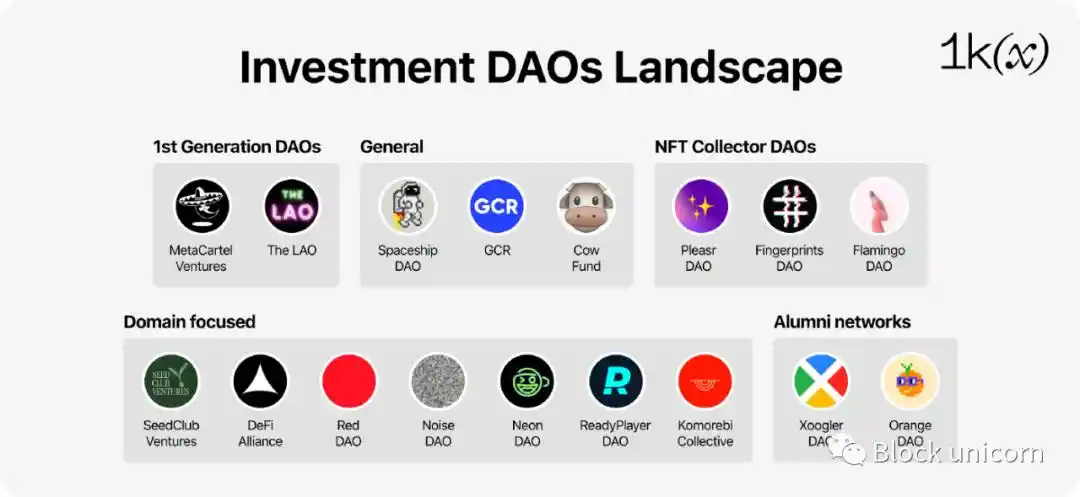
Investment DAO pattern (source: 1KX)
Incubating the rise of DAOs (second generation)
Incubation DAOs are communities that collectively help launch and launch new products and projects -- while taking a small share of project ownership in exchange for providing initial incubation. While these incubation DAOs often provide conceptual planning or design sprints, in which pre-release projects are able to plan their product strategy behind the scenes, many incubators often apply to participate in the community signals these DAOs provide rather than the actual operational added value. Because communities often precede social and technological revolutions, incubating DAOs has played a key role in exploring the maze of ideas that emerging markets have become "home-made computer clubs" for various ecosystems.
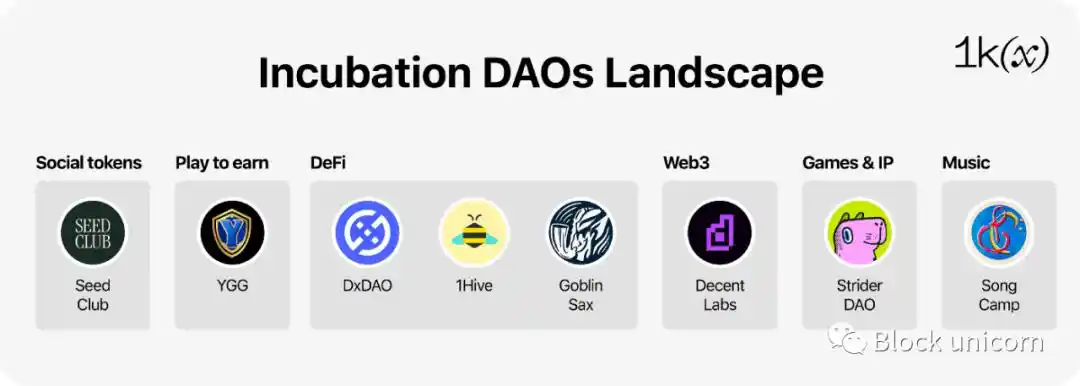
Incubate DAO industry (source: 1KX)
Next step: The rise of the Service DAO -- Upending the unit economics of venture Capital
While the DAOs mentioned so far have mostly dealt with ecosystem needs for high-value services, we believe that in order to develop founders' vc landscape, we need to evaluate vc from a service perspective rather than purely financial functions:
- Projects receive funding and value-added services from investors.
- Projects pay a price in dilution of project ownership. (selling % of its token supply or equity)
We expect more DAOs to focus less on investment and more primarily as "service DAOs" -- organizations that bring together highly qualified practitioners under a community to provide services to third parties (engineering, audit, design, legal, research, financial management, etc.). In exchange for ownership of the project. As these service DAOs build demand for their services, they will be able to accumulate ownership of the protocols they use, further harmonizing incentives between them.
While some funds have traditionally offered a variety of services under the same umbrella, we are likely to see services offered through the service DAO being much more finely priced and potentially much better per unit economy than funds offering bundled services under their "platform."
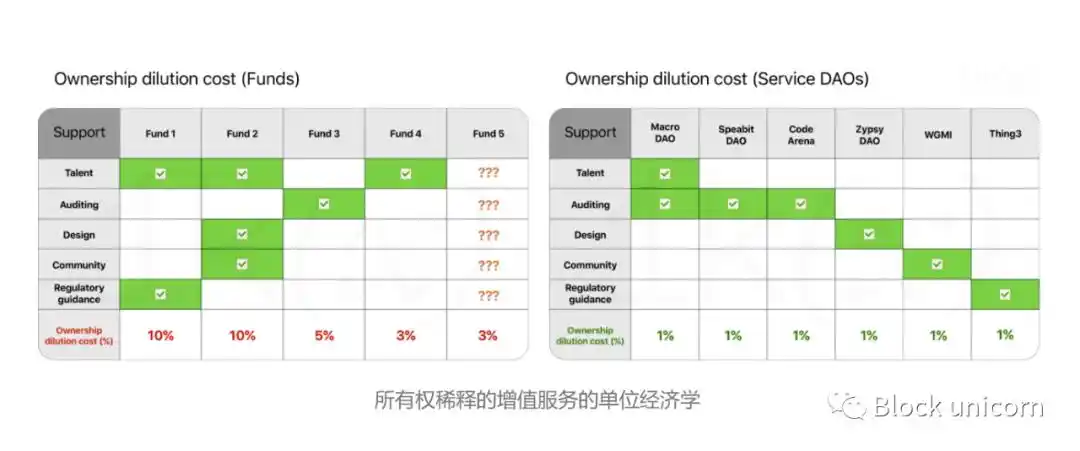
Case 1:Suppose a team needs the most help with regulatory guidance, which of the following options might they choose?
A platform that provides funding, brand awareness, talent sources and regulatory guidance, hoping for a token 10 percent of the project's supply.
监管指导服务 DAO,提供同样高质量的服务,以换取 1% 的 Token 网络。
If a team needs other services available from the fund as well as regulatory guidance, it may make sense for the team to work with the fund. But in other ways, the service DAO model enables projects to meet their needs directly, without the significant dilution that traditional funding typically entails. From our perspective, we see this increased bottom-up competition for services that fundamentally improves the economic unit of venture capital in favor of the community and founders.
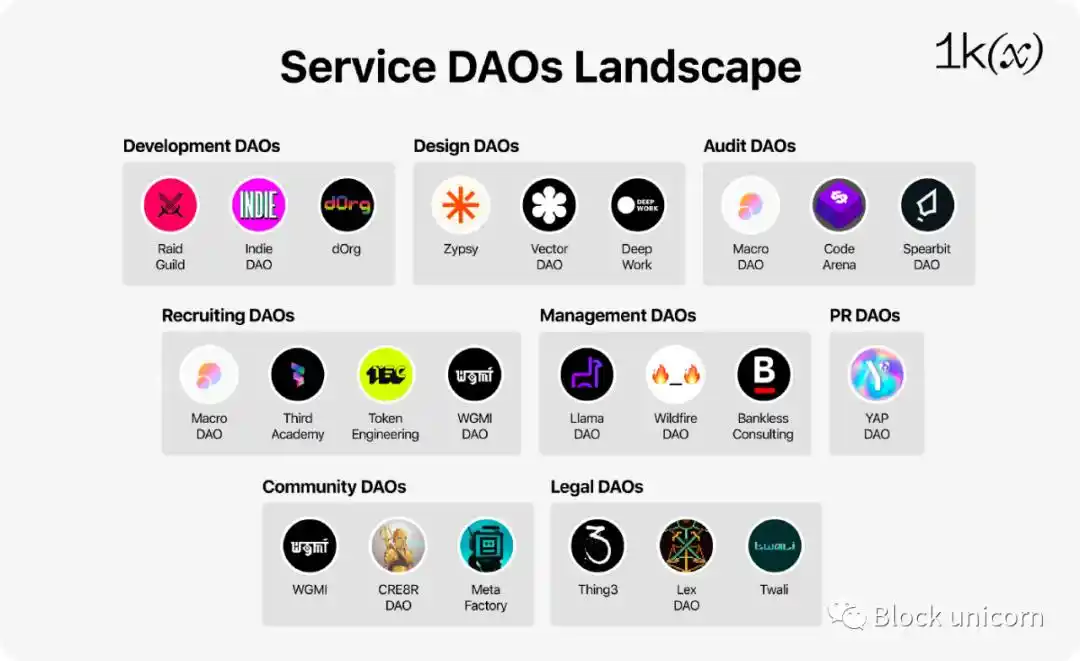
Service DAO pattern
Why DAO?
35% of US employment is for building trust (legal contracts, enforcement, auditors) and this is reflected in the administrative processes required to set up and run equity companies -- through an organizational stack that supports smart contracts, which takes weeks instead of perhaps minutes.
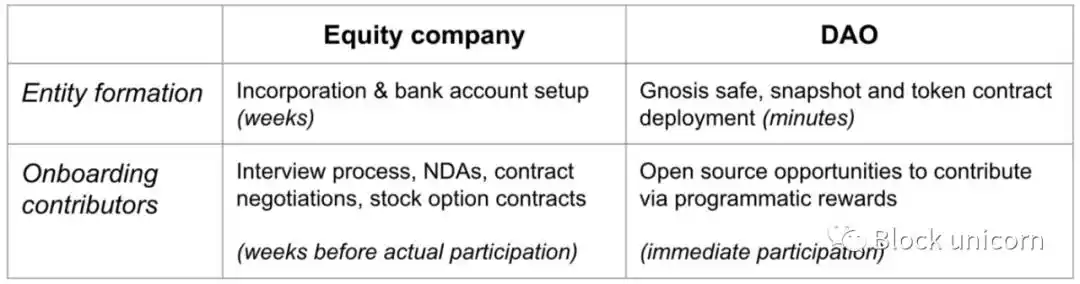
This is the fundamental advantage of cryptographic organizations over traditional equity organizations. However, despite this unique advantage, there are some major measures of DAO's success as a scale model.
These measures include:
- Retain the best contributors. (The best contributors to DAOS may face significant financial incentives to move up and join individual projects with greater capacity. How can DAO provide equal financial advantage for participation? .
- Solve the free rider problem. (DaOs need to figure out how to balance community ownership and individual participants to ensure that the most active contributors are rewarded for their work and have a long-term stake in the DAO, while minimizing the impact of passive members).
- Difficulty in activating potential community talent. (Even for THE DAO, which had access to talent, getting talent on the network to contribute was difficult. How do we create scalable coordination processes to efficiently produce high-quality outputs?
While DAO has not yet achieved 100% long-term operational excellence today, we believe that the lower cost of encrypted entity formation and coordination will allow DAO not only to proliferated more, but also to experiment around new and novel incentive and ownership structures. Through unlicensed innovation and access to the open source contributor pool, we believe daOs will ultimately result in more flexible, procedural, and expressive organizational structures that are better able to aggregate, retain, and attribute value to the best contributors. In turn, we believe these local Internet organizations will build higher quality output with greater efficiency.
Vision of a local DAO startup industry
We are on the verge of a venture capital revolution and want to accelerate the vision of building DAO's indigenous venture capital landscape.
Over the next 18-24 months, we will continue to:
- Investment service DAO, incubation DAO, investment DAO.
- Help various DAOs cooperate with each other to form joint ventures.
- Create a network of service DAOs to cross-communicate operational insights.
- Help determine how service DAOs handle projects of varying maturity, from early teams to large-scale symbolic management vaults
So far, we have seeded a vibrant DAO ecosystem under our portfolio:
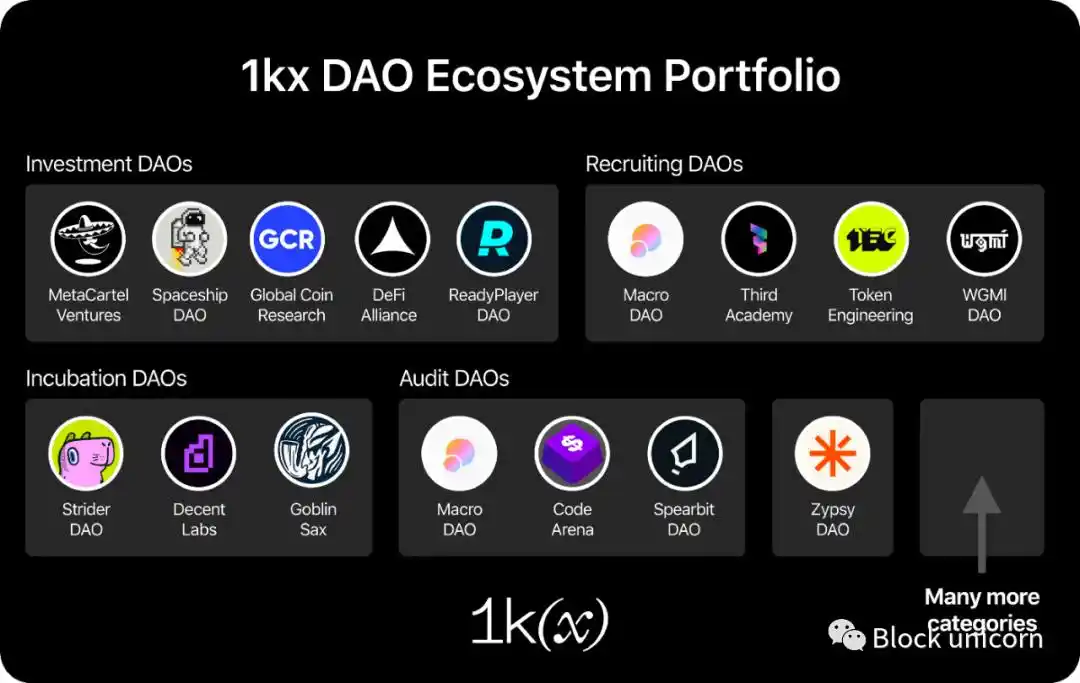
Directly meet their needs without incurs the severe dilution that occurs in traditional funds.
帮助早期团队启动 Token 网络:
- 设计 Token 经济模型 (分配策略、激励计划、治理结构、价值循环)。
- Ecosystem building (initiating or directing the MARKET SUPPLY and demand DAO, community coordination, contributor coordination, governance participation).
- Guiding the infrastructure ecosystem (running validators, building open source infrastructure for portfolio projects, running liquidity provisioning and arbitrage bots).
The original link
Welcome to join the official BlockBeats community:
Telegram Subscription Group: https://t.me/theblockbeats
Telegram Discussion Group: https://t.me/BlockBeats_App
Official Twitter Account: https://twitter.com/BlockBeatsAsia
 Related Articles