Referring to the national economic system, discuss how DAO should establish an internal economy
Original title: " Building an Economy Within a DAO "
Original author: Shreyas Hariharan
Original compilation: Lolifox, dao2
This article is based on my presentation at Crypto, Culture, & Society. Crypto, Culture, & Society is a learning DAO that is building a humanities education for cryptocurrency.
While more and more complex activities have moved to the digital world, our tools for collaborating in digitally native ways have not evolved at the same pace. DAOs are emerging as a key collaboration mechanism, but they are still in their infancy. To reach their fullest potential, DAOs should, like nations, strive to build a thriving internal economy in service of their mission.
This article covers how DAOs build internal economies, use their native tokens and treasuries to achieve their goals, and apply economics, history, and anthropology model to work effectively.
I. How to build an economy
Why are Japan, Korea and China successful?
The book "How Asia Works" by Joe Studwell details the An economic model applied by governments in Asia, including other countries, to build successful economies.
The success of these countries runs counter to conventional economic philosophy emphasized by Western universities and institutions such as the International Monetary Fund (IMF) and the World Trade Organization (WTO) . Unfettered free markets can be harmful to underdeveloped economies. Successful Asian economies are thoughtful about which sectors of their economy to open and when.
Strategies cited in the book include:
- Land Reform: Removing land from inefficient
- Import and Export Policy: Subsidize exports and impose tariffs on strategically important imports
- Immigration Policy: Allow Selected Skilled Workers, Limit Land Ownership by Foreigners
- Protect Local Industry: Protecting Local Farmers and Manufacturers from Foreign Competition
- Currency Protection: Devaluing Currencies to Make Exports More Competitive
- Special Economic Zones: Set aside areas like Shenzhen to give more economic autonomy
- Tax incentives: Tax Subsidies for Local Industry
Countries like South Korea and mainland China started with a lot of land and a relatively uneducated workforce. It is too costly to train citizens for high-skilled jobs in areas such as information technology and financial services. Instead, the government adopted a land reform policy that allocated land to agricultural laborers who worked on the land.
The result is that economically incentivized farmers operate small plots of land that increase productivity and crop yields, thereby boosting household incomes. This agricultural success in turn fostered the development of local manufacturing. Since manufacturers cannot get rich from local consumption (the local economy is not rich enough), they have to focus on exporting to the US, Europe and other richer economies.
The way to stimulate exports is not to fully open the economy, but to selectively set up special economic zones to provide tax subsidies for strategically important industries. Governments selectively revalue currencies; China in particular is known for devaluing its currency so that its exports can be competitive in global markets.
While these strategies are not sustainable in the long run, they are important in the early stages of economic development. An economy needs a strong foundation to be fully open to foreign competition.
Applying the government's successful economic model to DAO
So, when we apply the construction economy What happens when China's Asian model is applied to building a DAO?
Let's take a look at FWB(Friends With Benefits) as an example.
LandAgrarian Reform: Widespread
Token distribution
Similar to the way East Asian governments distribute land from feudal landlords to laborers, DAO must Token Distributed to a wide range of participants, allowing those who contribute to earn Token , and possibly inflationary Token Supply to dilute old, inactive participants in favor of new, active participants.
One of the things that the FWB has done is to set up several working groups where members can exchange contributions to the DAO Token .
Immigration Policy:
Token threshold(75 FWB) and scholarship
FWB to anyone with 75 FWB Token And those who are approved by the FWB team offer membership. They also have a scholarship program for selected applicants.
Unlike the Open Borders policy, this organized and governed the membership of the DAO in the early days.
Currency Protection: Liquidity Provision and Fiscal Diversification
A large part of the FWB Token The supply is held by the treasury, so the circulating supply is limited. The treasury is selectively invoked by the community responsible for curation.
FWB manages their liquidity program. Most of the large liquidity providers are trusted FWB members and they will not sell their FWB positions at will.
Special Economic Zones: FWB Cities, FWB Gatekeepers, FWB Radio
< /p>
You can think of sub-DAOs as loosely defined special economic zones. They are empowered and given some money to produce a specific product or service.
Tax Incentives: Funding from the DAO Treasury
FWB's treasury has funded a Token The threshold product, a newspaper covering the FWB weekly news as well as major events in various cities.
Will Token and treasury designed as a decentralized, programmable game
DAO is an internet-native organization whose key rules are governed by smart contracts rather than legal contracts manage. You can encode important things like membership, ownership, key assets, or property that the community owns on-chain. And on the edge, you have humans managing key parts of the DAO like shared bank accounts or treasuries, upgrades to the protocol, and changes to the DAO constitution.
Today, most protocol DAOs make their native Token 40-60% of the community treasury is allocated to the community treasury, which is then distributed through on-chain governance. The challenge is that on-chain governance is slow and ineffective, meaning there is hardly any native Token get assigned.
However, over time, allocating local Token The rules of the DAO can be coded at the beginning of the formation of the DAO. By setting these rules, the DAO creates a game in which builders, users, market participants, and other stakeholders can participate in order to gain native Token .
Bitcoin block rewards: a game with transparent rules that creates economic activity
Bitcoin provides a great example of this idea in action. Bitcoins are created as a reward for mining, as an important function of using computing power to verify and record new Bitcoin transactions. Incentives created by its creator Satoshi Nakamoto sparked an entire ecosystem and economy of players mining Bitcoin, including mining companies like Bitmain, including hydroelectric plants in Italy and Costa Rica, ASIC mines designed for mining Bitcoin machine, wait.
While the Bitcoin model is not without its critics, it established a transparent way for market participants to earn Bitcoins and achieved great success success.
Curve: an open, attack-resistant mechanism that brings complex economic behavior
Based on Curve to utilize and distribute its Token And the rules that were created, a whole ecosystem has sprung up with a lot of activity both inside and outside the DAO.
For example, Convex Finance emerged as a protocol that unties the governance and economic rights of Curve holders. As Kydo said, a group of people inside Curve Finance wanted to make their CRV (their Token ) to maximize revenue. However, their individual voices are not enough to sway any proposals. Therefore, they pooled their voting rights together (unionization), which was implemented in Convex Finance (union). Holders can relinquish their Curve governance rights to Convex while maintaining an economic interest in veCRV (voting-escrowed Curve), which includes transaction fees, yield, and CVX rewards. In addition, holders can use Votium to induce veCRV holders to vote to distribute rewards to specific pools.
Affiliation between DAOs
Business-to-business (B2B) relationships are strictly , while the relationship between DAO and DAO (D2D) is fluid. B2B relationships are defined by legal contracts, proprietary software, and private negotiations with key company executives. D2D relationships are made up of smart contracts, governance forum posts, open-source software, and relationships with the DAO community, Token Open negotiations between holders and core team to define.
D2D cooperation is closer to national regional alliances than corporate mergers and acquisitions. An important D2D Token Swaps, like the NATO agreement, are partly about protecting each other from stepping on each other's toes. Yearn is a good case in point - they helped several protocols like Pickle, Rari Capital, and Alchemix when they were exploited. This helps Yearn build trust with other DAOs.
When code is open source and forks are allowed, what you want to "get" is community and ecosystem development around the protocol, which cannot be achieved by force Finish.
Successful cooperation will involve product integration, resource sharing, support in case of attack, and increasing the economic value of both parties' DAOs. Collaboration will also involve participating in the governance of the other, and will exist as long as both communities are willing. If you implement the Sablier flow Token Swap, two DAOs can cancel the transaction or sell at any time Token .
II. Barter and the Gift Economy
The Financialization of Everything
Cryptocurrency financializes almost anything - from an open source protocol, to a meme, to a person's future income. The financialization of everything combined with the ability to exchange anything through decentralized exchanges like Uniswap and Sushiswap shows that we are entering a loosely defined barter economy.
Anything can compete to become currency. It's easier than ever to create an asset out of anything, and it's easier than ever to exchange assets for each other.
Mobility is to Web3 what bandwidth is to the web
When exchange becomes more common (more important to the economy), liquidity has also become more important.
A useful analogy is that bandwidth is used in the Internet era, and liquidity is used in the blockchain era. Bandwidth is the speed at which data can flow on a network, while liquidity is the ease with which you can exchange your assets for other things. Having sufficient bandwidth and liquidity will allow the DAO economy to thrive.
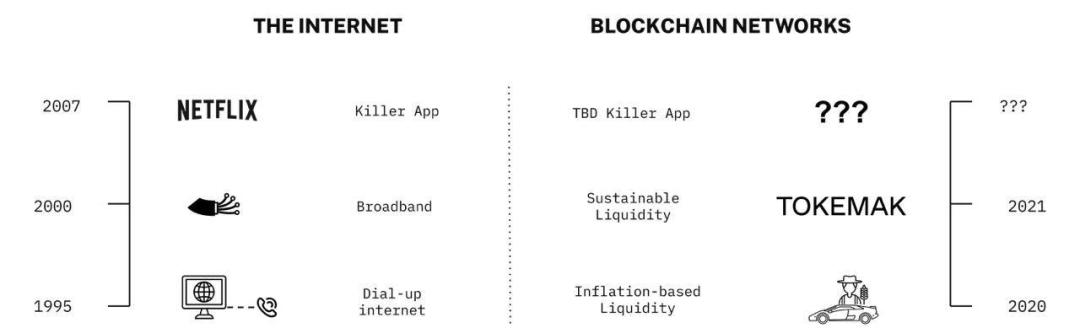
Source: Liquidity Wizard
Source: Liquidity Wizard
Gift Economies Between DAOs
Many Anthropologists Scholars disagree with the commonly held view that a barter economy evolved before an economy based on credit or money, a view widely propagated by the 18th century economist and philosopher Adam Smith. In fact, many anthropologists believe that early economies were based on generosity and reciprocal gift economies. (e.g. I give you something you need, and at some point you give it back in a certain way).
This appears to be occurring within the interactions within the DAO. As trust is built within the DAO, members foster trust and will at some point be rewarded for advancing the DAO's mission.
However, the concern with web3 is that every interaction has the potential to become transactional. DAOs must take care to prevent this from becoming part of the culture, as it devalues intrinsic and social motivations of members. The best DAOs will run gift economies internally, even if they are more transactional with other DAOs.
Inexhaustible treasury and unlimited time horizon
Have Permanent capital is valuable because some projects require longer time horizons and inexhaustible sources of funding. Endowment funds for monasteries and universities in China were established with the understanding that funds need to be in perpetuity.
The DAO treasury often funds long-term, open-source projects, which means funding needs to be as sustainable as possible.
As always, whether DAO or traditional institution, there are exceptions depending on the goals of the project. For example, the Gates Foundation plans to spend all of its resources within two decades of Bill and Melinda's death so they can focus on the most pressing issues of the day.
Socialists meet capitalists in DAO
DAOs are interesting because they contain elements of two different ideologies, socialism and capitalism. There is a mixed pattern that emerges from the libertarian-leaning belief that everything can be financialized and money should not be controlled by any centralized institution, and the leftist view that workers should own more of the economy than just is wages. This is why web3 encompasses a multitude of political views - because people can be attracted to it for different reasons, and both sides can be right.
In many ways, DAOs provide a better model for collaboration and distribution of ownership than some of our existing structures. Successful DAOs will build a thriving internal economy that fulfills their mission. They should be conscious about how to use their native Token and treasury to maintain and grow their communities.
Original link
Welcome to join the official BlockBeats community:
Telegram Subscription Group: https://t.me/theblockbeats
Telegram Discussion Group: https://t.me/BlockBeats_App
Official Twitter Account: https://twitter.com/BlockBeatsAsia