Cobie discusses the ApeCoin pledge proposal in detail: creating new value is more meaningful than playing shell games
Original title: "Cobie: The Death of ApeCoin and Staking "
Original Author: Cobie
Original Compilation: Tao of Yuan Universe
< br>
Recently, I was contacted by a member of the ApeCoin Board of Directors who asked me to provide some feedback on some proposals, and I presented my ideas on the phone.
I want to write about things that are openly discussed because I think they are interesting topics.
Before I start, I want to clarify: I do not hold any ApeCoin, I am not shorting ApeCoin, I used to own BAYC in the past, but now I do not Ideas for long-term or short-term exposure to anything related to the Yuga Labs ecosystem. I am not a financial advisor and in fact have long been rumored in the industry to be an idiot.
The death of staking
Staking has had some meaning in the past. I think Peercoin was the first protocol to introduce the proof-of-stake (PoS) mechanism, about ten years ago. Since then, the PoS mechanism has become more and more popular in new blockchains, and all newer ecosystems are built on PoS blockchains.
For Peercoin and later PoS networks, staking has a purpose. Owners will provide their tokens as collateral for a chance to validate blocks, for which they will be rewarded. Staking thus rewards users for risking their collateral and working: a function necessary to participate in the continued functioning of the network or protocol.
But somehow, over time, the term staking has been redefined. The current staking seems to mean that if you don’t sell the tokens you currently hold, we will give you more tokens as rewards instead of being rewarded for contributing to the security of the blockchain .
These modern staking mechanisms have no function in the ecosystem they belong to. They don't do anything in a practical or technical sense, they don't make the ecosystem stronger, they're just shell games that use the names of different things to obscure their actual purpose, which is to encourage less dumping.

When PoS protocols issue rewards to stakers, they are buying the security of the blockchain. When DeFi projects offer liquidity mining programs, they are buying growth and TVL. It seems worthwhile to trade something in order to make the protocol more sustainable, larger, or more secure.
But these new "staking" mechanisms gain nothing but reduced liquidity for potential sellers.
If you do not stake, your share of the network or protocol will be diluted by new emissions. Plus, new stakes are risk-free! You don't lose tokens because staking does nothing! So, lock up your tokens! Move them off the market instantly...in fact, we'll pay you!
Simply using rewards to encourage users not to sell, and the payment method is the same asset that users choose not to sell. This seems to be the late creation of Ponzi games way of stages.
ApeCoin
Okay, let’s take a quick look at ApeCoin.
It has a total supply of 1 billion, it does not mint or burn new tokens, so the total supply will always be 1 billion APE.
ApeCoin’s Token ownership distribution is as follows:
47% belong to the ApeCoin DAO “ecology” Fund"
15% is used for community airdrop
15% belongs to Yuga Labs
14% belongs to "startup contributors" (investors?)
8% goes to founders
1% goes to charity
In terms of unlocking, it looks like Yuga Labs, founders and Investors are locked for a year, but there seem to be exceptions where some coins are unlocked immediately and some are unlocked after 6 months.
The remaining unlock timeline appears to be in the 1-3 year range, with the entire supply 100% unlocked within 4 years.
Anyway, back to the topic.
ApeCoin’s pledge
There is currently a pledge plan proposal for ApeCoin, which is Written by Animoca, which appears to be a crypto gaming VC software hybrid whose founder is on the board of ApeCoin.
In the words of the proposal author, the goal of this proposal is to benefit the APE ecosystem by motivating early NFT adopters and existing and potential ecosystem participants to participate activities, making ApeCoin the preferred Token for web3.
The proposal itself seems complicated, but I can summarize it for you, it basically says:
< /p>
We should pay people who hold ApeCoin 17.5% of the total ApeCoin supply over the next three years, and we should give them a different rate of return if they also hold BAYC/MAYC/BAKC.
It is not clear to me how issuing APEToken to those who already hold APE "incentivizes early NFT adopters and existing and potential ecosystem participants to participate in meaningful Conducive to APE Ecosystem Activities".
Isn’t this just paying ApeCoin to those who hold ApeCoin?
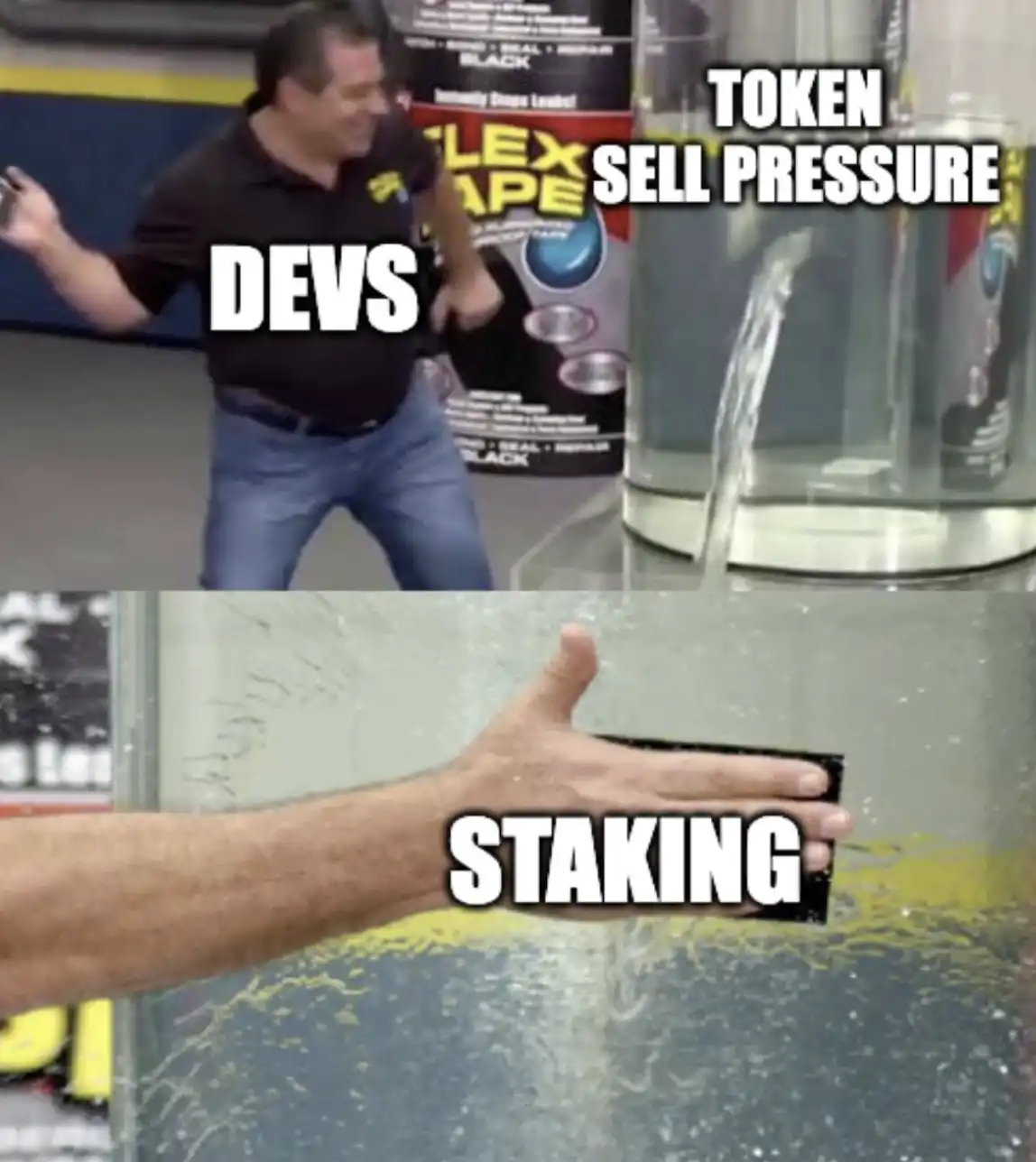
In fact, if we're really being honest about this proposal, what it really means is "let's unlock the , to pay some Token rewards for holders who don’t sell, so we can fake some utility before actually building.”
< /p>
$2.6 billion in staking rewards, in exchange for nothing but air
ApeCoin's current overall valuation is about $15 billion, which means Its DAO treasury holds approximately $7 billion in tokens.
Animoca's proposal proposes to give away $2.6 billion worth of tokens (approximately 37% of the remaining DAO tokens) to APE holders for free over the next three years.
Since this staking doesn't actually do anything practically or technically, you can simply think of it as bribing users not to sell means. The proposal reads: "If you don't sell your APE or BAYC, we will give you more APEToken!"
DAO will have 37% of the remaining Token is used for bribes, so it must consider the importance of bribes.
Given that these tokens can be spent on a lot of things, they are currently worth $2.6 billion after all! They can create a lot of value for ApeCoin, build a sustainable ecosystem and attract new external capital.
From an outside perspective, it appears that the DAO spent more than 1/3 of its remaining tokens to bribe people not to sell when early contributors passed the early unlock phase .
However, when you consider the supply and demand dynamics this staking program will bring about, it seems more of a conspiracy than an actual malicious strategy.
There is currently about 15% of the circulating supply of ApeCoinToken on the market, this inflation/emission plan will increase the supply on the market by about 75% in the first year only , but I don't believe this will increase the demand for ApeCoin by 75%, so an isolated staking program may harm the economic interests of locked-in Token holders.
However, ApeCoin does have a real problem: how does it provide additional supply to the market so that incoming founders and investors will not become Largest share of liquidity supply?
In my personal opinion, it is good to spend the dedicated funds, but the funds should be spent for growth purposes and moving towards their original stated goal: becoming the currency of web3. These Tokens should not be used to reward those who already hold Tokens.
ApeCoin DAO
The remaining assets of ApeCoin DAO should focus on solving practical problems for users.
I don't know what it means to achieve the mission of "becoming the main currency of web3", but I know that there is a "user demand" in the NFT ecosystem, which can Funded or built by ApeCoin DAO.
Why is OpenSea the main trading place for Boring Apes? Last year, BAYC and MAYC traders spent about 20,000 ETH on OpenSea, which means that 60 million US dollars are leaving the ecosystem every year.
BAYC holders, or NFT holders in general, may wish to receive NFT credits while retaining ownership. Could ApeCoin DAO Create a Major NFT Lending Market?
Why do Boring Ape users keep getting hacked? What educational resources are needed to help people self-custody their assets more effectively? Can ApeCoin DAO launch an attractive custody service?
And so on. I'm sure the community will come up with some better ideas.
DAO should be committed to creating new value for APE ecological users and potential users, and it should solve the practical problems of users in the NFT community.
These funds should be used to acquire and incubate utilities, establish revenue streams and create a sustainable DAO.
Should there be a pledge program?
I have a good reason to think that 15% "retail" ownership share is too little, and the first year or so of a staking program (and the only one eligible The staked token supply comes from retail investors) can raise this to a more meaningful level.
I can also see an argument for a 10-15 year emission plan: APEToken has no minting function and cannot increase its own supply. If the DAO burns all APETokens in the first few years, it will have no more firepower to incentivize activity or capture future value. Also, over time, you'll achieve a wider, more desirable distribution by extending the amount of time someone has to be an ecosystem participant.
I can see an argument for why BAYC NFTs should be staked: so that users don't have to choose between joining the community by buying BAYC or buying ApeCoin. In addition, newcomers are more likely to enter the APE community through NFT rather than interchangeable tokens, because this is how everyone in the current APE community works.
I can also see an argument for why BAYC NFTs should not be staked: ApeCoin is a brand new entity that was founded by the BAYC community, but Actually no longer directly attached to NFT.
In reality, these arguments do not have much basis in reality, because it is difficult to say: what is the significance of this staking pledge plan? What is the program trying to achieve?
This proposal says some nonsense about "incentivizing participants to do things in the APE ecosystem", but the staking proposal itself seems to be out of touch with this goal.
If the goal of the ApeCoin DAO staking program is to acquire new members for the DAO, a credible staking program may include offering NFT holders within the APE ecosystem Issue ongoing rewards. The APE ecosystem may even acquire other NFT collections and issue APETokens to these community members.
If the goal of the Staking pledge plan is to support the liquidity of the BAYC ecosystem, then APEToken emissions should be provided to LPs in the APE/WETH market, and for NFTX Class pools provide liquidity to people.
If the goal of the staking pledge program is simply to drive up prices, then it needs to lock assets and provide higher returns for longer lockups, And stifle supply outside the market for as long as possible.
Without stated goals regarding the purpose of the staking plan, it is difficult to design a staking plan that achieves those goals. Getting more supply into the market, bribing users not to sell, or offering "fake utility" are not credible goals of a staking scheme.
Personally, I will design a small program to motivate to introduce more and more new people into the Ape ecosystem in the next ten years, and I will Reward existing holders for continued participation in the ecosystem. My personal opinion is that new users will join the NFT community, not the fungible asset, and therefore, the holders of the NFT assets should be paid, not the holders of these tokens.
I would supplement this pledge program with an aggressive, greater purchase value program.
Governance
ApeCoin is now a multi-billion dollar organization and it needs a Long enough for a long-term plan. There should be a good answer to this question: How do we turn this $7 billion in APE treasury assets into $100 billion over the next decade or two?
However, the time span of crypto investors is not always very long, on average, I think they don't care much about their Token project in 2 months What will be done within, let alone a 10-year plan.
So if you tell the community and say, "Hey, we've decided there won't be a staking program, we're going to contribute to the ApeCoin DAO ecosystem by paying the builders to invest in growth,” and they might be very upset.
"I don't get any tokens for free anymore? And outsiders can get tokens worth millions of dollars? Just to build a lending market? This is all What the hell?"
Retail investors are unlikely to seriously consider the impact of "OHM-style supply inflation" on existing holders, nor are they considering price The chain reaction of falling charts.
Governance of complex and multifaceted analytical problems is thus an odd environment, one that quickly finds its way into politics.
I hardly believe that Token voting by retail investors will give the best mid-term results, in fact they are more likely to vote for disruptive mid-term results.
I read an article today that said Sushi's treasury shrunk from $1 billion to $30 million in 1 year. I don't know if this is exaggeration or fiction, but I think this will be the common story of many failed DAOs.
Summary
Staking mechanisms should be designed to support ecological goals, they should be used Incentivize the parts of a product, community, or network that require people to work or take risks.
The ApeCoin DAO currently has $7 billion in capital, it should use that capital to incentivize people to take risks, work and grow the community, not as an interest rate Bribes are given to existing holders as a reward for not selling.
With no utility or value capture, spending 37% of the fiscal pool on emissions is not only worthless, but may actually be detrimental to the APE ecosystem damage to long-term prospects.
We should have resisted changing the meaning of the word "staking", but it may be too late now. The term is now inherently misleading, and can mean several different things.
I really hope we don't live in a world where the main currency of the Internet is called "ApeCoin", but I hope to try to avoid this article A clear bias that is relevant for any DAO that finds itself in a similar situation.
How bad is ApeCoin's staking proposal
Bored Ape community keeps failing in crypto Known for its self-preservation.
In response, the ApeCoin committee suggested that the BAYC NFT would actually "contain" your APEToken.
How does Staking work for NFT holders
If the BAYC ecosystem An NFT holder who wants to stake in Pool 2, 3, or 4 (depending on the NFT) will pair the NFT with their ApeCoin to enter the relevant staking pool. The NFT itself is not pledged, it just acts as the key to the "vault" holding the pledged ApeCoin . NFT holders still retain the ability to sell their NFTs. By default, if you sell an NFT that is actively staking ApeCoin, you are also selling the key to access the associated staking ApeCoin.
And if only NFT is to be sold without selling the related pledged ApeCoin, the NFT seller will release the pledged ApeCoin before listing the NFT.
This means that if you lose your BAYC, you also lose your APEToken!
You can't split your NFT and your APEToken into different wallets, which means if someone steals your BAYC, they don't have to do anything Extra things can take away your APEToken. By default, APE and BAYC are used together! marvelous!
This design seems to be intentionally convoluted and produces more bad results than good ones. Even forgetting that you staked APE behind a particular NFT could be a huge financial mistake, really bad design.
The board of directors of ApeCoin also issued the following statement:
“Why can’t I only stake one BAYC Ecological NFT?
We believe that everyone in web3 should control their own assets, and in order to provide this right to NFT owners, the NFT itself will not be pledged into the staking pool. Furthermore, by staking ApeCoin rather than NFT, the ApeCoin DAO incentivizes and facilitates the long-term development of the community of ApeCoin holders.”
This seems straightforward puns. Everyone should control their own assets, so you can't put these assets in the contract. But you can put other assets into the contract!
This doesn't really make sense, I can only conclude that they are taking users for fools.
Anyway, what happens after three years of staking?
"What will happen at the end of the three-year pledge period?
Need to draft a new AIP, and vote on it to determine the future staking mechanism, then put that decision in the hands of the community. Ideally, at the end of the 3-year staking period, the DAO will have ongoing income to continue incentivizing staking and rewarding the ecosystem system participant."
"Ideally"? So, wouldn't it be better to determine the income plan before the pledge plan? What if a solid income plan took 5 years instead of 3? It also seems crazy to devise a staking program with no knowledge of the product and revenue plan that is initially only being used for subsidies.
It doesn't really matter anyway, because staking doesn't serve any purpose in this case, it's just for bribing people to remain community members .
Oh, the current pledge proposal also includes 1.3 billion USD in Token emissions next year (calculated at the current market price). Assuming all holders are in a reasonably "Western" high tax regime environment, this alone would generate $700 million in selling pressure. That's cool.
Write here, I don't want to write anymore.
Original Link
Welcome to join the official BlockBeats community:
Telegram Subscription Group: https://t.me/theblockbeats
Telegram Discussion Group: https://t.me/BlockBeats_App
Official Twitter Account: https://twitter.com/BlockBeatsAsia

 Related Articles