Answer 14 doubts about PoS
Original title: "What you need to know about PoS"
Original author: u/domotheus
Original compilation: ETH Chinese
As the merger approaches, more news will emerge, and many more articles will be published by many uninformed crypto journalists. This signals to more people that a merger is indeed close, which will lead to more questions and discussions about PoS, while also repeating the same topics and misconceptions. I saw this to some extent last week when the Kiln testnet was successfully merged and I expect to see more of the same going forward. So laying out some of my common points here, as I did in my last post (which was more about Ethereum in general), I boiled it down to a few simple points.
I intend to list these points every time I see them being raised. I encourage everyone to do the same, please correct me if I'm wrong, or suggest any additions.
What is a merge?
More information can be viewed in the website ethmerge.com, so I won't spend too much space on this part
< /p>
- After the merger, Ethereum will be secured by PoS consensus instead of PoW.
- It is not "Eth 2.0" after the merger, there is no such thing as ETH 2.0, this is an outdated vocabulary.
- If you are currently holding ETH, then you don't have to do anything. After the merger you still hold the same amount of ETH, there will be no such thing as "ETH2 Token", no need to migrate anything, etc. Everything remains the same, only the underlying consensus mechanism changes.
- It is called "merge" because the upgrade will merge the beacon chain (consensus layer) with the current chain (execution layer) and discard Part of the execution layer PoW.
- "Consensus" is just a fancy word for ensuring that transactions are ordered and that ordering is economically guaranteed not to change. PoW and PoS achieve consensus through different means:
PoW: "The cost of disturbing the ordering of blocks is too high, and it is more profitable to participate in accordance with the rules."< /p>
PoS: "The cost of disturbing block ordering is too high, because if I do, I will lose all my staked assets."
- Since only the consensus mechanism has changed, PoS itself will not significantly reduce gas fees.
Why merge?
- It will be cheaper to maintain security because less energy needs to be consumed to achieve consensus.
PoW: Requires miners to be able to at least cover the cost of all hardware and energy usage, otherwise no one will mine. This requires a large number of coins to be issued and sold quickly in exchange for fiat currency to pay the bills.
PoS: Just give the staker some income, so that people are willing to deposit assets instead of investing directly elsewhere. There are no expensive bills to pay other than a regular computer and a steady internet connection, so the yield just needs to reflect the opportunity costs and risks involved.
- more sustainable:
A blockchain is basically as secure as its The currency price is directly proportional. This is true for both PoW and PoS: the former (more valuable Token rewards = more reason to follow the rules = more miners = harder to break the consensus); the latter (more valuable pledge Token = more follow the rules To avoid loss of pledged Token).
Newly issued tokens essentially take value away from all holders and redistribute it to some. All else being equal, converting tokens to fiat can extract value from the network.
- This will pave the way for many scaling solutions, including data sharding, stateless, light clients, and more
- By separating the responsibility between the execution layer and the consensus layer, it can help reduce some of the complexity of code updates.
- Supporting the environment and reassuring players is certainly a nice side effect, but not the main reason to switch to PoS. Because this is mainly influenced by external factors, and Ethereum as a protocol does not have much control (such as the source of energy production, GPU supply chain, etc.).
When will it be merged?
- No official date has been announced yet. It’s just that developers and the community are cautiously and optimistically expressing their hope for a merger in June. For the reason, refer to the article "Five Signals That Ethereum Merger Will Happen in June 2022".
- Testing is still going on and the merge won't happen until the developers are fully confident that nothing will go wrong.
- I personally wouldn't pin my hopes on a June merge, but I'm sure it will happen in the summer, unless there is a very serious issue during testing Bugs (e.g., a critical bug that took weeks to fix, and the specification itself that had bugs that took months to fix and reimplement).
- The difficulty bomb is set to go off in June, so there will be a hard fork upgrade at that time, merge or not.
- I recommend bookmarking wenmerge.com to quickly see the latest status of each testnet merge to estimate the mainnet merge.
Don't be silly, they will put it off like before. A merge was promised years ago, but not yet
- First some useless blah blah blah: no official merge date has been announced yet , and was never announced. The deadline has never been set, why delay it?
- The quote "Ethereum will switch to PoS in 2018" stems from an extremely optimistic attitude, which not only underestimates the security design of PoS and underestimated the complexity of securely transitioning from PoW to PoS. The work done at the time amounted to a partial completion of the specification for Casper FFG, a hybrid PoW-PoS mechanism that was eventually scrapped. But now there are many different designs. None of these new designs worked then, but they do now.
After years of research, analysis of possible attack vectors, and continuous improvement, a complete protocol specification has been written
Client implementation is all done, now only testing is left
Everyone's work revolves around merging, Apart from merging, little else is going on. The necessary preparatory steps for the merger have been completed. Not saying "they've done complex work like EIP-1559, so now they can focus more on merging", but "all attention will be on merging". It is unlikely that a situation will arise where the merge is "postponed again" and the developers start another work. Nothing else can be done until the merge is complete.
Since December 2020, PoS has actually been running as a beacon chain. This means that Ethereum's PoS has been tested and run in the form of a product for more than a year, and the pledged assets on the beacon chain currently exceed 10 million ETH. It's just that the current PoS has not yet produced blocks for the execution layer.
Once the pledged ETH assets can be unlocked, the price will collapse
Of course, many stakers ultimately want to make a profit, especially those who locked up their stake when 32 ETH was only worth $10,000. But there are still many other aspects to consider:
The merge will not unlock any ETH. Withdrawals will be made in the first hard fork after the merger, probably 6-8 months later. In the past few months, there will be no PoW Token issuance (approximately 13,000 ETH/day) will be sold, and there will be no PoS Token issuance in the market for the time being.
Just like staking ETH needs to be queued, withdrawals also need to be queued. Assuming there is a massive sell-off, everyone is in this queue, and the exit rate is limited to 1125 validators/day. So there is no “opening the floodgates” moment. It will take more than a year for all stakers to unlock. Over the course of a year, about 38,000 ETH returned to the market every day (or... about 1% of the average daily volume).
After the merger, validators will also start receiving fee rewards, and it is estimated that the rate of return will double. (Combined ETH issuance and staking yield estimates). Thousands of people are queuing up to stake right now. Since they accept 5% annualized rate of return, I don't think they will give up continuing to pledge when the annualized rate of return becomes 10%.
By far the biggest risk involved with staking is mergers. Something catastrophic could happen. However, despite these risks, people have been staking and locking up their ETH for over a year, despite the uncertain date of unlocking ETH. How many people/institutions are watching from the sidelines, waiting until this risk is gone before joining the staking fleet?
Don’t forget, the withdrawal of pledgers means fewer verifiers, which means that verifiers who do not quit will have a higher rate of return. Likewise, there is more incentive to join staking for those who have not done so before.
But, of course, this is cryptocurrency, and its properties as a cryptocurrency will not change. Mergers bring some exciting and volatile possibilities, or there could be a downside with all the good news, who knows. I'm not going to pretend I can predict the future, but it seems to me that more ETH is likely to be put into staking than withdrawn.
If PoS is so good, why didn't Ethereum use it from the beginning?
PoW is easy to conceptualize and implement, PoS is more difficult. Especially back in 2014, it was mostly a theoretical concept still being researched, with some blockchains implementing some version.
There are a few fundamental issues that need to be overcome from a research perspective before considering implementing PoS.
There is no one universal PoS scheme. Each PoS blockchain has its own PoS specification, and each has advantages and disadvantages. So many people say "other blockchains have done it, why can't Ethereum do the same thing", it's not that simple.
One benefit of starting with a PoW chain is that it allows anyone to mine permissionlessly. This makes Ethereum's Token distribution method much better than those chains that are PoS from the beginning (they also have to decide how to distribute the initial Token, and the distribution method really cannot achieve permissionless).
Related to the above: Yes, Ethereum still has pre-mining/pre-sale, but after years of mining and multiple rounds of bull-bear cycles, ETH Constantly changing hands, the pre-mined Token has now diluted to half of the total supply, and the proportion of the top 10,000 ETH holders is close to the proportion of the top 10,000 BTC holders. So, in 2022, when Ethereum is an extremely liquid and easy-to-buy asset, it's not a big deal.
This is really a ruse that ruined the efforts of the miners for many years
Since Since its release, PoS has always been the ultimate goal of Ethereum, and every miner knows that it will end one day. There is no scam or unfair situation here.
Economic factors trump any form of miner loyalty to the blockchain. You can think of a blockchain as a company, and miners as employees.
Miners/employees are paid for their services (i.e. providing secure consensus) in the form of block rewards. Wages are paid out by the employer (blockchain) by diluting the value of the Token currently held by the holder (see "Why merge?" above).
Miners generally look for the chain that offers the highest reward, and if another token that can be mined by the GPU gives more rewards, most of them will immediately Ditch Ethereum.
Similarly, Ethereum will pay less if the staker can perform the service provided at a lower price.
This is not entirely exclusive. Miners can also be Token holder blocks and blockchain users. There is nothing stopping them from holding their earned rewards and participating in staking.
If you do not consume real-world energy for mining, Token loses its inherent value
I don't quite agree with this statement. There's nothing magical about computing hashes over and over until you find one that meets arbitrary requirements. I mean, imagine a PoW blockchain where work is done by solving Sudoku puzzles; Once the value of a certain side is found, it is easy to verify. This does not mean that solving Sudoku itself brings value to the world. Raising the mining difficulty of a certain token doesn't magically make everyone richer, it just makes mining less profitable - unless, of course, demand also goes up, but so far that's been the case in the cryptocurrency world. Not too much of an issue.
I think the value of a Token ultimately comes from supply and demand, and the demand comes from the value of the block space. People need ETH to buy block space, whether ETH is generated by miners or stakers. Of course, more miners means more security/decentralization, further increasing the blockspace value proposition in a positive feedback loop. But this feedback loop exists in PoS Ethereum too, and they're super cool too!
PoS is a recipe for full centralization
PoS is a recipe for full centralization
It is basically the same as PoW, but slightly different. "Better" or "worse" really depends on your perspective. In my opinion, PoW is really just an additional step to PoS.
As a community, Ethereum attaches great importance to decentralization, and the research team will find ways to mitigate any potential centralization vectors. Even at the cost of sacrificing other important things like scalability (e.g., keeping the gas limit low so that more nodes can participate in a decentralized network, even if this leads to network congestion and transaction fees high).
There are indeed some shortcomings at present, decentralization is a spectrum and a process, and we have not yet reached this goal. Right now we still rely on a lot of centralized things that need to be gradually replaced in the long run. That is to say, none of these centralization obstacles represent the risks of the network. In fact, there will be corresponding solutions in the latest roadmap released by Vitalik for the statement "because of X, this network is centralized". Personally, I find it more exciting to come up with a bunch of solutions to solve problem X than to just give up on decentralization and say "We can't decentralize because of problem X".
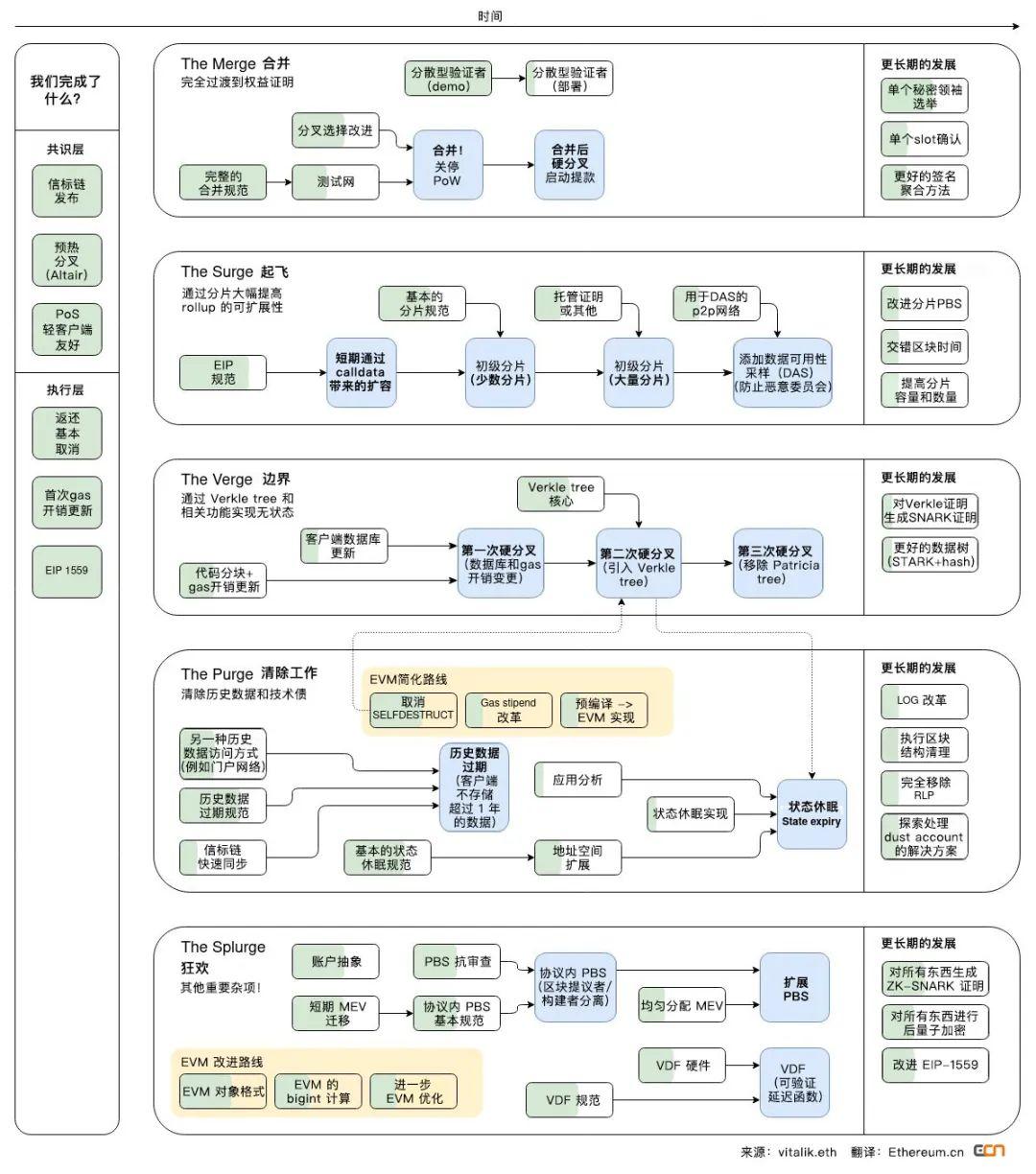
Ethereum Protocol Development Roadmap
There is something interesting about Ethereum's PoS design that is often overlooked: quadratic penalties. There are no severe penalties for a single validator node to go down, malfunction, or directly attack the network. And if a thousand validators do it at the same time, there will be a more severe penalty.
That said, if you're a large organization running thousands of validator nodes, it's in your own interest to spread them out Come on, avoid cloud hosting, and use a different client, etc. Sure, the assets are still centralized, but at least the points of failure are decentralized, which is good for the overall health of the network.
Some large mining entities rely on a central location to amortize costs that authorities can monitor based on energy usage and shut them down . Moving mining equipment around the world is difficult, but staking only relies on private/public keys and consumer-grade computers.
PoS actually makes "the rich get richer"
Yes. Unfortunately, we live in a world of extreme wealth inequality. Blockchain cannot solve this problem.
This is also true for PoW. Whoever has money can buy more mining machines and earn more money. In addition to mining, the return on investment is also affected by economies of scale: the centralized mining industry has a lot of money to buy hardware at a certain discount rate and move to places where electricity is cheaper. Individual miners simply cannot compete with it in reality. Whereas in PoS, everyone gets the same rate of return proportionally, whether they stake $10 or $10 million.
"It's true that these large mining industries may be centralized, but they have no reason to attack the network because they have millions of dollars invested in the infrastructure.. ...." So you're saying, are you okay with the existence of large centralized operators, as long as they have some sort of large share of the network?
Is this the passive interest of your deposit? Print money out of thin air? Wouldn't that be like a central bank issuing additional fiat currency?
You have to stretch to make that point, but I've seen people do it (laughs ). These views usually start with "PoS is nothing new".
Verifiers are still doing some "work": creating blocks and validating other blocks. It's just that the work consists entirely of actually useful work (which the blockchain needs to reach consensus on), rather than computing hashes over and over until one of them satisfies an arbitrary requirement.
This is not really "free money printed out of thin air", there are still costs involved in the pledged assets, they are just more abstract and more It's not intuitive.
Opportunity Cost - Why stake if another investment can give you a higher rate of return?
Poor liquidity - from the moment you deposit, your funds are locked, queued for your validators to activate, and then when you withdraw At that time, you have to line up again to propose.
Inherent risk - staking is still a fairly new thing and things can go wrong along the way. A critical error could occur, the network could be attacked, your staked hardware could be damaged, etc.
Volatility - it's still a volatile asset after all, and if you're the kind of investor denominated in your local fiat It's not very attractive when it could be down 30% in time and the yield might only be 5% (however, once the asset doubles, a 5% yield is very nice, turning a 100% gain into 110%) .
Maintenance costs - you still need to maintain your validator nodes and keep them secure, ensure 100% uptime, update software, etc.
There is an interesting point here: the more stakers, the lower the staking rewards for individuals. This basically means that all the costs listed above will be priced by the market itself. The reason is simple: if the staking yield is too low for the rewards received to cover maintenance costs, then people will quit staking and invest elsewhere. Fewer people are staking, and yields have picked up again. Similarly, if the rate of return is too high, more capital will be attracted, and the rate of return will drop again.
As for inflation: Assuming that the market as a whole, the ideal rate of return is 5%, of which 3% comes from Token issuance. Calculated in this way, about 30 million ETHs are pledged and an additional 900,000 ETHs are issued each year. With a total supply of 120 million ETH, the inflation rate is 0.75%. As long as the gas fee is at least 23 gwei, the inflation rate is lower than the ETH burn rate brought by EIP159. (I can’t stress this enough: Ethereum will soon be a profitable deflationary asset)
“Nice math, but no supply upper limit, and they change monetary policy all the time"
For many years, the goal has been "to achieve a minimum viable issuance while securing the network", compared to Setting an arbitrary supply cap, Ethereum prioritizes the security of the network.
As for monetary policy changes, none of the updates were inflation-increasing. Low inflation (and especially deflation) has been a goal of the community since day one.
Once the burn rate of EIP-1559 matches the issuance rate, there will be an equilibrium point that acts as an effective supply cap - again market forces against Ethereum The block space valuation is determined.
So, there is no such thing as an "Ethereum Central Bank" arbitrarily adjusting inflation/deflation rates and printing money to cronies. The market itself determines the inflation/deflation situation, and no single entity can control it like a central bank controls the inflation rate of fiat currencies.
Whales have enough funds to control and change the rules and fine honest validators
This aspect is exactly the same as PoW: even if you have 99% of the computing power, you can't make invalid transactions without the private key and steal other people's assets or change protocol rules. Can't really do anything other than reorganize blocks. 1% of honest nodes will reject any block that doesn't follow the rules, then the bad guys will be mining on an invalid/useless chain. The same is true under the PoS consensus. Now we just replace "computing power/mining" with "pledge weight/pledge" (the difference is that if the perpetrator of the reorganized block is discovered, all pledged assets will be fined and confiscated. However, the blockchain cannot completely destroy the mining equipment).
Simply put, a large amount of ETH is involved on the chain. There are currently more than 10 million ETH, and that is before the merger. At current prices, that's about $30 billion. Both the "amount of ETH staked" and "the value of ETH" are expected to rise, so attacks become less and less likely because the economic cost of launching an attack is too high. And if the attacker is from outside of Ethereum, it is ridiculous to get so much ETH in the first place (where do you buy 10 million ETH to achieve 51% pledge ratio? Or 20 million?)
< p>32 ETH is too much, the average person does not have that much money
I agree that this is a big problem . There are some proposals to lower the threshold for staking (better signature aggregation or active validator caps and rotations), but they don't seem to be a high priority right now, making sure the base layer can be secure.
The reason why such a high number of ETH pledges is required is because this value needs to just meet a technical point. In short, it needs to be low enough that everyone can participate, and there are enough validators to ensure the security of the blockchain; but high enough so that there are not too many validators and the blockchain overhead is too high big. And each validator node has the same amount of pledge, so that each validator has exactly the same weight when deciding who produces a block in the distributed random process, which reduces a lot of complexity.
From a technical point of view, there was a lot of math involved in arriving at the threshold of 32 ETH, which was worth about $7,000 at the time. Early math back in 2017 even suggested a minimum of over 1000 ETH.
Thankfully, just like the mining pool in PoW, PoS also has a pledge pool to allow small amounts of ETH to be pledged. This doesn't necessarily contradict the mantra "not your private key, not your token", thanks to schemes like RocketPool, Secret Shared Validators (not yet available) that utilize smart contracts to achieve Permissionless, decentralized and non-custodial. And because of the quadratic penalty mentioned above, I believe decentralized staking will outperform centralized staking schemes in the long run. I recommend everyone to read superphiz's staking guide for more information. If you value decentralization, participating in staking through exchanges is very bad.
Related to the above, it is best to think of a solution like Rocket Pool as a higher-level abstraction of basic staking, rather than just a " Staking Pool". I've written more details about it here for anyone interested.
PoS has not been proven to work, but we know PoW works
This argument is actually perfectly reasonable, and obviously we can't really refute this claim. Only time will tell. I just think this argument is irrelevant in the context of Ethereum being switching to PoS, and having decided to switch all along. If you don't believe in it, don't participate/invest in it. I personally believe in a long-term sustainable PoS Ethereum.
These are all part of the great cryptocurrency experiment in our lives. Either it will be short-lived, and it will be a pity that it will fail so that no one knows about it; or we will succeed in creating a powerful network that can survive in human civilization. To achieve this, prioritizing decentralization is key. I mainly see this kind of decentralization in Bitcoin and Ethereum, although their philosophies are very different. That's why long-term, I'd love to see how the two end up playing out.
Original link
Welcome to join the official BlockBeats community:
Telegram Subscription Group: https://t.me/theblockbeats
Telegram Discussion Group: https://t.me/BlockBeats_App
Official Twitter Account: https://twitter.com/BlockBeatsAsia
 Related Articles