Curve Ecology is a nesting doll or DeFi Lego combo? Try to read the Redacted Cartel
Curve Ecology is a Set of Dolls or DeFi Lego? Trying to Understand Redacted Cartel
Original source: title Crypto
本文尝试从 Curve War 的基础上去简单理解 Redacted Cartel,把 Redacted Cartel 理解为是 Curve War 的 Bribe 延伸平台,做 Bribe 的 Marketplace,用于争夺更多的投票权,进而争夺更高的流动性。
Curve War
The way to understand Curve War is usually simple. Before introducing this, we need to get a sense of what Curve War really is.
The essence of Curve War is to compete for the liquidity of Curve. Higher liquidity is definitely better for the project. For example, if UST wants ecological expansion, better mobility is definitely the first step, and a higher TVL pool at Curve is one of the important indicators. Therefore, UST and FRAX projects will be crazy to have higher liquidity of their coins in the pool of Curve.
Surely the easiest way to provide higher liquidity would be to provide it yourself, but it is clear that the cost is very high. For example, UST not only requires a large number of UST, but also a large number of other stablecoins such as USDC/USDT to form the pool. So in fact the optimal way is to attract others to provide liquidity. The way in which various external agreements attract liquidity and the resulting conflicts is called Curve War.
Money goes where the returns are highest. The number of CRV voting rights caused by the mechanism setting of Curve can determine the income of different pools in Curve. At this time, Curve War more clearly refers to the fight for the voting rights of CRV. There are two ways to gain CRV voting rights. One is to buy more CRVS directly. The second is to "bribe" others to vote for them, buying only CRV votes.
In fact, the cost of buying CRV directly is much higher. Therefore, different project parties prefer to "bribe" to buy the voting rights of CRV instead of owning CRV itself, which is a more economical way to achieve the goal.
So far, the more specific scope of Curve War is the "War" in which different projects purchase the voting rights of CRV.
Convex War
Interestingly, the projects involved in Curve War seem to be around Convex, rather than Curve itself. Why?
The reason is simply that a large part of the voting power of CRV is controlled by Convex. In fact, Convex controlled a very large portion of the CRV, and thus its voting and earnings rights. But other agreements are not so much about earnings rights as voting rights.
This is equivalent to the general manager handing over most of his power to the secretary, so the bribed person essentially wants to bribe the general manager, but most of the power has actually been transferred to the secretary, so the target of the bribery becomes the secretary.
Before it was handed over to this secretary, there were actually many secretaries vying for the position of general manager, and one of them finally won. And Convex is the winning secretary. This article does not elaborate on what makes This particular Convex successful.
This should make sense to you:
1. For higher liquidity, different agreements need to compete for the voting rights on Curve to attract others to provide TVL, because it is cheaper than providing TVL by themselves
2. The way of fighting for voting rights has shifted from buying CRVS directly to "bribing" CRV holders to buy only voting rights because it is also cheaper
3. Since a large part of CRV has been controlled by Convex, the main battlefield of the "war" is at Convex
But wait, this is not the end.
Since Curve War has evolved into Convex War, this means that the "Curve voting rights" held at Convex have been transferred to Convex's own Token: CVX. As a result, users who pledged CVX to Convex can vote at the convent platform to determine the amount of rewards for the liquidity pools on Curve, thereby influencing the liquidity levels of different pools on Curve.
But there are problems with voting: a user doesn't actually know which pool to vote in or which pool has the highest payoff, or the process of voting + getting a vote reward is too complicated. New so-called "vote aggregators" have emerged to address this problem and help maximize user voting revenue.
Redacted Cartel
This article is about Redacted Cartel, and it's a perfect time to show up. That's what Redacted Carted is all about.
Since there are many concepts, let's do a little Recap again:
1. All pools on Curve compete for liquidity
The pool-based aggregator to Convex "as" Curve controls the voting rights of a large number of CRVS
3. CVX enables the CONVent coin to command CRV
4. Curve War evolved into a contest for CVX votes
5. The voting process is not user-friendly, and vote aggregators appear
6. Redacted Cartel is one such aggregator, but apart from Convex, it is only one of many projects that will be supported in the future to help more projects and users achieve voting optimization
In order to have the right to vote at Convex, Redacted Cartel needs to have a large number of CVX or CRV (CRV can be directly pledged to Convex) just like The Convex control Curve. If the Redacted Cartel wants to support voting for other protocols, it's going to need a lot of governance tokens for other protocols as well. How to obtain a large number of these tokens becomes a core issue, because only a large number can have an impact on the project being governed.
The way Redacted Cartel did it was Fork OHM's Bonding mechanism. You buy Redacted Cartel's native Token, BTRFLY, at a discount, just like OHM did. Tokens currently accepted by Bonding include TOKE, ETH, FXS, CVX, CRV and Btrfly-Ohm LP. Clearly, the supported tokens also indicate the protocols that Redacted Cartel's Bribe aggregator will support in the future.
So let's take a look at what Redacted is.
Redacted is a Fork of OHM, and the original Token is BTRFLY. It combines the mechanisms of OHM and Convex at the same time, and is committed to building a trading market with governance/voting/bribery as the object. Redacted is an extension of Convex War, and it not only serves Convex, but also plans to serve other similar projects.
If DeFi 2.0 is a Liquidity as a Service, LaaS, then Redacted and its ilk are a Vote as a Service, VaaS.
Currently, Redacted's Treasury has approximately $114 million in assets.
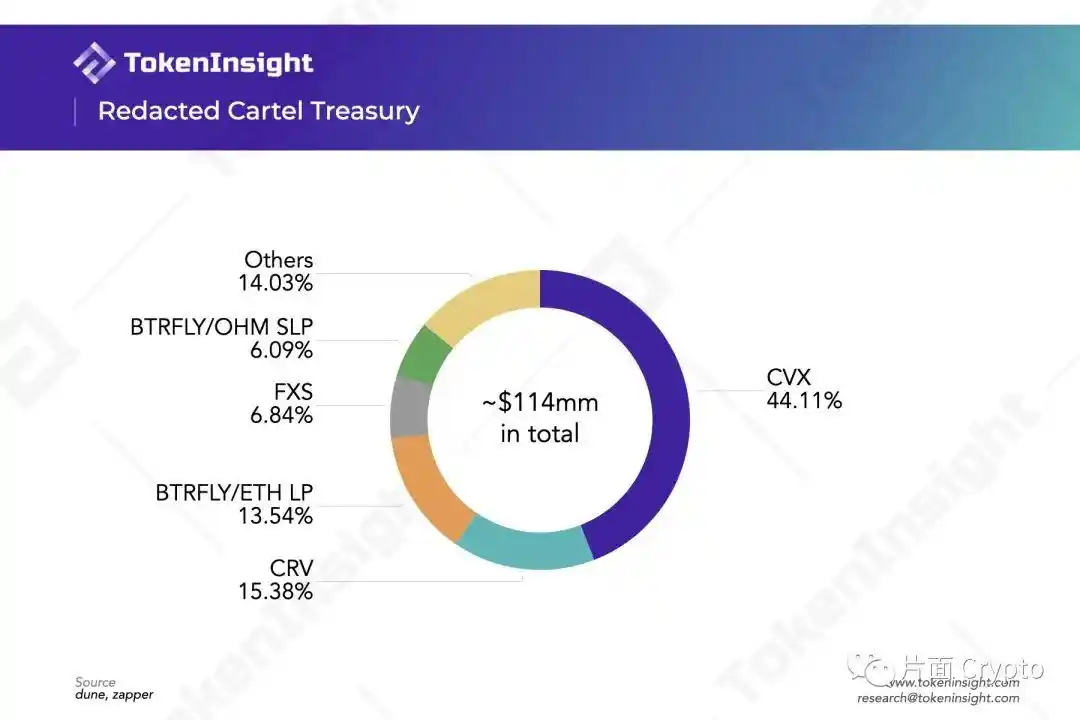
CVX and CRV accounted for more than half of them, and the number of CVX exceeded 1 million. For comparison, Frax and Terra are currently the two largest holders of CVX, holding approximately 3.65 million CVX, with Redacted in third place. Therefore, from this perspective, Redacted has exerted a certain influence on the result of Convex.
Redacted's acquisition of Votemak, where Tokemak votes, will relaunch Hidden Hand, a rigged exchange. Hidden Hand will be the core venue for VaaS and support Redacted to extend other protocols besides Convex.
Specific process:
1. Users entrust voting assets to Hidden Hand
2. Hidden Hand sold the voting rights bid to the external agreement required, and in return, Hidden Hand received the Bribe reward
3. Hidden Hand redistributes the reward to the user, to Redacted Treasury, and then to the owner of BTRFLY

Source: Redacted Cartel
All of the voting process, and maximizing the revenue from the vote, was handed over to Hidden Hand in Step 2 above. Meanwhile, the holder of BTRFLY can obtain the right to command Hidden Hand by pledging BTRFLY.
I don't know if you've fully understood "Curve War" to "Convex War" to "Redacted War" (and what's to come in the future).
To continue with the example of the former secretary, the first secretary gained the trust of the general manager through her own ability, and thus gained the power of delegation from the general manager. Secretary 2 also obtained the trust of secretary 1 for solving part of the problem, thus obtaining the power of second delegation from secretary 1. Secretary of the three... .
In addition, Redacted has plans to launch Pirex. Pirex can be understood as a voting derivatives market. If you think the price of a Bribe will be higher in the future (that is, the right to vote will be more expensive), you can buy the vote in advance and sell it when the price rises, or vice versa.
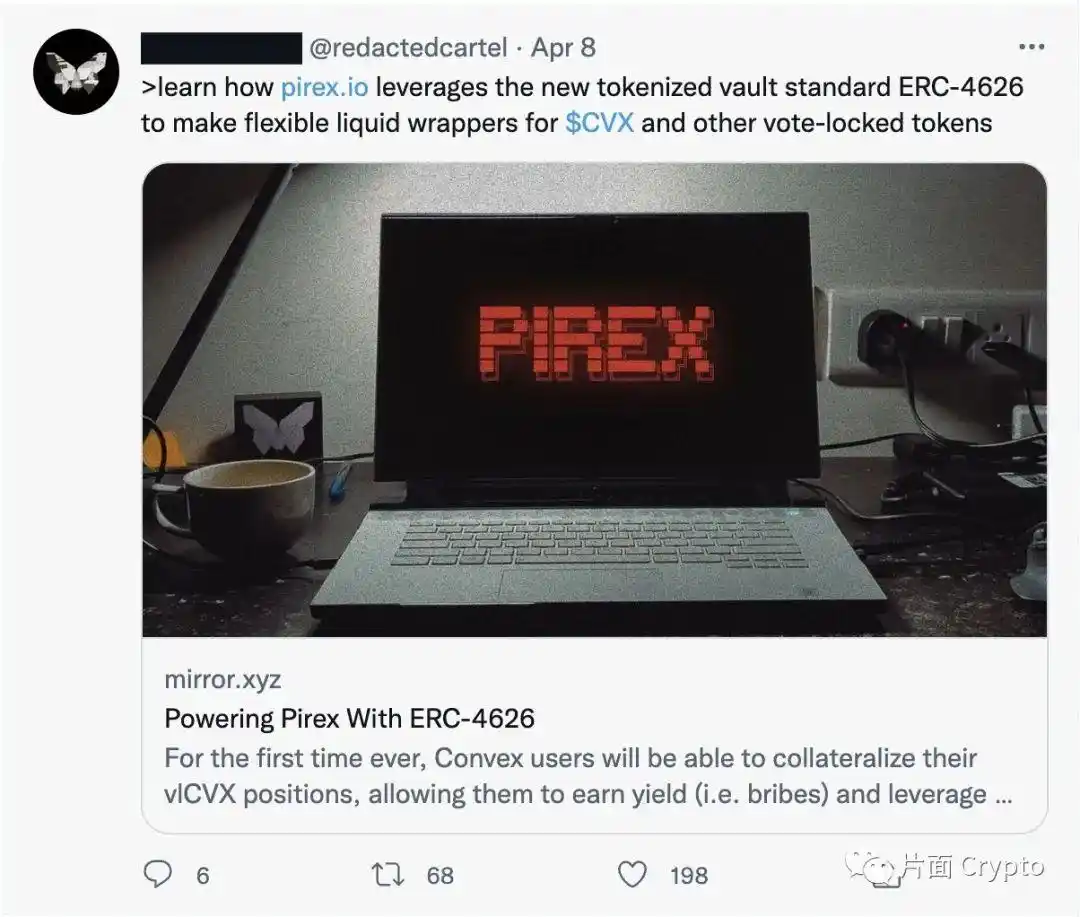
Source: @RedactedCartel Tweet 8th April 2022
There are many other things that should be covered but are not
This paper only tries to introduce 'Redacted' in a simple way. It has to involve a lot of content about Curve War and a number of projects. I hope it can help you understand 'Redacted' and 'Curve War'. There are a lot of things left out of this article.
Curve, for example, has a Bribe market, where users can vote directly on different pools of Curve.
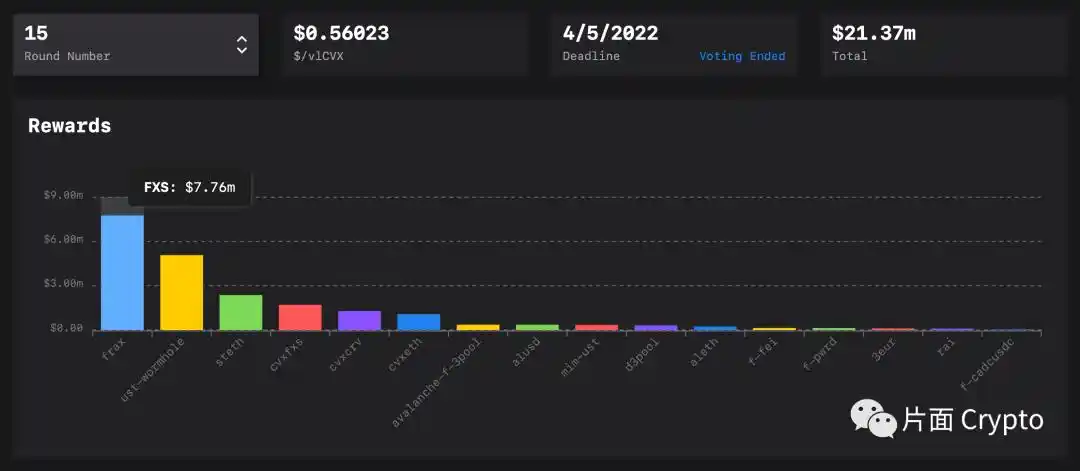
Similarly, There is Votium. Votium is a Sophisticated market built on Convent, and it is the main Convent market at present. After the CVX pledge, the user gets the vlCVX certificate, which can be used to vote. If users don't want to vote on their own, they can also delegate vlCVX to Votium so that Votium can solve these problems in a one-stop shop. In this sense, Votium is in competition with Redacted.
Source: llama.airforce
Votium votes are held every two weeks. In a recent poll, an outside agreement cost $21.37 million. The average price of a single vote (that is, the cost of buying a two-week vote on vlCVX) is $0.56. Frax and Terra spend the most, at $7.76m and $5.07m respectively.
The above two aspects are "Redacted" from the perspective of Curve and "OHM". Replace OHM's underlying payoff logic with Bribe payoff. The similar understanding method is like FloorDAO, which also uses OHM Bonding mechanism, and the bottom income is to provide liquidity for NFT assets to obtain income.
The essence of Curve War is to compete for higher liquidity. From the perspective of external protocol, ordinary users' participation in Convex must have a higher benefit than the direct Stake on Curve.
In addition, the yield of Curve is not only determined by the amount of votes, but also the TVL of the pool itself. The higher the pool's TVL, the higher the rewards.
Some time ago, Terra launched 4Pool, which is aimed at 3pool, and may be the main battlefield for liquidity competition in the future. If we spend a lot of money to grab part of the liquidity of 3Pool, it is not impossible to even surpass it. I wonder if DAI will fight back and also put up money to buy voting rights and reward 3Pool.
In addition, about 10 hours before the writing of this article, Do Kwon said on Twitter that once Terra's own Bridge was completed, Curve would not be used in the future, which would be a great negative for Curve and Convex.
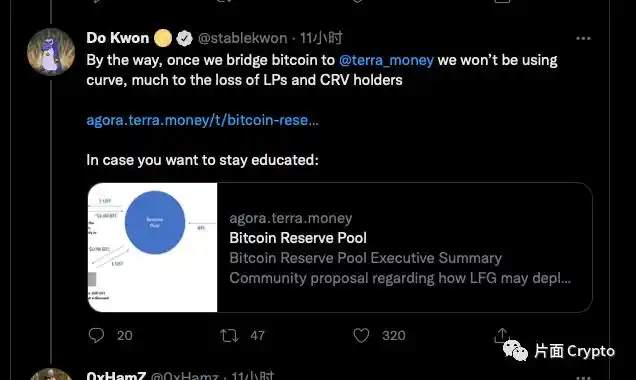
Is It a Big Thing? If so, how will the current competitive landscape for these projects change in the future? From Curve to Redacted, or even to the next agreement that commands Redacted, is there any sense in going from "Curve" to "Redacted"?
In crypto, don't under-estimate everything.
In crypto, don't over-estimate everything.
A simple explanation of the various letters:
Native Token of crV-Curve
VeCRV -- The certificate after Curve lock, which has the right of income and governance
Cvx-convex platform native Token
CvxCRV - The credentials obtained by the user after the CRV has been pledged to Convex. In fact, the CRV pledge is changed to a veCRV, but the credentials given to the user are cvxCRV
VlCVX - Token obtained after CVX is pledged
The original Token of Btrfly-Redacted can be obtained by Bonding
XBTRFLY - Token obtained after BTRFLY Stake
Wxbtrfly-wrapped version of xBTRFLY, which can be used as collateral for other agreements
PBTRFLY - Token for teams that can exchange pBTRFLY for BTRFLY at a lower price in the future
Glbtrfly-stake then obtained the certificate of governance right of Hidden Hand
Blbtrfly-stake then gets the revenue voucher of Hidden Hand
3Pool-curve The best-known pools are USDT/USDC/DAI
4Pool - Terra's pool at Curve is planned to go beyond 3Pool: USDC/USDT/UST/FRAX
The original link
Welcome to join the official BlockBeats community:
Telegram Subscription Group: https://t.me/theblockbeats
Telegram Discussion Group: https://t.me/BlockBeats_App
Official Twitter Account: https://twitter.com/BlockBeatsAsia

 Related Articles