What kind of chemical reaction will Web3+ music have?
Original title: "Web 3 Music - An Experimental Innovation to the Traditional Music Industry Chain | 0xResearch"
Original Author: Zixi, 0xRank
1. Traditional music market overview< /h3>
1. The traditional music market is experiencing disappearance and rebirth
In the past 20 years, the size of the entire music market can be described as disappearance and rebirth.
Physical music represented by records, CDs, and albums continues to weaken. %. After 2010, with the continuous development of Web 2, Internet music represented by streaming media has developed rapidly. In 2020, the streaming music market will reach US$13.4 billion, an increase of 3250% compared to 2010.
Although the market size of the entire music market in 2020 is still not as good as that in 2001, we have noticed that Internet music represented by Web 2 streaming media is constantly Giving new life to the scale of the entire music market. With the mature infrastructure of Web 3, the growth of musicians and users, and the problems existing in the traditional music industry chain, we believe that Web 3 music may be another innovation in the music market.

Global music market size
Source: "International Music Market Report: 2021"
2. Global musicians The order of magnitude is around tens of millions, but the income is not satisfactory
From the perspective of creators, the number of musicians in the world should be around Ten million or so.
From the perspective of the global market, according to Spotify CEO Daniel Ek, by the end of 2020, there will be about 8 million musicians on Spotify, and the number of musicians in 2025 will reach 50000000. From the perspective of the Chinese market, both QQ Music and Netease Cloud Music have more than 300,000 musicians. Considering data duplication, there will be tens of millions of musicians worldwide.
The growth of musicians has benefited from the significant reduction in distribution and production thresholds. But in terms of income, the income of most musicians is not satisfactory. The music industry 28 is quite differentiated. Judging from the income of musicians in China in 2020, 75% of musicians have a monthly income of less than 8,000 yuan. In addition, most long-tail musicians' music income is just side money.

2019 Comparison of monthly income of musicians in 2020 and 2020

Comparison of music income of musicians to total income

The number of clicks an artist needs to earn a minimum
Stuff Source: "China Music Market Report: 2020", Euterpe White Paper
3. Global paid music streaming users have exceeded 400 million< /h4>
From the perspective of users, as of 2020, the number of paid music streaming media users in the world has reached 443 million. In the past 10 years, international streaming media paying users have shown rapid growth. From a domestic perspective, the number of people paying for QQ Music alone has reached 71.2 million in 2021Q3, and the payment rate has reached 11.2%. In addition, music users also include record consumers, concert consumers, music-related peripheral consumers, etc. The overall potential music consumer number and penetration rate are expected to maintain rapid growth.

2010-2020 World Stream Media Paying Number

2019-2021 QQ Music Paying Numbers
4. The complex industry chain of traditional music tracks is the core factor leading to the low royalties of musicians
The industrial chain of the entire traditional music track is too complicated, which is the core factor leading to the current low royalty income of musicians. The upper reaches of the entire music industry chain are mainly music producers represented by lyricists, composers, and singers. Jay Chou, Fang Wenshan, etc. are well-known to everyone. The middle reaches are mainly record distribution companies, mainly the world's four major record distribution companies represented by Sony, Universal, EMI and Warner. The downstream is mainly all kinds of consumers and various agents, such as QQ Music, NetEase Cloud and listening users.
In the current distribution of royalties based on streaming music over the Internet, musicians receive less income. The current practice of streaming media playback platforms is that 42% of the royalties of a song are distributed to record companies (such as Sony, Universal, etc.), about 30% are distributed to operating systems (such as Android, IOS, etc.), and about 20% are distributed to the Internet. Playing platforms (such as QQ Music, NetEase Cloud), lyrics and songwriters can share a total of 8%, and singers are mostly settled by record companies. If the lyrics and music are represented by multiple layers, the royalties will also be divided layer by layer, and there will be less in the hands of the author.

Traditional music distribution industry chain
5. Traditional musicians have less copyright distribution, and there are delayed income and opaque distribution
In addition to less copyright distribution, musicians also have delayed income and opaque distribution of copyright. Record companies, publishers, etc. usually publish information on copyright royalties on a quarterly basis, but the real income in the hands of musicians often needs to be deferred for one or two years.
Current users only need to click the mouse to download related music on the streaming media platform, but countless middlemen need one or two years to distribute the royalties distributed to copyright holders.
On the one hand, this is due to the fact that the laws of the copyright industry are quite complicated, and secondly, due to the large number of industrial chains and middlemen. Secondly, according to the Rethink Music report, 20%-50% of the copyright revenue will not go to the legal copyright owner, but will be embezzled and devoured in various opaque processes.

Music copyright involves all parties
Source: RETHINK MUSIC, FAIR MUSIC:TRANSPARENCY AND PAYMENT FLOWS IN THE MUSIC INDUSTRY 26 (2015).
II. Web3 What problems does music solve
1. The essence of Web3 music is to reshape the industry chain
The essence of Web 3 music is to reshape the industry chain. Compared with the extremely complicated industrial chain of traditional music described above, the Web3 music project reshape the industrial chain and simplifies it to: musicians directly cast music into NFT through creative projects or MusicFi / NFT Marketplace and submit it to downstream consumers hands.
By reshaping the industrial chain, the main benefits are:
1. Reduce complicated intermediary fees. As described above, on streaming media platforms, musicians can only get about 8% of copyright income, and the remaining 92% is exploited layer by layer by record companies, operating systems, and streaming media platforms. The most direct benefit of simplifying the industrial chain for musicians is to obtain higher income to support them and lead a better life.
2. Make royalty income more transparent and timely. As mentioned above, in the traditional music market, copyright fees are delayed for one or two years, and the distribution process is extremely opaque, and most long-tail musicians have low bargaining power, so they can only suffer in silence. Phenomenon. By casting music on the chain into NFT, the royalties obtained by playing the works can be transparently and instantly fed back to the musicians. However, how to truly and fairly transfer the income obtained from music works off-chain to the chain is a problem that needs to be solved.
3. Fans can share the benefits of musicians' growth. Musicians who are optimistic about fans, after purchasing NFT in the early stage, can enjoy the royalties on the one hand, and enjoy the premium of NFT’s rising value on the other hand. The potential benefits of both are beneficial for Web 3 users (especially NFT enthusiasts) to continue to purchase musicians' NFT products.
4. Fundraising is more convenient. Taking the U.S. market as an example, the traditional artist/musician’s publicity + marketing costs range from $500,000 to $2 million. This is a high cost for small, medium and independent musicians, but through the issuance of the NFT primary market, artists can easily raise hundreds of thousands of ETH through white paper + community operation + personal influence to fund the completion of the work, and then continue to let the work Appreciate giving back to the community.

Investment required for new artists in the US market
2. Web3 music cannot solve the problem of low income of long-tail musicians
Although it is mentioned above that web 3 music can reshape the industrial chain, it cannot solve the problem of low income of most musicians. From the perspective of the supply side, after the 21st century, the cost of distributing music has become lower and lower, so a large number of online musicians have sprung up, intensifying market competition. From the demand side, users have limited entertainment time, and now they have to compete with applications such as short videos such as Tiktok + long videos such as Bilibili to compete for customer time.
Secondly, the number of Web 3 users is relatively small, plus the differences in languages and styles in different countries, the number of people who are willing to listen to music on the Web 3 music platform is Very few. Therefore, for most long-tail musicians, their published music works are likely to become zombie works, so it is a fact that they earn less. Web 3 music just reshapes the industrial chain, making the industrial chain more transparent and efficient, and assisting musicians to become richer, rather than allowing musicians to cut leeks.

Most Web3 music plays very low
3. The sub-tracks are mainly divided into streaming media playback, transactions, royalties and creation, etc.
At present, the main sub-tracks in the entire Web 3 music track are divided into streaming media playback platform, NFT trading platform, royalty platform and creation platform. The imagination space of these four sub-tracks is relatively large.
The creation platform is upstream of the track, supporting users to create the first-generation music NFT, and to create secondary and multiple creations of the first-generation works. Users can easily create new memes based on JPG, but the music itself is difficult to create, and the second creation is more difficult. The birth of the music creation platform greatly facilitates users' secondary creation, which is more conducive to users' dissemination of community culture and improves the liquidity of music NFT.
The NFT trading platform is the upstream/midstream of the track, mainly for musicians to issue NFT to fans through the primary market and to trade between fans in the secondary market A platform for NFTs.
The streaming media playback platform is the downstream of the track, similar to QQ Music and Netease Cloud Music, it is the music playback platform of Web 3, and it is the music player's expansion One of the core platforms of community influence, its development logic is exactly the same as that of Web 2 streaming media playback platform.
On the basis of realizing NFT royalties, the royalty platform usually also has DeFi functions. Web 3's music royalty platform serves musicians and fans, and the purpose of its birth is to solve the problems of opaque and deferred royalties.
Different sub-track divisions of Web3 music at present
3. Project Mapping
1. List of track star projects

2.Audius: currently the largest Web3 streaming music playback platform
Audius is currently the largest Web3 streaming Media music playback platform. Audius adopts the method of Web 2 mailbox registration + Web 3 wallet login, which is friendly enough to traditional Internet users and avoids the relatively large threshold for wallet login. As a music platform, the entry of top music stars will bring huge traffic to the platform. Audius is trying to attract musicians through Token rewards.
In the early days, the platform absorbed some musicians as consultants or creators to issue a large number of airdrops. In the airdrop in October 2020, each person received an average of 500 10,000 tokens (currently worth 3.5 million U.S. dollars) to encourage big Vs to create works and give back to the platform.
Secondly, Audius also releases an incentive plan to attract long-tail musicians. The creators of popular playlists can also get 100 tokens.
The vast majority of Audius users today are probably Web 2 users, not crypto users. Judging from the current Token holding addresses, the recent holding addresses have reached about 24K. Compared with the current users (about 100K daily active users), most users (75%+) are not token holders, but Web 2 Indigenous residents or users interested in crypto/music.
Similarly, it can be seen from the community atmosphere that there is a channel in Discord that is only open to token holders, while in other channels, discussions are prohibited Most of the currency prices are discussing music creation itself.

Token unique holding address

Audius daily active users
3 .Audius: Token empowerment is acceptable, and the economic model needs to be improved
Overall, token empowerment is acceptable, and Token The main functions are:
Pledging to participate in node operation. Audius' music files are stored on IPFS. The nodes are divided into content nodes, which are mainly responsible for storing user data, images, and audio files, etc.; and search nodes, which are responsible for searching playlists, users, etc. Among them, becoming a content node requires a pledge of 200,000-10 million tokens, and becoming a search node requires a pledge of 200,000-7 million tokens, and the overall cost is relatively high (retail investors can choose proxy pledges)
Community Governance
Mining
< /p>
Participate in the platform economy. However, the overall platform economic model is weak, tokens are only used as rewards, and the amount of rewards is not large. In addition, since the platform has no income plan for the time being, there is no way to adopt the model of pledging income.
Audius is good and bad. The advantage is that it strives to move closer to decentralization, allowing users to upload works without review, and adopts the Web 2 mailbox + Web 3 wallet login method. The open API can call songs, etc. to external apps. The disadvantages are also obvious. Since music can be uploaded without review, it may be suspected of infringement and content security issues. Secondly, music on Audius cannot be copyrighted, and there is no clear creator income plan. All in all, Audius still needs to improve the economic model now.

Audius Future Circulation

Audius Price Change
4. Pianity: Music NFT trading platform built on Arweave
Pianity is a MusicFi NFT trading platform built on Arweave, which mainly involves the primary market sale of NFT. Pianity does not currently support users selling related NFT products to each other, but will open a secondary market in March, where musicians can receive 8% royalties. NFTs on Pianity are divided into four tiers, each with a different number, and the number of releases and prices depend on the musician. At present, Pianity's music NFT cannot enjoy copyright dividends.
At present, Pianity has a token PIA that is circulated on the platform, which has not yet been issued, and the price is always 0.1 US dollars. Users can purchase NFT on the platform through ETH, USDC, etc., and then the official will regularly divide the total value of personal NFT by the total value of user NFT on the platform to distribute PIAToken dividends.
PIAToken is mainly used to purchase NFT, and the project party will often issue activities such as purchasing NFT with PIA and then returning it. At present, there is little information, and the platform economic model is acceptable, and the project party needs to gradually improve the relevant information.

Pianity's transaction volume since its launch
5.Sound.xyz: Greatly improved the income of musicians Level
Sound.xyz focuses on the first release platform for the works of Web 3 musicians. Sound.xyz currently only supports primary market transactions, and the purchased NFT can only go to Opensea and other secondary market transactions, and the current MusicFi NFT liquidity is insufficient, and the transaction volume in the market is relatively small. In addition, the highlight of Sound.xyz is that after users purchase NFT, they can post public comments to let the public know their thoughts on the work and enhance the interaction between artists and musicians.
Sound.xyz has drastically improved the income levels of musicians. According to the sales of Sound.xyz in the past 30 days, among the 69 musicians, more than 54 musicians have a monthly income higher than the US minimum income of 1,400 US dollars, and more than half of the musicians have a 30-day income of more than 6,000 US dollars, and many music Ren did not release any new works this month, and his monthly income from royalties has already reached more than 3ETH. Compared with traditional streaming music platforms, Sound.xyz has indeed greatly improved the income level of musicians.
However, Sound.xyz adopts an invitation system for musicians to settle in, so some of the musicians settled in can be considered as new stars or outstanding players in the industry, and do not have the right to Universality of income improvements for all musicians.

Sound.xyz music review

More than 54 musicians earn more than the minimum monthly income in the United States
6. Opulous: Royalty Platform, MusicNFT+DeFi
Opulous features a royalty platform and Music NFT+DeFi. Opulous' main business is music NFT primary distribution + secondary market + royalties + DeFi. After the user owns the NFT, the musician will automatically receive the royalties of the music, which is a business that other music trading platforms have not yet set foot in.
The second highlight of Opulous is its DeFi loan, that is, musicians can use the 1-year royalties of future projects as collateral to borrow assets from the platform. In addition, the platform also supports the use of stable royalty music NFT for collateral to obtain corresponding loans. This DeFi product has greatly enhanced the liquidity and application of the head music NFT, and began to build an application-level music NFT Lego.
The overall empowerment of $OPUL is acceptable. The main functions of OPUL are: 1. On-platform trading & Mint’s settlement token 2. Staking 3. Liquidity mining 4. Governance, etc. Overall, token empowerment is acceptable, and the pledge function has not yet been launched. After the launch of the staking function in Q2 to share the platform's revenue, the value of the token will rebound to a certain extent.

Opulous Economic Model
< br>
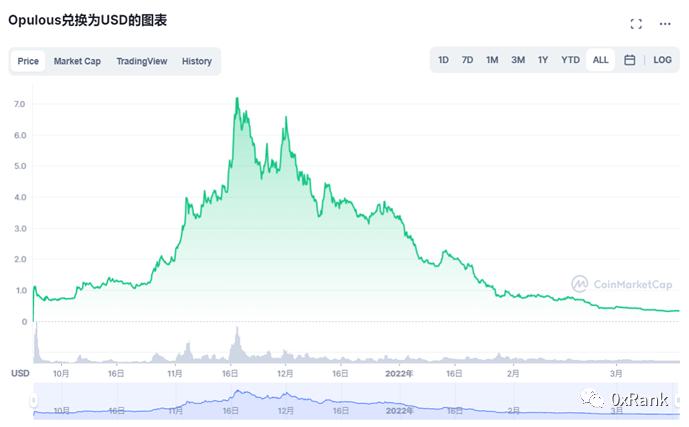
OPUL currently has low empowerment and weaker prices
7. Melos: Support secondary creation, stimulate the development of MusicNFT Lego
Melos is different from other Music NFT exchanges in the market, its focus is streaming music creation. Its trading part is the same as the exchange model on the market, listening to music is free, but holding NFT does not enjoy additional benefits such as royalties.
The exciting part is its creation and secondary creation. Users can upload a piece of music/or create a piece of music with electric steel to generate the first generation of NFT (New Forge).
Then the user can recreate the music NFT to generate a new offspring NFT (Jam Forge). The Musicblock on the chain records the relevant DNA and GEN generation of each NFT. DNA includes author, creation, traceability, etc., and Gen represents generation level. Melos stimulated the development of music NFT Lego to a large extent, and ensured the process of confirming the right of use through on-chain traceability.

Melos music creation interface

The current trading volume is increasing rapidly and liquidity is increasing
MelosToken is better empowered, and the future will follow The rising prosperity of music NFT has helped the price rise.
1. 50% of the transaction fees obtained from the Melos music NFT market will be used to purchase Melos and destroyed, and the remaining 50% will be allocated to the treasury.
2. Users can purchase NFT minted by other users in the creation room, and then pledge the NFT as a node, and pledge a certain token in the node to Get extra rewards. The node rewards for staking NFT and the additional rewards for staking tokens will be distributed daily according to the staking situation of the entire platform.
3. 20% of the above tokens in the pledge pool will be put into Uniswap to provide liquidity.
4. Currency holders will be regularly allocated to the exchange's handling fee dividends.
5. Users who cast music NFT will get certain token rewards.
6. KOL and community contributors will be rewarded with tokens.

Melos Economic System Overview
4. Review from DeFi to SocialFi
1.Where is the Web3 music road: From the perspective of DeFi and GameFi
Web 3 music has 4 sub-tracks +Music NFT has a total of five tracks. Let's think carefully, how will Web 3 music NFT develop?
Before analyzing this issue, let's take a look at the success/failure experience of the mature application layer tracks DeFi, GameFi and some mature SocialFi.
After experiencing the summer of DeFi in 2020, DeFi began to explode on a large scale. The core reason why DeFi did not explode before 2020 is:
1. How to find initial users and start-up funds
< /p>
2. CEX's listing fee is high, and after listing, the price and liquidity will increase to a higher level. The real solution to the above problems is liquidity mining. Liquidity mining continues to expand through the snowball of "Token rises - APR rises - more users buy tokens after seeing the APR rise - Token continues to rise", but collapses in the middle logic chain (Usually there are fewer users entering the market, selling pressure> entering the market), and stepping on the right foot with the left foot will become a death spiral of stepping on the left foot with the right foot
2021 is GameFi Fall. The core factor of the GameFi outbreak is that users from the third world have reduced income due to the epidemic, and they need to obtain income subsidies for their families. At this time, Axie happens to provide such users with the opportunity to make gold.
After Axie's revenue surpassed that of Honor of Kings in July 2021, GameFi has completely moved into the world of encrypted users. The Ponzi color of GameFi is stronger, and the growth logic adopted is similar to stepping on the right foot with the left foot. "Users enter the market--Token rises--gold earning rises--attract new users to accept tokens and NFTs enter--Token keep going up".
But with the collapse of Cryptomines, which accounted for 1/4 of BSC's daily trading volume, GameFi 1.0 has gradually come to an end, and the remaining old GameFi is still lingering. Different from DeFi, which actually solves the financial needs of users, GameFi1.0 represented by Axie is more of a special product born under the bull market and the Fomo sentiment. It is a PPT product made to cater to the APR addiction of Web3 users. Most of the GameFi that still exists are platform + metaverse games with grand narratives.
2.Where is the Web3 music road: From the perspective of SocialFi, which has the same purpose
The logic of SocialFi is different from that of DeFi and GameFi, but it is similar to that of MusicFi. It is based on the love generation of big V/musicians to purchase related fan Token/NFT . The logic of SocialFi is simplified to - if a big V wants to realize his social capital (obtain token), then he needs to spend time and money to prove the value of his social capital (POW proof of work). Similar to the logic of BTC/ETH, this also shows that the blockchain-based Web 3 is very suitable for the development of SocialFi.
The essence of SocialFi can be understood as a big V (or an individual) using their own influence to create their own social network based on blockchain technology. Capital (that is, personal brand reputation), on the other hand, seek benefits for his fans.
But it is precisely because of the above logic that SocialFi also has a big problem now:
3. For social platforms and Token distribution platforms, the empowerment of platform Token value is more important.
4. Fewer users. At present, SocialFi still needs a long way to go to develop. Its track scale is still small, its mechanism is relatively primitive, and there are few aborigines of Web3. There are very few SocialFi users who are willing to use products with poor experience.

Review of the entire encryption track
Five. Summary
Based on the above analysis, there are 4 sub-tracks of Web 3 music + music NFT itself has a total of 5 tracks. The more deterministic track may be Platforms for royalties, streaming, creation, and more. For music NFT, its role lies in listening, collection, support for idols, and distribution of royalties.
Aside from the music NFTs with royalty distribution released by top musicians, most music NFTs will have weaker display scenes and show-off attributes than JPG NFTs. However, after top musicians release royalty-bearing NFTs and users earn a lot of profits, the music NFT track will usher in an explosion.
The imagination of the entire Web 3 music track is relatively strong. Streaming media and creative platforms can cooperate with major well-known musicians on the IP side, use token incentives to achieve Listen to earn and Create to earn, and become the Spotify or QQ Music of Web 3.
The birth of the royalty platform is to solve the complexity in the traditional music industry chain, to provide musicians with better tools, and to solve the problem of low royalty distribution in the industry chain , deferred, and opaque phenomena. The music NFT trading platform is limited by the fact that music NFT itself is weaker than JPG NFT, and that Opensea will continue to dominate in the short term, so the development path may be relatively unclear.
The problem with the whole track still exists:
2. From the perspective of IP, there is a lack of leading stars such as Taylor Swift and Jay Chou, and the current Web 3 musicians are relatively long-tailed.
3. From the perspective of the project side, the economic models of many project parties are not perfect enough, the empowerment of tokens is weak, and the whole project is more like " I created this environment, so users want this demand." Music projects with a strong social nature are similar to SocialFi. When SocialFi’s project Token is poorly empowered and adopts content mining to start a cold start, the consequence is that users start to create unlimited spam content, and enter the death spiral of mining, withdrawing and selling. Therefore, when the music project starts Listen to earn and Create to earn, if the token value is not given, the death spiral will also be the final result.
When we look at projects, it is difficult for us to judge the number of users in the crypto world, but we can:
1. Whether the project party can have a star IP. Without star IP, the cold start effect of many long-tail musicians alone will be very bad (that is, the NFT transaction volume will be very low)
2. The project party is in Do you understand Web 3 when you have a star IP? If you apply the music model of Web 2 mechanically to Web 3, there is a high probability of failure.
3. Whether the economic model of the project party is reasonable. At present, the economic models of most projects are not particularly brilliant. The empowerment of Token is not only pledge, but also governance or mining. Few of them can achieve transaction payment or are very popular. The outstanding part can be transaction payment, some tokens required for listening to songs, platform profit sharing, various rewards, etc.
Welcome to join the official BlockBeats community:
Telegram Subscription Group: https://t.me/theblockbeats
Telegram Discussion Group: https://t.me/BlockBeats_App
Official Twitter Account: https://twitter.com/BlockBeatsAsia
 Related Articles