Web3 Music Track: Market Context, Business Value, breakout path, and Investment opportunities
Web3 Music Track: Market Context, Business Value, Breakout Path, and Investment Opportunities
原文来源: 许潇鹏; 黄敏强;Mint Ventures
Point of view in this paper,
· Music is a global market with an annual revenue of $20 billion, and the dominant power of the industry is gradually shifting from copyrighted record companies to online music platforms
· Web3 和音乐 NFT 中短期仍无法解决音乐人收入低的整体问题,其意义在于提供音乐产业价值分配的革新方案,为后续的音乐产业升级做好技术、商业和理念上的准备
· Web3 音乐产业暂时不具备类似于 DeFi 这样的爆发条件,还需要期待用户基数、社区理念上成熟,但技术准备已经比较成熟
· 音乐类 NFT 较难复现头像类 NFT 的火热,Web3 音乐项目的爆发路径可以参考 DeFi 的业务飞轮模式
The body of the
This track insight focuses on the Web3 music track.
Since the DeFi track broke out in 2020, crypto commerce has gained its first audience beyond investors: financial customers. With the popularity of THE CONCEPT of NFT in 2021, the wave of Web3 applications began to spread to the field beyond finance, and the boom of NFT collections and the summer of chain games took place one after another. With the DeFi app "commercializing proof" and NFT collections and linked games expanding the crypto population, the "Creator economy" will end 2021 with a new wave of Web3 storytelling.
And Web3 music is just a subdivision track in "creator economy". In addition, music, as an important category of NFT collection, can also be classified as a key category under the TIDE of NFT.
From the perspective of Web3 business, music circuit has a huge bilateral market: Creators & AMP; Consumer; From the technical point of view, NFT, L1+ blockchain data storage (Arweave, Filecoin) and other technologies are gradually mature; At the narrative level, the music track has the dual blessing of NFT collection + creator economy.
2021 is arguably the first year of the Web3 music track. Will 2022 be its year of opportunity?
In this article, we consider and try to answer the following questions:
· Web3 音乐赛道所对应的音乐市场大背景是怎么样的?
· 如何定义 Web3 音乐项目?它和音乐类 NFT 解决了现有音乐产业的什么问题?
· Web3 音乐项目的爆发需要具备哪些前提条件?
· Web3 音乐赛道会以什么样的方式爆发?
· 如何捕捉其中的投资机会
Section 1 Status quo and business model of music industry
1.1. Participants and industry changes in the music industry
Music is a huge industry, with IP and user bases as big as social and games. On the supply side are musicians or record labels, entertainment or management groups that have signed a large number of musicians. On the demand side, there are consumers of music, both ordinary music lovers and ardent fans or fans.
Music has a long history of business development. Its transmission media include live band performances, phonograph, radio, TELEVISION, digital media such as vinyl records, tapes, CDS, MP3, and now streaming media music platform. Every change of music communication media will bring changes in the industrial form.
Record companies used to have the most say in the industry, controlling the discovery and packaging of artists, the production and promotion of music, the distribution of albums and the running of concerts, and so on. They also accounted for the lion's share of royalties. In addition, record companies also own a lot of quality music rights. However, with the emergence of the Internet, the advantages of music production and publicity that record companies once firmly controlled are no longer obvious, and music promotion channels are moving from centralized media to social media. The maturity of digital technology has reduced the cost of music creation, and more and more people have taken to the road of music creation, making and releasing their own music with a faster tempo and shorter path.
Online music platforms have become a new intermediary between listeners and musicians. Not only do they promote, distribute, recommend and settle their revenues, they are also moving upstream, nurturing new and original musicians, and the number of artists signing on to music platforms is increasing. The explosion of new original music, on the one hand, satisfies the changing music taste and the desire for new content of music consumers in the Z era, on the other hand, it also provides online music platform with a bargaining chip to compete with traditional record companies in copyright.
After sorting out the current environment of the music industry, we need to consider an important question before we start the specific market analysis: what kind of product is music in this era? All business logic rests on this question, all industrial structures are laid out on this question.
Zhong Wen, the author of the public account "Pin-play", once gave a classic description of this:
"... what kind of scene, what kind of form, either in the music of the core attributes will not change, music is our empathy with the world of a way to transcend time and space is a kind of language and culture. Maybe this is the most "sexy" it is the music industry. At any time, any civilization, we all need to music, also will be similar to the rhythm of moving." -- Taste: "Online music paying users exceed 71 million, TME Drives flywheel of music Industry"
As a kind of spiritual consumer goods that "empathizes with the world", music has a stronger property of repeated consumption than books, movies and TV series. Even the most passionate of novelty listeners will have cherished music on their players that has been played hundreds of times. Once people find a favorite song, the engagement is tens of times greater than other content products.
Here's a preliminary summary of the music industry:
· Major participants in the music industry include musicians (songwriters, singers, etc.), record companies, music platforms and music consumers
· 互联网音乐平台已经取代传统唱片公司成为这个产业的新巨头,其掌握了音乐的宣传、发行、结算等核心环节,并正在向内容上游拓展,直接培育音乐人和制作原创音乐
·
音乐的商业本质在于为听众提供了与世界共情的方式,它也是重复消费率最高、最具黏性的内容产品
1.2. Market size of music track
Next, we will observe the current size of the music market from three dimensions: market revenue, consumers and musicians.
1.2.1. Income scale
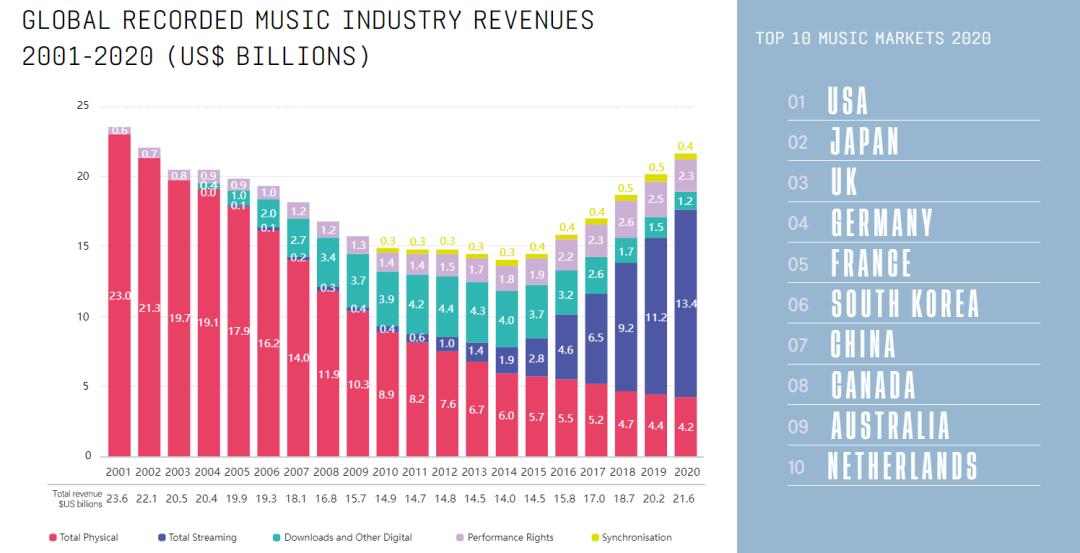
According to the annual report released by the International Federation of the Phonographic Industry (IPFI) in 2021, the total revenue of the global recorded music market in 2020 was 21.6 billion DOLLARS. It has been in positive territory for six consecutive years since bottoming out in 2014 ($14 billion), but has yet to surpass its 2001 high.
Data sources: the international music market report: 2021 https://gmr2021.ifpi.org/report
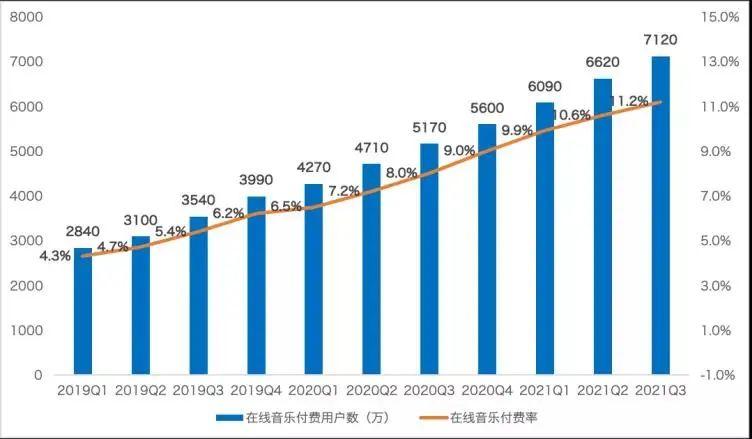
The United States, Japan, The United Kingdom, Germany and France ranked among the top five music consumers, and China ranked seventh, just behind Korea. While China has the world's largest Internet population, its share of paying users for music is much lower than in the West. According to the financial report of the third quarter of 2021 disclosed by Tencent music entertainment group (TME), which ranks TOP1 in the number of users and revenue in China, its paid online music users reached 71.2 million, accounting for 11.2%. Users' Arpu (monthly payment per user) for the first three quarters of 2021 is 8.9 YUAN (RMB).
Source: TME 2021 Q2 earnings report
According to the second quarter of 2021, Spotify, the overseas giant of online music, has 365 million monthly active users and 165 million paid subscribers, accounting for 45.2%. The user payment rate is about four times that of Tencent Music, and its Arpu value is 5.02 DOLLARS.
In terms of music revenue sources, online music revenue accounts for 62% of the total global music revenue, with a year-on-year growth of 19.9%, while other sources include physical sales (physical albums, etc.), download and other digital revenue, performance and related copyright, and music licensing revenue. All of these fell month-on-month in 2020 (affected by the pandemic).
According to the above data, we can find that music is a global market of 20 billion dollars. Online music platforms such as Spotify and Tencent Music, whose products include QQ Music, Kugou and Kuwo, have helped revive the music market, which had been in a slump since 2001. "Online music platforms pay musicians according to the number of plays" has become the most mainstream music business model, namely "streaming media music platform model".
1.2.2. Scale of paying users
According to MIDiA Research, the total number of music streaming subscribers reached 523.9 million in the second quarter of 2021, up 26.4% from the same period in 2020, and Spotify remains the largest platform for subscribers.
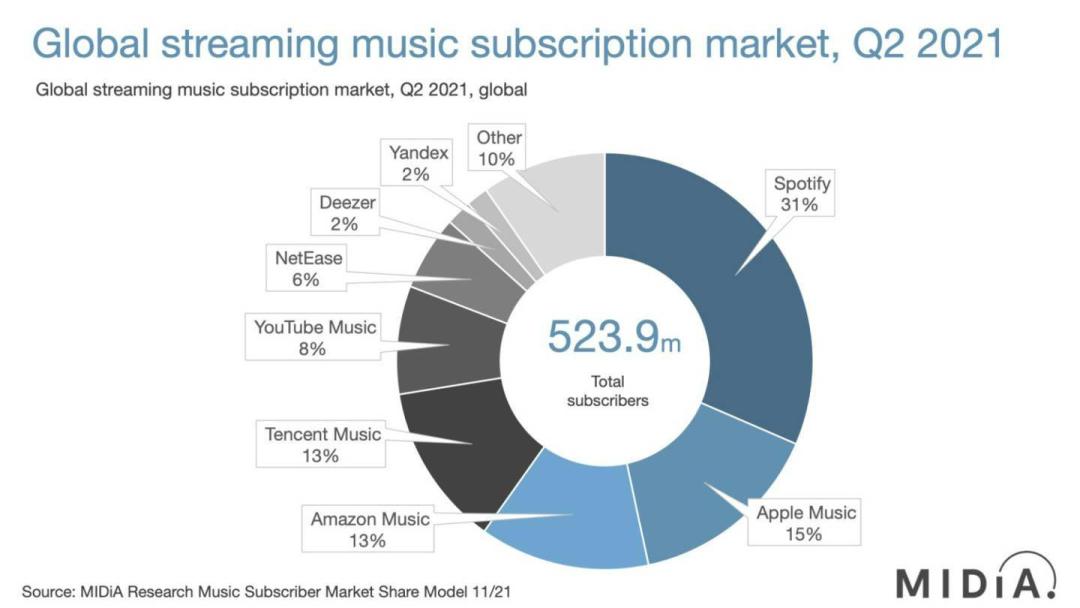
Source: MIDiA Research
Of course, the users of music are not limited to the paying users of online music platforms, but also include physical record consumers, concert audiences, consumers around musicians, and music licensing buyers (such as advertisers). But this segment of users also mostly with streaming music users overlap.
1.2.3. Scale of musicians
At Spotify's "Stream On" investor conference, CEO Daniel Ek said 8 million musicians had joined the service by the end of 2020, and he expects the number to reach 50 million by 2025. In The Chinese market, Tencent Music and NetEase Cloud Music, the two largest online music platforms, both recently disclosed their musician data, and both platforms have more than 300,000 musicians. Combined with the above data, we can conservatively estimate that the total number of musicians in the world should be more than 10 million.
However, while the number of musicians is growing, their music income is not ideal, and only a very small number of musicians are able to make a living from music. As of 2020, only 184,500 creators made more than $1,000 from Spotify, according to Loud&Clear. In terms of China's music market, according to the Report on Chinese Musicians released by Communication University of China in 2021, 51% of musicians earn less than 4,999 RMB per month, while only 9% earn more than 10,000 RMB per month. The figure is a big increase from the previous year. In 2019, the report showed that 49% of musicians earned between 1 and 1,999 yuan, which was not enough to support their living expenses.
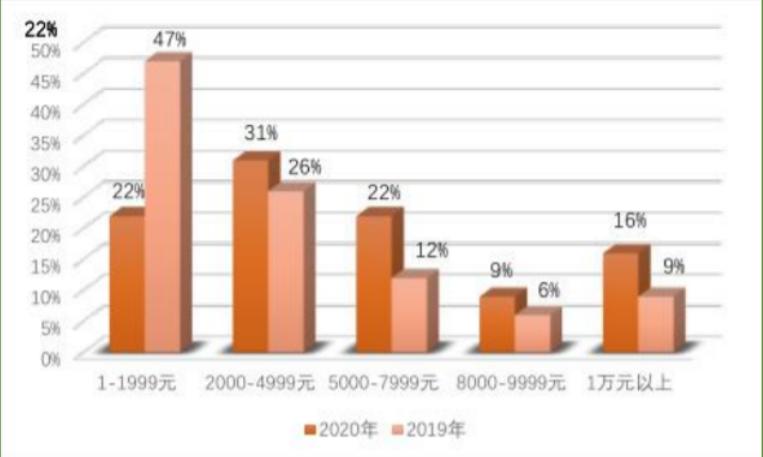
A comparison of the income of Chinese musicians in 2019-2020; Source: Report on Chinese Musicians: 2021, Communication University of China
1.3. Business logic of music market
Copyright is the core business logic of music market, and the complete right of a song can usually be divided into four parts: copyright of lyrics/song, recording copyright and singer performance right. The four parties above enjoy the royalties after the release of the song, while other personnel, such as producers, arrangers and musicians, enjoy the one-time settlement.
Historically, the big record labels were at the heart of producing music, discovering artists, songwriters and professional teams. They also have the strongest right to speak, holding the singers' performance rights and recording rights (master tapes), as well as the Copyrights of lyrics and songs handled by their copyright companies. Music rights are concentrated in the hands of a few big labels, as smaller labels are taken over by the big ones. It also accounts for the lion's share of the industry's revenues, with universal music's parent company Vivendi generating 1.186 billion euros in royalties in 2020 and growing.
Photo: Southern Weekend
However, with the rise of online music platforms, a growing number of original artists with relatively free identities, and powerful IP artists setting up their own studios, musicians are increasingly escaping the control of record labels.
Online music platforms are one of the core sources of copyright income for both original musicians and record companies.
Online music platforms usually settle with copyright holders based on the number of songs played. Take Spotify as an example:
Spotify makes money in two main ways: paid subscription revenue from Spotify and advertising on Spotify's free version. About two-thirds of the money will go to music rights. Spotify divides the royalty pool according to each copyright holder's "share of traffic" on Spotify, but does not pay a fixed fee for "per stream", or volume of streams.
That's because paid subscribers don't pay per stream, but a flat membership fee.
In each country it launches, Spotify adds up the number of music streams from copyright holders each month and divides them by the total number of streams in that market to get traffic share, which divides the music revenue for that region.
For example, if the total number of streams in The Mexican market is 1,000, and an artist has 1 stream in the region, he or she will earn 1/1,000 of the total royalty pool in the Mexican market. The total royalty pool for each country, based on paid subscription revenue and advertising revenue from users in that market.
This means that each musician's income from the online music platform is influenced by three core factors: total revenue from the online music platform, the amount of music played by that musician and the amount of music played by other musicians.
Of course, in addition to the income from streaming platforms, musicians' income sources include: offline/online performances, direct sales or downloads of digital albums, music licensing fees (movies, commercials, variety shows, etc.) and other ancillary sales. But these sectors either have a low or declining share of income.
1.4 summary
Through this chapter, we can summarize the current music industry as follows:
The commercial nature of music is that it provides listeners with a way to empathize with the world. It is also the content product with the highest repeat consumption rate and the highest stickiness
Music is a $20 billion + market, with online music platforms taking the lion's share of revenue and growing fastest
Online music platforms are replacing traditional record labels as the core players in the game, and their control is creeping into the whole process
The core business model of this industry is copyright. Currently, the overall income of musicians is not high, which is determined by the increasingly fierce market competition and the industrial structure dominated by Internet platforms
This is also the context of the market that Web3 music track faces, and it is this context that breeds its value and business logic.
Section two: The value of Web3 music projects
2.1 Define Web3 music track
The so-called Web3 music track refers to the overall music industry chain constructed based on Web3 paradigm, and its characteristics mainly include:
· 核心服务协议基于区块链构建和运行
· 数字音乐资产基于区块链和去中心化储存技术发行和流转
·
在价值分配上具有去中介、透明化等特征
·
音乐消费者逐渐向社区用户过度,可能享有更大的权利和共建可能性,甚至直接分享 IP 本身的价值
So, what problems and new opportunities can Web3 music projects and music NFT with the above features solve?
2.2. Problems Web3 music project tries to solve
2.2.1.Web3 cannot solve the overall income problem of musicians in the short term
When it comes to the value of Web3 music track, or music NFT, we often hear that musicians can use NFT as a music carrier to sell directly to their fans, avoiding layers of exploitation by record companies and online music platforms, so as to increase the income of musicians.
However, the author believes that the Web3 music wave does not mean that the income of musicians as a whole can be improved in the short term. In the short term, it just provides them with more transparent and diversified channels and value distribution tools.
Music is subject to the same laws of supply and demand as any other commodity, and while the marginal cost of digital music is close to zero, the reality is that consumers' attention is limited, and the world's population's "total time spent consuming content" is limited.
That is to say, on the supply side: the number of new music works has increased rapidly as the cost of producing music in the digital era has fallen rapidly, making it possible for ordinary people to create and distribute music. Demand: There is a clear ceiling on the amount of time the population spends on content, and this time is also being contested across sectors such as video games, online video, and social tools.
In this case, the unlimited supply of music works is faced with increasingly scarce entertainment time and attention, and most music becomes "zombie works" with few clicks and no attention, which is the inevitable fate under the cruel market competition. The NFT of Web3 and the music medium does not change this fact, just as DeFi can create a more equal, open and innovative financial environment, but does not make all users rich.
2.2.2. Value of Web music and NFT: Reshaping value distribution and future music service infrastructure
So what are the positive changes brought to the music industry by the introduction of Web3 and NFT?
In the author's opinion, there are mainly the following two items:
·
基于区块链和智能合约,可以为音乐人、用户和其他产业方提供更为透明、自动化、高效的价值分配系统
·
相对于仅有「听歌价值」的传统数字音乐,基于 NFT 发行的音乐作品,具有可编程、可溯源、可组合、可交易的新属性,以此可以衍生出目前难以想象的全新音乐服务模式和场景
To put it simply: to reshape the value distribution of the music industry, endows music with new value connotation beyond listening to music, and prepares for the next upgrade of the music industry technologically, commercially and ideologically.
2.2.2.1. Remodel value distribution
The so-called "remolding value distribution" mainly refers to:
·
提高收益分配的透明度和便利性,提高信息的对称性
·
为音乐人提供中介更少,链路更短的音乐发行渠道和基于交易的新型版税方案
·
可以将用户也纳入价值分配的体系中
To be specific:
A. Improve the transparency and convenience of revenue distribution
In the existing music industry, online royalties on a song can go in several directions. In a 2021 article titled "Ten Years of The Copyright War: Has Music Gotten better as Prices Have Risen nearly a thousandfold? According to the report, Wu Xiangfei, the lyricist, said:
"In music streaming platforms, 42% of a song's revenue is distributed to record companies, 30% to operating systems (such as Android and iOS), 20% to Internet streaming platforms, 8% to lyrics and song writers, and most artists are paid by record companies." Typically, Internet platforms provide detailed play-data to copyright companies, which in turn provide songwriters with details of their individual play-data and royalty reports, which songwriters find difficult to verify. Because "the cost of rights protection is high and the voice of musicians is low, they can only bear it silently."
Wu xiangfei also said:
"Different copyright companies offer different prices to creators, pricing power is in the hands of the company... The two copyright agencies provide the same song, the same year of royalties 195 times different."
In the face of huge and centralized record companies, music platforms and copyright agents, it is difficult for relatively disadvantaged musicians to peer into and examine the actual income of their music. The music industry running on the block chain can greatly improve the transparency of the entire value distribution process, and the settlement and distribution of music income based on smart contracts can be automatic, efficient and transparent. The transparency and efficiency of the whole industry reduce the rent-seeking ability of intermediaries, which is beneficial to both musicians and users in the long run, and institutions in between have to hand over more interests.
B. Offering distribution channels with fewer intermediaries and shorter links and new royalty schemes
Catalog, Sound.xyz, Nina and other NFT display and sales platforms provide musicians with a brand new distribution channel for their works. Musicians can make their music into NFT through these platforms and sell their music works to a single or multiple music collectors through auction or direct sales. In addition, musicians can set transfer royalties on the NFT and receive a percentage of the resale amount each time the NFT is resold.
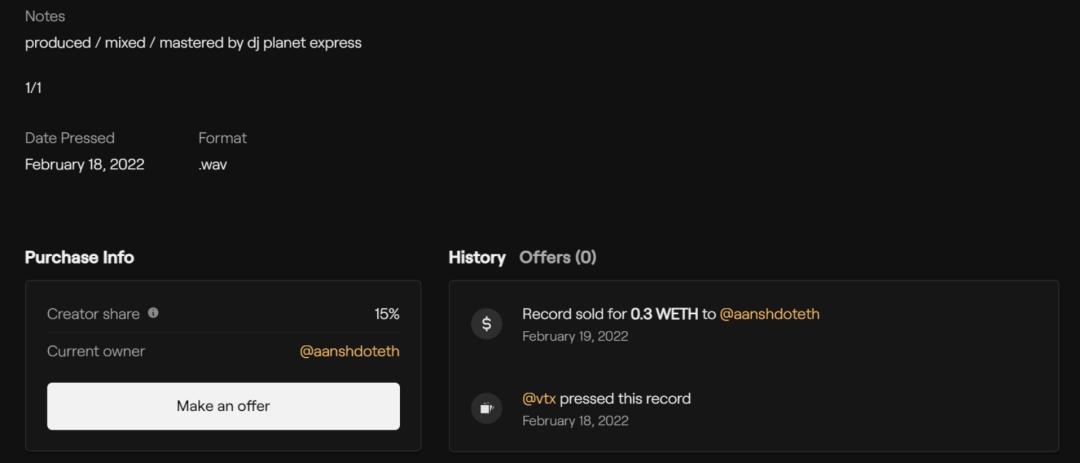
The NFT details of the music on the Catalog show the current owner, distribution price, resale royalty rate, etc
C. Users can also be included in the value distribution network
Traditional digital music copy and audio stream can only be used for playback, belonging to a right of use, while NFT form of music represents a kind of ownership, and even the ownership can be directly linked to the copyright of music, so that NFT buyers also participate in and obtain copyright benefits. Royal, the Web3 music platform, is designed in such a way that when users buy an artist's NFT, they get a share of the music's streaming revenue.
Combined with the above points, we can regard Web3 music as an innovation of "production relationship", and NFT is its technical carrier.
2.2.2.2 Activation of new music services and new scenes
In addition to the key role in value distribution Web3 music and NFT longer-term effects may be mediated by NFT music programmable, traceable, composable, tradable new attributes, opens up a brand-new service category does not yet exist and new scene, stimulate broader product and service innovation, and directly improve the industry's output.
Live Nation, for example, recently announced Live Stubs, a program that will give fans a free NFT with their concert ticket. Live Nation CEO Michael Rapino explains: "Our Live Stubs product evokes the nostalgia of the days when fans collected concert Stubs, while giving musicians a new tool to deepen their relationship with their fans, and we can't wait to see the creativity and future prospects of this community."
While Live Nation hasn't disclosed exactly what the concert's "stub NFT" will be used for, it's reasonable to imagine that the NFT could be used for:
· 访问官方歌迷俱乐部或 DAO 的专属通行证
· 访问该场演唱会的后台特别花絮
· 作为粉丝凭证,接受来自歌手所发行的粉丝代币的空投
· 作为盲盒使用,可以抽取歌手提供的其他权益,比如下一场演唱会的前排座位、后台访问权限等
Become the fan's identity tag, placed in the identity display bar on the chain
...
In addition, based on the programmability of NFT, musicians can open the use and mixing rights of music NFT, and other musicians can buy the copyright of original music and remix it into new music. Async. Art provides the above services.
We have to admit that the above imagination is still scarce and limited, and the truly great innovation is often beyond our current cognition. Just as fans of classical bands who sat in concert halls a hundred years ago could not have imagined that today we can pay to attend a live stream of a singer's concert, or even attend Justin Bieber's music festival in the metasverse with a virtual ID, It's impossible to predict exactly what new services the Web3 music industry will offer.

On November 18 last year, Justin Bieber performed a "meta-cosmic concert" based on motion capture technology in collaboration with virtual concert company Wave VR.
But we do know this for sure:
· 基于 Web3 的音乐服务类型,一定比现在的 Web2 音乐服务更加丰富、多样和精彩
· 在基于区块链的元宇宙中,NFT 可能才是音乐的主要格式
By then, nFt-based music will not only be used for playback, but also have a variety of functions such as "collection", "identity tag", "production material", "ticket", "financial equity certificate", becoming a "key" for users to unlock rich music services.
To sum up, Web3 music project can provide a new value distribution scheme in the short term, making the value distribution of the music industry more transparent and fair, and gradually transforming consumers into rights holders. In the long run, the new paradigm of Web3 can activate entirely new types of music services, and NFT may be the mainstream music carrier of the future.
However, there are still a lot of prerequisites for Web3 music apps to really catch on.
Section 3 the premise of the rise of Web3 music track
3.1. User scale: User challenges for Web3 music, social and game projects
While the Web3 music circuit has a bright future in the long term, it is important to recognize that Web3 music, social and gaming applications are very different from DeFi, and DeFi's commercial success cannot simply be replicated in these areas.
Block chain and COINS at the beginning of the creation is financial applications, in the hearing the currency design goal is to provide a set of decentralized payment system, even in the earliest COINS and chain block's birth, behind every male chain address is driven by financial motivation users, no matter because they recognize the concept of decentralized financial, or purely speculative purposes.
That's why DeFi apps based on Ethereum smart contracts are being promoted and developed so quickly, because they fit users' financial needs.
We can also glimpse the reality that "user needs in the crypto world are dominated by financial needs" from the development history of the chain game field.
In 2018-19 we saw a wave of chain games, the idea was to "make blockchain-based games", and the wave ended up with a very short life cycle, and the only thing that was impressive was the number of gambling apps and speculative projects like FOMO3D (which fit the speculative nature of financial users).
In 2021, the wave of online games is back, and this wave is far bigger in terms of number of users, participating institutions and duration than in 18-19. Of course, there are many other reasons for this, such as the larger population of cryptography in 2021, DeFi and NFT have cultivated the application habits of users, and the overall market is in a bull market cycle, etc. However, the author believes that the core reason why the chain game project in 21 years is more successful than the earlier stage is its deep embedding of financial design. Or we can say that the essence of this wave of chain travel is not a game, but a gamified financial Ponzi.
In short, in a crypto world dominated by financial users, only financial apps are likely to succeed at the moment, while music, social, and games have a much harder time finding their audience than DeFi.
However, compared with games and social networking, music Web3 projects also have their unique advantages, that is, musicians have a very high mobilization ability for their fan groups. When musicians' IP and encryption projects find a better way to combine, the growth of non-encrypted users can achieve a breakthrough. A good case is the NBA TOP SHOT digital star card co-created by NBA and Flow as a non-encrypted traditional sports IP.
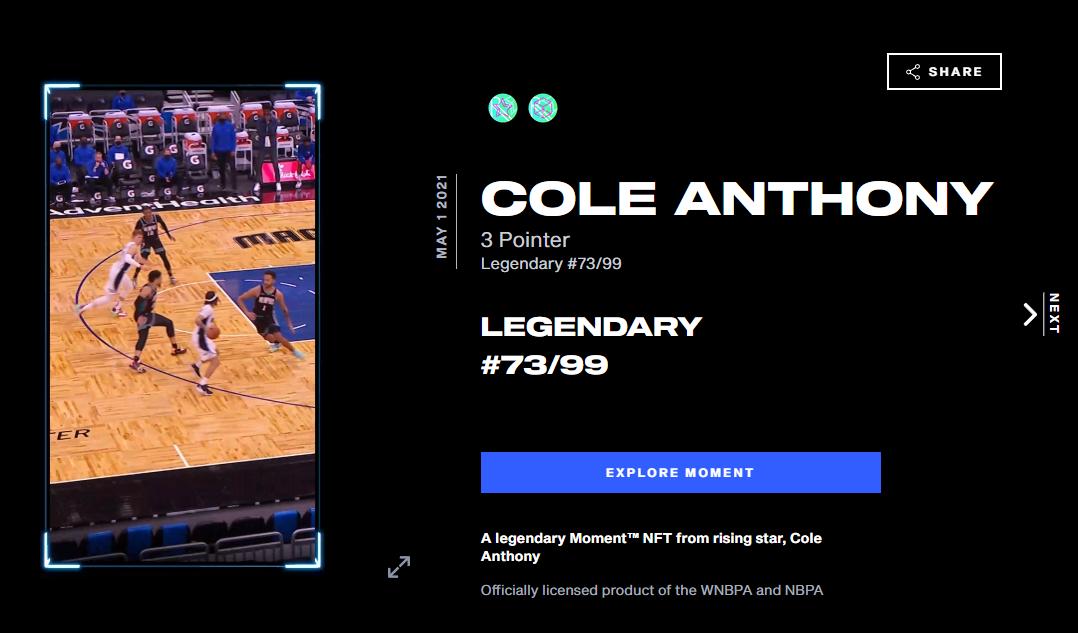
The digital star card on the official website of NBA TOP SHOT, source: https://nbatopshot.com/
The NBA TOP SHOT has been in beta since 2020, but it's been on fire since 2021. According to DappRadar, the NBA TOP SHOT has made more than 14 million deals to date, totaling more than $860 million. The number of transaction users exceeded 520,000. It's worth noting that NBA TOP SHOT's sales were also influenced by IP celebrity, with a 72% month-on-month increase in Sales in December 2021, largely due to its partnership with Kevin Durant and marketing plans.
Web3 music projects also need strong IP promotion, and there have been many music celebrities involved, such as the famous rapper Snoop Dogg, pop diva Whitney Houston, etc., have released digital music based on NFT. And well-known Chinese singer Hu Yanbin has released a digital music collection called Monk with Tencent Music.
In addition to music celebrities, traditional labels have also begun to test the waters in the NFT space, with Universal Music announcing the release of Bored Ape band Kingship in November 2021.
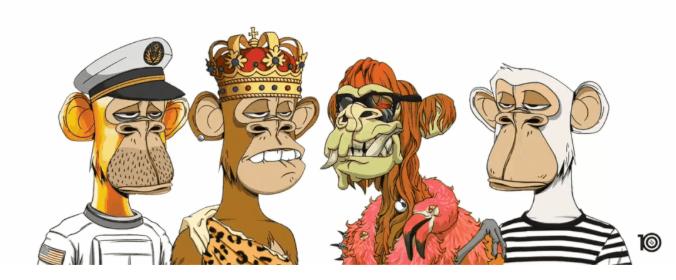
The user base is the biggest challenge for Web3 music products at present. In addition to waiting for the further growth of the population in the encryption world and the richer user groups in addition to welcoming financial investment, active promotion of music celebrities or institutions may be the main source of the rapid increase in the number of users.
3.2. Technical preparation: L1 public chain and distributed storage
Relative to the number of users, Web3 music technology is relatively mature. The size of a song is basically 5-6m, and currently Layer1 public chain + distributed storage AR and IPFS/Filecoin can fully support it. In terms of user experience, there is no obvious difference between It and WEB2 application in playing and listening, but most of the payment links only support encryption asset payment. However, with the rapid promotion of cryptocurrency payment, there are more and more cryptocurrency assets and fiat payment middlemen, and there will be no problem for listeners to directly purchase NFT songs with fiat currency in the future.
3.3. Community Concept: DAO experiment and value redistribution of fan community
In Zero to One, Peter Thiel, a well-known entrepreneur and investor, talks about getting users to cross the threshold of habit and trust and choose a new product that is "10 times better" than the original. Although musicians have every incentive to participate in the Web3 music experiment, for most users, they are unlikely to change their usage habits unless Web3 music products offer features that are not available and hard to replicate in current Web2 products.
In the short term, Web2 products have done a good enough job in the experience of listening to songs, no matter it is rich in music library, audio quality or fast connection. It is difficult for Web3 products to catch up with Web2 music platform in these experiences for the time being.
So do music users care about "owning" their songs, moving from streaming to NFT? Maybe not.
According to a report by the International Federation of the Phonographic Industry (IPFI), in 2020, paid music revenues from online listening grew 19.9 percent year on year, while paid download revenues fell 15.7 percent, a steeper decline than performance revenues, which have been hit hard by the pandemic. It is an inevitable trend that users' music consumption habits will shift from the "owning mode" of downloading to devices to the "access mode" of music platform. Unless, of course, the music NFT itself provides additional value beyond listening, as Kings of Leon did on March 5 last year with a new ALBUM called When You See Yourself. It was also the first band to release an album under NFT. The NFT is a "golden ticket" that guarantees lifetime ACCESS to four front-row seats at any Kings of Leon concert. It also offers a range of rights, including a chauffeur, a concierge, a private pre-show party with the band, exclusive lounge use and a merchandise booth at each show. But as you can imagine, this kind of customized service is not a zero-marginal cost service like streaming music, which cannot be provided to most people.
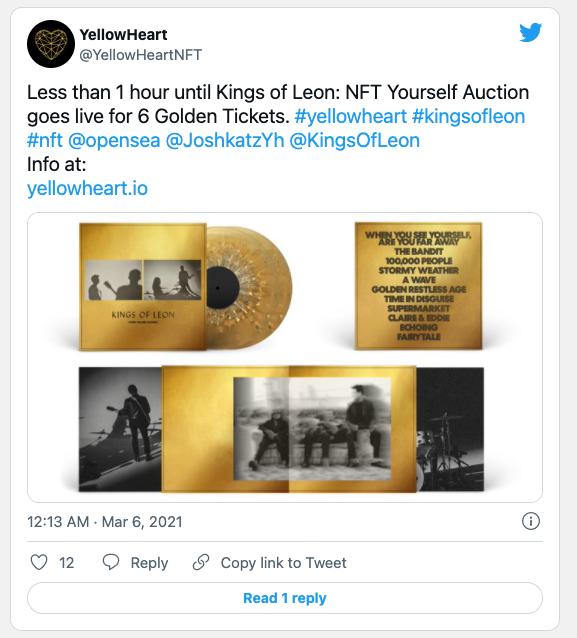
Kings of Leon limited edition "Golden Ticket" NFT
In the author's opinion, for users of music NFT, the real value of upgrade service may start from the redistribution of "rights of community \DAO" and music value.
DAO, as a new organizational form of distribution, co-construction and sharing, is naturally suitable for musician fan groups. In fact, many artist fan groups already operate as part of the DAO, and the emphasis on contribution and "generating power from love" fits in with some of the DAO's ideals. However, problems such as fund raising management, information opacity, confusion of responsibility and power distribution, and organization downtime caused by core personnel defection occur from time to time. The introduction of NFT, smart contract and DAO governance tools can effectively improve the above problems.
More importantly, owning a specific music NFT may become the exclusive certificate for fans to enter a musician DAO. The accumulation, combination and use of music NFT have a wide range of scenes in DAO organization.
For generation Z, who have a high acceptance of new things and a strong pursuit of belonging and self-identity, joining, participating and co-building a DAO organization of their favorite idols will surely provide much greater satisfaction than "collecting a SONG of Ta" or "going to Ta's concert". As for THE DAO organization, the introduction of NFT will also improve the efficiency of verification and management. As long as the introduction and co-construction rules of the DAO community are well established, more new users will join and be active, which will also stimulate the unimaginable new vitality, and may give birth to new music services.
In addition, if music NFT can directly link the distribution of royalty income with music consumers, and even introduce the recommendation mechanism of purchase and traffic, it will further improve the degree of social marketing and user participation of songs, and also provide richer value for users.
Therefore, in the next 1-2 years, whether there will be a musician fan organization based on Web3 paradigm and whether there will be a new way to mobilize a large number of users in the value distribution of music NFT will be an important event to observe whether the wind of Web3 music industry is coming.
To sum up, Web3 music track may need to meet a series of preconditions to usher in a similar wind wind to the summer of DeFi in 2020, including sufficient number of users, technical preparation, and the full practice of DAO concept in the music industry, which will be the key factors we need to observe in the future.
The fourth section & have spent The burst path of Web3 music track
Looking back at the more successful courses with a certain number of users and a long life cycle in the business field of encryption in recent years, one is DeFi, which began to rise in 2020, and the other is avatar NFT, which started to catch fire and go out in 2021. If Web3 music track erupts, which road will it take?
PS: The author has made the previous analysis of the chain game project which is also very popular in 2021. At present, its financial attribute is far greater than the game attribute. In essence, it is a gamification variant of Ponzi finance and still belongs to DeFi.
4.1. DeFi path
DeFi project has been in existence for a long time before 2020, but its real first year is 2020, which is very important because of the emergence of the "liquidity mining" mode, which solves the two mountains in front of DeFi previously:
· 如何找到初始用户和资金,完成项目的冷启动
· 中心化大型交易所的上所费用昂贵,不上的话项目代币又没有流动性
The novel model of liquidity mining solved the above two problems at that time, forming a wave of strong and lasting "decentralized finance engulfs the world" market narrative, allowing many DeFi projects to enter: token price rise liquidity mining APR further increase core business indicators of token price rise positive business flywheel.
Combined with the financial needs of encryption users, DeFi has accumulated a large number of real users, and its commercial value has been proven.
Liquidity in the mining and, of course, also have "left foot right foot god" ponzi color, when the market narrative agitation to, when insufficient funds flowing into the project, the above mentioned positive business flywheel will be interrupted, most projects will enter: currency leads to the deterioration of the core index down APR outflows currency fell further death spiral.
The DeFi projects that will survive are those where the user needs remain without subsidies.
4.2. Avatar NFT path
If DeFi projects take the path of "liquidity mining driving fundamentals", avatar NFT takes a completely different path, with Meme culture + social currency at its core.
2. The culture of Meme
One of the most important value sources of avatar NFT is Meme. A Meme is a popular Internet Meme that is copied and spread in a derivative way. The content with Meme gene is often created from the grassroots or by anonymous people. With simple and distinct style, it is easy to be created twice, and it gains new vitality and spreads quickly in the second creation of the masses.
A typical Meme is Pepe the Frog.
The Meme originated in 2005 in the Boy's Club comic book series created by cartoonist Matt Furie. Among several characters in the comics is Pepe, a happy frog who pees and pulls his pants down to his ankles. When asked why he does this, he replies, "Because it feels good man." On January 22, 2009, the image of Pepe was posted on 4chan, where users took the frog's original mouth and turned it in a different direction. And then came the Sad Frog, which has become a global sensation.

Pepe has been a Meme for 17 years since it was created in 2005
The elements of well-known NFT heads, whether CryptoPunk in pixel style or BAYC in hippie style, are all in line with those classic samples in Meme culture: they are mostly created by grassroots or anonymous people, with simple modeling and easy secondary creation and dissemination, possessing distinct subcultural temperament. Among them, BAYC's derivative cooperation and secondary creation with other groups are particularly rich and active. Meme is not only a consensus, but also an Internet mass culture that replicates and grows iteratively by itself. It is the expectation of users and investors on the value of NFT's avatar Meme that constitutes the first value connotation of NFT.
4.2.2. Social currency
What makes avatar NFT special is that its main scene is a presentation to the external social circle.
This gives it two huge advantages over other NFTS:
· 拥有最强、最广泛的免费传播效果。每一个在社交媒体上换上该 NFT 头像的人,都成为了该 NFT 系列免费的、长期的广告牌,Ta 所覆盖的社交圈层,每天都会看到这则「广告」。如果该头像拥有者是某个领域的影响力人士(比如艺人、体育明星、商业大亨),就会进一步引发认可其身份者的模仿和追随,为该 NFT 带来买盘,形成稀缺。
· 当该 NFT 的价格高到一定地步,该 NFT 头像就会成为一种典型的「凡勃伦商品」,具备了与爱马仕类似的奢侈品特征。凡勃仑商品的主要效用在于炫耀,且该炫耀效用会随着其价格的上涨而进一步上涨。而在网络时代,头像是个人曝光量最大的个人标志,这让昂贵的 NFT 头像成为了加密世界的爱马仕铂金包或法拉利限量跑车。
Due to the above characteristics, avatar NFT naturally has strong social currency attributes.
Meme+ social currency has achieved the powerful wealth effect of avatar NFT, in which social currency attributes play a greater role.
4.3. Outbreak path of Web3 music
At present, there are two main value carriers of Web3 music projects:
,Music applications, such as the publishing and trading platform of music NFT;
,Music NFT itself.
So, what path will Web3 music projects take to explode? Should we follow the business flywheel model like DeFi, or should we follow the Meme+ social currency model of avatar NFT to promote music NFT, and then promote the development of music platform?
I think the former is more likely.
It would be very difficult for a music NFT to see a burst of capital on the scale of an avatar NFT. Here's why:
At present, the scene of music NFT mainly lies in listening and collecting, while the display scene is weak. The utility of showing off is far less than that of avatar NFT, and the attribute of social currency is not strong
Although there are many memes in the music industry, such as the Korean song "Gangnam Style" that was once popular around the world, the electronic dance music of black people carrying coffers, and the "Wild Wolf Disco" that was popular in China, their life cycle is much shorter than that of picture memes, and it is more difficult to create and spread again
Compared with the popularity of music NFT reproducing avatar NFT, the rise of Web music platform is more likely, because it has a relatively clear business growth path, such as:
IP end: Web3 music platform can attract its users to join by cooperating with world-famous musicians. Of course, musicians can also do the platform by themselves
Industrial end: Web3 music platform can cooperate with well-known record companies and music platforms to obtain copyright and users, and record companies and Web2 music platform can also do their own platform
Product mechanism: Introduce Listen to Earn or Creat Song to Earn mode, bind users and musicians with incentive of project token, and rapidly expand the bilateral market of music
Among them, musician and industry resources are of course important, but who can design appropriate economic mechanism and turn business flywheel as soon as possible will be the early winner of Web3 music platform.
Just like the highly concentrated online music market in the Web2 field and the highly concentrated NFT trading platform, the Web3 music platform does not need too many small and medium players in the long run. The one who can expand quickly the earliest is likely to siphon off most users and musicians and form a competitive advantage that is difficult to surpass.
Section 5 & have spent Capture investment opportunities for Web3 music track
5.1. From the perspective of investment opportunities, the following points need to be noted.
The technical conditions of Web3 music track are relatively mature, but the maturity of users and community concept still needs time
Investing heavily in this track too early may, on the one hand, result in a high cost of capital; On the other hand, the earlier an industry is, the harder it is to pick the projects that will make it to the end. When we find that a large number of well-known musicians, music institutions or music platforms enter the market and produce good user import effects, DAO organization becomes an important form of music fan community, and the value distribution method of the industry gradually changes, it may be a better time to focus on investment.
5.2. Priority should be given to projects with high-quality industrial resources and a good knowledge of encryption mechanism design
As mentioned in chapter 4, IP resources of the industry and musicians are very important, but what is more important is that the project side has excellent design ability for the token model and product mechanism of the encryption project, and is familiar with the gameplay of the encryption business, rather than transferring Web2 mode to the encryption world by means of resources at hand. In addition, the project side should also have enough capital and investment determination to rapidly expand the bilateral supply and demand market of music at the very beginning and promote the rotation of business flywheel as soon as possible. Gala, the leading Web3 gaming platform project, recently unveiled its initial plans to enter the Web3 music market. Among the few revealed designs, it mentioned nods to auction, Listen to Earn and other gameplay, and a $1 billion industry incentive budget. In addition, Snoop Dogg and other heavy musicians will be invited to join in advance, which may become one of the samples of high-quality industrial resources + excellent encryption mechanism design.
5.3.Web3 music is different from DeFi's ceiling, so project valuation should be cautious
In terms of market size, there is a big gap between the $20 billion music market and the trillion-level financial market, and music, games, social and other tracks compete for users' time together, so the ceiling of Web3 music industry is far lower than DeFi. According to company valuations, Spotify, the world's largest online music company by subscribers, has a market value of around $30 billion, Tencent Music, China's top music company, has a market value of around $9 billion, and Universal Music Group, the largest holder of premium music rights, has a market value of around $41 billion (36.5 billion euros). At present, Audius, the most representative Web3 music project with the highest valuation, has achieved a total valuation of nearly 900 million DOLLARS in token full dilution. Under the premise that the market and user scale are far from mature, the valuation of this project in the bear market is not low.
Web3 music is one of the tracks that Mint Ventures has been focusing on for a long time. Welcome Web3 entrepreneurs to communicate with us and discuss.
5.4. References
IFPI: Global Music Report 2021
Here's How NFTs Could Define The Future Of Music
The next big trend in NFTs
Communication University of China: Chinese Musicians Report 2021
Ten years of copyright Wars: Has music gotten better as prices have risen nearly a thousandfold?
With more than 71 million paying users online, TME is driving the music industry's flywheel
China Economic Weekly: Online music is not profitable, why Internet giants continue to invest?
The original link
Welcome to join the official BlockBeats community:
Telegram Subscription Group: https://t.me/theblockbeats
Telegram Discussion Group: https://t.me/BlockBeats_App
Official Twitter Account: https://twitter.com/BlockBeatsAsia
 Related Articles