Sort out the comparison of NFT oracle track, Upshot and other 3 projects
Original title: "NFT Oracle Track Analysis"
Original author: DaPangDun, zhihong, realAlitta
1. Introduction< /h3>
Continuing from the previous article, we analyzed NFT’s liquidity problem, in the article, we pointed out:
In order to combine NFT with DEFI, it is very important The infrastructure is the "NFT oracle"
In this article, we will discuss with you the NFT oracle-related projects on the market and their origins. The pricing mechanism or model adopted to fully understand the current development direction and development of this track.
Second, Project Research
We have collected the current oracle projects for NFT prices, Mainly include:
Abacus , Upshot, Nftgo, Banksea
Among them, Nftgo has not found the relevant oracle mechanism for the time being. The official website said that it will develop it, but it is estimated that it has not been done well, so it is excluded
Let's understand one by one
1, Abacus
1.1 Introduction
< /p>
Abacus has two pricing mechanisms:
1) Peer incentive pricing (detailed in the previous article, Reference 3.5)
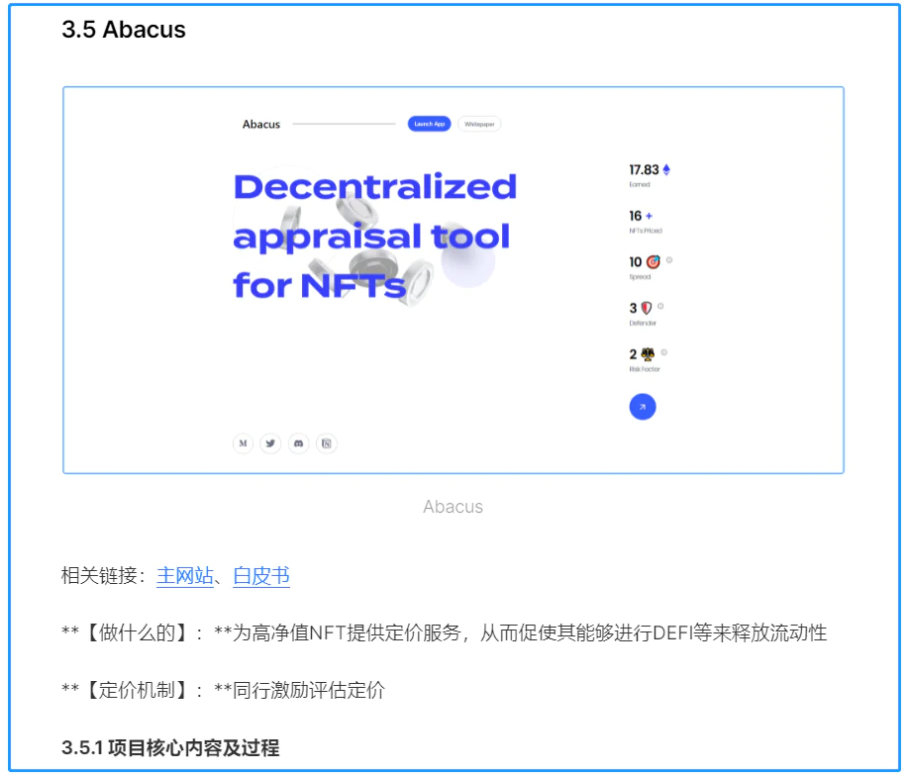
Introduction to Abacus’ Peer Incentive Pricing Model
2) Abacus Spot (detailed in a previous post, reference 3.5)
**Abacus Spot creates a liquid market for traders to speculate on the value of the NFT pool and achieve real-time valuation of NFT. **Liquidity is generated by traders initially entering the pool and further minting it throughout its lifecycle. The protocol pegs the value of NFT transactions to the real NFT value by requiring owners to exit by paying fees to holders or exchanging the proceeds for liquidity in the pool through a public auction.
1.2 How does it work?
1.2.1 Create a Pool
1) The NFT owner first deposits his NFT into the pool, and chooses to withdraw the fee, which represents the initial NFT valuation of the Token in his NFT pool. NFT is now locked in the pool and the only way to withdraw it is by paying an exit fee or selling it in an auction.
2) Start a Dutch auction of pool tokens (at initial NFT valuation) and end after the initial supply of tokens is sold out. The starting valuation is based on the total amount of ETH provided to the vault during the auction. For example, if a total of 100 tokens are sold for 0.1 ETH, the NFT's valuation starts at 10 ETH.
While a mining pool is active, the pool owners own "credentials" which entitle them to either pay the token holder an exit fee or Sell in auctions to withdraw NFTs from the pool. Using vouchers, NFT owners can use the value reflected in the pool to trade, lend or borrow. Additionally, pool owners receive transaction fees generated from the pool’s trading volume, similar to typical DEX liquidity providers.
1.2.2 Trade
1) Once the pool is created, trading can begin. The pool operates as an automated market maker (AMM).
This is the origin of the real-time price of NFT: the value of the pool is the real-time price of NFT
2) If NFT is considered undervalued, it may be eager to buy Token in the pool. If the supply of Token in the pool cannot cover the valuation of NFT, buyers will buy out the pool . Therefore, in the event that mining pool token supply dries up, interested speculators can mint new tokens at a premium.
1.2.3 Vault Closure
Vault closures happen in one of two ways:
1) Closing the auction
Extraction The first method for locked NFTs is to auction NFTs (where the owner can participate). In order to initiate an auction, the owner begins voting, which must be approved by a vote of token holders. At the start of the auction, transactions are locked and no other users are allowed to enter or exit the liquidity pool. After the auction ends,
--The auction price of NFT will be given to all holders of NFTToken, which will be distributed according to the proportion of ownership (there may be losses or gains)
--The winning bidder gets NFT
--NFT owner gets the value of the pool< /p>
2) Exit with exit fee
NFT owner pays exit fee to redeem NFT, exit Fees will be distributed among all Token holders in proportion to ownership. As mining pools will compete with each other for liquidity, we expect the exit fee percentage to reach market equilibrium, as owners must choose a sufficiently high exit fee to incentivize participation.
Related examples can refer to part of the content in the previous article (refer to 3.7.3)
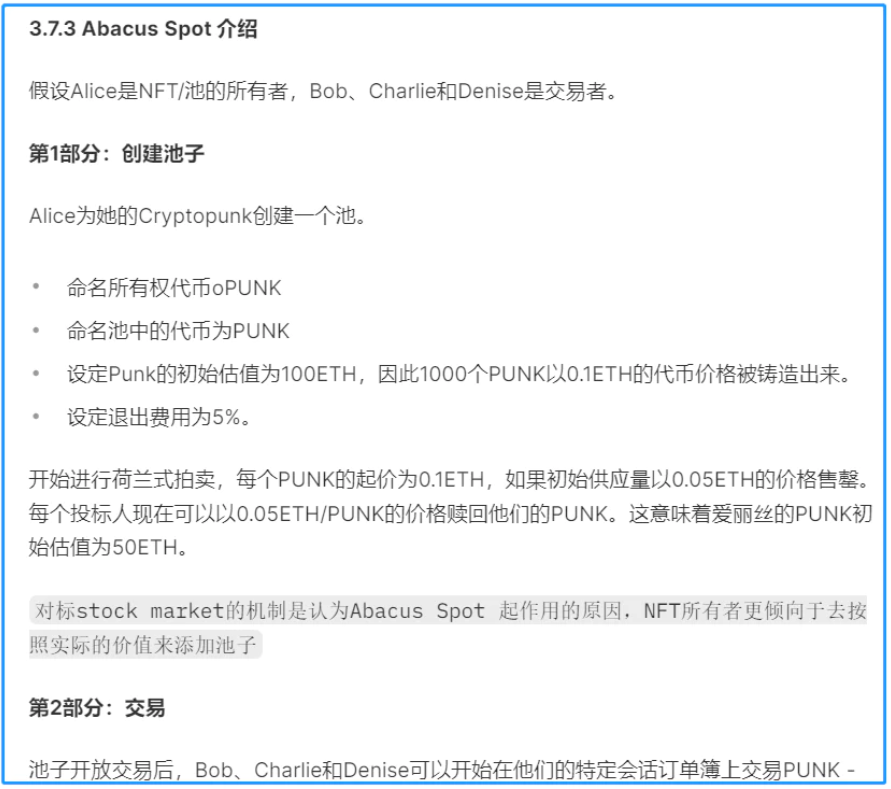
< br>
Abacus Spot example
1.3 Abacus What is the meaning of Spot?
1.3.1 Borrowing
< /p>
Because the price of NFT is the real-time value of the pool (because it is a game, it can reflect the actual value of NFT), so you can seamlessly participate in lending.
1.3.2 Lever Position
Interesting The most important thing is that this pricing method allows NFT owners to use leverage (NFT owners buy in the liquidity pool by themselves, which is equivalent to using leverage).
In fact, according to the official introduction, in addition to buying Token, traders also have the opportunity to short NFT pools that they think are overvalued.
2.Upshot
main website, related information< /a>
2.1 Introduction
Upshot One is committed to becoming a common NFT oracle project on the market, and its pricing mechanism has gone through two stages:
1) Question-and-answer protocol
2)Machine Learning
2.2 Question Answering Protocol
By designing a series of mechanisms to allow agents (those who answer questions) to answer questions honestly and with high quality, and then select the highest quality answer as the "answer" to the question.
2.2.1 Process
1) Question: Ask a question and list the options
2) Answer: The agent answers the question after placing a bet
3) Selection: Agents are randomly selected to answer the question based on their share of the bet
4) Scoring: The answers of the selected agents are scored and used as Solutions to problems
5) Forking: If the attack is successful or reflects different preferences, a series of questions and answers can be forked
Step 1: Ask a question
Anyone can ask a question on Upshot, However, the following rules must be followed
1) List possible answers to their questions (e.g. "yes or no" or "greater than or less than")
< p>2) Explain how confident the agent should be in their answer (the specific measure of confidence is the total amount of bets placed by the agent)
< br>
3) Define filter criteria to limit whose answers can be considered (e.g. "people who hold X governance token" or "agents on this beta tester whitelist")
4) Pay rewards to successful agents in any currency
Step 2 :Answer
The agent puts up the stakes and then answers as many questions as possible honestly. The higher the bet, the higher the confidence, the more questions can be answered, and the more likely it will be regarded as the final answer.
Step 3: Select
Upshot will Through "random sampling without replacement" of 3 proxies for subsequent scored answers.
1) Using no-replacement sampling ensures that "creating many fake accounts, each holding a small amount of bets will never be more direct than one account with a large amount of bets Betting is more profitable".
2) Random sampling requires a random seed to ensure that the sampling is truly random and unpredictable. Upshot One secures the random seed through a two-step procedure. First, seeds are chosen ahead of time, and will be chosen in future blocks, which is difficult to predict before their creation. Second, after the selected blockchain is actually computed, it is used as input to Chainlink's Verifiable Random Function (VRF) service, which outputs a cryptographically secure random number that is used as an Upshot One The random seed chosen by the agent.
Step 4: Scoring
Will be selected Given proxy answers are provided to Upshot One's peer-to-peer prediction mechanism in an attempt to elicit honest information without any means of verification (i.e. not necessarily ground truth). And this peer-to-peer prediction mechanism has the characteristics of non-minimum mechanism, multi-tasking and DMI mechanism.
Explain a few nouns:
[Non-minimum mechanism]: It is to ask participants to provide Information beyond the answer itself. That is, they asked participants how likely it was that someone else would say the same answer as they did, and the participants who scored the highest were the "least surprised" or "least error-prone" or "most predictive" participants.
[Multi-task]: It is to let the agents answer as many questions as possible to increase the relevance of the answer
< /p>
[DMI Mechanism]: It means that at least three participants must answer at least 2C questions (where C = the number of possible answers, so C = 2 for "yes or no" questions) to answer any group Answers are scored. Participants' answers are aggregated into columns and indexed by their respective questions.

These columns are aligned with each other and then split in half. Each "semicolumn pairing" was converted into a matrix listing the number of overlapping answers between participants. For binary questions that are "yes or no" questions, a 2x2 matrix is formed, then the determinant of the matrix is calculated and multiplied by another matrix.
If an agent always says "yes" even though the honest answers to certain questions are a mix of "yes" and "no", then every When a conflicted agent is paired with an honest agent, their scores are lower.
Step Five: Fork
One Questions may be subjective in nature, and people may wish to resolve again (e.g. if you say yes, you like the outfit, but the question is resolved as no, then maybe you should use a different set of solutions to curate your fashion), so Upshot allows forking (i.e. breaking away from) a chain of resolutions.
2.2.2 Results
Upshot original It is planned to use this question-and-answer protocol to price NFTs on the market, such as asking whether the price of the NFT is between 1~2ETH, or whether the price of X NFT is higher than that of Y NFT to determine the price of NFT, but this method has Obvious disadvantages:
1) It is not easy to expand, if the NFT market is too large, if you want to price accurately, the problem is too large, and it is not suitable for This rapidly changing large-scale NFT market;
2) The result evaluation is not very accurate.
So the project party gave up using this question-and-answer mechanism to price NFT, and switched to machine learning (ML) with high scalability, high accuracy, and high efficiency To give NFT a fully automatic and smoother pricing.
2.3 Machine Learning Model
Upshot The machine learning model is based on historical sales data and NFT metadata to comprehensively analyze and predict, and based on these valuable information and historical sales data, it is converted into a denser and richer data set, rather than relying solely on the price trend of a single NFT , to generate accurate and reliable pricing.
2.3.1 Introduction
1) Machine learning models ingest historical sales data, bid/ask prices, and NFT metadata to build features from this information to generate accurate and reliable pricing.
2) Validate predictions by checking their accuracy on data not used during training, and by comparing the model's predictions with actual sales prices Get the margin of error.
3) Both the predicted price and margin of error provide useful information for NFT buyers, sellers, or developers building products on top of the NFT economy.
A machine learning model capable of Integrating data not considered by simpler models, such as pooling the sales history of NFTs to predict individual NFTs and leveraging a range of NFT metadata. Much of the research work on the current project is focused on building different predictor, use automated methods to discover the most important variables and iterate to obtain a lean but robust model.
2.3.2 Features
Shapley values
The model uses Shapley values to reveal the importance of the different variables used in the model.
This helps explain how a complex ML model arrives at its predicted NFT price, which is useful for further model development and understanding unexpected predictions.
Analysis like this can also help to visualize the underlying drivers of NFT prices and identify the variables that really matter to each NFT project.
Rarity value
The model will be based on Combining attributes of an NFT to construct a rarity value, the basic idea behind involves calculating the probability of observing an attribute of an NFT. The higher this probability, the lower the rarity score. The lower the probability, the rarer it is, resulting in a higher rarity score.
Current models implement fast approximations to these probabilities, since calculating them exactly given the large number of possible combinations is computationally complex. In addition to calculating the first-order rarity score, the model also calculates a second-order score, which takes into account not only the probability of observing a specific attribute, but also the probability of different pairs of attribute combinations within the group.
This method of calculating rarity can be extended to arbitrarily high-order rarities and other NFT items besides CryptoPunks, where a fixed set of NFTs are Rarity value released. Projects releasing new NFTs over time may have new characteristics never seen before, requiring more complex calculations of rarity values.
3, Banksea
main website, related information
3.1 Introduction
The purpose of Banksea We are building an innovative, safe and efficient NFT pool-based lending center.
The protocol has two main functions: NFT price oracle and Pool-based NFT lending platform. The former is the foundation of the latter. In this article, we will only introduce the part of the NFT price oracle.
3.2 NFT Price Oracle
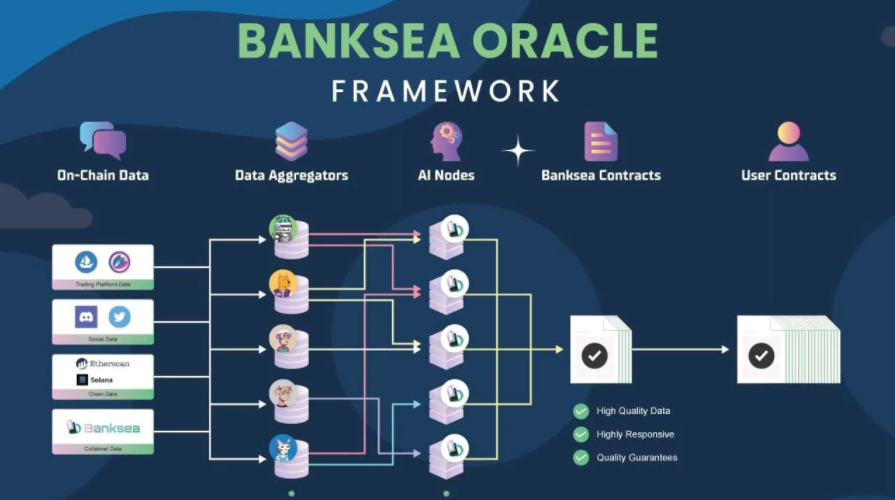
Banksea Oracle architecture
Banksea Oracle consists of three parts: AI node clusters, on-chain contracts, and contract interfaces.
[AI node cluster]: Crawl NFT related data, extract NFT features, AI model calculation.
【Contract on the chain】: A summary price provided by distributed AI nodes to provide the final NFT price and risk assessment.
[Contract Interface]: Connect with NFT ecology and projects, support the development of customized pricing mechanisms, and support users to query single NFT prices.

3.2.1 Quote generation process
1) Obtain multi-dimensional data
Real-time monitoring and capture of market data, social media data, Ethereum and solana The NFT data on the chain provides data support for NFT valuation.
2) Data aggregation and cleaning
Aggregate and clean NFT data of different dimensions to generate Features required for NFT models.
3) AI node cluster
According to the constructed NFT feature historical data training model, deployment The model provides NFT quotations and assesses the risks.
4) Contract on the chain
Data is sent to the data demander through aggregated data on the chain . The oracle machines of all nodes send data to the smart contract on the chain. After the smart contract removes outliers through certain logic, it takes out reasonable data and provides it to the data demander.
5) Contract interface
The AI node will provide data to the oracle program on a regular basis, predicting The computer program will summarize and save the data. Third-party programs can read the saved data. Provide Rust and JS interface request contract.
3.2.1 How to prevent the oracle from being attacked
1) NFT project whitelist system: The project party will dynamically adjust the NFT series that can be used for quotation according to certain rules
2) Quotation , Risk assessment dual AI model, and the input data dimensions are diversified: In addition to the quotation model, the AI node also has a risk assessment model to assess the risk of NFT
3.2.3 How to deal with the large price fluctuations of NFT?
1) Real-time valuation to achieve minute-level or even second-level monitoring
2) Filter quality NFT assets through the whitelist
3. Comparative analysis
Abacus Spot
Advantages :
The price reflects the actual value of NFT: because after the game of market participants, although there may be deviations, it is biased
Automatic and real-time price: In the AMM market, the price will be reflected in real time, and it can also be obtained by providing an API.
Disadvantages:
Large-scale application is very difficult Difficult: Because each NFT needs to go through a lottery auction, it is inconvenient to automate and the efficiency is not high;
It is more difficult to expand: when the pool is closed, the price It disappears, and the price-based derivatives can't be done at all.
Status:
Currently I observe its Discord activity is very low, of course, there is also the possibility that people are busy with things and have no time to manage;
After Chizi suggested the introduction of AMM, in fact, it doesn’t matter, no Consuming other things, but how to attract people or provide liquidity providers to do this AMM is a very important point to consider;
Currently the project is still in development stage.
Evaluation:
Therefore, we evaluate Even if Abacus Spot is successful, it will only target some high-net-worth NFTs, and then release the value of these NFTs to intervene in DEFIs like lending. It is unlikely to become the infrastructure for large-scale NFT pricing.
Upshot
Advantages:
Using machine learning algorithms to predict the price of NFT has the prospect of large-scale pricing;
< br>
According to the official website, when the price is given, the error range of the price will be given, which is a good price reminder for all participants of NFT;
Although the specific algorithm mechanism of Maching Learning is not given, some details (such as variable importance distribution, rarity, etc.) are given, and some prediction cases are given , the overall feeling is more pragmatic;
According to the understanding of technical personnel, Upshot's team is very powerful, and it also has experience in developing pricing mechanisms (question-and-answer agreement).
Disadvantages:
Machine learning Defects of the model itself:
1) A large amount of data is required for training. At present, whether the effective NFT historical metadata is enough and whether it can be trained Appropriate model;
2) Generally speaking, machine learning algorithms are prone to overfitting problems, how to solve them, and whether they need to iterate continuously;
p>
For different projects, machine learning needs to pay attention to different attribute characteristics, that is to say, different NFT series will need to train different models, which is actually very important for It is not good to expand the market; at the same time, when the attributes of NFT increase or decrease, the model will also fail to a certain extent and need to be updated iteratively. This is also a thorny problem that needs to be solved.
Status quo:
Although there are not many people on Discord There are many, but there is still a certain degree of activity. The project party has also obtained a new round of financing, and I believe that it is more motivated to do things;
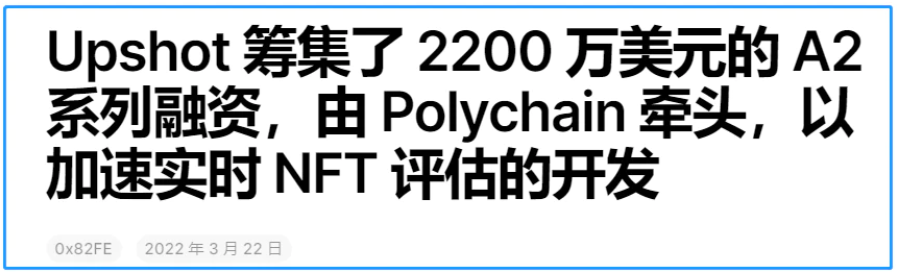
At present, the project party has opened the API test application, and there is also a Beta version test, you can participate in it;
The project party has not released any information about the issuance of Token The plans and materials of the NFT are mainly spent on building a real-time NFT evaluation system.
Evaluation:
Our opinion on Upshot The evaluation is very high. This machine learning model based on NFT historical metadata makes it possible for NFT to obtain real-time prices, so that NFT and DEFI can come to a historical intersection;
It may become an infrastructure of NFT*DEFI in the future;
Of course, we also need to pay attention: but because it is not a simple algorithm mechanism ( For example, the weighting mechanism), the price will have a high degree of uncertainty, and the credibility of the price depends entirely on the results and error intervals given by the model, and the future performance remains to be seen.
Banksea
Advantages:
The AI model is used to train the NFT data set to generate accurate and efficient forecast prices. Compared with Upshot, in the data set Introduced more associated data: such as social data, media data, etc., to a certain extent enriched the dimension of data;
Dynamic NFT whitelist filtering mechanism screening For high-quality projects, the quotation model combined with multi-dimensional data sources + AI model + multi-node reward and punishment mechanism makes the quotation more reasonable;
The project party also developed a loan mechanism: in In terms of lending, risk exposure for lenders allows users who are willing to take risks to obtain higher interest rates, and users who are unwilling to take risks obtain stable income; for mortgage parties, a pre-liquidation buffer period is set to give mortgage parties enough time to avoid being caught Liquidation;
From the perspective of the economic model, the agreement has prepared a safe fund pool for bad debts through the combination of collecting insurance premiums from the insurance fund pool + agreement income distribution, and Prevent the risk of fund pool depletion through the protocol support module, so that the protocol can resist black swans and run in a more robust manner;
Disadvantages:
As a kind of machine learning, AI also has possible problems in the above-mentioned Upshot project: whether the data set can train a reasonable model, the process Fitting problems, different NFT systems require different model problems, NFT feature changes require iterative model problems;
The official did not give the mechanism principle of the AI model, this part According to the reply from the management personnel, the source code will not be open source, so the effect needs to be marked with a question mark;
The information and documents related to the loan mechanism have not been updated at present, only the liquidation of this Part of the information;
According to the official introduction, it will provide minute-level or even second-level price responses. Calculation, which also needs to be followed and observed continuously.
Status:
As Solana Hackathon
In April 2022, ID0 will be launched, high popularity is a good thing and a bad thing, there may be a primary market We made a calculation: the primary market valuation is about 100 million US dollars;
The latest Gitcoin13 donation contains Banksea, if you have a donation, you can go to Discord to apply for an OG status. According to the administrator's introduction, there will be an airdrop;
It issued CitizenOne's NFT in January, Holders of NFT can enjoy some permissions. Interested friends can study it. It is currently in the secondary market< /a>It is tradable
Evaluation:
We are highly affirmative of Banksea. Its design concept has first passed the rigorous test of the hackathon. Its AI model and lending mechanism are logically very reasonable.
It introduces more dimensional data in pricing to ensure the accuracy of pricing, and introduces a risk AI mechanism in lending to ensure the safety and security of lending funds liquidation risk.
It is very likely to become an oracle infrastructure for NFT*DEFI, and has a complete docking project with DEFI.
Of course, we also need to pay attention: we need to observe the landing effect and actual performance of the project.
Comparison
We pass several dimensions Abacus, Upshot, Banksea are compared:

Several prophecies Machine project comparison
4. Summary
1. Overall thinking
In the previous article on "NFT Liquidity", we pointed out:
Credible NFT valuation is the key to mass adoption
Because:
1) Through the real-time pricing of NFT, NFT can truly communicate with DEFI Combined;
2) Information transparency of NFT prices will lead to increased market activity: tools that make it easier for participants to evaluate NFT can significantly reduce the onboarding cost of new users, Bring greater income to sellers and increase overall activity in the market;
3) Real-time quotes for NFT will increase market transparency and reduce information in the NFT market friction, and encourage the participation of the broader developer community - opening the floodgates for a new wave of NFT products and protocols.
2. The current development ideas of NFT oracle machine
1) If combined with our above As can be seen in an article, the NFT price prediction mechanism has undergone many attempts and developments:
Peer Incentive Evaluation Pricing/Game Pricing/Liquidity Pool Pricing/Algorithm Pricing/...
2) The current market trend is more inclined to use algorithmic models to price NFT prices in real time. This transformation is in response to real needs. If NFT is to be priced on a large scale, efficiency issues, participation costs, and complexity issues must be taken into account. Automatic calculation and operation by machines is the most ideal result.
3) We analyze the following two types of algorithm models that have a higher probability of success:
--focus on predicting the future value of NFT (for out of the error range)
--Advantages: [The technological progress of machine learning is very rapid] [Can self-adjust parameters] [Negative feedback correction based on the results] [No Too much human intervention is required]【More narrative】【Higher technology moat】
--Problems that need to be solved:【How to improve the accuracy of the calculation model Guaranteed, it takes time to test] [The model needs to be iterated when the NFT attributes change] [Different NFT series need to correspond to different models]
Based on Weight calculation model of historical metadata:
--Focus on analyzing the current value of NFT (giving a confidence interval)
--There are not many such projects in the market (of course, there must be some methodologies)
< /p>
--Advantages: [Results are more predictable] [Only parameters need to be adjusted for different NFT series] [NFT attribute changes may not affect the model itself]
< br>
--Problems that need to be solved: [The adjustment of parameters may require a lot of intervention, which is unfavorable] [The technical pool is shallow and easy to be copied]
3. A good NFT oracle in our mind
3.1 What is a good oracle
We believe that a good NFT oracle machine should be able to automatically and comprehensively price head projects, rather than single and only floor prices. Automation and comprehensive representation of efficiency; the effectiveness of quotations must be strong enough, because the market is changing rapidly; the mechanism must be simple enough, and the simplest way to solve problems according to Occam’s razor principle is the best, and complexity will bring uncontrollable and uncontrollable foreseeable risk. To put it simply, the input data is comprehensive and clean, the quotation is real-time, and the model is simple.
3.2 What to do
For projects
According to coinmarketcap, there are a total of 2,100 NFT projects, and the top 10 projects (accounting for 0.5% of the number of projects ) accounted for 70% of the total market value, indicating that the market value of NFT projects is mainly concentrated on top projects, so good projects need to be screened out according to certain rules. There must be a dynamic update mechanism to filter out poorly developed NFT projects and join NFT projects that meet the requirements. (It can be understood that there must be a listing and delisting mechanism)
About data
The oracle is a price generator, the input source data is processed by the oracle, and the price is output. Therefore, to make a reasonable oracle machine first depends on what data needs to be input.

Data Source Analysis
From the data source:
--The small amount of NFT attribute data is the main factor in determining the price. As the input data of the oracle machine;
--Although the data on the NFT chain and the NFT trading platform data have some noise, they are also the data that can most directly reflect the price of NFT It needs to be used as the input of the oracle machine;
--The community data and social media data of the project are too noisy, the processing process is cumbersome, and the model used in the quantification process Complexity is not suitable as a data source for oracle input. If it is to be used, certain means are needed to limit the weight.
Oracle model
With input After the data, the oracle can choose to process the data in three forms: [rule], [model] or [rule + model] to generate the final output price.
Because the price of homogenized Token is relatively continuous, it adopts the form of multi-nodes to provide data and process the output according to rules. Compared with homogenized Token, NFT Prices are discrete and each NFT has different attributes. Simple rules are not enough to give a reasonable price, so models need to be selected to price this kind of target with more complex patterns.
Considering the real-time requirements of the quotation and the interpretability of the model, a simple machine learning model is a better choice, but a deep learning model is too complicated and should A complex quotation system will have unpredictable systemic risks.
In addition, using the model will involve the use of historical data. Whether the price distribution of NFT changes with time is a key factor in determining the length of historical data used. This part needs to be determined by using the model to fit the price trend of the top project.
4. Suggestions
We suggest that you keep paying attention to Upshot and Banksea , If you have the opportunity to participate in depth!
Original text link
Welcome to join the official BlockBeats community:
Telegram Subscription Group: https://t.me/theblockbeats
Telegram Discussion Group: https://t.me/BlockBeats_App
Official Twitter Account: https://twitter.com/BlockBeatsAsia

 Related Articles