Whose cake did NFT grab?
Original title: "Angry at NFTs? No need! "
Original author: Knifefight, Cointelegraph Magazine
Original compilation: Nanfeng, Unitimes
"Every time you get angry For every minute, sixty seconds of happiness are lost.”
—Ralph Waldo Emerson
At the end of January, one of my favorite Internet content producers, Dan Olson (aka Folding Ideas), posted a video titled "Line Goes Up" outlining his complaints about NFTs (non-fungible tokens). As I write this, the video has amassed over 6 million views — nearly double that of Dan Olson's next most successful video. That's an impressive number of views for a 2.5-hour documentary with little marketing.

The screenshot is from a video titled "Line Goes Up" released by Dan Olson, video link: https://www.youtube. com/watch?v=YQ_xWvX1n9g
In the video, Olson makes the following argument:
1. Cryptocurrencies are useless except to sell to more stupid people.
2. NFTs, DAOs, and "earn while you play" games are just looking for more fools.
3. The fools who buy them become accomplices in a marketing scam.
4. NFTs are ugly, centralized and meaningless, they exploit artists and destroy the environment.
Honestly, this video really put me off. It’s not that Olson doesn’t like NFTs — it’s perfectly acceptable to not like NFTs. The reason it frustrates me is because the subject matter of his previous videos resonated with me a lot. Olson described NFTs as "incomprehensibly tedious," while Crypto enthusiasts are "terrible people" with "poor judgment" and "low social literacy." He called Ethereum founder Vitalik Buterin a "butthurt warlock". In short, NFTs make Olson angry. And he's not the only one who feels this way.
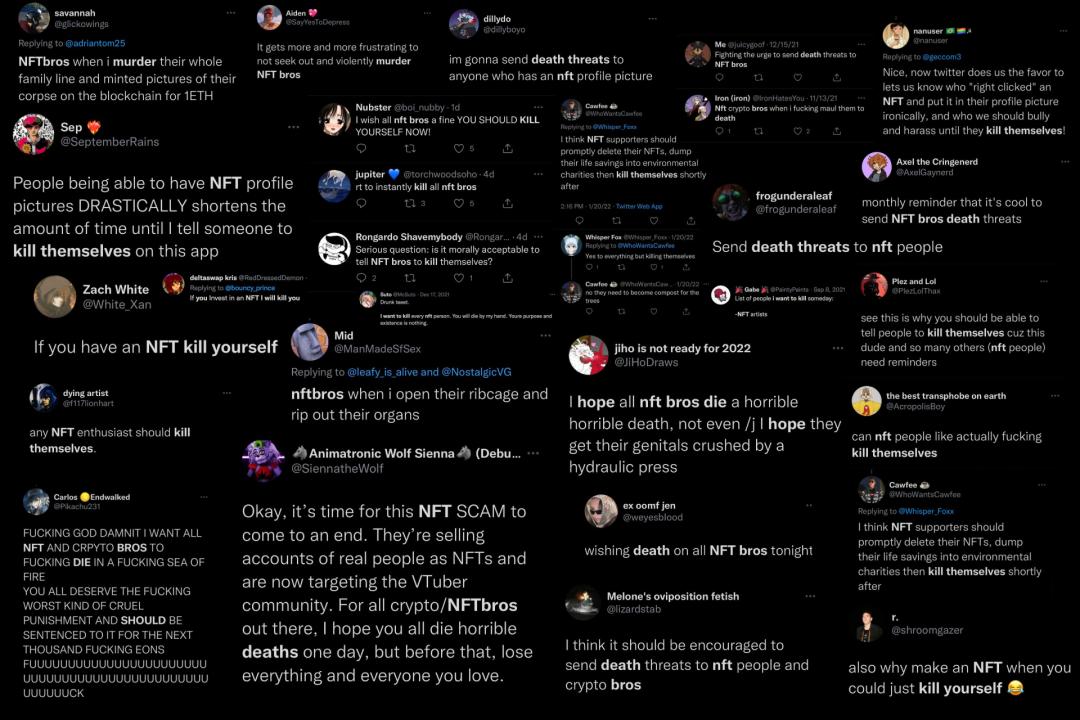
Just to clarify, I agree with many of Olson's criticisms of the Crypto space. This area attracts gamblers, scammers and fools. Motivated reasoning and dishonest marketing abound. I'm skeptical of DAOs myself, and I don't find the current generation of P2E (play-to-earn) games attractive either. Olson describes a lot of examples of bad behavior in his videos, and for the most part, those are accurate descriptions—of course, there are plenty of other examples like this that he could use to make the same point. The history of the crypto industry is indeed full of failed projects and open scams.
The problem is not that Olson's examples are wrong, but that the conclusions he draws are wrong. Some people misunderstand Crypto, but that doesn't mean Crypto is useless. Some people have created bad art using NFTs, but that doesn't mean NFTs are bad art. Explaining the value of NFTs by looking for the worst examples is like trying to explain the value of the Internet by listing the worst websites.
Olson sampled what he described as NFT projects by accepting random Discord spam invites — roughly akin to evaluating a site’s average quality. It's a stupid way of measuring average quality, and measuring average quality is itself a stupid thing to do. The average quality of a website doesn't mean anything and doesn't matter - what matters is the quality of the sites you choose to interact with. The same is true for NFTs.
There is no such thing as NFT art
A common complaint about NFTs is that they are ugly . In the "Line Goes Up" video, Olson described NFTs as "ugly," "garish," and "incredibly cringeworthy." However, to anyone who understands NFTs, these criticisms are obviously meaningless. This is not only because art is subjective and no one has the right to think that a type of art has no value, but because NFT is not a type of art at all. NFTs don't look like anything. They may or may not be associated with any visual effect. NFT is not an art style, but a tool that artists can use.

BAYC Boring Ape NFT
Currently, we have representative portrait photography , Generating NFTs of art, songs, virtual real estate, poetry, memes, stones, video game props, financial contracts, and sports. If someone tells you that NFTs suck, he's telling you more about the limitations of his own imagination than about the limitations of NFTs. It's like someone who's only seen Marvel movies confidently asserting that the movies are inherently unrealistic.
NFTs are useful, which is why people use them
Olson in " Line Goes Up begins with a description of the 2008 mortgage crisis and how Bitcoin emerged from it. His critiques of Bitcoin are unconvincing, but largely irrelevant to his argument for NFTs. However, it is interesting to do a macro analysis of the arguments he makes about Bitcoin, as it symbolizes how he has misunderstood NFTs. According to Olson, Bitcoin does not solve any problems. He said:
“Cryptocurrency cannot solve 99% of the problems in banking because these problems are problems of human behavior, motivations, social structures, patterns .The question is what people do to other people, not the word 'bank' on the outside of the building where they do it."
Indeed, Bitcoin does not would remove the excesses of banking or capitalism, but to be fair I don't know of any technology that does that. The idea that Bitcoin is designed to eliminate banks is a bizarre, historically agnostic straw man fallacy. Satoshi Nakamoto himself spoke about how banks will use Bitcoin. The purpose of Bitcoin was never to solve all problems in the economy - Bitcoin was to make it impossible to devalue wealth or censor transactions. Reasonable people may disagree on whether these problems are worth solving, but Bitcoin does solve them.
Bitcoin may not be of much use to Olson, but to Alexei Navalny (a well-known Russian opposition figure) and For Putin's political opponents, it is useful. It is useful for citizens of countries whose currencies are struggling, such as Nigeria, Venezuela, and Turkey, as well as ordinary people trying to flee Ukraine and Russia. It worked for feminist protesters in Africa, whose governments stripped them of their bank accounts, and women in Afghanistan, who weren't allowed to have bank accounts at all. Olson called Bitcoin "the favorite of thousands of gambling addicts," perhaps because he didn't know that Coinbase alone had millions of active users around the world.
You don't have to believe that Bitcoin is good or that anyone thinks it works. However, anyone claiming that Bitcoin is useless ignores the many ways it has been used. Olson's complaint against NFT is also repeating this wrong way of analysis: Olson poses a problem, says that NFT is supposed to solve this problem, shows how this problem has not been solved, and then concludes that NFT So useless - without researching why people are actually using NFTs.
NFTs are not meaningless, they are pointers
Olson believes that NFTs are meaningless, Because they are not as useful as advertised. Admittedly, images referenced by NFTs may be lost or replaced. The same image can be minted into multiple NFTs, or minted into NFTs on multiple blockchains. The NFT does not prove that its minter is the artist who created the image, nor does the NFT prevent anyone else from accessing the image, even if they do not own the NFT. Olson (correctly) points out that NFTs are not useful for proving the authenticity of art, and then (wrongly) concludes that they are not useful at all.
NFT cannot prove the authenticity of art, because authenticity is the subjective evaluation of the audience, not the quality of the art itself. Different people may have different opinions about which version of a work of art is the most authentic or how much authenticity is important. No technology can prove authenticity because authenticity is not a technical property. That was never the point of NFTs.
What an NFT can prove is who minted the token, who once held it, and who owns it now. That’s not the same as authenticity — but that doesn’t mean NFTs are worthless, Olson explained. Documenting the provenance of artwork is an expensive and valuable service, and NFTs can provide the same service with stronger guarantees.
From this perspective, we can see why the above criticism is not interesting. Some NFTs have images that can be changed, some have permanent images, and some have no images at all. Whether there are images and whether those images can be changed is not a property of the NFT, but the result of the artist's choice. Thinking that NFTs are useless because the artist's choice might surprise you is like concluding that a painting is worthless because Banksy once tore it up at an auction. is useless as well.
There is nothing harmful about NFT
Of course, thinking NFT is pointless and bad This argument for good art is incomplete by itself, because there is a lot of pointless and bad art in the world - and there's nothing wrong with that. Two-thirds of the merchandise on Etsy would be considered pointless and lousy, yet no one is going to make (or watch) a two-hour documentary about it. Olson's real argument is that NFTs are bad for three reasons:
1. NFTs are bad for the environment;
2. NFT is dangerous for users;
3. NFT exploits artists.
Let's consider these three points one by one.
1. The impact of NFT on the environment
Generally speaking, the impact of cryptocurrencies on the environment Influence is a large and complex topic, and we do not have enough space here to cover it. If you're interested, I've written in more detail about the energy impact of Bitcoin mining and why we don't need to panic about it. However, for the sake of discussion, let us assume that PoW mining is bad for the environment. What does this mean for NFTs?
How much energy a miner spends validating the network is directly proportional to how much they can earn by mining - the more miners are paid Well, the more they are willing to mine. Anything that increases miner revenue increases the energy footprint of the network, and anything that decreases miner revenue decreases the energy footprint. In order to reduce the impact of PoW mining on the environment, it is necessary to reduce the profit of mining.
When users trade NFTs back and forth, they pay miners transaction fees, which increases mining revenue somewhat. However, these fees are proportional to the frequency/urgency of NFT transfers, not their value. For example, BAYC (Boring Ape Yacht Club), currently the most expensive NFT collectible series, has generated about 200 transactions per day since its launch. The Ethereum network processes about 1.2 million transactions per day.
On the other hand, NFTs are priced using ETH - so anyone buying an NFT is selling ETH. When a lot of NFT prices go up, it means a lot of people are selling ETH (thus buying NFTs), and when a lot of people are selling ETH, it means that the price of ETH is depressed. Miners are paid in ETH, so anything that puts pressure on the price of ETH puts pressure on miners’ income. In other words, every time the price of an NFT project goes up, it’s bad news for Ethereum miners. Want to stop people from mining on Ethereum? Just buy pictures of bored apes.
Of course, the real situation is much more complicated. NFTs got a lot of mainstream attention, which attracted more users to Ethereum. Different NFT projects will have different prices and different trading volumes. Even the same item can change over time. NFTs are just one part of a large and complex ecosystem, and it's far from clear whether they increase the profitability of mining or reduce overall mining efficiency.

Pixelmon NFT
2. Do not mix tools with tools
In the "Line Goes Up" video, Olson discusses his contempt for NFT holders and paternalistic concerns about people being taken advantage of by scams and fraud swing back and forth between. He can't seem to decide whether to blame the technology or the user community. Personally, I think we should blame the liars. Scams and fraud predate NFTs and exist in a world where NFTs never existed.
When scammers start adopting NFTs, overpromising naive investors and pocketing their money is nothing new, nothing special about it Change. Fyre Festival (biggest music festival scam in history) doesn't need NFTs, and neither does WeWork. Unreleased MMORPG game Star Citizen has raised more than $400 million since its initial crowdfunding in 2012, before NFTs existed. There are indeed scammers using NFTs to play out old plays in new markets, but NFTs don't really unlock anything new or different about scams. NFTs are just one trend scammers are hanging on to.
Part of the fear here seems to stem from a technical misunderstanding, with Olson claiming that NFTs could contain assets that "live forever in your wallet like land mines." Malicious code - this is simply not true. The NFT does not contain the code, nor does it exist anywhere. When someone sends you an NFT, what actually happens is that a record is sent to the blockchain, causing the smart contract for that NFT to grant new permissions to your address.
Nothing is "placed" anywhere, the NFT itself is just a record written to the blockchain, not a payload of potentially dangerous code. The goal of scammers who actively send victims NFTs is not to inject code into their wallets, but to convince victims to go to the attacker’s website and sign malicious transactions. Such an NFT is like a spam, luring the victim to a phishing website-the NFT is not the attack itself, but just a bait.
Olson (correctly) observed that bad actors were using NFTs, and then offered that as evidence that NFTs are bad -- but that's a false conclusion. Bad guys use many of the same tools that good guys use. Drug dealers use dollars, terrorists have cell phones, and Hitler wore pants. When bad guys use a technology, all this is telling you is that the technology must be useful.
3. Many artists are already using NFT to make money
Olson in "Line Goes Up" The last major argument against NFTs is that NFTs are actually bad for artists. This is a common perception, but consider that Beeple, the third highest-paid living artist of all time (who sold his NFT art collection "Everydays" for $69 million at Christie's auction house) makes money almost entirely from selling NFTs , which is also an unusual view.

Sure, Beeple's Everydays probably isn't worth $69 million, but what is it really worth?
Olson's contention is that the Beeple deal should not have counted because MetaKovan, the buyer of Beeple's portfolio, issued B20 tokens based on the "ownership" of these collections (total supply 1000 million pieces). This is an interesting argument for several reasons. First, no matter how sincere you think that valuation is, Beeple actually made $69 million. There is no denying that the sale was in the artist's favor.
Secondly, if you look at the relative valuations of B20 tokens and Beeple's $69M Everdays NFT, there's absolutely no way MetaKovan will pass the selloff B20 tokens to make a profit, because there is not enough trading volume to achieve this kind of profit. Therefore, it stands to reason that MetaKovan may have been biased, but in the end it was MetaKovan who paid for the auction.
In the end, there was another bidder who was willing to pay the price: Justin Sun, the founder of the Tron network, posted a video saying that he was trying to bid for a higher price. bid, but encountered a site error. So, even if you ignore MetaKovan entirely, there is still a buyer willing to pay Beeple $69 million for the Everydays NFT. $69 million might be a staggering price, but it's true.
Using the Beeple/MetaKovan transaction as an example, Olson makes a broader point that most transactions in the NFT space are "wash transactions" (wash trades), in which sellers buy art from themselves and fake the interest or price their art attracts. To someone unfamiliar with the NFT market, this might seem like a legitimate concern, but to anyone who understands the space, it's pretty naive. This would become apparent with more investigation into the mechanics of the transaction.
NFT trading market OpenSea charges a 2.5% fee per NFT transaction, plus miner fees, so the cost of washing transactions is quite expensive. NFTs are also subject to capital gains taxes, so anyone who creates false profits for themselves is also creating very real tax obligations. It's also largely pointless, since it's much easier and cheaper to fake the Discord and Twitter activity of a new project that hasn't launched than it is to fake the market volume of an already launched project. There are many opaque transactions in the NFT market, but not so many fake transactions.
This means that most of the money goes to NFT project creators, which is why artists like Beeple are discovering that NFTs are a lucrative new Chance. Olson claimed, without providing evidence, that most artists lost money in NFTs. The cost of minting NFTs has always been cheap, and recently it can be done for free. Not everyone finds the NFT marketplace profitable for them, but it's not expensive to mint NFTs that will never be sold. If an artist loses money in an NFT, it is because the artist is an NFT buyer, not a seller.
Stolen NFTs don’t make sense
So artists who sell their work are getting money from NFTs Benefit — but what about artists who don’t have or don’t want to create NFTs? Art theft (that is, stealing other people's artwork to mint NFTs) is so rampant in the NFT market that DeviantArt had to launch a special tool to detect stolen artwork and issue takedown notices. Doesn't this mean that NFTs are being used to exploit artists?
Art theft is reprehensible, but blaming NFTs for artwork theft is like blaming piracy on the RedBubble (an online art gallery and creative community) platform Behavior attributed to the presence of T-shirts as well. The problem is the theft of art, not the medium through which the stolen art is sold. NFTs don’t make art easier to steal, nor do stolen art make it more valuable. In reality, NFTs aren't that useful to thieves: it's impossible to tell the difference between prints sold by artists and pirates, but it's possible to know exactly who created which NFT. Anyone who cares if they buy a copy will buy a copy, and anyone who doesn't care if they buy a copy can mint their own version for free. Art theft doesn't have anything useful to sell.
Stolen NFTs mean nothing. It's like buying a certificate from someone who doesn't have the authority to issue certificates.
More sophisticated con artists will not focus on selling stolen art, but use stolen art to sell a larger scam , like pretending this is concept art for an upcoming video game. But, like the RedBubble bootleggers before it, the problem is art theft and fraud, not crooks using specific tactics to inflate their art. NFTs are not crucial to the scam at all, they are just a way to attract the attention of a group of wealthy potential targets.
There is no need to be angry about NFT
It should be noted that I am not saying that every Everyone should understand or value NFT. It's perfectly acceptable to be indifferent to them, or not understand why other people like NFTs. But I don't think anyone should be upset about NFTs, and I think the video "Line Goes Up" is a good example of how this misunderstanding can happen.
Throughout the video, Olson blames NFTs for everything from kitsch to economic inequality. The result is not so much a coherent argument against NFTs as a long list of things Olson doesn’t like about the world, and his own personal take on NFTs. Being guilty of being connected led him to draw the wrong conclusions. NFTs are just one trend scammers are hanging on to. They are good for artists and are often heartfelt favorites of collectors as well. They're not bad art because they're not a type of art at all. They are tools that artists can use.
NFT is not the ultimate boss of late capitalism. They are just one file type. If you've never been mad about jpegs, then you don't need to be mad that someone else can take ownership of jpegs.
Original Link
Welcome to join the official BlockBeats community:
Telegram Subscription Group: https://t.me/theblockbeats
Telegram Discussion Group: https://t.me/BlockBeats_App
Official Twitter Account: https://twitter.com/BlockBeatsAsia
 Related Articles