Rise of the Gaming NFT Market, Representing the Split of the General NFT Market with Opensea
Original Title: "IOSG Weekly Brief | Game NFT Market: Opensea The Easiest Piece of Cake to Carve"
Original Source: IOSG
Part.1 Insight
Game NFT Market: Opensea The Easiest Piece of Cake to Carve
Author: Peter, IOSG Ventures
This article is for industry learning and communication purposes only and does not constitute any investment advice
TL; DR
- Verticalized NFT trading markets will rise, eroding Opensea's market share
- The Game NFT trading market is expected to be one of the first successful verticalized platforms
- The current Game NFT trading market ecosystem has taken shape
- The Game NFT trading market will hold a more prominent position in the future
The NFT market over the past year has been crazy. It seems that at some point, familiar celebrities began to buy NFTs, changing their social media avatars to these cartoon animal pictures. Coupled with the hype of a bull market and the wealth effect, most people also began to learn about NFTs and get involved. Many companies have also used NFTs as a marketing tool, such as Adidas, Li Ning, McDonald's, Louis Vuitton, and more.
NFTs have become a cultural phenomenon. People buy NFTs (especially avatar PFP NFTs), join a community that aligns with their personality, connect with like-minded people through online and offline gatherings. NFTs have become a key to a community, filling the need for a sense of belonging. Stimulated by celebrities and the wealth effect, NFTs gradually take on the characteristics of luxury goods and investments.
Numbers can tell everything: According to data from Nonfungible.com, the NFT market's trading volume in 2021 was $17 billion. This number was only $82 million in 2020, an increase of over 200 times. In 2021, there were over 2.5 million addresses holding or trading NFTs, compared to only 89,000 in 2020. Among them, the vast majority of transactions occurred on the general NFT trading market Opensea, which once held over 98% of the market share. With a 2.5% transaction fee, its highest monthly revenue exceeded $350 million.
However, with the explosive growth of NFT users, different demands will arise for NFTs, leading to the development of more types and functions of NFTs. As the market value of the niche markets expands, the general NFT trading market will gradually be replaced by vertical markets. This is not new; we have already seen similar things happen in the Web2 world, such as eBay's market share being divided among several vertical markets with core categories.
Over the next cycle, represented by Opensea, it is the split moment for the General NFT Marketplace. We will see more vertical trading markets starting to seize Opensea's share. Thanks to real utility, the gaming NFT trading market is expected to be one of the first successful vertical platforms.
The Split Moment of the General NFT Trading Market
The current blockchain ecosystem is like the Internet ecosystem of the 1990s. When eBay went public in 1998, its GMV was only $105 million, but it already had the most users of any global e-commerce website. In the United States, less than half of adults had used the Internet at that time, even fewer used e-commerce platforms, and it was hard to imagine a platform surviving solely by selling a particular category. By 2013, eBay's GMV had reached $83 billion, and almost everyone had learned to shop at online stores.
eBay is still an online store that includes everything, a place where you can buy clothing, books, electronics, furniture, real estate, hotels, and even all kinds of odd items. Although it once dominated the industry, its GMV growth has slowed significantly in recent years. The most important reason is that more and more vertical platforms have slowly eroded eBay's market share, disrupting the areas where eBay used to hold dominance.
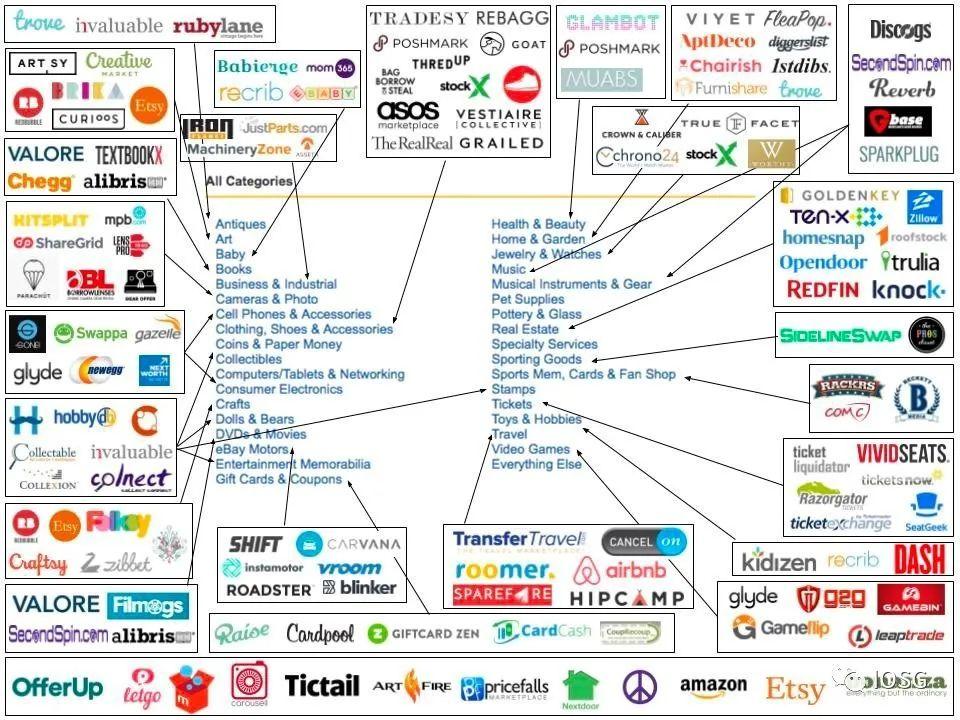
Source: Disrupting eBay: The Rise of Vertical Marketplaces
Justine and Olivia Moore described the trend of eBay's split in 2018. Once consumers concentrated on the eBay platform to meet all their needs, they gradually moved to more specialized vertical platforms. In these vertical markets, the combined market value of Etsy, 1stdibs, Airbnb, Chegg, and Zillow exceeds $130 billion, several times eBay's current $30 billion valuation. What can be seen from this? In the early stages of e-commerce development, the user base was not large, but eBay was able to meet this part of the demand very well. With a large number of new users pouring in and the expansion of demand for specific categories, vertical markets can accommodate these users, thus creating a larger market.
Similar to eBay, Opensea is also a dominant general-purpose marketplace in the NFT space. It was established in the previous bull market and has become the market leader in this cycle, once holding a 98% market share. Looking back at history, it took nearly a decade for vertical platforms to surpass eBay, but the pace of business transformation within Web3 is faster. We are likely to see faster splits in the Crypto market for NFT General Marketplaces like Opensea. The reasons are as follows:
1. Opensea is a non-exclusive content provider with a somewhat outdated item recommendation mechanism
First of all, not all NFT assets listed on Opensea are exclusive to the platform. In simple terms, since all NFT assets are on-chain, there is no exclusive content on Opensea that other platforms cannot provide. Other platforms only need to read on-chain contracts to display all NFT collections.
Furthermore, Opensea lacks a robust mechanism for discovering and recommending NFTs. Currently, it often takes the form of "post hoc recommendations," such as showing transaction leaderboards and recently trending projects. Creators find it difficult to rely on Opensea's recommendations to increase their sales, and users cannot learn about interesting projects suitable for them through the recommendation mechanism, only getting information about which projects are trending. The reason behind this is that it is difficult to make recommendation judgments for purely investment-based financial products; recommendation mechanisms are more suitable for content-rich gaming and music NFTs.
2. Lower User Migration Friction in the Web3 World
Since all assets are on-chain, trading platforms can easily read on-chain data and list NFT collections. For NFTs, liquidity primarily comes from sellers listing items because many users search for low-priced NFTs through aggregated platforms (such as Gem). In other words, to compete for Opensea's liquidity, the key is to incentivize sellers to list items. Currently, the cost for sellers to migrate to other trading platforms lies in onboarding and authorizing NFTs' gas fees. Compared to web2 platforms that require filling out a lot of information, undergoing qualification reviews, and even paying a deposit, web3 migration friction is already very low. For buyers, connecting their wallets allows them to buy on different platforms seamlessly.
3. Opensea's Liquidity Barrier is Not Insurmountable
Opensea lacks user incentive measures, leading to the gradual loss of the early-established liquidity moat. Earlier this year, projects like OpenDAO and LooksRare emerged to vampire attack Opensea, rewarding loyal Opensea users with platform tokens. LooksRare's trading volume once surpassed Opensea. The emerging NFT trading platform X2Y2 is rapidly gaining Opensea's market share through fast feature iterations, better UI/UX, and extremely low transaction fees (X2Y2: 0.5%, Opensea: 2.5%). To avoid the misconception of wash trading (in terms of transaction volume, Opensea's market share is now less than 20%), we can see a declining trend in Opensea's share from the percentage of active users.
Furthermore, unlike the Defi field, the same NFT can be listed on multiple trading markets simultaneously, meaning that the liquidity of NFTs can be more easily transferred and diversified. Professional traders often list NFTs on multiple trading markets at the same time.
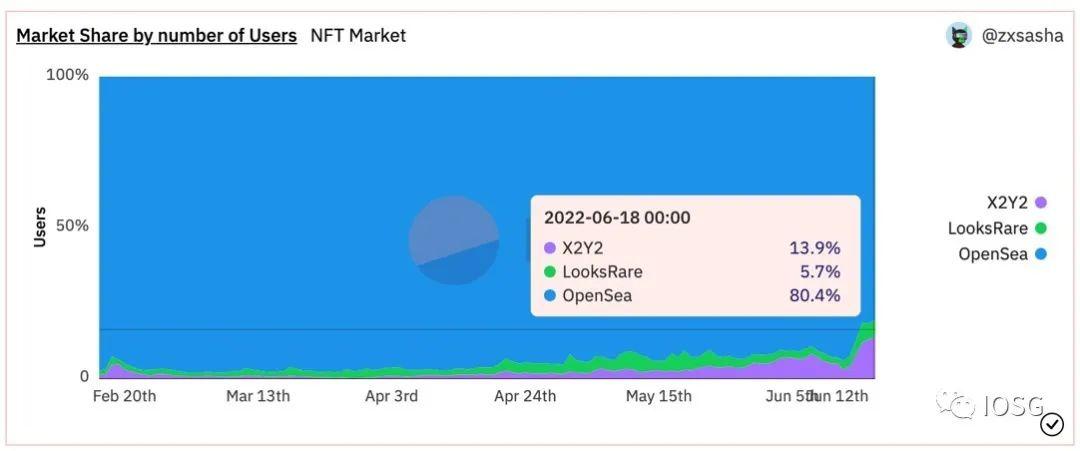
Source: Dune
4. Opensea's Poor Management, Failure to Stand Out in Brand Value
Opensea's poor management has long been criticized by users. Its security has also been continuously questioned, and the platform's reputation has been damaged by malicious events such as theft, fraud, and contract bugs. Opensea has a large number of fake and counterfeit NFT collections, with long processing times for complaints, where both developers' and users' rights are not protected. In May of this year, its homepage mistakenly promoted a counterfeit PXN NFT series, which was delisted after reaching a trading volume of 3600 ETH. Opensea's contract has also had bugs, causing several Bored Ape NFTs to be sold at a low price, resulting in losses for collectors. Opensea is not significantly ahead of its competitors in terms of security and reputation and has not yet established a strong brand moat.
Verticalized Ecosystem of NFT Trading Markets
Having observed the NFT trading market for a long time, we have also seen direct competitors to Opensea such as Rarible, LooksRare, and X2Y2, which are positioned similarly to Opensea (some of which also have good trading volumes). However, we believe that in the future, the entities that can create a larger market share and surpass Opensea are not necessarily or most likely not direct competitors of Opensea, but a set of verticalized NFT trading platforms focused on a specific niche.
NFTs are not just JPEGs. In terms of format, NFTs are divided into JPEG, MP3, MP4, SVG, iframe, arrays, matrices, and more. In terms of categories, NFTs are divided into collectibles (PFP), pure art, virtual world, gaming, music, sports, equity, finance, and more.
Tasha Kim summarizes the verticalization of the NFT trading market as follows. In several major categories, we can already see the initial establishment of a verticalized ecosystem, such as gaming (Fractal, Lootex, DMarket), music (Catalog, Glass, Roya), art (SuperRare, Sloika, Foundation), and more. Some platforms have already made significant achievements, and emerging platforms have also received substantial financing.
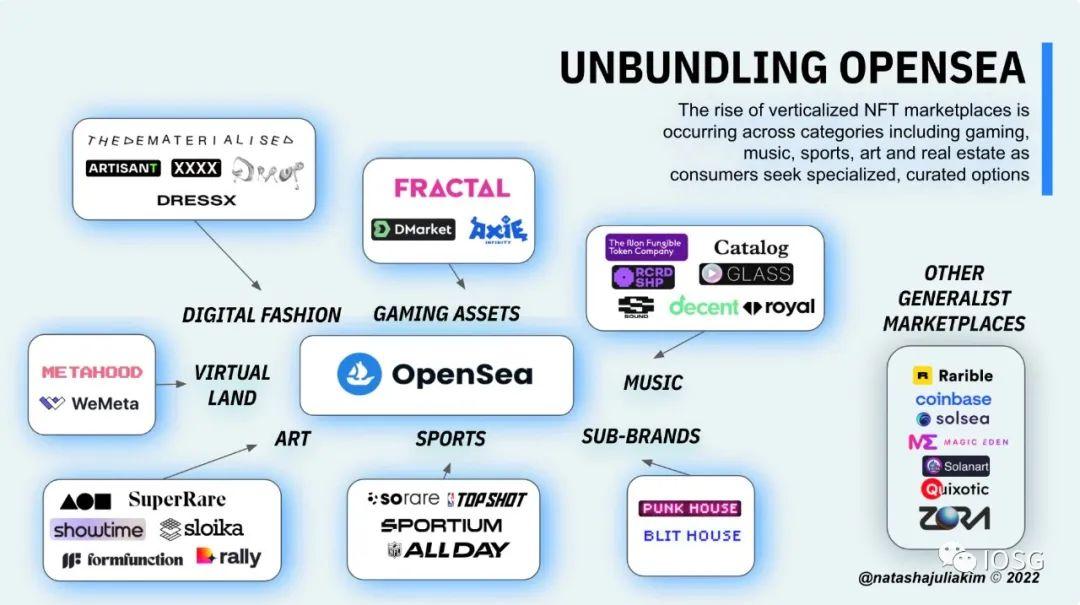
Source: The Unbundling of Opensea
So, what motivates users to migrate to a verticalized platform instead of staying on a generalist platform? Let's once again take a look back at the evolution of verticalization on traditional Web2 platforms and why eBay eventually lagged behind in the vertical market:
1. Authentication Service: For certain products, people have a strong need for authentication to reduce the risk of purchasing counterfeit goods. However, products listed on eBay do not guarantee authenticity.
2. Quality Control: eBay does not perform quality control on the platform's products, leading to a large number of subpar and junk items flooding the platform, making it difficult to distinguish between good and bad quality.
3. Price Guidance: eBay does not categorize the same products or provide a minimum price reference, making it difficult for users to find a reasonable price among tens of thousands of search results.
4. Lack of Community: eBay lacks an intimate community feel, making it difficult to incentivize users for repeat purchases and active participation in the marketplace.
If a vertical market wants to compete for Opensea's market share, it also needs to provide something that a generalist NFT market cannot, such as:
1. Content Quality Improvement through Auditing: For niche fields, the entry threshold needs to be appropriately raised to filter high-quality projects for users and reduce user losses.
2. Targeted Design for Niche Fields: Platforms can optimize UI/UX for specific categories, such as providing a 3D immersive gallery for art categories or introducing player settings for music categories.
3. NFT Pricing Service: For certain types of NFTs like equity, finance, and gaming, which have revenue-generating potential, a DCF model can be used to price them.
4. Building Community: NFTs in niche fields are more likely to establish a strong cohesive community, as seen in gaming trade markets guiding players to exchange gaming experiences and even promoting asset exchanges between different games.
The Rise of the Gaming NFT Trading Market
So, on the eve of the imminent explosion of the NFT verticalization platform race, what type of platform could be the first winner to emerge? The gaming NFT trading market is the most promising dark horse.
Game NFTs have always been the second largest category in terms of collectible NFT trading volume. With the arrival of the NFT bear market, the trading volume of collectible NFTs, where speculative value outweighs actual utility, may continue to decline. NFTs will move towards a direction that values intrinsic value more. According to data from Nonfungible.com, the trading volume of game NFTs in 2021 reached $5.17 billion, and when including virtual world NFTs that can be attributed to the gaming category, an additional $510 million, the total trading volume reaches $5.68 billion. Calculated with a 5% royalty fee, game NFTs generated profits of $284 million. According to Nansen's estimate, by 2023, the total profit of the gaming industry will be around $200 billion, with the profit of the blockchain gaming industry reaching $5 billion, accounting for approximately 2.5% of the addressable market.
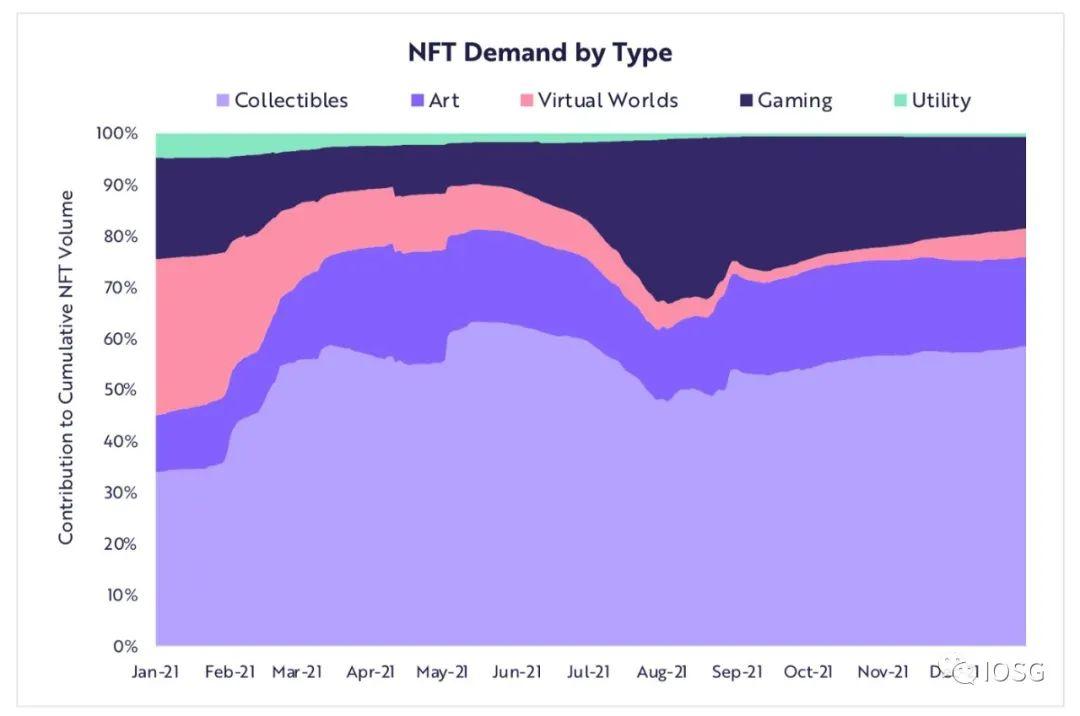
Source: Annual Research Report from Ark Invest
Game NFTs are the most prominent use case for NFTs. Game NFTs are nothing new. As early as 2017, CryptoKitties was one of the first games deployed on Ethereum. Although PFP NFTs now dominate the majority share, game NFTs always manage to stand out with practical utility when faced with speculative scrutiny.
For collectible or art NFTs, the story behind them and the act of collecting give them value. However, in addition to satisfying the first two types, game NFTs also provide additional utility value, allowing users to truly engage and immerse themselves. Utility is a sustainable direction that expands the addressable market of NFTs.
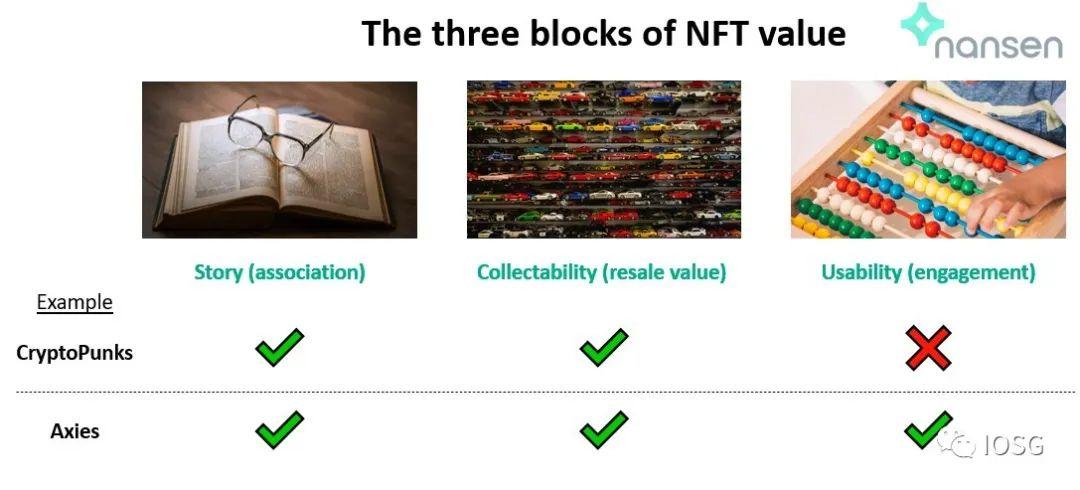
Blue-chip PFP NFTs are also entering the gamified narrative, providing more value support. The Bored Ape Yacht Club (BAYC) series has introduced the game brand Otherside, where future BAYC holders can use their NFTs as avatars in the game. Additionally, series such as Cool Cat, Doodle, Pudgy Penguins, Azuki, and others have plans to launch games.
While large game publishers are more likely to establish in-game NFT marketplaces, users are also more likely to prefer trading within the game rather than navigating to other platforms. However, an open platform can bring many advantages to the game:
- Game Community: The platform can provide a larger community than a single game, where game players' appreciation and reviews of the game can be seen. The community's leaderboard and achievement system make the platform a more immersive place than within a single game.
- Cross-Selling Opportunities: Based on platform data recommendations, it can also promote cross-selling of games and game assets. When different game assets converge on one platform, coupled with NFT interoperability, asset interchange between different games and cross-game asset migration can be achieved.
- Asset Pricing and Comparison: Since the short-term driving force for user gameplay in blockchain games is Yield, an open platform can leverage the rich attributes of game assets and refer to the prices of other yield-bearing assets to provide price suggestions, making it easier for users to compare.
- Targeted Improvements: Official markets often have many disadvantages, such as restricting currency types, price limits, high fees, lack of open aggregate trading, and batch trading. An open platform can make targeted improvements.
Even in the more closed ecosystem of web2, there are dozens of third-party trading platforms built around CS:GO, such as CSGORoll, Skinchshier, CSmoney, SkinMonkey, DMarket, etc. In the web3 world, due to one trading market being able to cover NFT assets of multiple (theoretically infinite) games, the GMV of the game NFT trading market will be considerable.
Game NFT Trading Market Ecosystem Case Study
Eden Games: Universal NFT trading market with a game section
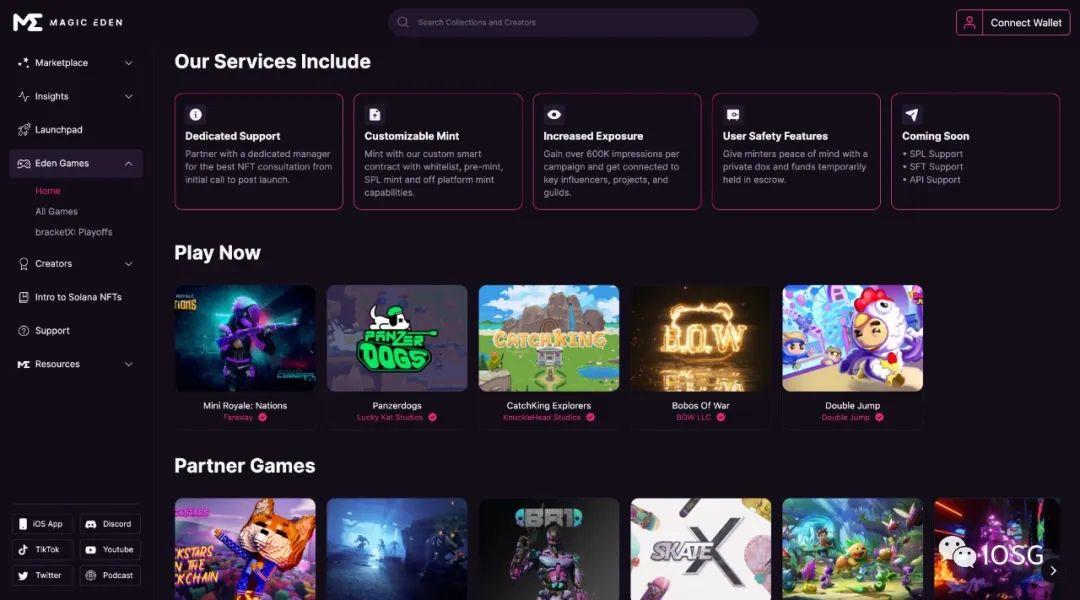
Magic Eden is a universal NFT trading platform similar to Opensea, focusing on the Solana blockchain ecosystem. Eden Games, on the other hand, is a one-stop platform launched by Magic Eden specifically for game developers and gamers.
Eden Games currently includes the following features:
- Dedicated Game Listings: Each game's introduction page includes a game trailer, the content display page shows the game's social content and description, as well as the NFTs the game contains.
- Content Hub: Game content recommendation mechanism to help players quickly find the content they need.
- Tournament Channel: Regularly hold game tournaments, invite community members to participate, and provide rewards.
- The platform provides developers with: NFT consulting, customized minting, marketing and promotion, user security, and other support services.
Idea: Magic Eden itself is a leading NFT marketplace on the Solana blockchain (trading volume on Solana surpasses that of Opensea), with 1.5 million daily active visitors and 10 million monthly active visitors. Eden Games is planning to leverage Magic Eden's massive built-in traffic to become a discovery and distribution platform for games and game NFTs. The giant entering the game NFT marketplace has a natural traffic and liquidity advantage.
Eden Games
Fractal: A Vertical Game NFT Marketplace
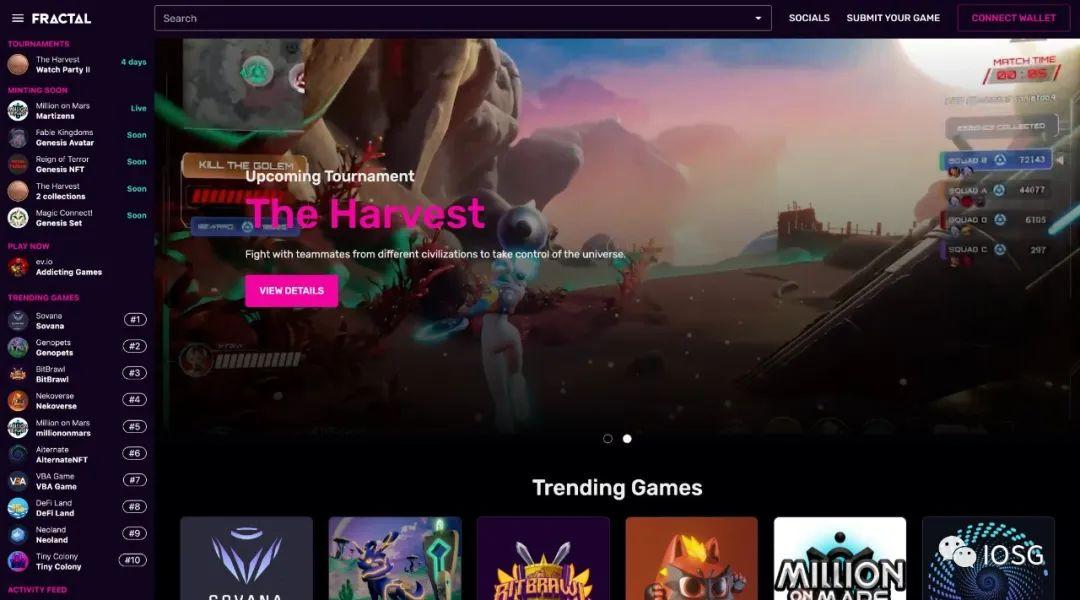
This platform was founded by Twitch co-founder Justin Khan, focusing on blockchain games and game NFTs. It aims to create a more secure marketplace for NFT games and provide them with promotion and distribution services.
Fractal's value proposition includes:
High-Quality Game NFT Launchpad: Fractal employs a strict vetting process, currently accepting only 5% of applicants, with over 20 projects in the pipeline.
Fractal provides NFT-fi services with gaming features such as lending, staking, fractionalization, etc.
Fractal will serve as the best-in-class game management and discovery layer, empowering game developers to reach consumers.
Idea: Fractal itself does not develop games and is not backed by established NFT giants (such as Magic Eden). Looking at successful web2 game platforms like Steam, Epic, and even TapTap, they all have the seed users brought by their parent companies' in-house developed games. Fractal hopes to overcome more obstacles in its positioning as a game management and discovery layer.
Fractal
DMarket: Platform Integrating Web2&3 Game Assets
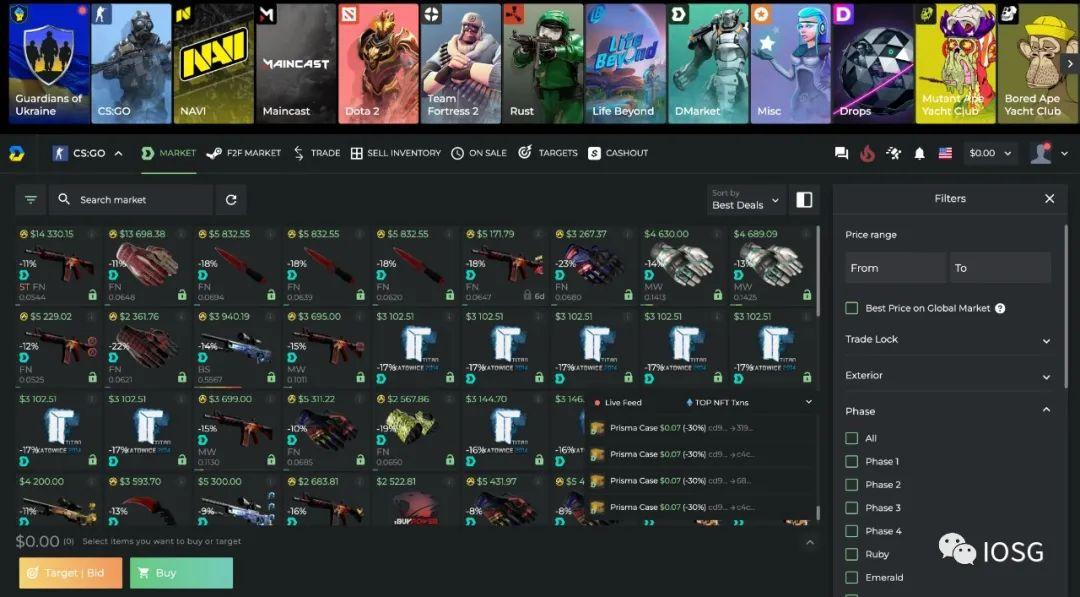
DMarket aims to create a multi-billion-dollar digital asset trading platform for game developers, players, streamers, and esports organizations. What sets DMarket apart is its use of blockchain technology to enable trading of in-game assets (including skins, not just NFTs) from both web2 games (such as CS:GO and Dota 2) and web3 games (such as Decentraland).
Idea: In traditional games, the most profitable games often have a "skin economy," with large DAU free games where billions of dollars worth of digital assets circulate in the secondary market annually. In fact, as early as before 2016, platforms like OPSkins emerged for trading game assets using Bitcoin. These third-party platforms utilized Steam's API to integrate with other payment systems and circumvent many of Steam's restrictions (e.g., a weapon skin cannot exceed $1,800). These platforms attract a large number of traditional gamers and serve as a vital gateway to convert web2 players to web3.
DMarket
Future Outlook
You need to break before you can build anew. After reaching its peak profit on August 6th last year (daily revenue of $17.5M), Axie Infinity's daily revenue has now dropped to below $10K. The narrative of blockchain games is undergoing a transformation, and the play-to-earn model is also facing scrutiny. With Axie Infinity's "failure," this is gradually becoming an industry "consensus."
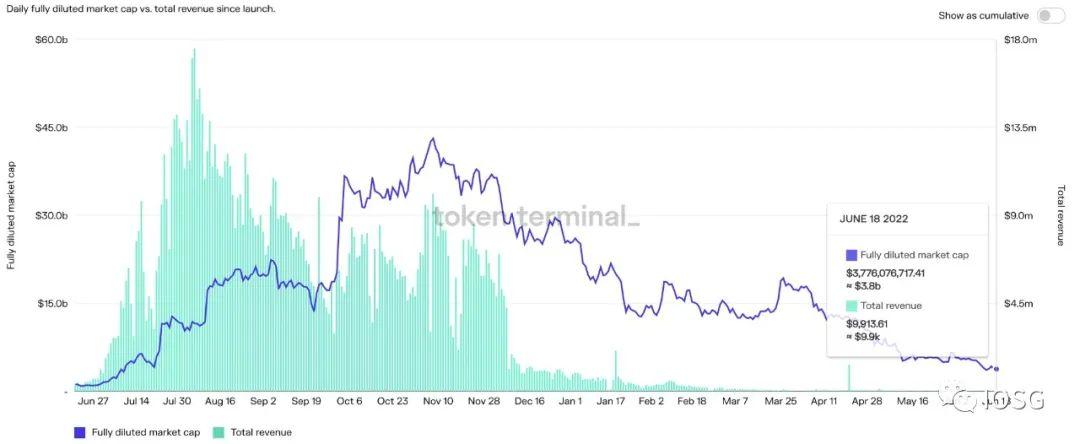
Source: https://tokenterminal.com/terminal/projects/axie-infinity
But let's also look at the bright side: Axie Infinity has generated a total revenue of $1.3 billion, and its token AXS FDV has reached a market cap of up to $43 billion. Even after the market downturn, it still stands at $30 billion. Without the cryptocurrency economy, Axie Infinity, developed using a Web2 approach, would never have achieved what it has today.
Despite the NFT industry's explosive growth in the past two years, we are still in the early stages of the industry. According to Hootie Rashidifard's research, data from June 2021 shows that only 13% of Americans have purchased cryptocurrency, with this number dropping to 3% globally. The top-ranked Axie Infinity currently has a DAU of about 300K, a number that will only decrease when removing multiple wallet accounts. In comparison, the Web2 game with the highest DAU, Roblox, has data as high as 8.6M. This indicates that there is still a lot of room for blockchain to grow.
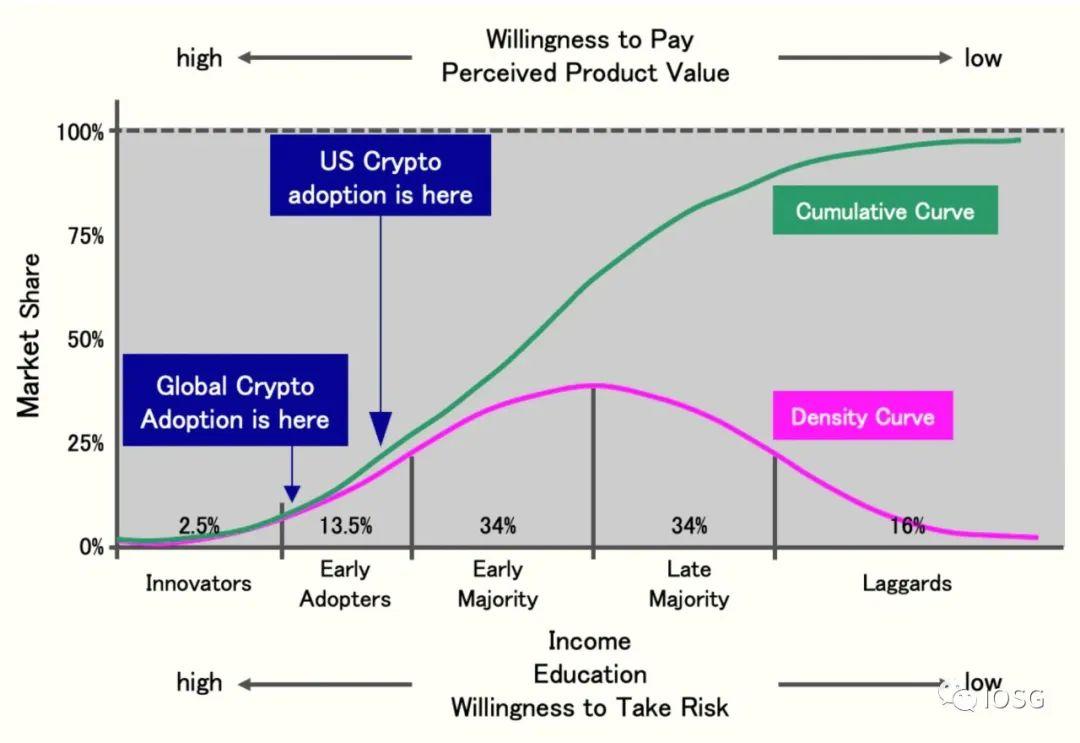
Source: Am I Too Late?
NFTs are the underlying elements of the Metaverse and blockchain games, while the NFT trading market is the cornerstone of the digital asset economy. Niche NFT trading markets focused on gaming are expected to be among the first successful vertical platforms in the future. However, in addition to basic trading functions, we can see that gaming NFT trading markets are expected to become a discovery layer in the gaming ecosystem. How Web3 games attract users has always been a hot topic.
The customer acquisition and revenue calculation methods for Web2 games are clear: ad placement → user acquisition → user retention → comparing LTV and CAC to calculate ROI. However, Web3 games face significant challenges on the ad buying side due to regulatory compliance, low conversion rates on user acquisition, and difficulty estimating LTV on the profit side. Trying to promote Web3 games using the current Web2 promotion methods will result in a high CAC that is difficult to recoup (unless it is free-to-play and embeds blockchain at a level that users do not discover). The current mainstream promotion and revenue sources for Web3 are: community seed user accumulation → airdrop diffusion → promotion within the Crypto community → INO/IDO funding → NFT secondary trading fees + Token Value (LTV).

Source: https://flow-with-heart.notion.site/Web2-Web3-075e6dc8b0a04afe9e46e13db8aa858c
This Web3 promotion method relies on community fission, placing high demands on the project's founding team, making it difficult to quickly reuse for other projects. Exaggerating a bit, this has CX attributes. The production and promotion processes that are difficult to reuse do not align with the game industry's large-scale project initiation, rapid iteration, testing, optimization, or elimination production processes. Coupled with the uncertain business model mainly relying on secondary market trading fees, this ultimately makes it challenging to estimate CAC and LTV.
The Play-to-Earn Business Model of Blockchain Games has not yet been fully validated, indicating that the market structure is far from solidified, leaving plenty of opportunities for entrepreneurs. Unlike the web2 model where platforms earn revenue through ad sharing and game fees, a Game NFT platform can sustain its operations solely through primary and secondary NFT transactions (or focus on secondary transactions), significantly reducing the burden on game developers. With the widespread adoption of blockchain games, the game NFT trading market is poised to take on a more prominent role, facilitating user acquisition, user discovery, user retention, cross-game promotions, and user migration, thus leading the industry's development.
Part.2 Investment and Financing Events

The Wildcard Alliance Completes $46 Million Series A Funding Round, Led by Paradigm
* GameFi
Independent game studio Playful Studios' Web3 game subsidiary, The Wildcard Alliance, has announced the completion of a $46 million Series A funding round led by Paradigm, with participation from Griffin Gaming Partners, Polygon, and others. The company is set to launch a multiplayer online battle arena game.
Atmos Labs Completes $11 Million Seed Round Financing, Led by Sfermion
* Metaverse
Metaverse developer Atmos Labs has completed an $11 million seed round financing, led by NFT investor Sfermion. The round saw participation from various companies including UK hedge fund billionaire Alan Howard, Animoca Brands, Collab+Currency, FBG Capital, GSR, CoinGecko Ventures, and Avocado Guild, among others. The funding will be used to create a "Play-to-Earn" metaverse. Reportedly, their first game will be the F1 racing and flight game ExoGP.
Castle Completes $1.5 Million Pre-Seed Round Financing
* NFT Smart Wallet
NFT smart wallet CASTLE has completed a $1.5 million pre-seed round financing, led by Dragonfly Capital. Participating investors include Palm Tree Crew, Lattice Capital, Whitestar, and Framework, as well as individual investors such as Andy (Fractional), Gmoney, Jess Sloss (Seed Club), Trevor McFedries (FWB & Dapper Labs), Linda Xie, Cooper Turley, Hunter Horsely (Bitwise), Mariano Conti, Jason Goldlist, John Barnett, Joshua Harris, among others. The Castle wallet features include multi-signature support, built-in NFT marketplace, batch transactions, portfolio tracking, and more. It is currently in open beta with users able to join the waitlist.
zCloak Network Completes $5.8 Million Pre-Series A Funding
* Zero-Knowledge Proof
Zero-knowledge proof startup zCloak Network has completed a $5.8 million Pre-Series A funding round, with participation from Coinbase Ventures, Bixin Ventures, Matrixport Ventures, DFG, Sancus Ventures, KuCoin Ventures, Sanctor Capital, Hash Global, and Jump Capital, among others. This funding round will be used to expand partnerships with Web3 applications and other blockchain networks. IOSG participated in the previous round of investment.
Bits of Stock Completes $4.4 Million Seed Funding
* Cryptocurrency Reward Platform
The Netherlands-based consumer cryptocurrency reward platform Bits of Stock has announced the completion of a $4.4 million seed funding round, with participation from Keen Ventures and Yellow Accelerator. The Bits of Stock application enables consumers to earn cryptocurrency rewards from everyday shopping and has already partnered with over 60 brands, including Adidas, KFC, Nike, Zara, Uber, Spotify, and Netflix. The company has also launched an API that allows retailers, neobanks, BNPL providers, and other clients to embed the reward experience into their own applications.
Foresight Ventures Launches $200 Million Crypto Fund Foresight Secondary Fund I
* Fundraising
Foresight Ventures has launched a $200 million crypto fund, Foresight Secondary Fund I, which is a Special Purpose S (SAFT) fund focused on investing in crypto assets seeking liquidity in the private markets. According to official disclosures, the crypto exchange Bitget is the fund's largest single LP.
Immutable Launches $500 Million Developer and Venture Fund to Accelerate Web3 Gaming and NFT Projects
* Fundraising
Ethereum NFT layer 2 scaling solution Immutable has announced the launch of a $500 million Developer and Venture Fund to accelerate the adoption of Web3 games and projects. This funding will support projects building Web3 games and NFT-focused companies on its Immutable X. The fund will be divided into a venture fund and grants, with the venture fund partnered with venture firms like BITKRAFT, Animoca, Airtree, King River, GameStop, among others. The grants program plans to hire professionals through Gods Unchained and Guild of Guardians to provide applicants with essential Tokenomics, game design, and marketing knowledge.
Sequoia Capital Launches Two New Funds with a Total Size of $2.85 Billion to Expand Investment in the Web3 Space
* Fundraising
Sequoia Capital's subsidiaries Sequoia India and Southeast Asia have announced the launch of two new funds, namely the Sequoia Capital India Early Stage and Growth Fund (approximately $2 billion in size) and the Sequoia Capital Southeast Asia Exclusive Fund (approximately $850 million in size). Reportedly, in addition to continuing to focus on areas like SaaS and FinTech, both funds will further expand their investment scope, including the Web3 space. Sequoia India and Southeast Asia have previously invested in Web3 startups such as CoinSwitch Kuber and Polygon.
Part 3 IOSG Post-Investment Project Updates
Avalanche: Three Arrows Capital Has Never Managed, Used, or Custodied Funds from the Avalanche Foundation
* Public Blockchain
In response to recent market speculation following Three Arrows Capital's liquidation, Avalanche clarified on Twitter that Three Arrows Capital has never in any way managed, used, or custodied any funds from the Avalanche Foundation's treasury.
StarkWare Launches StarkNet Alpha 0.9.0 on Mainnet, Introduces New Fee Mechanism
* Layer 2
Israeli zero-knowledge proof development firm StarkWare has announced the launch of StarkNet Alpha 0.9.0 on the mainnet, following its earlier release on the testnet. The new version features mandatory fees, with other upgrades or changes including the introduction of Contract Classes and Contract Instance separation, enabling the use of the factory pattern on StarkNet, and the replacement of delegate calls with library calls.
In previous news, StarkWare, valued at $2 billion in January, completed a $50 million Series C funding round. In March of this year, StarkWare showcased for the first time in its testnet release of Alpha 0.8.0 a fee mechanism priced based on computational complexity, though the payment of fees was not mandatory in that version.
MakerDAO to Temporarily Disable Aave DAI Direct Deposit Module (D3M), Maker Protocol Reveals stETH Holdings, with stETH Collateral Value of Approximately $260 Million
* Stablecoin
The MakerDAO community's proposal to temporarily disable the Aave DAI Direct Deposit Module (D3M) has passed, and the execution will begin at 5:03 AM UTC on June 18th. According to the proposal, the temporary disabling of the Aave DAI Direct Deposit Module is due to 1 billion out of the 2 billion DAI borrowed on Aave v2 being lent to Celsius, primarily backed by stETH, posing a risk. Once the proposal is executed, the target borrowing rate for Aave DAI Direct Deposit Module (D3M) will be set to 0.
The Maker Protocol Twitter disclosed the stETH holdings, with stETH collateral representing about 3% of all DAI collateral, valued at around $260 million; the WSTETH-A Treasury holds 204,661.12 WSTETH, valued at $243.2 million, with a total debt of 82.9 million DAI and a collateralization ratio of 293.42%; the WSTETH-B Treasury holds 9,014.31 WSTETH, valued at $10.7 million, with a total debt of 2.5 million DAI and a collateralization ratio of 424.42%.
The Kava community has initiated a vote to reduce the annual inflation rate for Kava stakers to 13.5%
* Public Blockchain
The Kava community has opened voting on Proposal 89 to adjust the annual inflation rate for Kava stakers from 17% to 13.5%, with current support at 98.48%. The vote will end on June 22.
Industry Pulse Part 4
Samsung Launches Samsung Wallet for Storing and Accessing Digital IDs and Digital Keys, Integrating Samsung Blockchain Wallet
* Wallet
Samsung has announced the launch of the Samsung Wallet, integrating Samsung Pay and Samsung Pass for users to store and access digital IDs, payment and membership cards, digital keys, among other data. Moreover, Samsung Wallet is secured by Samsung Knox's defense-grade security and integrates with the Samsung Blockchain Wallet to leverage the open Galaxy ecosystem, enabling users to easily monitor their cryptocurrency portfolios across multiple crypto exchanges.
Carbon-Neutral Web3 Protocol Co2 Zero Partners with EOS to Launch TrustEVM on the EOS Network
* Virtual Machine
The Carbon-Neutral Web3 protocol Co2 Zero, supported by Alibaba Cloud, has announced a partnership with EOS to launch the EOS network's official Ethereum Virtual Machine (EVM) TrustEVM. Co2 Zero is a Web 3.0 protocol for personal carbon neutrality, NFTs, and carbon asset transaction circulation, supporting trusted records of the carbon footprint lifecycle and trusted circulation of all elements of carbon emissions through blockchain's technical features such as decentralization, tamper resistance, traceability, and full traceability.
Central Bank of Bangladesh to Study Feasibility of Introducing CBDC
* Digital Currency
Bangladesh's Finance Minister AHM Mustafa Kamal has stated that as part of the country's 2022-2023 fiscal year budget, the Bangladesh Bank plans to study the feasibility of introducing a Central Bank Digital Currency (CBDC). Kamal noted that many countries globally are exploring CBDCs as a viable alternative to privately issued digital currencies, considering them as a risk. With the growth of internet penetration and the e-commerce industry in Bangladesh, he emphasized the need to consider this alternative, stating that the primary purpose of CBDC is to facilitate digital transactions, encourage startups, and e-commerce businesses.
Solend Governance Proposal Approved, to Impose Special Whale Collateral Requirement and Temporarily Seize Whale Account
* DeFi
The governance proposal initiated by Solana's DeFi lending protocol Solend has been approved with 1,155,431 votes in favor (97.5%). The proposal supports imposing a special collateral requirement on whales holding more than 20% of the total borrowed amount, where a 35% special liquidation threshold is required if a user's borrowing exceeds 20% of all borrowing in the main pool. Solend Labs is granted emergency powers to temporarily seize whale accounts to enable off-chain liquidation, which will be carried out through a smart contract upgrade. Once the whale's account reaches a secure level, the emergency powers will be revoked. Earlier reports indicate that Solend founder Rooter has urged a particular whale (address starting with 3oSE) to repay the loan promptly to avoid liquidation risk. This whale holds $170 million in SOL deposits and $108 million in Stablecoin borrowings, currently representing 95% of SOL deposits and 86% of USDC borrowings. The liquidation price for the whale's borrowing is $22.27 (current SOL price is $29.16). In case of liquidation, it will start with a partial liquidation capped at 20% of the outstanding loan (around $21 million). Subsequently, Solend has temporarily disabled USDC, USDT, and SOL borrowings in its Main Pool.
Stablecoin MIM Issuer: Treasury Has Sufficient Assets to Cover Defaults, Will Announce Specific Repayment Plan
* Stablecoin
Stablecoin MIM (Magic Internet Money) issuer Abracadabra has stated that its treasury holds sufficient assets to cover the $12 million default incurred during the UST collapse. Once more information is received about the LUNA 2.0 airdrop scale and timing, Abracadabra will release a comprehensive repayment plan. Abracadabra notes that its operational treasury (excluding SPELL Token) currently holds over $13.2 million in assets, including 6,619,923.5 MIM and 10,380,153.06 CRV. In addition to the operational treasury, Abracadabra's assets include a separate SPELL treasury and unclaimed LUNA 2.0.
Deribit: Three Arrows Capital Has Been a Shareholder of Its Parent Company Since February 2020, Few Accounts Have Net Debt on Deribit
* Trading Platform
Cryptocurrency derivatives trading platform Deribit has stated that Three Arrows Capital has been a shareholder of its parent company since February 2020. Due to market developments, a few accounts have net debt on Deribit, and Deribit believes these accounts may be distressed. Even if these debts are not repaid to Deribit, Deribit will remain financially healthy, and operations will not be affected. Deribit can confirm that all client funds are secure, and Deribit will absorb any potential losses.
Circle to Issue Euro Stablecoin Euro Coin
* Stablecoin
USDC issuer Circle has announced that on June 30, it will launch a euro-backed, regulated stablecoin Euro Coin (EUROC) on Ethereum, later this year expanding to support other blockchains. Starting June 30, 2022, institutional clients will be able to use Euro Coin via a free Circle account, and developers can now start integrating with the Euro Coin smart contracts. Anchorage Digital, Binance.US, Bitstamp, Compound, Curve, CYBAVO, DFX, Fireblocks, FTX, Huobi Global, Ledger, MetaMask Institutional, and Uniswap Protocol will support Euro Coin at launch.
OpenSea to Migrate to New Protocol Seaport, Expects Gas Cost Reduction of Approximately 35%
* NFT
NFT marketplace OpenSea announced on Tuesday that it is restructuring its backend, moving from the Wyvern protocol to its in-house developed open-source protocol, the Seaport Protocol. This transition can significantly reduce transaction costs on the platform, with Gas costs expected to decrease by around 35%. The new protocol is estimated to save users over $460 million in fees annually. In addition to lowering Gas costs, migrating to Seaport will also allow OpenSea to eliminate new user onboarding costs, enabling users to bid on entire collections and making wallet signatures easier to read and understand.
Meta to Partner with Maison Margiela, Prada, and Thom Browne to Launch Digital Fashion Marketplace
* Metaverse
Meta CEO Mark Zuckerberg announced on Friday during an Instagram live stream that they are partnering with Maison Margiela, Prada, and Thom Browne to launch the Meta Avatars Store digital fashion marketplace. The store will go live on Instagram, Facebook, and Messenger, allowing users to purchase digital clothing for their virtual avatars. The Meta Avatars Store will launch next week in the U.S., Canada, Thailand, and Mexico, initially featuring digital clothing from Maison Margiela, Prada, and Thom Browne, with plans to introduce new brands in the future.
FTX Acquires Canadian Regulatory-Compliant Cryptocurrency Exchange Bitvo
* Exchange Platform
FTX has announced the acquisition of the Canadian compliant cryptocurrency exchange platform Bitvo. The Bitvo acquisition is set to be completed in the third quarter of this year, subject to approval from Canadian regulatory authorities. After the acquisition is finalized, Bitvo will either be integrated into the FTX global team and serve the Canadian market's users. Bitvo is a compliant Canadian exchange platform, having become the first cryptocurrency exchange platform to be officially registered in Alberta, Canada, in April 2022, and is regulated by the Canadian Securities Act, allowing Bitvo to offer a secure and straightforward way for users in the region to trade and acquire cryptocurrency assets. Additionally, Bitvo is also registered as a money services business with the Canadian financial intelligence agency FINTRAC.
Original Article Link
Welcome to join the official BlockBeats community:
Telegram Subscription Group: https://t.me/theblockbeats
Telegram Discussion Group: https://t.me/BlockBeats_App
Official Twitter Account: https://twitter.com/BlockBeatsAsia