Dialogue with Big Time: The new economic form of GameFi2.0
Original title: "Dialogue with Big Time: The New Economic Form of GameFi2.0"
Original source: Circle
Original compilation: Shenchao TechFlow
This article is a compilation of the dialogue of Circle's podcast "Money Movement". The founder of Circle, Jeremy , talks to Ari Meilich and Thor Alexander of Big Time Studios. The future of blockchain-based games, the creator economy, and the economicization of digital games are explored. Deep Tide TechFlow is authorized by Circle to compile and forward.
Record< /h4>
Jeremy:We have invited Ari Meilich today, he is the co-founder of Big Time studio and the co-founder of Decentral Land .
We'll be discussing Big Time Studios next, and our theme will be what they're building. But I think we're also going to really explore some of the bigger topics that are getting a lot of active attention.
In the encrypted economy, what will the NFT gamification market model of Metaverse bring to creators? I believe you should have thought about this problem, because you have done a lot of work in this area. It is my pleasure to discuss these topics with you. You are welcome and thank you for joining us.
Ari:Okay, thank you for having us here.
Jeremy: Well, ok. I think we have a lot to talk about. Let’s go back to your early days in crypto and talk about your origin stories and how you got here. At the same time, we will also talk about the land of Decentral, after all, everyone has seen its extraordinary growth rate.
Ari:Okay. I would say that this project (Big Time) actually started to incubate when Thor and I, along with the rest of the DEcentraland team, were about to launch Decentral Land. And we anticipate that when the product is rolled out to the public, there will be some changes in our corporate structure in favor of full decentralization.
This means we are disbanding the original development company, creating a new independent foundation, and forming a DAO. So as we go through the process, we naturally step back from management as the entity disappears. In this regard, he and I have very strong ideas, we want to do it in different ways, and think about what shortcuts should be taken to promote and speed up the usage rate of the product.
But then when we launched Decentral Land, maybe there were only 20 to 50,000 players playing the so-called blockchain games, which was still very early stages, And we've lived through this time firsthand. Even with all the hurdles, regular users are still trying to play these games. Players looked down on blockchain games back then, and maybe they still do.
Blockchain games are like free games back then, when most games were paid. So I decided to continue building in this area. We have foreseen that blockchain technology will become one of the components of the game track.
So we decided to start a new company and start with AAA games or what gamers call hardcore games. As much as we wanted to make this game a bit lower, we wanted to make it for people who really like the game and let them spend a few hours playing it, and it doesn't matter whether they have money or whether there is speculation like other game makers Psychologically irrelevant.
Thor: Two biggest things we learned in Decentral Land:
1. One is now well known that there is a huge demand for NFT, especially in games.
2. Another thing that people have not realized is that the entry barrier of blockchain games is too high for ordinary people.
So one of the Big Time visions is to turn that around and break down all the barriers. It’s a mass market that allows people to enter with a lower barrier to entry, without barriers like getting a cryptocurrency wallet or having to go to a cryptocurrency exchange or company to handle cryptocurrencies.
Jeremy: Yes. We also just disclosed that Circle and Circle Ventures are among the investors in Big Time. We're really excited to support what you guys are doing. Moreover, we are also partners in linking cryptocurrency infrastructure and traditional financial infrastructure to the blockchain game world, and creating more seamlessly integrated blockchain games.
Giving people access to the market is key. And I really appreciate the opportunity to work with you on multiple fronts. thank you all. We dial back a little bit, and you know, there's an incredible amount of hype around the Metaverse right now, from Anaptys to blockchain games.
It was hype to a certain extent, but it was enough to surprise us all. Maybe you won't because you've been doing this for a long time as believers. As someone who built one of the great examples of virtual worlds, what are the biggest trends right now in your eyes? How can people get involved with current trends?
When people describe things they tend to simplify things, and as a long time practitioner, I'd love to hear you blow it up, like No puns in your Metaverse article.
Thor: Okay. I think what we're seeing is the intersection of three trends that's changing the way everything works.
1. The first is around ownership, which is what blockchain is really good at -- helping people and businesses really take control of their assets.
2. The second trend that follows is that you can own your identity instead of Facebook owning it for you, much to their chagrin .
3. The third trend is the really exciting one, it is interoperability between different worlds, the realization of the first two trends is the Preconditions for the realization of the three trends. The third trend is where we end up going, and it won't just exist in the pens of writers beyond the Great Wall.
There you can have a virtual identity and use it to enter and exit the virtual world. You will own virtual assets, such as some companies and databases that you own now. You can take them to different worlds. This is just the beginning too, everyone is excited about it, which is cool.
We've got a lot of plans for how we're going to get there, but it's all very long-term. Now we don't want to put the cart before the horse, but keep things as simple as possible and build the product in the right order.
Ari: In addition to what Thor said, there may be some other changes. For example, consumers and their behavior, they can buy assets in the game as they like, but consumers have very little control over these assets. And in the real world, you can lend books to friends or resell them, and of course your albums or whatever. Controlling one's own assets in a separate virtual world was not possible until recently.
With blockchain, players' virtual items will be more secure. We'll have more transparency on their properties. And there is a common standard for how these items are exchanged and transferred.
So the fact that people are buying assets now is buying a certain amount of reproduction of the asset. And we know that in the future, you can transfer it whether the game developer wants to or not. I think it boosts people's confidence when buying. As a result, people may spend significantly more time than they would in a traditional game because it's not a sunk cost for them. Instead, they know those assets will stay with them.
Jeremy: Yes. This kind of digital ownership is a huge part, like you said, it already exists in some form, but in an open, interactive, fluid way. Clearly, ownership is a coping strategy.
So, what is the broader phenomenon, that is, making money through games. The real economy, regardless of whether listed companies are looking for their own development path, you are also building your own blockchain game. So how far will blockchain games develop before they become a place for people to make a living?
Not just speculating on ourselves and enjoying, obviously, entertainment and enjoyment are principles of hope, but, where is the boundary? Where do you think those boundaries should be? Seems like a lot of people are after this. And there have been many hot spots in this area, and people want to try to replicate this model.
And, maybe it makes sense when you think about it from a gaming perspective, which I'm very interested in.
Ari: Generally speaking, the distribution of game items is that publishers or game developers sell items to players. With freely transferable assets, you can gain economic benefits and can introduce more innovations in terms of money flow.
You'll get more active peer-to-peer transactions where you can trade items for real money, or time for real money. People hope that at a certain point in time, the flow of funds will not just be from players to developers, more people will invest their time and money into a game, and there will be other players who are not involved in the development company or publishing company. accept funds.
There is a super trend in the online world, more and more people are trying to make a living online. If you pay attention, there are probably 50 million influential people who already make a living producing content on social media.
It is one of the most in-demand careers for kids and teens and those involved in online gaming these days. I think there's a lot of pent-up demand in that regard. Some very small and elite groups, such as e-sports athletes, make money through competition. And when there's 3 to 4 billion people playing online games in such a small segment and making a living online, obviously there's a lot of demand. More people are also starting to choose careers on the Internet.
I'm not saying that the future of gaming is merging play and work, I'm just saying that more of this will happen gradually. Because a lot of people are looking forward to spending a lot of time on it. So you'll also naturally want to hire people online, or you'll outsource some tasks to other people.
Jeremy: The size of this economy and the amount of activity is enormous. It's interesting. That's all an entry point, but there's a piece of data I'm going to bring up: this morning, the US releases labor force participation numbers, with non-farm payrolls showing an increase in employment.
There was also news of 200,000 new jobs. LinkedIn's chief economist said on a TV show that she thinks it's off target because it's just the amount of hiring activity and new entity creation activity.
Every sector is forming new companies at a record pace right now, but they don't show up in the kind of W2 salary data that people typically get. And, it's kind of like how much of the real economy. People are making money for a living, but they don't get a W2 payroll from an online game, but they do make a living in the crypto economy.
It's obviously going to become more and more apparent, as you talk about that digital lifestyle and stuff like that. Maybe this can be connected to what you guys are building. This concept, a triple-A, high-production value game, can in some ways be seen as the foundation of the platform you're building.
Maybe you can chat, for example, you can assume that this is a platform, a platform of other creators. Your studio, what kind of game interoperability do you envision looking like? How far into the future do you think an interoperable marketplace will be? Also, maybe you can share your own business roadmap publicly.
Ari: We have launched a big Team studio.
Like in 2018, 2019, everyone was looking for top blockchain applications, but this has changed a bit. There are many wallet companies in the blockchain game field, and everyone is trying to send "funds" to these non-existent game companies. The most important thing if you want to be successful is to build content. That aspect is consistent when we start talking to more traditional game companies, and we try to support their games as well.
We realize that we need to navigate all the challenges in becoming a first party content creator. In the near future, we will meet the game companies we want to support and grasp the solutions to these problems. So we've been focusing on building big games and indie games. In most cases, even though we know that in the process of developing a game, we need to polish a lot of tools and understand the processes that are useful to external companies.
But the worst thing is that we still have to focus on the game itself. The game will launch in April. As an early bird launch, the game will initially be available to those who have purchased an early access license for an extended period of time, approximately 12,000 people. We have of course been in communication with various game studios.
What happened in the last six months or so, ACCE exploded and became a giant, and maybe audiobooks are sort of like traditional game development Those who have begun to have a more positive view of the prospects that blockchain games may bring, and understand that this opportunity is quite large.
So I think the timing is great because we've been in development for over a year and a half and we're close to our launch date (and in the market in a few days) start) less than half a year. Now we are ready to invite other game developers to join and provide them with tools and our expertise, as well as our market liquidity.
We've seen what challenges the future holds in terms of technology, game design, economics, regulation, and more. This is no small matter. We will use some methods to design assets to make them legal and compliant. So we're trying to work with studios that are trying to go down that same path.
I think the most important thing is to develop together with gamers, because it takes at least three years to develop a game, sometimes even longer. We're trying to work with developers whose games can stand on their own. Even if we were in a bear market like in 2018, there was no such rapid growth as we can see now.
Jeremy:Yeah, that was exciting. Groups of creators, traditional game developers, etc. have begun to realize that (they) are just in our own business.
A game developer needs to build a blockchain game, what are the key parts? What are the most common of these parts? These things will be built on some foundation, if given some interoperability, what will bring to them?
Thor: From this point, we can abstract a level, that is, here is our development on how to successfully make blockchain games or A playbook for better blockchain games. It's similar to what we've done with social games and MMOs before, where there's an existing way, everybody's doing things, and then a disruptive force comes along and you have to change your game and figure out what can make The recipe for how games work in new mediums. It's like, our biggest advantage is from the decentralized land and the first generation of blockchain games that the party has already made.
So we're now in GameFi 2.0. All of these are bold. The opportunity we give to those who work with us and get on the platform. Here's a bunch of things you can do with great results. Not only that, but it also includes the reasons behind it. It's a secret we've learned the hard way, and we can use it to help people avoid falling into the trap.
Ari: To answer your question more specifically, people need to actually know how to sign these types of assets. The current game economy is different from before. Before people can freely transfer assets, the business model needs to be slightly changed, because the current business model is still one-to-many. Now there are more and more open economies.
Just like that, we started thinking about giving players an easy way to get players into the game. When you step out of the small circle of the blockchain industry, most people don't know what a wallet is. They don't understand Meta Mask wallets. They don't understand that wallets need to be self-custodial. But despite that, I'm an advanced user myself and use it all the time.
We're trying to sign up for those who aren't ready to accept these things. But who would want someone to act on their behalf to keep their assets safe? This has always been a no-no in blockchain development.
Because it might break those principles, like you can't help them in a scenario where you're holding assets on behalf of your father, where you're not a censorship resistant. We're actually doing some work on other fronts as well, like with gateway CAs and checks in the mail, because we want to work with partners for payment processing.
It's kind of like we had a turning point a few years ago, and at that point it came up with some different obstacles. Beyond that, to some extent, the way of building a community in a blockchain is also different. You must be able to use different ways to motivate participants. This is another thing we have, I think.
Jeremy: Yes, that's right. Incentive design and drive exist in various kinds of network dimensions. It's been a lot of fun.
We are partnering with dApper Labs and they are trying to improve the format of their digital collectibles, creating a scalable model. And I think they've got great insight and FTS as well, but there needs to be a user experience that allows people to really seamlessly go into these marketplaces and access them with a high-fidelity experience.
Also, be able to take on some of these things (like customer due diligence and releases). This needs to be done in a compliant manner so that it can actually be accessed. We are already seeing partnerships with major sports leagues like MLB (Major League Baseball) and other partners being built in a similar way.
So it will be interesting to see that. Games, whether to become the norm. This quality, experience, will become the norm, and in contrast, it just needs to be more fully self-sovereign as advanced users enter the order.
Ari: Like centralized projects where there are no guardians and access to a wider audience Chance. But we may have those opportunities.
Jeremy:Yes. But I think while part of that promise is that at the core of your architecture, our blockchain, and our NFTs, at the core of that is the exchangeability, the interoperability and actually the ability eventually for people to be able to move things around in this way Promise of.
I mean, it's essentially about people's experience when they participate in these.
I'm curious about this question. How do you think the market structure has evolved? Around this, we obviously have examples like NFT marketplaces, and everyone seems to be trying to launch NFT marketplaces. After launch, we will go mainstream and adapt to user preferences to build a huge exchange. There must be derivatives, options, futures and the like to satisfy their NFT work or what they will be looking for. That's a bit more for a content-oriented experience?
Ari: Yes, I think as the market develops, there will be The space and needs of the specific market segment of the vertical. The NFT market they launched is now usually focused on digital art, and there will be others focused on music and FTS.
This is going to be a pretty big trend, and over the past year or two, we've seen a higher popularity. That's a completely different use case. I'm not a big fan of digital art though, I just love games.
As you can see, many gamers outnumber art collectors. Even NFTs make art collections more accessible. The market and demand for the game is likely to be much larger, and the needs of these people are completely different.
In our case, specifically, our architecture and system allow NFT to exist in the game or in the market, but we need to act as a wallet character of. The way most existing market businesses are structured now, usually what we see are wallets, or based on centralized infrastructure, such as Violences or FTX in the market, you need to connect it to the back end of the game. I'm not sure how this will work unless they open up some APIs.
This is also the purpose of our infrastructure. For game developers, it will be easier for them to figure out what is unfair, and users can see it clearly when they play the game.
Jeremy: That makes sense. You know the relationship between various specific platforms, where the NFT content is tied to a specific specific application, whether it's a game, an artwork or whatever, it looks fascinating.
How does that fit into Big Time and what you're releasing in the spring? Does it have a Token mechanism? Will it be a key part of the game itself? We had a guest in one segment that was Michael from Star Atlas. Recently, they have done sorting, governance tokens, and then NFT, they are a multi-Token economic structure. What do you think of Token's background in the game itself outside of NFT?
Ari: Yeah, so we actually designed our first game, you wouldn't really Games need to be this way. Are there any crypto assets? Maybe it's like a quick primer on the game, and then we can build on top of that.
Jeremy: Why not?
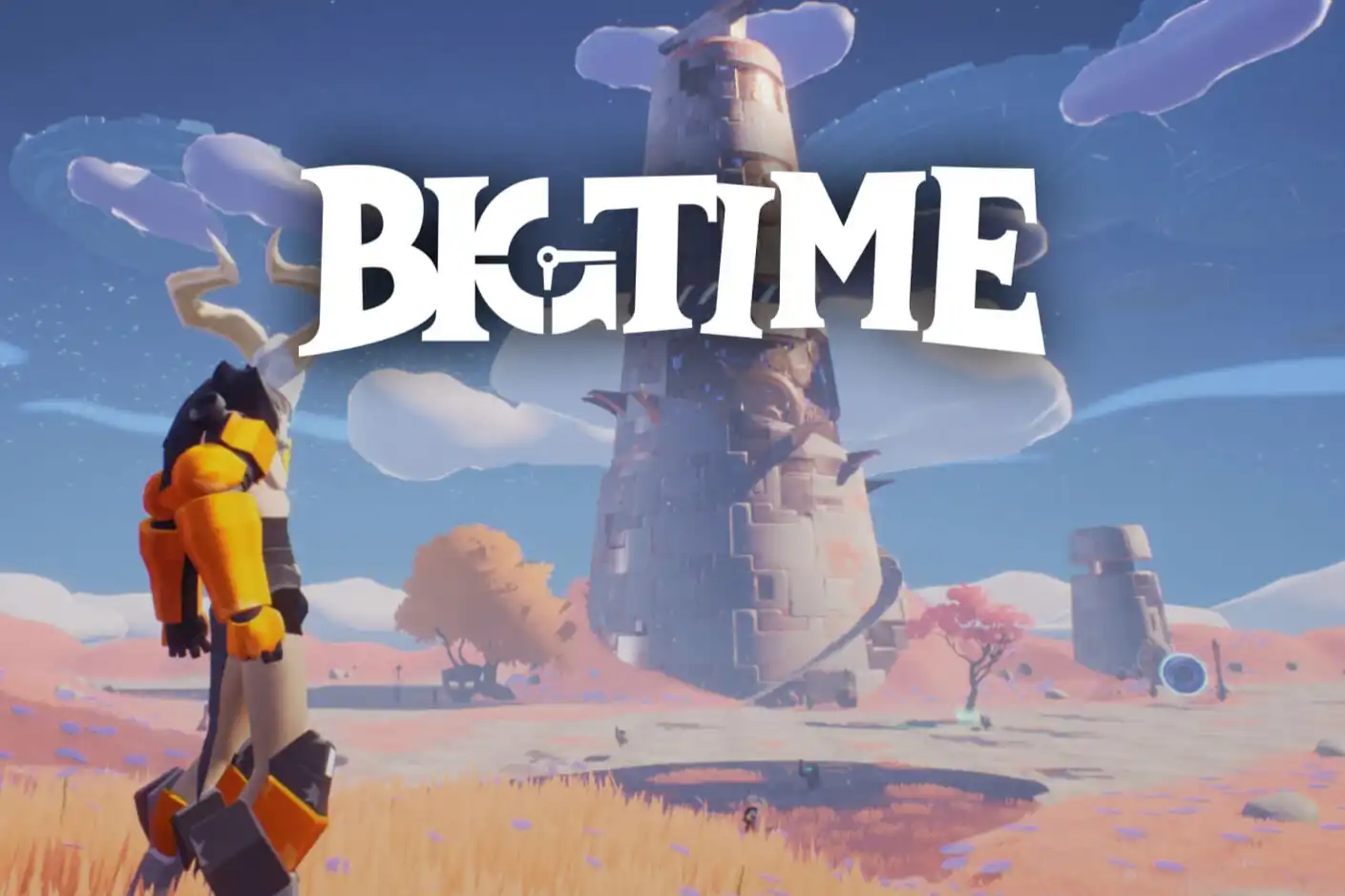
Thor: This game is an action RPG game, a bit like a tribute to old games like Diablo 2, Players kill monsters for loot, and then move on to bigger monsters. At its core, it's a compulsive loop.
So, what we've done is we've enhanced the drops that are part of this driving formula, with super rare, limited edition items. We're addressing some of the issues we've seen, such as in order to fasten our Auction House 3 ship, we've taken a hard line and announced that there will be game-based items.
Then we launched a skin project, but all NFT or skin projects can never be satisfied. This way, there will never be a situation of paid games, and people can participate directly with their wallets. Players who don't pay don't get an unfair advantage, all they can do is join the game and really dress up their characters to make them look really cool.
So what we're doing is creating an arbitrage opportunity between people who have more money than time and people who have more time than money. In this way, one party can continue leveling and kill their time, and then the other party, who is busy with work every day, can fast in and fast out. These busy people may have enjoyed playing these video games before, but now don't have enough time because of work, family, etc. Thus, they can use their wallets and level the playing field to purchase items that they would normally only be able to obtain through leveling. That's what the market does, it allows them to get what they need in a way that doesn't cost them time.
This is the core of what we do.
At the same time, we have added some very cool innovations to this core model, such as innovations in the work rate of Token: take guilt as everything The first order of is also part of our thinking.
An interesting evolution we've seen is players forming guilds for games that we haven't launched strategies and use them to your advantage. This allows us to bring guilds from the back end of the design roadmap to the front end, and it's a "community first" approach to development that's great for working on early bird products.
This gives everyone the opportunity to participate in the earliest stages of game development, which is co-development with gamers. They're a partner who tell you "Hey, these are things we like! These are things we want to try!"
Community Progress It really cheers me up.
Jeremy: What I'm trying to say is that these are community based and combined with the game economy - people The amount of time and money invested in the involved phase of game creation is fascinating and amazing.
It's very different from anything I've ever seen. If you have to take a step back a little bit, you've gone through an evolution in the blockchain space.
And within this space, as a technologist and an entrepreneur, I like to think about converging trends like those things that you can see happening, Or something that is about to happen in a few years. They are more feasible or more suitable. From your perspective, what new things are people interacting with?
Whether it's VR, AR, or in that basic economy, how do those economies or markets end up? Part of your argument is that great gameplay and user experience is something people care about. But when you think about what's happening at the technical level, when you think about what's happening on the surface, you have to imagine what it's going to look like two or three or four years from now.
Thor: The really big disruptive factor is the ubiquity of machine learning and advanced artificial intelligence. This is not to say that we are going to program computers, but that we are going to teach computers to think.
I don't think a lot of gamers have even started to think about how this will affect games. But it's going to fundamentally change the way we make games, and it's happening. I mean, if you want our games to be better, then you have to make our computers better, not our programs worse.
Not many people are out there talking about it. But in reality, a lot of this is already starting to happen on the fringes. This is one of the most important things.
Jeremy: What examples do you think have disrupted the way games are developed?
Thor: Or experience? I'll give you a good example, the animation aspect of the game. We brought in keyframe animation from the 2D industry like Disney, and evolved motion capture, and 2D animators have largely been replaced by motion capture technology.
What we're seeing now, instead of motion capture, where someone comes in and makes a keyframe, is game observation capture, where they're going to take Learn, and then we can say, I want a character that moves like this, this is an animation, something like this.
Not only is this a huge cost savings, it's an amazing creative savings, game development cycles won't be so long anymore, and trying new things It's not that difficult. So we're going to see a lot of really cool stuff. We'll see something similar when it comes to animations.
How do you program a character to act the way you want? We can let a person play the role first, and then we will teach the machine based on this. Then we get really interesting feedback, and it feels more like you're racing against real people than some designer-curated behavior.
The other thing I seem to have said already is that mobile singing games have accelerated the trend of this technology making the opportunity much wider, regardless Where are you.
Like I said before, I think it's proven stuff. At some point, many people have no source of income and look for opportunities on the Internet. But in fact there is a huge game economy, and people are pouring money into it, probably $150 billion a year.
The old model was that all the money went directly to the developer, but now it's much easier to transfer value between peers or between players. That's just the expectation that more money will go to people who don't develop games but want to find their place in the digital economy.
Jeremy: This is an interesting concept. What is Internet Games GDP? It's a question that you never really think about, maybe some people do. But you know it's a real thing, right? How much economic activity does it have, not just in terms of paying for content or paying developers or distributors.
It's actually a whole economy and it's super exciting to see what you guys are doing and we're excited to see every Incremental steps, and milestones you have reached now. And we'll be watching closely, and again, it's a real pleasure to work with you because you're building the system.
Ari:Yes, me too. Thank you for having us here and looking forward to its launch in the market.
Jeremy: Thank you.
Original text link
Welcome to join the official BlockBeats community:
Telegram Subscription Group: https://t.me/theblockbeats
Telegram Discussion Group: https://t.me/BlockBeats_App
Official Twitter Account: https://twitter.com/BlockBeatsAsia
 Related Articles