Can the learning-to-earn model enable Web2 users to cross the technical threshold to enter Web3?

原文标题:《 学习就能赚钱?Learn-to-earn 模式到底是什么? 》
原文作者:召猫 ;编辑:Doge
This article is from wechat official account:Old yuppie
On March 12, RabbitHole (aka RabbitHole) announced the launch and casting of the adventure medal, which is eligible to be awarded to anyone who completes at least one RabbitHole skill task by February 18. It's worth noting that the medal is not airdropped, nor is there a reward such as a Token, but only as an on-chain credential that allows users to showcase their skills and knowledge in the app. Its non-transferable nature eliminates secondary market hype and ensures that any wallet address with an adventure badge actually completes the skill required to learn.
Although everyone in the industry has heard about RabbitHole (the RabbitHole task is often recommended by friends when the call cat first enters the ring), little is known about the specific content of the project. In this article, I will introduce you to the specific problems solved by RabbitHole and its unique learn-to-earn model.
Project introduction

The name "Rabbit Hole" comes from the British fairy tale Alice in Wonderland, in which a young girl goes on a series of fantastic adventures after she accidentally falls down a talking Rabbit carrying a pocket watch.
As a Web3 product that encourages players to learn and explore Dapps, RabbitHole rewards users with tokens based on their on-chain performance, both from the learning app itself and RabbitHole, so that users are constantly motivated to explore apps in different ecosystems.
By completing different tasks on RabbitHole, users can learn different skills (not badges, but actual abilities). Use Aave to learn lending, use Polygon to learn on-chain governance, use ENS to learn domain registration and management, etc. These practical skills can help users better adapt to the changing world of Web3 and make more money out of it.
There is pain points
In the current market environment, new projects and applications are constantly pouring out, but there has not been a systematic teaching process for all kinds of projects and applications. Many Internet users are familiar with the concepts of the metasurverse, Musk, Dogecoin, NFT and so on, but remain outside the blockchain. The reason is that there is no systematic learning of relevant application knowledge and the formation of a huge threshold. They do not understand the advantages and disadvantages of various public chains, nor do they understand the similarities and differences of L2's solutions to the existing problems of Ethereum, nor can they distinguish the NFT narratives with huge price differences after similar JPG images. They only have a vague understanding of the concept of Defi, and cannot talk about the great changes in human organizational forms led by DAO. As a result, Web3's growth is limited by the lack of rapid user growth.
Learn - to - earn mode
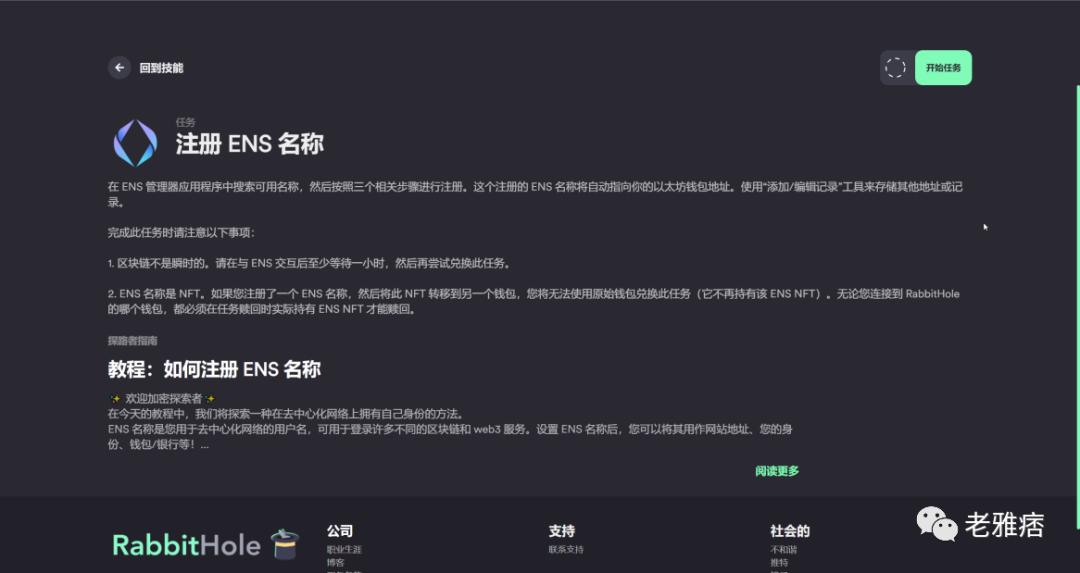
RabbitHole innovatively proposed the learning-to-earn mode to solve the technical threshold for Web2 users to enter Web3. This new educational model can help users earn rewards while learning. When the knowledge learned, skills mastered and information acquired can bring direct benefits to them, a positive cycle is generated, and the resulting benefits are enough to offset the learning costs paid in the early stage.
The intrinsic motivation for this model is that new projects pay for skill learning tasks and reward users for completing specific interactions early in the project. This is similar to early bird rewards or bounty hunters in the Internet industry, where rewards are paid for completing specific tasks, except that all tasks and actions are performed on the chain. What's interesting about this model is that it's a positive sum model rather than a zero sum model.
- For users, completing quests not only gives them new skills but also a special RabbitHole badge
- In the case of applications, you can harvest a batch of high quality users with strong learning ability at an early stage
- For RabbitHole, it's about making profits and building traffic while completing the cycle
Since its launch, RabbitHole has distributed over $750,000 in rewards from sources including but not limited to Polygon, Uniswap, Aave, Compound, The Graph, ENS, and more. Many of these users also received additional airdrop rewards for their early participation in the project, such as ENS. So while RabbitHole is small at the moment, the potential to earn rewards through learning is huge, given the skills users have learned and the reputation they have built up for the project.
Special skills
RabbitHole has six skills to gain (more to come) :
Protocol Politician
Token Swapping( Token 交换)
Identity Pro
Lending (Lending)
BrightID(Digital Identity)
Asset Management

Different skills have different task requirements. After completing corresponding tasks, users will be rewarded with experience value. After accumulating enough experience value, users can upgrade (perhaps in the future, the newly released project party will give certain rewards to high-level users, such as whitelist, to encourage such high-quality users to use).
Of course, as the level rises, so does the amount of experience needed, and the tasks that need to be completed are not daily, requiring users to pay attention to the dynamics of the project.
The future vision
In the Web2 world, the main body of social business activities is the company, and the company system is also one of the most important organizational forms. Companies are organized in accordance with the law, and the workload and benefits are divided according to different abilities, contributions, and experiences. In this process, there are problems such as uneven distribution, different goals and environmental constraints. This has led to the creation of an industry of freelancers, who search bounty hunter platforms for tasks and are rewarded for their work, but this is also a form of work that can't be quantified, wages are difficult to pay, and information platforms are prone to fraud.

So in Web3, can we use blockchain technology to create a new task platform based on the original idea? RabbitHole is showing us this possibility. Through zero-knowledge proof, users do not need to provide their own privacy information, nor need to communicate with the demand side, so that they can publish all the required work ability proof on the chain. This is also beneficial to the demand side, because the imtamability of blockchain also ensures the authenticity of users' information, and workers do not need to worry about the security of their salaries, which can be settled automatically through smart contracts. The DAO, which has no fixed organizational form, no strict distinction between superiors and subordinates, and no need to provide all kinds of privacy information, is our best-selling DAO.
Imagine a future world where Web3 and the metasverse come to life. A variety of DAOs work together, and "Web3 residents" assume a variety of identities in which they learn, acquire skills, earn rewards, and participate in different DAOs. There is no rigid distinction between the physical world and the digital world, and blockchain technology provides a foundation and a guarantee of trust.
A whole new business model has sprung up. In the real world we are all human beings, but in Web3 we are all free and unconstrained. Of course, the DAO is still in its infancy, and RabbitHole is far from the scale and sophistication of the large task platforms found in Web2, but the possibility is compelling enough.
Competitive product introduction
Project Galaxy
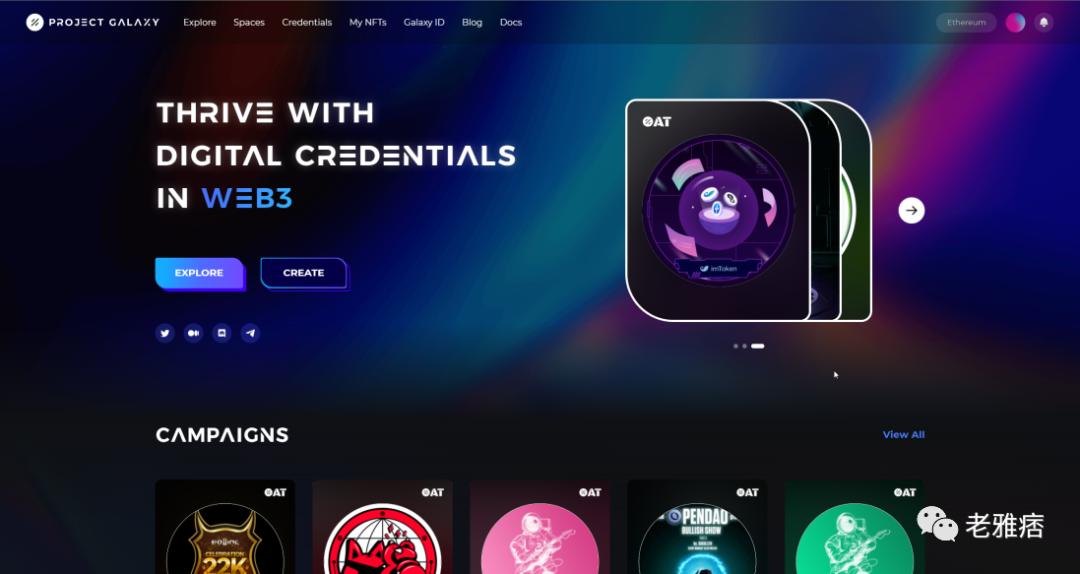
Project Galaxy is a Web3 credential data web application built on an open and collaborative infrastructure that helps Web3 developers and projects leverage credential data to build better products and communities. At the same time, data managers are rewarded for using credentials in Galaxy's application module, credential Oracle engine, and credential API. Data managers contribute to the credential data network and earn revenue after the data is used.
An example of an on-chain voucher would be a record of your borrowing money from AAVE and Compound that was never liquidated, or your contribution to the liquidity pool when the agreement was first activated, or your on-chain voting history. Just as all behavioral data in Web2 counts toward users' credentials, companies like Google and Facebook run algorithms on users' credentials to deliver targeted ads.
Project Galaxy aims to build an open and collaborative credential data network accessible to all developers in Web3. For on-chain credentials, curators can provide subgraph queries or static snapshots. For off-chain credentials, we've integrated with data sources like Snapshot.org, Twitter, and Github. By contributing to Galaxy's credential data network, curators will be rewarded when credential is used in Galaxy's application module, credential Oracle engine and credential API. Because there are users consuming (paying for) data in its ecosystem, this will incentivize more users to manage Project Galaxy's data network.
To date, more than 100 partners have launched more than 500 events on Project Galaxy.
POAP

POAP, short for "Proof of Attendance Protocol," is the platform and infrastructure that enables POAP publishers and POAP collectors to create and store Web3 records. This is a group of smart contracts currently managed by POAP Inc.
POAP 是收藏品,是根据出勤证明协议智能合约铸造的 NFT。每个 POAP 都是收藏家持有的数字记录,作为他们参与物理、虚拟或精神活动的数字证明;POAP 可以兼作 Token ,使其收藏家获得潜在的未来效用。因此,POAP 收藏是用户生活中书签的数字表示,它不依赖于任何典型的个人身份信息 (PII),例如姓名、性别、国籍、护照号码等。因此,这成为了跟踪用户对独特和独特体验的出勤率,而不会泄露个人数据。
There are two main players in the POAP ecosystem:
Issuer: An individual or institution that creates poaps and distributes them to collectors to further establish or increase their community value and encourage participation.
收藏家:收到 POAP 并将其收集为他们最伟大和最特殊时刻的不可变记录的人,数字化为可收藏和可追踪的 Token 。
POAP provides the platform for casting NFT. Each issuer determines the aesthetics, distribution, quantity, and effectiveness of the POAP they issue.
Characteristics of the POAP ecosystem
Since POaps are NFT, they are minted and secured on the blockchain. By default, POaps are cast on xDai, an Ethereum-based side chain that uses proof of interest.
This makes POAP free for everyone, and it can be forged by collectors and distributed by publishers.
POAP is an open platform where all parties are equal citizens. As a result, brands use the platform on the same terms as individuals and social groups.
conclusion
In short, RabbitHole, as an on-chain incentive platform, not only has a unique learn-to-earn mode to encourage users to better explore and use the Web3 world, but also uses skills badges and other functions to visualize their skills and on-chain information as identity tokens in the blockchain world. However, there are many competitive events on the track, and the final winner depends on the team operation ability and team technical level. I suggest you go to experience ~
In particular, our article is not as investment advice, please think for yourself, or the same sentence: investment should be cautious.
References:
https://rabbithole.mirror.xyz/ZYcTE1mh5TxpGNHEPWon8KH7R3MlllJE4VhG_yJIr-M; https://mirror.xyz/daovoice.eth/0EewuCDeUE2yk9OoXquzj8Jh17jSoGjWP42BLEWbh_o
https://galaxy.eco/
https://poap.xyz/
https://rabbithole.mirror.xyz/ZYcTE1mh5TxpGNHEPWon8KH7R3MlllJE4VhG_yJIr-M
The original link
Welcome to join the official BlockBeats community:
Telegram Subscription Group: https://t.me/theblockbeats
Telegram Discussion Group: https://t.me/BlockBeats_App
Official Twitter Account: https://twitter.com/BlockBeatsAsia
 Related Articles