Why is Polygon so popular?

Polygon's Ecology Project: Who's Next?
原文作者:召猫
编辑:Doge
On March 9, Polygon announced that DraftKings, a Nasdaq-listed sports and entertainment company, will join The Polygon Ecosystem as a validator and node operator. DraftKings will partner with B2B digital asset infrastructure provider Zero Hash to become one of Polygon's 100 validators.
DraftKings is an American daily fantasy sports and sports entertainment company. The company allows users to participate in daily and weekly fantasy sports-related matches and win money based on individual players' performances in five major US sports, English Premier League and Uefa Champions League soccer.)
In addition to the involvement of traditional capital, more and more on-chain projects are being published on Polygon (such as Lens Protocol). So what is it about Polygon that makes it so popular, and how far has the ecology gone? If you have these doubts, please see below ~
Project introduction
Polygon is a framework, a blockchain network and scale-out solution that can be used to create ethereum-compatible blockchain networks. It's more of an agreement than a single solution. As a result, one of the major products in this ecosystem is the Polygon SDK. It helps developers create ethereum-compatible networks. The Polygon Network, known as a proof-of-stake (PoS) side chain, was one of the first products to go live in the Polygon ecosystem. The essence of a side chain is a parallel chain connected to another blockchain.
Side chain has many advantages, one of the most significant is improved transaction throughput and low cost. As anyone who has used Polygon's network will know, its transaction speed is amazing and its cost is extremely low compared to That of Tai Fang. Even so, some trade-offs were made to achieve this performance.
Polygon supports The Ethereum Virtual Machine (EVM) to which existing Ethereum applications can be migrated with relative ease. In addition to getting an experience comparable to Ethereum, users can also enjoy the high throughput and low cost mentioned above.
So, what can users do with Polygon? The answer, of course, is to have an Ethereum-like experience at a lower cost and faster speed. Polygon has deployed some of the hottest decentralized finance (DeFi) Dapps, such as Aave, 1INCH, Curve, and Sushi. Of course, there are a few native apps unique to Polygon, including QuickSwap and Slingshot.
Token 效用:
1. Pay the gas fee;
2. Vote to participate in governance.
To solve the pain points
To address the issues of low throughput, high processing fees, and poor scalability on traditional public chains like Bitcoin and Ethereum, Polygon provides an infrastructure with extreme scalability, consensus modules, and governance for deploying and configuring its blockchain.
There are two types of blockchains that can be deployed on Polygon: standalone and secure. Standalone chains are blockchains that do not rely on Ethereum's consensus for security. This solution is targeted at projects that already have their own validation nodes or are looking to implement another scalability solution. These standalone chains are typically used by enterprise networks or mature chains that want to integrate with the Polygon-Ethereum ecosystem. A security chain is a chain that does not have its own authentication network but relies on the Polygon security layer. Polygon has an extremely high level of security while allowing developers to choose from a variety of security solutions. These security chains are designed to help startups and projects that need reliable security systems.
Polygon PoS (proof-of-stake) chain is the most typical one. The project uses proof-of-interest consensus and is implemented by regularly submitting snapshots of Polygon's PoS chain to the Ethereum blockchain. These snapshots are submitted by Polygon's 100 validators, which overcomes low Ethereum throughput, allows faster transaction processing, and reduces Gas charges. User experience is guaranteed to a certain extent.
The modular nature of Polygon's design also addresses the complexity of development efforts caused by the non-customizable technology stack. Polygon's modularity allows for customization and upscaling, enabling developers to build default blockchain networks that meet their development needs. It is beneficial to shorten the time to market and save the cost of community cooperation.
Project highlights:
High scalability;
Full Ethereum compatibility;
Modular design makes it easier for developers;
High interoperability;
Low fees lead to high users.
The data analysis
Data on the chain
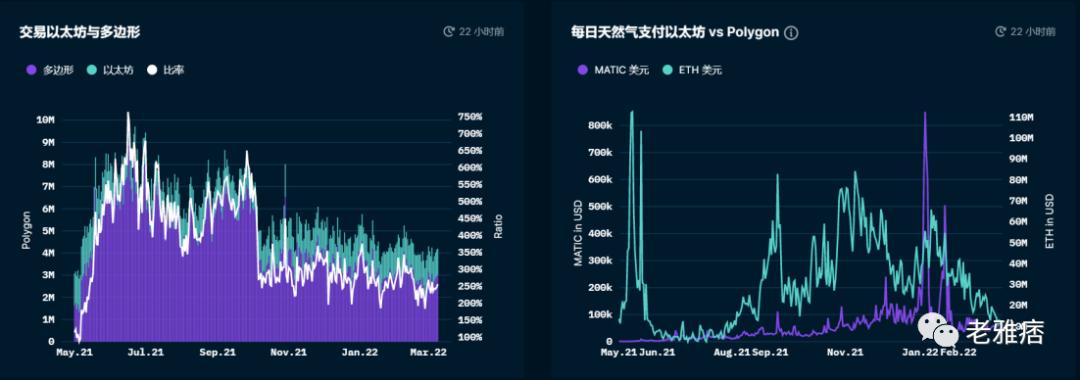
According to Nansen data, the current daily active address number is 305K, weekly active address number is 1.01m, monthly active address number is 2.23m, active address shows a trend of stage fluctuation. Active users are mainly concentrated in transactions, QuickSwap, Aave and Centre, and transaction costs are on the decline as a whole.
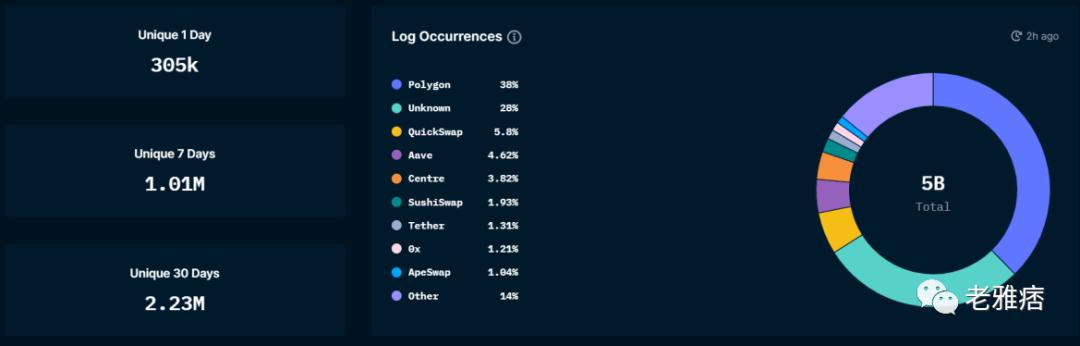
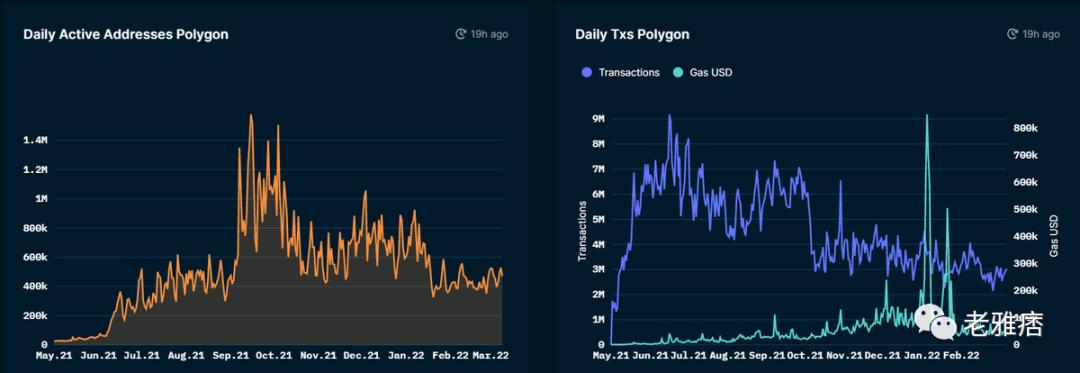
As the L2 solution of ETH, Polygon's data on the chain overlap with ETH, such as transaction fee, gas fee and contract deployment quantity, which not only reflects the core positioning but also reflects the good implementation effect of its solution.
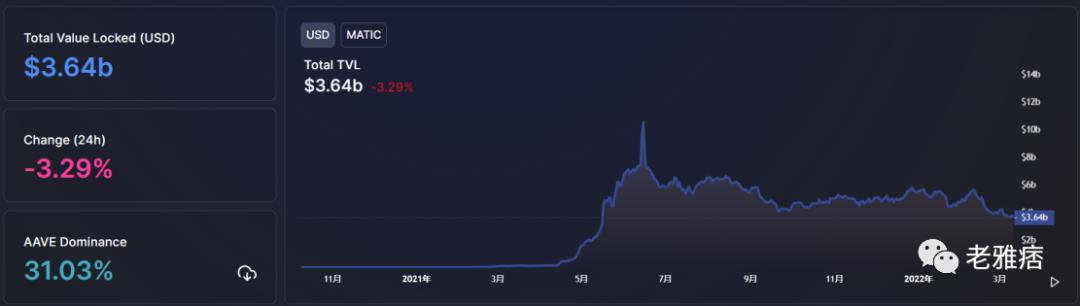
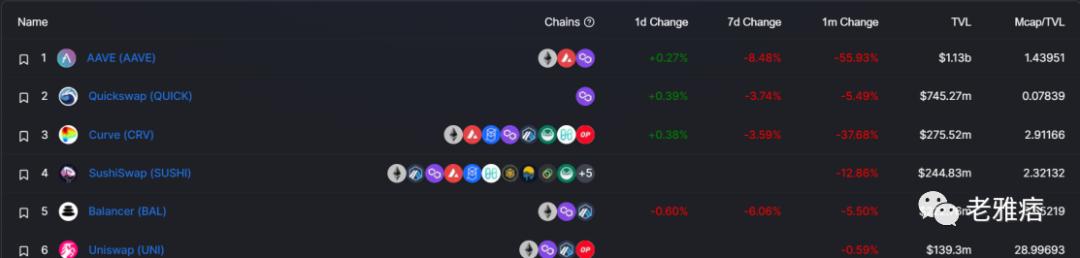
In terms of lock-up volume, it is currently the eighth in the public chain, with the current TVL of 3.64B$, following the trend of periodic fluctuations. The main lock-up amounts are distributed in AAVE, Quickswap, Curve, Sushiswap, and Balancer. Quickswap is the local protocol of Polygon.
Ecological applications
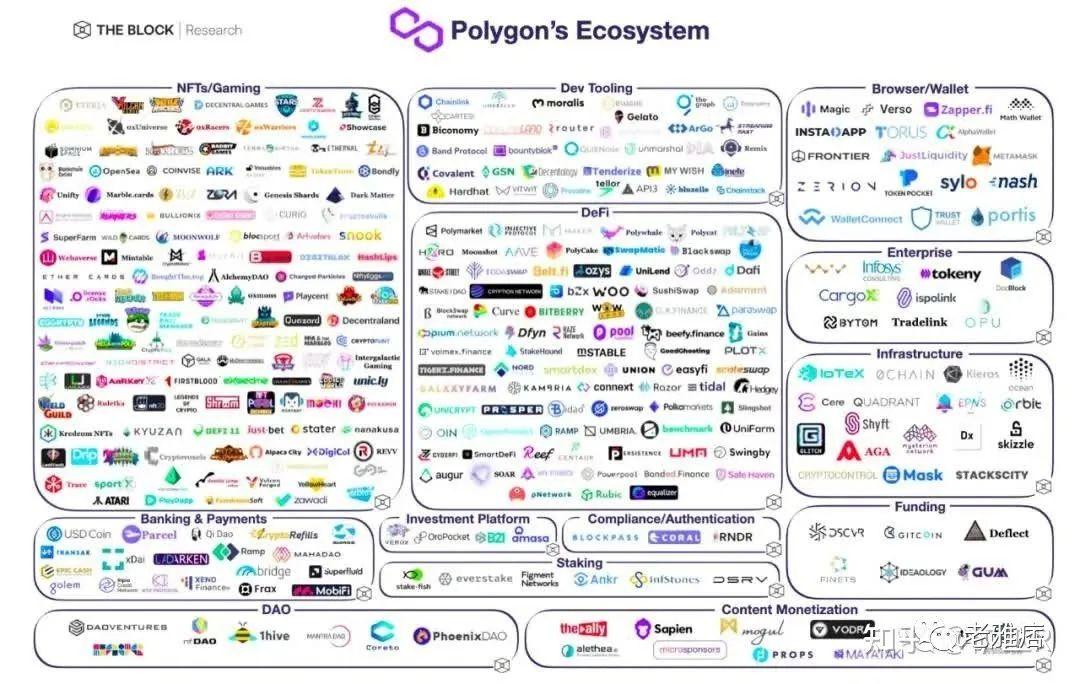
Polygon ecosystem presents a relatively complete map. There's no shortage of popular NFT and game projects like Quickswap, Aavegotchi, Terra Virtual, Exeedme, Interesting projects such as NIFTEX, which creates and trades NFT fragments, and Tokenized Tweets, which stores Tweets on blockchain. Below I will give you a few in the way of each track.
DeFi: Quickswap
QuickSwap 是 Uniswap 的分叉,由 Nick Mudge 和 Sameep Singhania 在 Polygon 区块链平台创建。它采用自动化做市商 (AMM) 模型,为用户打造交换 Token 的去中心化交易平台 (DEX)。QuickSwap 没有订单簿,用户在称为「流动性资金池」的 Token 资金池中交易。
用户可以将 ERC-20 Token 从以太坊转移到 Polygon,并且只要存在对应的流动性资金池,即可通过 QuickSwap 交易任何 Token 对。只要提供 Token 对,即可建立新的流动性资金池,从其他用户处赚取交易费用。
QuickSwap 的界面、操作观感和用户体验与 Uniswap 几乎如出一辙。用户无需注册或完成任何 KYC(身份认证)流程,即可交易持有 Token 。只需将钱包关联平台并预存 MATIC 来支付交易费用。QuickSwap 也是开源产品,使用 Uniswap 通过审计的代码,获得一定程度的信任与安全性。
许多用户之所以选择 Polygon,是因为其交易速度快,且费用低廉。流动性供应商和交换者可以使用 Uniswap 经过审计的代码,并享受支持 ERC-20 的 Polygon 网络带来的优势。此举的一大好处是,使用简单的区块链桥即可交易 ERC-20 Token ,规避了以太坊的高昂费用。因此,QuickSwap 在以太坊兼容性、简单易用和价格优势这三方面达到平衡。
GameFi: LoserChick

LoserChick is an on-chain game created by the Emoji DAO, driven by the community, with no private equity, no capital, and all $CHICK released with equity. Catch eggs, open blind boxes, Mint NFT, NFT mining... At LoserChick, users can not only enjoy the thrill of catching cranes, opening blind boxes, but also reap the benefits of NFT mining.
而其经济结构两部分组成:流通 Token 和非流通 Token 。
流通 Token :$CHICK、$EGG、LoserChick NFTs
非流通 Token :$cCHICK、$cEGG
其中,流通 Token 用于支持资产价值的锚定。非流通 Token 用于游戏「抓蛋」部分的计数功能,是$CHICK 到$EGG 兑换过程中的中间数据。$CHICK 是 LoserChick 生态系统的基础价值 Token 。LoserChick 将首先部署在 Polygon 网络上,并产生最大供应量(ERC-20 标准 Token )的 71.73%(9,564,000 美元)。LoserChick 在 Polygon 上运行一段时间并跨链后,剩余 28.27% 的最大供应量(3,769,333 $CHICK)将在非 Polygon 链(BSC、以太坊 Layer 2、Heco 链等)上发行部署已经完成。$EGG Token 由用户在游戏的「Mint NFT」模块中使用。对于每个「Mint NFT」操作,用户将燃烧 1 个 $EGG Token ,然后有可能随机获得一个 LoserChick NFT。
Metaverse project: Somnium Space

Somnium Space is an open, socially familiar, blockchain-powered virtual reality world where users can buy land, build or buy things and monetize their experience. Somnium Space was originally built using Loom Network and migrated to Polygon to support its complex game economy, including avatars, NFT collectibles, and more.
Somnium Space's game model is similar to DencentraLand and SandBox. But Somnium Space seems to be moving faster with VR than the latter two. Meanwhile, based on its association with Polygon and other public chains and its experience in VR, it may be able to bring a breakthrough point for NFT from different perspectives.
Trading platform: Bondly

与其他交易平台类项目不同,Bondly 专注于满足多链交易的需求 和 OTC 交易模式,虽然其最终愿景为丰富的数字资产类别提供服务,但目前项目主要把精力放在 NFT 市场,主要工作围绕 NFT 的 Token 化服务、交易和 NFT 应用展开工作。项目创始人对 Bondly 的表述是:「Bondly 是下一代收藏品基础设施和粉丝互动方式,我们的 Web3 平台使创作者能够使用本地化数字资产交互直接与粉丝进行全新的体验。」
Of course, more and more projects are being deployed on Polygon, as evidenced by the number of active addresses and active logs.
conclusion
Polygon, a blockchain extension solution for creating Ethereum-compatible blockchain extensions, has attracted a significant number of users in the market with the advantages of fast transactions, low cost, and compatibility with ethereum Virtual Machines (EVM). In terms of project popularity, Polygon has a high degree of popularity and market recognition, with an order of magnitude more active addresses and log activity than Avalanche. However, as far as dapps in the ecosystem are concerned, most of them are in the early stages of development, both in terms of development and actual market performance.
In terms of long-term vision, Polygon hopes to offer more scalable solutions in the future, including ZK Rollup, Optimistic Rollup and independent blockchain, Helps create a more dynamic Layer 2 interconnection ecosystem for Ethereum.
In a word, day by day
In particular, our article is not as investment advice, please think for yourself, or the same sentence: investment should be cautious.
References:
https://twitter.com/QuickswapDEX
https://blog.polygon.technology/
https://academy.binance.com/zh/articles/what-is-polygon-matic
https://pro.nansen.ai/multichain/eth-vs-polygon?network=polygon
https://www.coingecko.com/en/coins/polygon
https://mirror.xyz/0x29A0010E150b72A353961D6C9b831Dc6c55E37de
The original link
Welcome to join the official BlockBeats community:
Telegram Subscription Group: https://t.me/theblockbeats
Telegram Discussion Group: https://t.me/BlockBeats_App
Official Twitter Account: https://twitter.com/BlockBeatsAsia

 Related Articles