Polygon: Current status, Future growth, and Valuation analysis of Ethereum Expansion Swiss Army Knife
Rearranging Polygon: Current, Future Growth, and Valuation Analysis of Ethereum's Expanded Swiss Army Knife
By Yuxuan Li and Ye Wang, Mint Ventures
The report points
Core Investment Logic
Polygon It provides a very comprehensive scheme around the expansion of Ethereum, with excellent comprehensive quality, which is a project worthy of long-term attention. The specific attention logic is summarized as follows:
Ethereum scaling is currently the number one issue facing the crypto industry when it wants to bring in more users, and solutions to scaling issues are a huge market
Polygon PoS The past development of Polygon has accumulated a good reputation among users and developers, and it has always maintained a close relationship with the Ethereum community. The good relationship between users, developers and the Ethereum community provides a solid foundation for Polygon
ZK Rollup (Zero Knowledge Rollup), invested by the team, is one of the most promising expansion technology solutions at present. Polygon has accumulated certain talent advantages and technology first-mover advantages in the ZK field through continuous capital investment and several successful mergers and acquisitions. It is a promising business growth point in the future
The team has relatively excellent strategic level and execution ability, which is reflected in good business foresight, fast business landing ability, and excellent marketing and business development ability. Its achievements are especially outstanding in introducing traditional enterprises and non-Web3 Internet enterprises
Horizontal comparison of other public chain projects, its overall valuation level is currently in the low range
The main risk
Polygon PoS stalled in the subsequent public chain competition, failing to attract and retain developers and users
The expansion of Ethereum has undergone a major technological route change, and the direction of ZK Rollup is no longer recognized by the community, impacting the prospects of Polygon related businesses
Polygon's ZK Rollup sub-project has fallen far behind expectations
Polygon PoS Official cross-chain There's been a major safety incident at the bridge
The valuation
Through horizontal index comparison, even without considering the value of ZK Rollup sub-project, we judge that the market value of Polygon is low compared with other Layer 1 projects. By comparing its own historical data, we judge that Polygon's current valuation is in the median range.
For more information, see the Valuation Level section.
This article is written by the author based on the project information and market background at the time of writing. Due to the limitations of the author's knowledge and information, the content of this article may contain errors in data, facts, and analysis and deduction. Peer exchange and correction are welcome. None of the content in this article constitutes investment advice.
Basic Information of the project
Project Business Scope
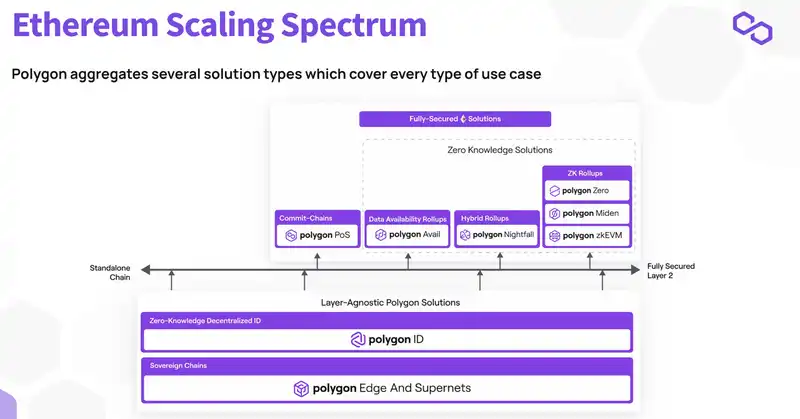
Polygon is dedicated to scaling up Ethereum. There are six solutions to scaling up Ethereum, including:
Polygon PoS: An EVM (Ethereum Virtual Machine) compatible side chain, which went online on June 1, 2020, is currently Polygon's main business.
Polygon Avail: Aims to become a universal data availability layer for the blockchain world (various side chains, Layer2 Upload the complete transaction record to the Ethereum main chain for verification and archiving, and ensure that it can be retrieved and used at any time.) In the idea of Avail, various side chains and Layer2 upload all transaction data uniformly to the Avail, which can sort and record the transaction data. Through the means of cryptography to ensure that the transaction data is accurate and verifiable, so as to ensure the availability of data. This saves the cost for other side chains and Layer2.
Polygon Avail went online on June 29, 2022.
Polygon Nightfall: Nightfall is an Optimistic Rollup for enterprise clients established by Polygon in collaboration with Ernst & Young. Nightfall combines partial zero-knowledge proof features and is currently in beta.
Polygon zkEVM: The original project was called Hermez , was renamed Polygon zkEVM after Hermez was acquired by Polygon in August 2021. Polygon zkEVM is a ZK Rollup with opcode-level compatibility. In V God's EVM compatibility level classification, the current Polygon zkEVM and Scroll are ranked as the third level, more than other ZK Rollup, in the EVM compatibility is at the forefront of the current ZK Rollup.
Polygon Zero: In November 2021, Polygon acquired mir and renamed it Polygon Zero. Poygon Zero released Plonky2 in January 2022. According to the material on its website, Plonky2 is the world's fastest recursive zero-knowledge prover (more on this later) and is a core component of Polygon Zero. Polygon Zero is expected to be initially online in 2022Q4, realizing sharding +zkEVM.
Polygon Miden: In November 2021, Polygon announced plans to develop an Ethereum scale-up product, Polygon Miden, which uses ZK-Stark technology to combat quantum computing and emphasizes the ability to verify off-chain transactions. Miden is expected to go live on the main network in 2023Q1.
Among the six extension schemes, ZK Rollup's three projects, zkEVM, Zero and Miden, have the same security as the Ethereum main network in terms of design, while Polygon PoS has a lower security.
Source: Polygon website
In addition to the aforementioned extensions, Polygon has also launched its own DID System Polygon ID, and developer tools Edge and Supernets.
From the current development of Polygon, Polygon PoS is the basic disk of Polygon, The ZK Rollup matrix, which consists of Polygon zkEVM, Polygon Miden, Polygon Zero and Polygon Nightfall, is a potential growth point recognized by the market at present. We'll focus on these two parts of Polygon's business below.
Project history and roadmap

Business details
Polygon PoS
Polygon PoS was officially launched on the main network on June 1, 2020, and is currently the main service being run by Polygon.
Technical Architecture:
And BNB Chain, Solana Polygon PoS is a side chain of Ethereum, so it is necessary to have a brief understanding of its architecture. Polygon PoS architecture can be divided into three layers:
A series of contracts deployed on the Ethereum chain
The Checkpoint node of the PoS
Matic Side chain

Source: Polygon website
Central to the architecture are the "Checkpoint nodes of PoS," which produce and validate all the blocks on the Matic side chain and periodically synchronize information between Ethereum and the Matic side chain. Specifically, these PoS nodes transmit information from the Ethereum main network to the Matic side chain by listening for events on the Ethereum chain. By regularly aggregating multiple blocks generated by the Matic side chain into the Merkle tree and publishing them to the Ethereum chain, the Matic side chain can be realized. Information synchronization on the Ethereum main network.
From the above process, we can also find the difference between Polygon's Ethereum side chain architecture and L2 like Rollup and other independent L1:
Compared to independent L1 like Solana, the core work of Polygon verification nodes includes synchronizing information between the Ethereum backbone and the Matic side chain, which cannot exist independently from its backbone (Ethereum).
Compared to arbitra M & NBSP; , Optimism While the Sequencer of Rollup and PoS node of Polygon are both responsible for synchronizing side chain /Rollup information to the main network, However, the Sequencer of Rollup needs to carry out strict verification when transmitting information to the smart contract of the Ethereum main network, so that it can inherit the security of the Ethereum main chain. In Polygon's architecture, information from the Matic side chain -> The steps of the Ethereum main network are more about result synchronization than verification, so the security of Polygon PoS is actually determined by its PoS nodes. From this perspective, Polygon, like Solana and other independent L1, needs to guarantee its security by itself.
Ecological Progress:
Since its launch in 2020, Polygon PoS has gone through a period of hibercountry. After entering the second quarter of 2021, Polygon POS has developed very rapidly. It is the third public Chain with relatively complete ecological applications after Ethereum and BNB Chain.
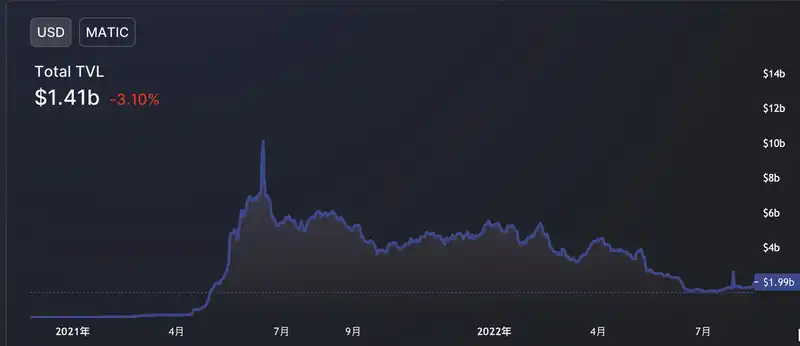
By business area, Polygon is catching up fairly quickly in the DeFi space, with Polygon's TVL ranking second only to Ethereum and BNB Chain for much of 2021.
There may be two reasons for this rapid development: First, compared with other public chains that want to be "Ethereum killers", Polygon defines itself as a supplement to Ethereum from the very beginning. The team also invites members of the Ethereum Foundation to be advisers, and its side chain positioning can be found in its friendly attitude towards Ethereum. It is this strong relationship with the Ethereum community, especially developers, that has led Defi to Uniswap , Aave , Curve When performing multi-strand expansion, the first chain selected is all Polygon.
Second, in late April 2021, Polygon launched a $150 million DeFi development fund to subsidize users' access to the Polygon network. For a long time, you can earn MATIC tokens from Polygon officials by depositing in Polygon's Aave or doing LP at Curve.

Data source: Defillama
However, perhaps due to the obvious brand effect of DeFi leaders, the degree of innovation of DeFi projects on Polygon chain is slightly insufficient. From the perspective of TVL, among the top 10 projects, only Quickswap and KlimaDAO are native to Polygon. Other projects are derived from other chains. Quickswap is a Fork of Uniswap v2. KlimaDAO can be seen as the fork of Ohm.
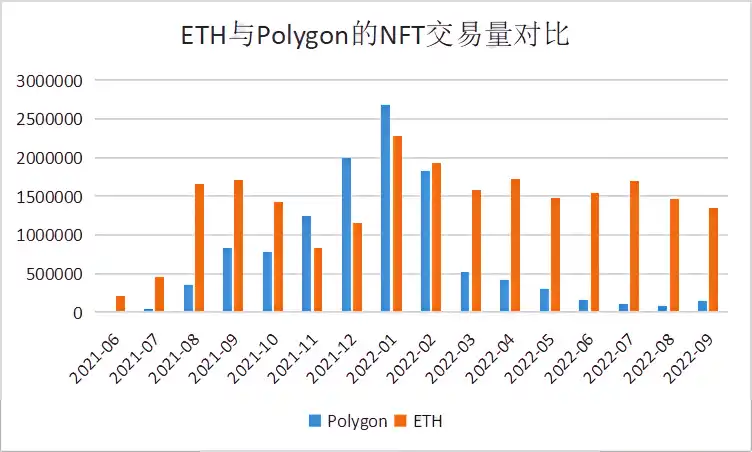
In NFT At the end of June 2021, Opensea supported the Polygon chain. Polygon and Ethereum almost split the high and low end of the NFT market. Since then, NFT volume on Polygon's chain has approached or even surpassed Ethereum's level, benefiting from the cheap and fast trading experience. However, the average NFT trading price on Polygon's chain is extremely low, often less than $100, and the total volume is significantly lower than Ethereum's. Polygon, which focuses on the low-end NFT market, showed a more pronounced downward trend when the NFT bear market hit.
Source: Opensea, collated by Mint Ventures

Data source: Crypto Slam, Mint Ventures collation
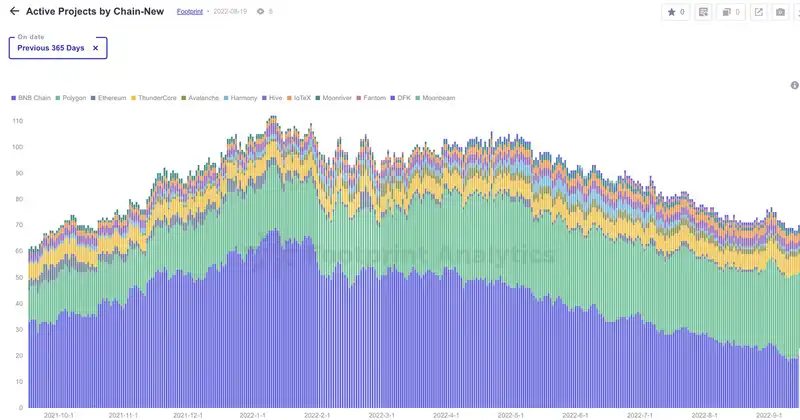
In terms of games and the metaverse, the two leading projects of the metaverse Decentraland And & have spent The Sandbox Deployed on the Polygon chain in April and June 2021, respectively. According to Footprint, Polygon has been second only to BNB Chain in terms of active games for most of the year, and in July this year it overtook BNB Chain to become the blockchain with the most active games.
Source: https://www.footprint.network/chart/Active-Projects-by-Chain-New-fp-28725?on_date=past365days~
In July 2021, Polygon announced the formation of Polygon Studios to focus on NFT, Gaming, and Metaverse Investment in the field. As of today, according to Messari Polygon Studios has invested in more than 36 projects. Polygon co-founders Jaynti Kanani and Sandeep Nailwal are also active angel investors, having invested in 25 and 69 projects respectively. Almost all of these projects are deployed on the Polygon chain.
It is also worth mentioning that Lens Protocol, the underlying social Protocol of Aave team, is also built on Polygon. The Toucan Protocol and KlimaDAO, which are mainly carbon neutral, are also deployed on Polygon. Polygon also supports some of the directional innovation that is scarce in the Web3 space.
In terms of off-chain expansion, Polygon's special position within the Ethereum ecosystem and its superior environmental friendliness (ETH With a low cost and fast experience, Polygon is one of the best options for both Web2 and legacy businesses looking to test the waters of blockchain or web3. In just the last six months, Polygon has established partnerships with Web2 and traditional enterprises, including:
On Sept. 27, stock and cryptocurrency trading platform Robinhood Announced the launch of the Polygon-based Web3 wallet;
On September 12, Starbucks announced a partnership with Polygon to leverage Polygon's blockchain technology to support its member and partner loyalty platform, Starbucks Odyssey;
On July 18, Mercedes-Benz launched Acentrik, a data marketplace built on Polygon;
On July 13, Polygon was selected for Disney's accelerator program, the only public-link project in the same batch of six;
On May 23, e-commerce giant eBay released its first series of NFTS on the Polygon chain, which allows users to purchase NFTS directly on the eBay website;
On May 10, social giant Meta announced a partnership with Polygon for Facebook. Creating an NFT platform with Instagram;
How to bring in more users is a long-term issue for the entire Web3 world. Traditional enterprises and Web2 giants have tens of millions or even hundreds of millions or billions of users. From the realization path, cooperating with them is a feasible way to introduce Web3 users. In this respect, Polygon has made far better progress than other public chains. It's still early days, but we can expect to see more collaborations between Polygon and traditional enterprises and Web2 giants in the future, bringing more users to Polygon and the Web3 world as a whole.
Above, we can probably outline the development of Polygon PoS ecology:
The core foundation for Polygon PoS is its low cost and support from the Ethereum community. While Arbitrum and Modernism are similarly supported by the Ethereum community, the on-chain Gas costs (tens of cents to a few dollars per session) are still too expensive for high frequency interactions. Within the Ethereum ecosystem, Polygon is pretty much the only option for applications with frequent on-chain interactions.
DeFi protocol represented by transaction and lending is the infrastructure on the chain, supporting various activities on the chain. The blue-chip DeFi protocol has a proven user experience, a dedicated team, and the trust of a good performance history. There is little need to repeat the wheel, so Polygon has adopted a simple subsidy leader strategy: Aave, Curve, Uniswap, and Quickswap. It meets the DeFi requirements of most users.
The game and metaverse areas are more focused on unique experiences, which vary greatly from project to project. Polygon has adopted an investment + incubation strategy to make extensive layout in this area, bringing more quality projects to the Polygon chain through investment.
In the wider world beyond Web3, Polygon is actively working with various giants to realize its vision of "bringing the world to Ethereum."
ZK Rollup
Rollup is the most recognized expansion scheme of Ethereum at the current executive layer. Its core is to execute transactions outside the Ethernet main network and only release data to the Ethereum main network, so as to achieve the purpose of expansion.
Optimistic Rollup and ZK Rollup are two main Rollup schemes. The main difference between them is how the main network verifies the transactions uploaded by Rollup.
Optimistic Rollup does not verify the trades, but "optimistically" assumes that the trades are bona fide by default, setting a challenge period (7 days) in which anyone with questions about the trades can challenge them by submitting a "proof of fraud".
ZK Rollup summarizes the results of off-chain calculations into a "proof of validity" and then submits this "proof of validity" to the Ethereum main network. Under the zero-knowledge proof mechanism, although the contract of the Ethereum main network does not "understand" the actual situation of the transaction, it can verify the authenticity of this batch of transactions through the verification of the "validity proof", so as to ensure that ZK Rollup can achieve expansion on the premise of inherits the security of the Ethereum main network.
ZK Rollup is Polygon's deep business orientation. In August '21, it announced that it would use $1 billion to support ZK technology, Polygon's zkEVM, Miden, and Zero expansion projects are also ZK Rollup solutions (Nightfall also uses some zk technologies). Compared with Optimistic Rollup, ZK Rollup "with the improvement of ZK-SNARK technology, it will win in all useful cases in the medium to long term" (Vitalik However, due to the late development, the overall development progress of ZK Rollup is limited by the lack of EVM compatibility. Polygon is committed to solving this problem. However, there are also strong competitors such as Scroll, Zksync and Starkware in the track. The competitive landscape of the ZK Rollup will be discussed in detail in the ZK Rollup Track Landscape section.
Polygon zkEVM: ZK Rollup that emphasizes EVM compatibility
Polygon zkEVM was originally called Hermez. Hermez had a version 1.0 product that went live in March 2021. This version supported the transfer payment scenario, but was not EVM compatible.
在 2021 年 7 月,Hermez 团队宣布开发 zkEVM(Hermez 2.0),开发完成后将为以太坊带来一个完全兼容的 zkEVM。紧接着在 2021 年 8 月,Polygon 以 2.5 亿美元收购 Hermez,原 Hermez Token HEZ 按照 1 HEZ = 3.5 MATIC 的汇率进行兑换,通过 Token 的形式完成了收购,同时 Hermez 团队的 26 名成员也并入了 Polygon 团队。
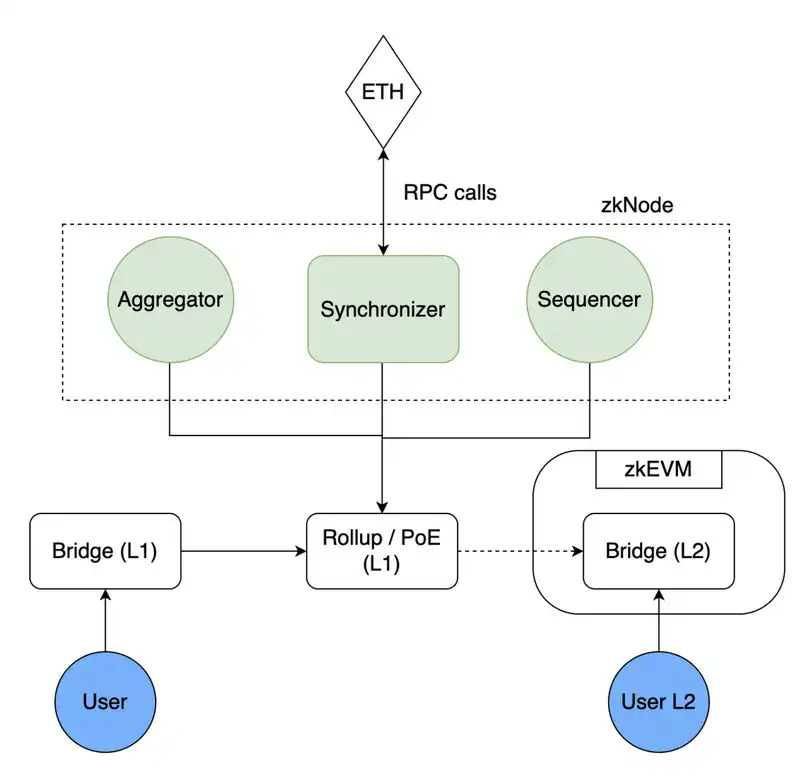
The architecture of Polygon zkEVM (Hermez 2.0) is shown below:
Source: https://docs.hermez.io/zkEVM/Overview/Overview/#zkevms-architectural-overview
Polygon zkEVM detailed architecture is more complicated, but the official document there is a clear description of interested readers can go to the official document (https://docs.hermez.io/zkEVM/Overview/Overview/) to learn more, Here we briefly describe the architecture of Polygon zkEVM:
zkNode, which includes the Sequencer, Aggregator, and Synchronizer
The Sequencer receives transactions from users, preprocesses them as a batch, and then submits that batch as a valid transaction to the PoE (Proof of Efficiency) smart contract. Anyone with the software needed to run a zkEVM node can be a Sequencer, and the Sequencer proposing valid batches can be incentivized by the fees paid by trade requesters or network users.
The Aggregator's task is to provide validation for the L2 transactions proposed by Sequencer. In addition to running zkNode, Aggregator needs specialized hardware -- zkProver -- to create zk Proof. In return for providing this service, the Aggregator can charge Sequencer MATIC fees.
The Synchronizer is responsible for reading events from the Ethereum blockchain, including new batches, to keep states fully synchronized. At the same time, Synchronizer provides interfaces to obtain data, including the transaction data released by Sequencer and the validity proof released by Aggregator.
zkProver is the core component of Polygon zkEVM and the most complex module. The core computation and execution process is in zkProver, which means that EVM compatibility needs to be ensured by zkProver. zkProver also internally subdivides a primary state machine actuator, a set of secondary state machines, and a SNARK proof component and a STARK recursive proof component.
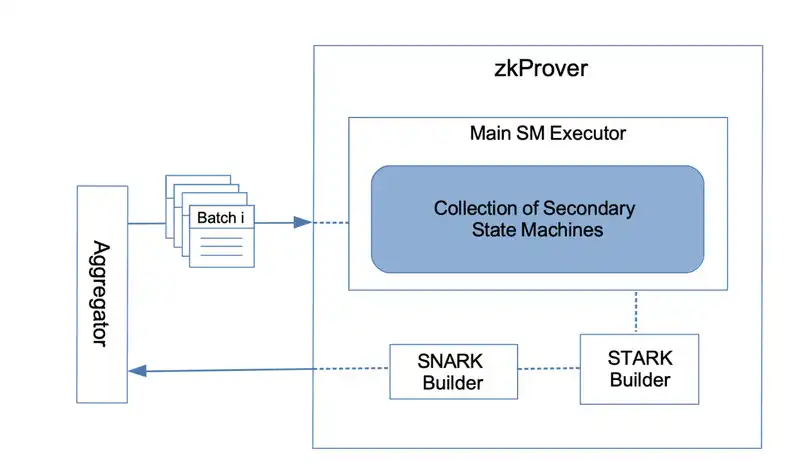
zkProver architecture Source: Official documentation
Proof of Efficiency (PoE) consensus algorithm. In Polygon zkEVM, the Sequencer that generates new batches is rewarded for maintaining network consensus. The PoE mechanism is mainly used to select which Sequencer can submit batches. The PoE algorithm can maintain the normal operation of the whole Rollup network as efficiently and decentralized as possible.
The bridge from Layer X to Layer Y is responsible for transferring funds from any Layer to other layers.
On July 20, Polygon opened the code for its zkEVM, and plans to open the unlicensed public beta network in Q3 this year, with the main network going live in early 2023.
Polygon Zero: Fast recursive proof
Polygon Zero's predecessor is Mir. Mir was founded in 2019 and has been exploring recursive ZK proofs. In short, recursive proof is "proof to proof", that is, "a set of transactions" can be verified by verifying "a transaction", so as to improve the verification efficiency of the proof. The Mir team released the recursive proof Plonky in 2020, which can generate a recursive proof in 15 seconds.
在 2021 年 12 月,Polygon 以 4 亿美元 (1 亿美金+1.9 亿枚 MATIC Token ) 收购了 Mir,并将 Mir 更名为 Polygon Zero,此次收购与对 Hermez 的收购一样,也同时将 Mir 团队全部并购到了 Polygon 团队中。
In conjunction with the acquisition, Zero announced the release of Plonky2, which can generate a recursive proof on a Macbook Pro in 0.17 seconds, 100 times faster than existing solutions, and can perform any proof (not just recursive proofs) in 20 seconds. Plonky2 has been open source since January 2022.
Polygon Zero hopes to build zkEVM supported by Plonky2, which, if implemented, will be the most efficient and fast ZK proof system possible. There is no detailed public document of Zero at present. According to the official website and some documents of Mir, the proof process of Polygon Zero system is as follows:
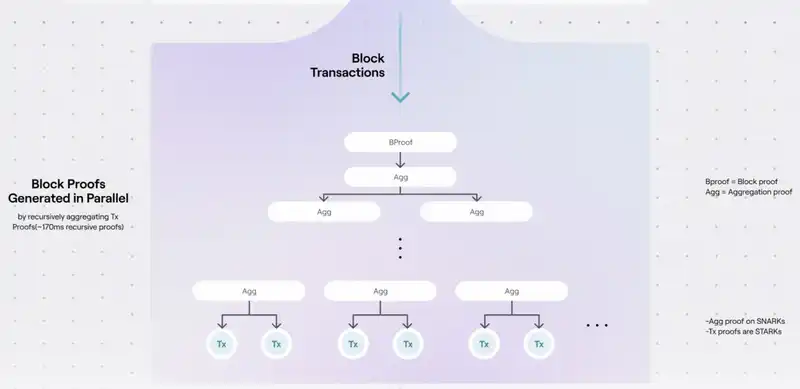
Source: Polygon website
The system generates an aggregate proof for every two transactions.
A new aggregate proof is generated from the two aggregate proofs, which are recursively layered to form a single aggregate proof for all transactions (up to 3000) in the entire block.
A block proof is generated from this aggregate proof.
Finally upload this block proof to the Ethereum main network.
The fast recursion capability provided by Plonky2 is key to this process. In this architecture, Zero will have several significant advantages:
The recursive proof feature greatly reduces the cost of verifying historical transactions for new verifiers when they join the network.
The size of the recursive proof is only 45kb.
Because the low-level proof generation is parallel, this gives Zero's architecture the ability to "scale out" : simply adding more machines to the network can improve the performance of the network. This means that the throughput of the protocol is not limited by the weakest node on the network, but only by the total amount of computation in the network.
In addition, the parallel recursive proof architecture also makes Polygon Zero's nodes naturally acquire the sharding property.
The core of sharding is to divide the transaction records of a period of time to different groups to process a sharding and then integrate them into a complete block. For example, if the original system processed 100 transactions per second, and now the system is divided into 10 pieces, each processing 100 transactions per second, the system will theoretically have a parallel processing capacity of 1,000 transactions per second.
However, a key problem of sharding is that the owner of the whole block must verify that the records in each shard are correct, because each shard is relatively centralized and error-prone. Suppose that the original 51% attack can modify a record in the main network, while the threshold of direct attack is 5.1%.
Obviously, it is impossible to require a verifier to fully recalculate the transactions in the original shards during validation, so shards lose all value for scaling. In the traditional domain, a single shard cannot be directly verified by the whole block. Therefore, the fragmentation of Ethereum and other public chains usually adopts the following strategy:
There must be a game within each fragment, for example, the packer and the producer will be split, let the packer pack their own bid to sell to the producer, the producer is guaranteed to be absolutely random.
The overall validation committee also needs a division of labor to ensure efficiency, but it must be random enough each time, and the committee needs to reassign frequently, otherwise the verifier can easily delete records by breaking one validation group.
Through schemes such as KZG commitment (Kate-Zaverucha-Goldberg polynomial commitment), the verifier can independently verify the fragments to minimize the possibility of missing data.
As we can see, in the whole package-block-verification process, several complex game-based mechanisms are needed to ensure security, which is a relatively inefficient parallel processing (sharding) mode.
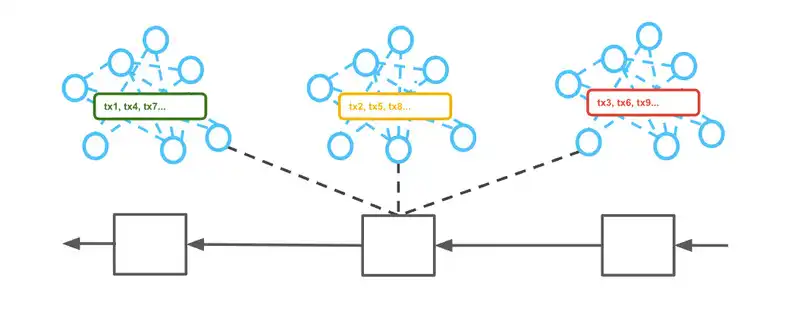
Source: https://mirprotocol.org/blog/Recursive-proofs-on-Mir
However, in Polygon Zero, the owner of the entire block can easily read the validity of the transaction directly from the proofs of each subdivision, thanks to the recursive zero-knowledge proof feature. Therefore, the mechanism of Polygon zero sharding (parallel processing) is far simpler and more efficient than traditional sharding based on game theory.
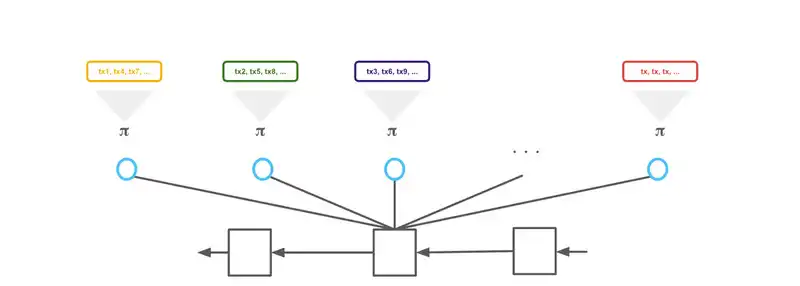
Source: https://mirprotocol.org/blog/Recursive-proofs-on-Mir
Of course, ZK Rollup level sharding only promotes the efficient operation of Layer2 itself, and to achieve system-wide expansion, the transaction compression rate of the entire ZK Rollup needs to be increased.
Polygon Miden: Open source zkVM based on STARK
Polygon Miden is a ZK Rollup based on STARK(Scalable Transparent Argument of Knowledge). Most of the current ZK Rollup are based on SNARK(Succinct Non-Interactive Argument of Knowledge), Only Starkware and Polygon Miden are working on the Stark-based ZK Rollup.
About: STARK and SNARK
ZK-SNARKs proposed in 2012 that related research and practice (Zcash, Loopring And J.P. Morgan) and are generally more mature. It has advantages in validation time, compression effect, Gas consumption and other indicators.
ZK-STARKs was officially published in an academic paper in 2018, proposed by Starkware team. Compared with SNARK, it mainly has the advantages of free initialization trusted Settings and quantum resistance, and is considered to be a more secure proof scheme in the long term.
The comparison between the two can be seen in the following table:

Source: https://consensys.net/blog/blockchain-explained/zero-knowledge-proofs-starks-vs-snarks/
The Miden architecture is shown below:
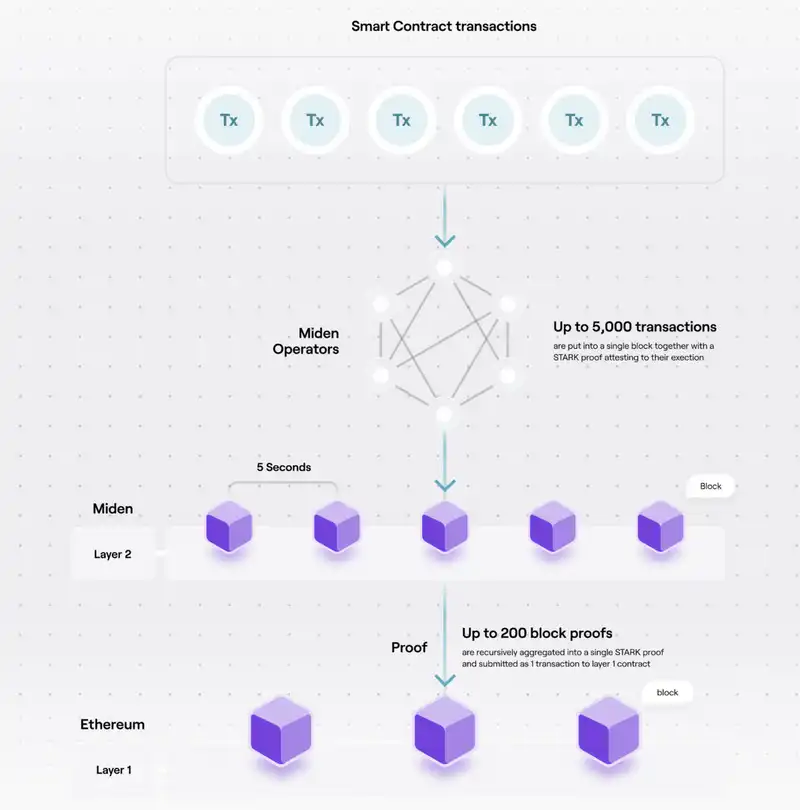
Source: Polygon website
The transaction is first distributed to the Miden execution node;
The execution node bundles 5000 transactions into a block at a time and generates STARK proofs;
Miden Layer 2 aggregates the 200 blocks to generate a STARK Proof A that the 200 bundled blocks (each containing 5,000 transactions) are valid.
STARK eventually proves that "a" will be uploaded to Ethereum to reach a consensus.
Miden's core components include the Miden VM and Winterfell:
The Miden VM was formerly the Distaff VM -- the first Stark-based virtual machine. The Distaff has been in development since early 2020 and has gone through multiple iterations of development and user testing.
Winterfell is a high-performance STARK prover led by Miden founder Bobbin when he was at Facebook.
According to the official introduction, we summarize the main features of Miden as follows:
Compared with ZK Rollup, which uses SNARK proof, Miden uses STARK proof, which is more secure in the long run (although it is more expensive in the short run, it can be dealt with by recursive proof).
In contrast to Starkware, which also uses STARK Proof, Miden is completely open source.
Developer friendly: The goal of Miden is to let developers run smart contracts on top of this zkVM without even learning anything about cryptography or zk proof.
Support for multiple programming languages: In addition to Solidity, the team is working on adding support for multiple programming languages, including Move.
The Miden VM is currently in alpha release, with the Turing-complete version v0.2 just released on 22 August, and the official release is scheduled for 2023Q1.
Polygon Nightfall: Blockchain solution for enterprises
In September '21, Polygon and accounting and enterprise services giant EY, Ernest & Young) formed a partnership and subsequently released Polygon Nightfall. In May '22, Polygon Nightfall launched a test web site and plans to launch the main web site this year.
In fact, Ernst & Young has been working on Nightfall since 19 years. Its goal has always been to provide blockchain services for enterprises. Therefore, the design of Nightfall has always emphasized the privacy of transactions, that is, users' on-chain transactions are not completely public. They initially wanted to build on the Ethereum main network, then found that having privacy on the Ethereum main network was too expensive, so they switched to L2 and eventually chose to work with Polygon.
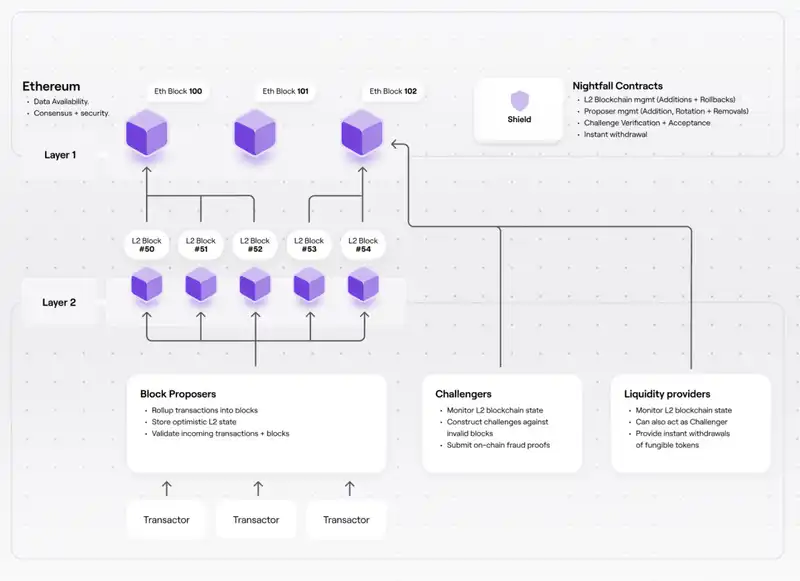
Polygon Nightfall architecture source: Polygon website
Polygon Nightfall is essentially an Optimistic Rollup, which then superimposes many zero-knowledge proof features to achieve the anonymity of transaction records. (When zk technology is mature, Polygon Nightfall will adopt the full ZK Rollup solution in the future).
For the enterprise, Nightfall's key benefits are security, privacy, and efficiency:
The Rollup feature enables Nightfall to inherit the security of ETH, reducing the cost of trust.
The application of zk technology makes the enterprise need not disclose the complete transaction record, which is convenient for the development of some business;
The Rollup model dramatically reduces the cost of the network. In addition, Polygon Nightfall uses a capital pool model, in which a capital pool provider takes the place of the enterprise to complete the seven-day fraud proof period, to facilitate efficient enterprise operations.
According to the Polygon website, Nightfall's primary target use case is the supply chain industry. Compared to the current supply chain industry, Nightfall can provide: Traceable and untampered supply chain data, efficient data verification and verification of authenticity, as well as secure payment methods, fast settlement capability and low transaction costs.
While the actual business will have to wait until the launch, the partnership with Ernst & Young demonstrates the Polygon team's strategic vision and ability to leverage Ernst & Young's vast global reach for enterprise services; Meanwhile, the product path is not limited to the technical path, and the most practical Optimistic Rollup+ZK+ capital pool is chosen to practically meet the business needs.
Financing and team situation
Financing situation
MiH Ventures participated in the Polygon seed round with an investment of $165,000.
2019 年 4 月 24 日,官方宣布在币安 进行 IEO ,以$0.00263 的价格筹集 500 万美元,占 Token 总量的 19%。
2019 年 4 月 30 日,官方宣布获得 Coinbase Ventures 的 45 万美元种子轮融资,占 Token 比例为 1.71%。
On December 20, 2020, Polygon announced a $1 million investment from angel investor John Lilic.
On February 7, 2022, Polygon acquired Sequoia Capital (India) led a $450 million funding round (cost not disclosed) from Tiger Global, SoftBank, Galaxy Digital , the Republic Capital Makers Fund, Alameda Research , Alan Howard, Alexis Ohanian, Steadview Capital, Elevation Capital, Animoca Brands Spartan Fund, Dragonfly Capital , Variant Fund and Kevin O "leary and 37 other organizations and individuals.
Team situation

The Polygon team started out with four co-founders, three of whom were from India:
Jaynti Kanani, Co-founder & CEO, graduated from School of Engineering, Dharmsinh Desai University, India in 2011 and has worked in development since then until co-founding Matic Network in 2017.
Sandeep Nailwal, Co-founder & COO, a graduate of the National Institute of Industrial Engineering, Mumbai, India, worked as a consultant at Deloitte and has since worked in operations.
Anurag Arjun, a 2006 graduate of Nilma University Polytechnic, India, has worked as a product and project manager in various companies.
Mihailo Bjelic, Co-founder. I studied information systems Engineering at the University of Belgrade.
After a series of mergers and acquisitions, the team incorporated the following core members:
David Schwartz, Originally the project leader of Hermez, David has more than 20 years of experience in the IT industry. He has been in contact with blockchain since 2018. In addition to Hermez, David also founded the DID-oriented project Iden3, which is also one of the underlying protocols of PolygonID.
Jordi Baylina, I'm the head of technology at Polygon zkEVM. Jordi, a veteran Solidity developer and co-founder of Whitechat Group, was instrumental in the hack of TheDAO and Parity Multisig, as well as participating in the audit of MakerDAO And Aragon Has been influential in the Ethereum developer community.
Antoni Martin is responsible for Polygon's corporate connections. He has nearly 20 years of experience in the banking system.
Bredan Farmer and Daniel Lubarov, The two were co-founders of Mir, with Bredan previously doing research at Duke University and Daniel having worked at payments company Square and Google. Their proposed Plonky2 can generate recursive proofs in 0.17 seconds, greatly improving the commercial process of recursive proofs.
Bobbin Threadbare, In charge of Miden business, he has made many contributions in zk-STARK's field and is an expert in STARK's field.
And Ryan Wyatt. Leading Polygon Studios, he is a former head of global Gaming Partners at Google and head of games at YouTube, and a former game reviewer who has worked on esports projects and has a strong presence in the gaming space.
Polygon's team of advisors is also very strong, They include Hudson Jameson, a core contributor to Zcash and Ethereum; Ryan Sean Adams, co-founder of Bankless; Pete Kim, head of wallet engineering at Coinbase; and billionaire Mark Cuban, among others.
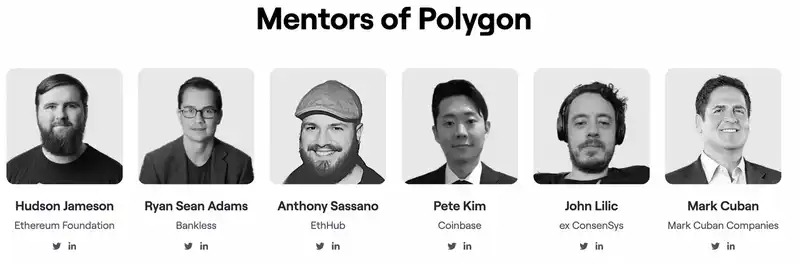
In general, the backgrounds of Polygon team and consultants in Crypto projects are very diverse, and their personnel profiles also show that they are both technical and operational.
In the process of development, Polygon team's original Plasma expansion plan gradually fell behind. However, Polygon adjusted its business direction several times in time, showing its strong strategic layout ability and practical implementation ability, which is reflected in:
Polygon went online the side Chain of the PoS architecture before the DeFi Summer began in June '20, before the BNB Chain went online on September 1st. At the same time, after BNB Chain successfully siphered Ethereum traffic with developer subsidies, the Polygon team quickly responded by following up on the subsidy strategy in April 21 and launched the Eco-Fund, which directly subsidizes the user behavior of the header app, rapidly increasing the TVL data of the app. This makes Polygon a key player in the chain Wars narrative that will continue throughout 2021.
In August 2021, when Arbitrum and Optimist Rollup were not online, they made a big bet on the Optimistic ZK track and announced a $1 billion investment plan, Quickly integrated Hermez and Mir two excellent ZK teams into their own ecology through personnel + project merger and acquisition, which greatly improved their technical capabilities in the ZK field. This is also one of the few successful mergers and acquisitions in the Crypto field (so far). In addition, this kind of merger and acquisition also produces a good synergy effect in the field of ZK. zkEVM, Zero and Miden have different business directions and can complement each other. For example, Polygon zkEVM adopts the suggestion of Polygon Zero to select the STARK proof generation of small field with 64-bit.
Business analysis
Industry space and potential
According to Tomasz Tunguz, managing director of Redpoint, there are now 5 billion Internet users worldwide, compared to millions of on-chain users; There are about 27 million Internet developers worldwide, and Web3 developers are on the order of 10,000. If we believe that Web3 can be introduced to the vast majority of Web2 users with greater freedom and cheaper trust in the not-too-distant future, there is still a lot of room for growth in terms of user and developer magnitude. Of course, the migration of Web2 users to Web3 is a long-term process, and it also needs to wait for the further improvement of infrastructure. However, the huge development space here is the huge opportunity faced by the public chain of smart contract represented by Ethereum.
Ethereum is the pioneer of smart contract public chain, and also the most representative smart contract public chain. Over the past seven years, we've seen the huge possibilities that smart contracts bring to Ethereum: users can trade, lend, manage money, play, create, socialize on the chain... We've seen Axie Infinity in this cycle; And how StepN has profoundly changed the lifestyles of millions of people over time. What's more, it's all happening on a trusted, permissionless blockchain, where everything is governed by rules that are made public in advance, and all changes to those rules are open and transparent: code, not people, governs. The ultimate goal of the public chain of smart contracts is to carry various business behaviors of billions of people. If it is realized, the real target in the era of Web2 is not Google, Meta and other companies, but the country.
In 2020-2021, the upsurge of DeFi, NFT and Game successively broke out on the chain, the expensive and slow of Ethereum seriously affected the user experience, and also affected the development of Ethereum itself. In this context, a series of low-cost high-speed public chain or cross-chain platform rapid development, also created the top 20 crypto market capitalization Solana, Polkadot , Cosmos , Polygon, Avalanche This batch of new projects.
In essence, the Ethereum expansion scheme and the other L1 public chains solve the problem of expansion, but choose a different implementation path: based on Ethereum or replace Ethereum. Although it is currently in a bear market, the capital is still actively investing in the new public chain and various Rollup schemes, which also shows the recognition of the capital for the expansion of the track.
To sum up, Polygon is on the Ethereum expansion track, the industry space is vast, and it is one of the most attractive narratives in the crypto world in the past and in the future.
Polygon PoS competitive landscape
Under the background of the current crypto bear market, the competitive landscape of the public chain of smart contracts is also changing: Terra A spectacular collapse. Yanshuigu, Tron quietly climbed to the second position of TVL, and the new public chain Aptos And Sui The recent rise in market attention has obscured Solana's edge.
Traditionally, crypto investors have used TVL and the fees paid by users as primary metrics to measure competition between public chains.
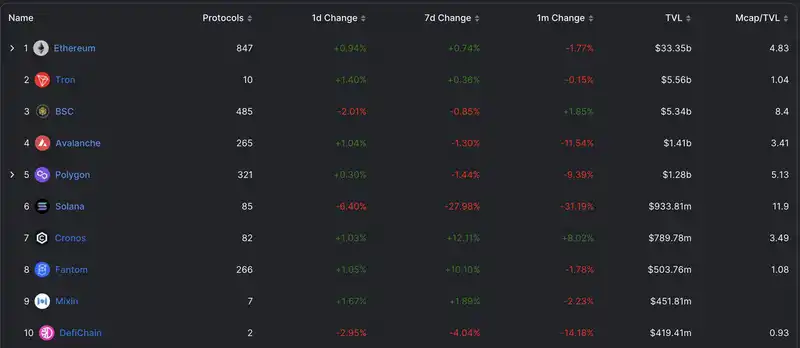
TVL ranking data source: Defillama
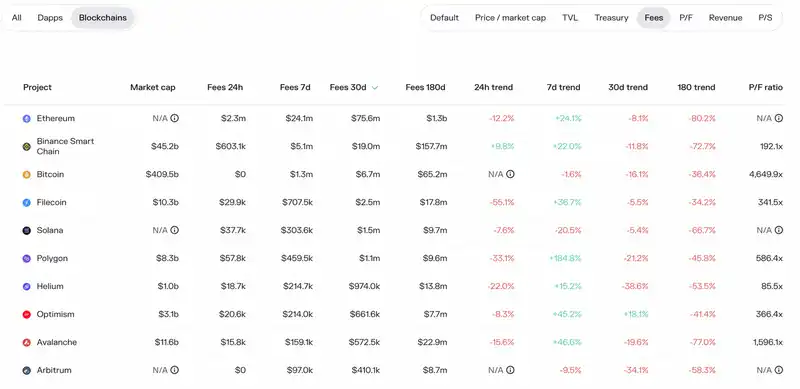
Public chain annualized cost data source: Tokenterminal
In terms of TVL, Polygon currently has 1.28 billion TVLS, ranking fifth. In terms of fees paid by users, Polygon users are ranked sixth among all blockchains (once Bitcoin and Filecoin are discarded; Two non-smart contract public chains are listed fourth).
According to TVL and public Chain data, Polygon's competitors include: BNB Chain, Solana, Avalanche, Modernism, Arbitrum, Cosmos, Polkadot.
The characteristics and competitive situation of these public chains is a very big topic. Finding a home for labs published in early September gives a very detailed description. We briefly describe the characteristics of the current public chain as follows:
Relying on Binance, BNB Chain has the most stable user source in the crypto world, and has a continuous subsidy and incentive policy. BNB Chain is close to or even exceeds Ethereum in many aspects of data. However, its ecology is relatively "closed" compared with other public chains, and it also has obvious characteristics of "planned economy".
Solana is the best in the crypto world in terms of single-chain scalability, with TPS of the order of thousands. There are many DeFi applications on the chain, and the NFT ecosystem is relatively prosperous. There has been a successful app like StepN with millions of users. But after the influx of users, Solana's network "outages" became more frequent, raising fundamental concerns about network security. The two new public chains of Move language, which have similar technical solutions and investment background, also continue to make progress: Aptos launched the main network on October 18, and Sui's test network was launched in August. The rapid development of similar competitors has also had a great impact on Solana.
Arbitrum and Optimist Layer2 solutions adopted Optimistic Rollup have good EVM compatibility. Like Polygon, they also attract many Ethereum blue-chip DeFi projects and their corresponding developers. There are also numerous innovative projects on the chain. However, limited to the architecture, they have significantly lower gas than the Ethereum main network, but the Gas of tens of cents to several dollars is still not low enough (although it will improve after EIP-4488), and their TPS is not much higher than the Ethereum main network. Questions have also been raised about the degree of decentralization of Sequencer, which is responsible for delivering data to Ethereum's main network.
Cosmos has survived the collapse of Terra, the largest chain in the ecosystem, but still attracts more and more developers with its autonomy and customizability (the ability to use its own token as a Gas token, the ability to build its own verifier network, etc.), high interoperability, and rich development tools. The recent dYdX I decided to move from StarkEx to Cosmos. The main problem with Cosmos at the moment is its slow development. The total TVL in the universe is not high at the moment, and the non-EVM experience raises the bar for some users.
Polkadot, as the other bit of cross-chain binary, has the advantage over Cosmos in that its parallel chains can share the security of the relay chain under the premise of heterogeneity, but this requires the huge sovereignty concession of the parallel chains. Core parallel chains within recent ecology; After the hacker attack, the development of other parallel chains is relatively general, and the activity level of the project within its ecology is also a certain gap compared with Cosmos.
Avalanche currently has a higher TVL and they also launched a Cosmos-like application subnet architecture that gives developers more autonomy, Two GameFi projects -- DefiKingdoms and Crabada -- have successfully launched an Avalanche subnet.
It can be seen that each public chain has its own relatively unique value proposition, and the competition between the public chains is intertwined. And each public chain is also evolving, with the progress of technology and market demand to adjust the competitive strategy and technical direction. The main advantage of Polygon's PoS chain compared to the public chain mentioned above is its good relationship with the Ethereum community, developers, and progress with traditional enterprises as well as Web2 major companies. The community's concerns about Polygon include the security of the PoS bridge and the centralization of the PoS node, as well as the uncertainty of the progress of the ZK Rollup project.
ZK Rollup track pattern

According to Vitalik's classification of ZK Rollup, ZK Rollup is divided into 5 categories (as shown in the figure above) according to the selection of performance and adaptivity:
Type 1: fully equivalent to Ethereum L1's zkEVM. This zkEVM is currently being explored by the PSE team at the Ethereum Foundation.
Type 2: zkEVM, which is completely equivalent to EVM, with slightly different EVM from Ethereum. Such as future Scroll and Polygon zkEVM.
Type 2.5: zkEVM with EVM equivalent but different gas cost (which may cause slight compatibility differences). This is where Scroll and Polygon zkEVM are heading.
Type 3: indicates the zkEVM equivalent to EVM. Such as the present stage of Scroll and Polygon zkEVM.
Type 4: zkEVM compatible with EVM at the language level, with different features and developer facilities. At the same time, developers cannot write EVM Bytecode directly. zk EVM for Type 4
There are & have spent zkSync And added Solidity to the Cairo compiler after the StarkNet.
It is worth pointing out that the different Rollup types mentioned above are not strictly good or bad, but mainly make different choices in terms of performance and adaption: the larger the serial number, the better the performance, but the lower the compatibility with EVM; The smaller the serial number, the better its adaptation with EVM, but the performance will be relatively poor.
Polygon competes with Scroll, zkSync and Starknet in ZK Rollup, among which Scroll is the closest competitor.
The following diagram can also show the differences in compatibility between these projects:
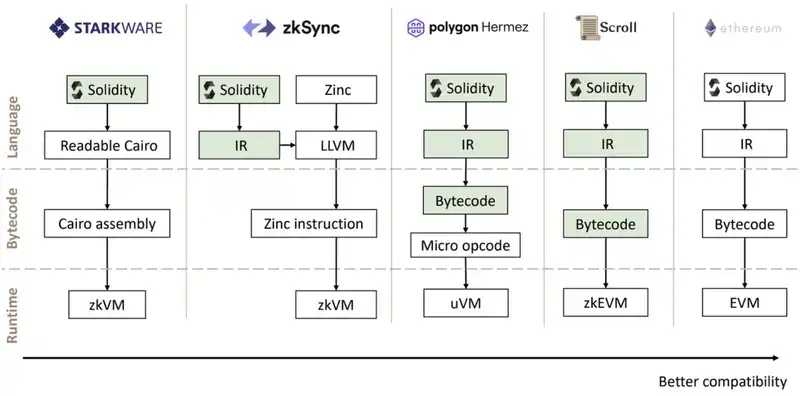
Source: Scroll team
The financing background and development progress of Scroll, zkSync and Starknet are as follows:
Scroll was completed in April 2022 by Polychain Capital Led the $30 million financing, Bain Capital Crypto, Robot Ventures, Geometry DAO and other participants. Several angel investors, including Ying Tong and Carlos Aria of the Ethereum Foundation, and members of the Ethereum community Anthony Sassal, Ryan Adams, and Santiago Santos also joined the funding round. Scroll released the Pre-alpha version of the public beta on July 15th. According to the roadmap, there will be Alpha tests after that, and the full beta test will start at the end of the year, and the main beta will be launched next year.
zkSync's development team, Matter labs, has completed three rounds of funding, most recently in November '21. Placeholder, Dragonfly, 1kx and 70 other institutions and individuals have contributed. zkSync launched a beta network for its EVM-compatible product, zkSync 2.0, in February 22, and its main network is expected to go live on October 28.
Starkware, the developer behind Starknet, has raised a total of $273 million from investors including Paradigms. , Sequoia Capital, Pantera Capital& NBSP; In its most recent investment round in May 2022, StarkWare Is valued at $8 billion. Starknet has been Alpha on the main network since November 2021, and there are still a number of improvements in the works.
We can roughly see that zkEVM is currently under development, and the project with better EVM compatibility has slower development progress. Scroll has the best EVM compatibility, and the development progress is relatively slower.
In Vitalik's view, the future of Ethereum is not a single Rollup unifying everything, but a world where multiple rollups coexist. From this perspective, many project parties exploring ZK Rollup are not completely competitive, and the current track is far from being competitive to the point of death. All ZK Rollup may have a bright future. However, in the short and medium term, which team can take the lead in the normal operation of the main network online zk EVM, will get a great opportunity in the competition.
Based on the current situation, Polygon zkEVM is expected to be the first Type 3 ZK Rollup to be launched on the main network.
Token model analysis
Token 作用
Polygon 的原生 Token 为 MATIC,目前来看,其作用主要有 2 点:
维护网络共识: Matic 侧链使用 PoS 机制达成共识,用户质押 MATIC Token 可以参与出块,获得质押收益。
支付网络中的交易费用: Matic 侧链上的交易费用以 MATIC Token 支付(ZK Rollup 的一系列子项目的交易费是以 ETH 来支付)。
Token 分配与解锁
初始 Token 共为 100 亿枚,于 2019 年 4 月正式流通。其具体分配如下:
私人销售 Token 占总供应量的 3.80%,这部分 Token 有 50% 在 TGE( Token 生成事件)释放,剩余 50% 锁仓 6 个月后释放。其中:
种子轮(Mih Ventures):以 1 MATIC = 0.00079 美元的价格进行销售,共筹集了 165,000 美元,销售了总 Token 供应量的 2.09%.
早期支持者(Coinbase Ventures ):以 1 MATIC = 0.00263 美元的价格进行销售,共筹集了 450,000 美元,销售了 Token 总供应量的 1.71%。
Binance Launchpad 销售 Token 占总供应量的 19%。它于 2019 年 4 月进行,总共筹集了价值约 5,000,000 美元的 BNB,每个 Token 约 0.00263 美元,占 Token 总供应量的 19%,此部分在 TGE 完全流通。
团队 Token 占总供应量的 16%。此部分 Token 锁仓 1 年,从 2020 年 4 月开始,每半年释放 1/5,在 2022 年 4 月释放完毕。
顾问 Token 占总供应量的 4%。此部分 Token 在 TGE 后 6 个月、12 个月、18 个月分别释放 1/3,在 2020 年 12 月释放完毕。
网络运营 Token 占总供应量的 12%。此部分 Token 在 TGE 释放 1/3,剩余部分分 32 个月线性释放,在 2021 年 12 月释放完毕。
基金会 Token 占总供应量的 21.86%。此部分 Token 在 TGE 释放 1/5,其余部分每半年释放 1/5,在 2021 年 4 月释放完毕。
生态系统 Token 占总供应量的 23.34%。此部分 Token 在 TGE 释放 1/8,其余部分每半年释放 1/8,在 2022 年 10 月释放完毕。
Token 释放节奏如图所示:
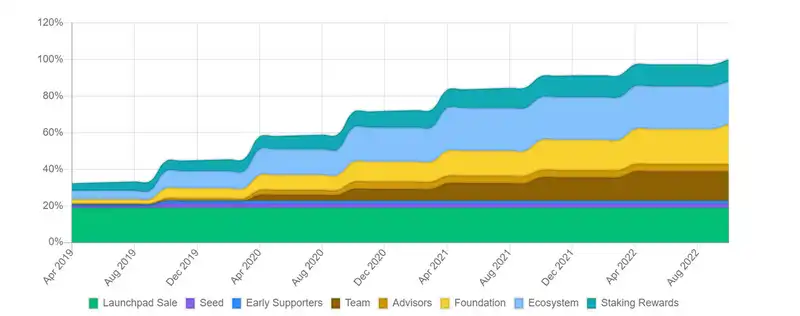
目前,所有的 Token 已经是理论上的流通状态,不过仍然有 10% 的基金 Token 未参与流通,以及 2.7% 的 Token 仍然留在解锁合约内,Binance 等交易平台都采用了 87.3% 作为实际流通量。
It's also worth noting that Polygon went live with an update similar to IPP-1559 in January. MATIC will benefit from the Internet boom, and the total number of MATIC destroyed is currently 3.11 million, or 0.03% of the total
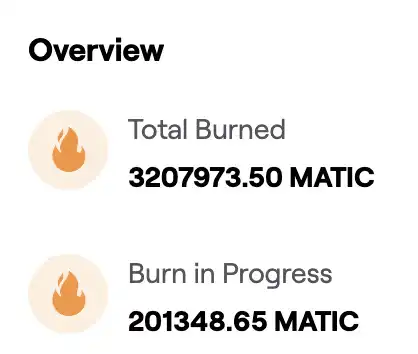
Source: https://burn.Polygon.technology/
risk
In terms of Polygon's current development, PoS is its base, while several of ZK Rollup's sub-projects are important potential growth areas in the future. Potential risk points of the project include:
Polygon PoS stall in public chain competition and fail to attract developers and users
The expansion of Ethereum has undergone a major technical route change, and the direction of ZK Rollup is no longer recognized by the community
Polygon's ZK Rollup sub-project has fallen far behind expectations
There was a major security incident at the official chain bridge of Polygon PoS
Preliminary valuation
Five Core Issues
Which operating cycle is the project in? Is it the maturity stage, or the early and middle stages of development?
Polygon is currently in mid-development. As a side chain, Polygon has become an influential public chain, and its application on the chain has been very mature and formed a relatively complete ecology. The ZK-Rollup project of the team layout will be launched in the next year, and there are still new growth points worth looking forward to.
Does the project have a solid competitive advantage? Where does this competitive advantage come from?
Polygon has certain competitive advantages in the fierce public chain ecological war. The author believes that these competitive advantages in descending order of importance are as follows:
Excellent talent accumulation in the ZK field, as well as first-mover advantage in technology and products
The growth of users and developers of public chain ecology has formed a positive cycle, especially with those non-Web3 but with a large number of users of large enterprises landed a lot of cooperation cases, ecological flywheel began to turn
Focusing on the expansion solution aggregator of Ethereum ecology, it has a good relationship with the Ethereum community with the most abundant talents and innovations
Although there are many product lines of business, there are relatively good synergistic effects in technology and ecology
The above competitive advantages are accumulated through the continuous judgment and selection of the Polygon team, which is behind the team's outstanding industry foresight and ecological operation ability, reflecting the high level of strategy.
While the battle for the public chain ecosystem is far from over, it remains to be seen if the Polygon team's vision of the future will be validated, and if the resources invested in advance will bear fruit and lead to a more solid moat.
Is the long-term investment logic of the project clear? Is it in line with industry trends?
The long-term investment logic of the project is clear and consistent with the general trend of the industry.
Compared with the store of value logic of Bitcoin, how to introduce more users to participate in blockchain, the global settlement layer, is the core narrative of the public chain of smart contracts represented by Ethereum, and the most important investment theme throughout this cycle and even the next cycle. As a staunch supporter of the Ethereum ecosystem, Polygon is in line with the industry's broader trend.
In the Ethereum ecology, Vitalik clearly puts forward that "the future of Ethereum is Rollup centered" and "in the medium and long term, with the improvement of ZK-SnARK technology, ZK Rollup will outcompete Optimistic Rollup in all useful cases". Judging from the development of Polygon in the ZK Rollup space, especially in the development of the ZK EVM Rollup, Polygon has become one of the most important players in the space.
What are the main variables in the operation of the project? Is this factor easy to quantify and measure?
In terms of Polygon PoS, the development of Polygon PoS can be measured by observing indicators such as number of active addresses, TVL, and number of active DApps.
In terms of ZK Rollup, since several core projects have not been launched yet, the main variables are the development and rollout progress of each ZK Rollup. Currently, the code for several core products is open source and can be tracked through Github in the form of code submissions. (Polygon announced the implementation of EVM equivalent zkEVM in July, but the actual effect has not been achieved; zkEVM was expected to be officially launched in Q3 this year, and currently zkEVM's online time has been updated to 23 years).
How is the project managed and governed? What is the DAO level?
The management and governance of the project relies on the core team, which historically delivers better results.
valuations
Polygon's business is mainly divided into two parts, the Polygon PoS chain and a series of sub-projects from ZK Rollup.
Polygon PoS valuation
We adopt a combination of horizontal comparative valuation and vertical comparative valuation to evaluate Polygon PoS.
Cross-sectional data comparison
The valuation of the public chain of smart contract is a complex and difficult topic. DeFi protocol can use revenue multiple and other methods to make valuation reference. However, the public chain of smart contract is more similar to a country, and it may be more appropriate to evaluate the current situation and potential of the public chain from the perspective of "comprehensive national strength". The "comprehensive national strength index" of the public chain should consider the number of active Dapps, active users, TVL, total value of assets on the chain, the number of active developers, the number of transfers on the chain, the total value of transfers on the chain and other data, and be obtained by certain weighting. However, there is no similar index at present.
Therefore, the author focuses on the four dimensions of assets, users, business activity and developers to compare Polygon with other public chain competitors.
Asset index: TVL. Users are willing to put valuable assets on a certain chain, which indicates users' comprehensive recognition of the security, availability and investment value of the chain. It is also the most commonly used data index for public chain valuation at present. (In fact, a better asset measurement index should include the NFT assets on the chain, but there is no accurate data on this aspect.) Therefore, we take the TVL of homogeneous assets calculated by defillama as the approximate asset measurement index, and adopt the current market value /TVL as the asset index of horizontal comparison. The smaller the value of this indicator, the more assets on the chain corresponding to its unit market value, and the lower the valuation.
User indicator: Number of active addresses on the chain. We chose the 30-day average daily active users as a measure of the active users of the chain, and used the current market value/daily active users as a cross-sectional user metric. The smaller the value, the more users it can carry per unit of market value, and the lower its valuation.
Index of activity. Dollar value of Gas consumed daily and total tx consumed daily. The activity of on-chain transactions is an index that is difficult to measure for public chains. Traditionally, the dollar value of daily Gas consumption is usually used as the valuation comparison term. The logic is that users' real willingness to be active on the chain can be more objectively evaluated through their behavior of paying the cost of Gas (for users). But the index of the problem is obvious, the high Gas prices is not conducive to the development of chain in nature, or, reduce the cost of user interaction in the chain of the chain is the etheric fang expansion as well as a variety of competition of the target, if the index has the very good, so we should not be expanded, and should not be in order to improve the TPS. But the author also did not find a good individual index can better measure the degree of activity (if you have better ideas, welcome to discuss with the author). Therefore, in the form of combining the dollar value of Gas consumed daily with the total amount of tx consumed daily, we converted the dollar value of Gas consumed in the last 30 days and the amount of tx consumed in the last 30 days into adult data, so as to obtain two indicators that can be compared horizontally: Market capitalization/annualized gas consumption amount, market capitalization/annualized tx number. Similarly, the smaller the value of these two indicators, the lower the valuation of the chain.
Developer metrics: Number of verified contracts on the chain. The number of active Dapps is also a good measure, but there are no reliable sources for this number. We measured developer activity on the chain using the average number of newly verified contracts per day on the official block browser over the last 30 days, and used market capitalization/average daily verified contracts as a cross-sectional user metric. The lower the value of this indicator, the more developers it can carry per unit of market capitalization, and the lower its relative valuation (since this value is generally large, we use a number of digits in the comparison).
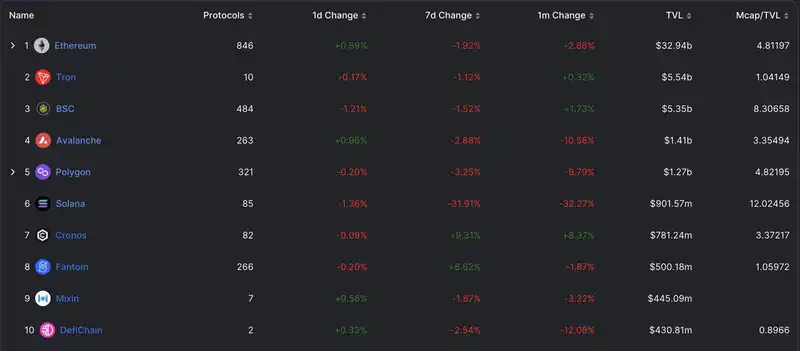
TVL's top 10 blockchain sources Defillama
此外在进行对比之前,我们还需要注意的是:排名前十的区块链的 Layer 1 Token 用例也有较大的差别。比如 BNB 除了是 BNB Chain 的原生 Token 还是 Binance 交易平台的平台币 (CRO 也类似),而 L2 的 OP Token 无法作为网络 gas 等等,如果将这些项目进行直接比较,其结果的参考性并不理想。
我们以「 Token 主要用例是维持网络共识,并且可以作为 Gas 费用来支付链上交易」作为智能合约公链的主要特征,以此来选择 Polygon 的可比对象,最终选取 Avalanche、Solana、Fantom 作为 Polygon PoS 的横向可比对象。同样的,我们也收集了以太坊的各项数据作为比较基线供读者参考。
The results of horizontal data comparison are as follows:
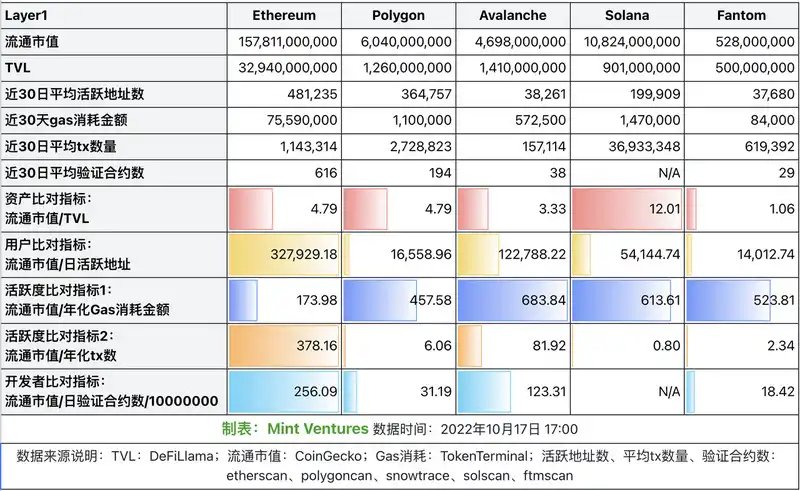
We can see clearly that:
In terms of metrics compared to Avalanche, in addition to asset metrics, Polygon has a significant valuation advantage in terms of users, activity, and developer metrics, especially in terms of active users, tx numbers, and developer stats.
In comparison to Solana's metrics, Polygon is also an overall underestimation, with the exception of daily tx numbers (and developer activity metrics that are not available).
In contrast to Fantom, which went into a slump after AC left, polygon is very similar in terms of user comparison metrics, developer comparison metrics, and daily gas consumption metrics, but has a big valuation gap in terms of asset metrics.
In conclusion, from the horizontal data comparison of Polygon, Avalanche, Solana and Fantom, Polygon's overall valuation level is low.
Longitudinal data comparison:
We also selected the above horizontal comparison indicators to intercept the valuation of Polygon PoS on the first day of each quarter for longitudinal comparison, and obtained the following results:
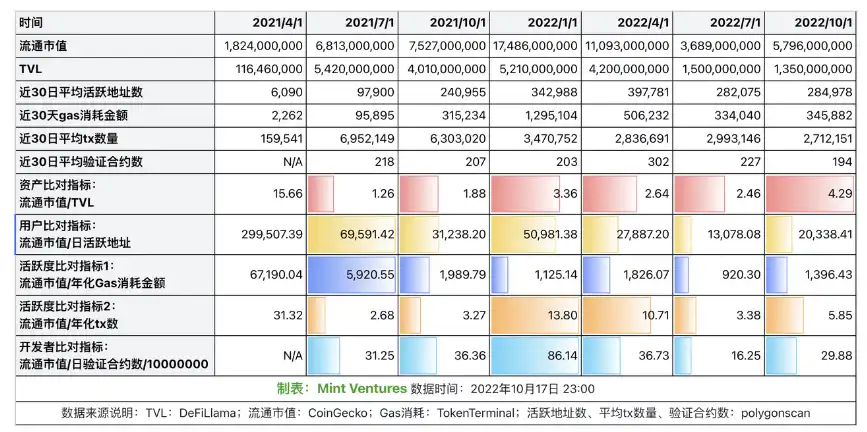
After stripping out the business data and the first half of '21, when the market cap climbed rapidly, we can see that Polygon's current valuation level is generally historically moderate. Broken down, Polygon's user data, activity data, and developer data perform well relative to its market cap, while in terms of asset metrics, it shows an increasing valuation.
On the other hand, valuations are up across the board compared with June and July, when all valuations were near their lowest, suggesting that the rally is still more valuation-driven.
In addition, none of the above estimates include Polygon's ZK Rollup subproject, which is estimated in the next section.
In conclusion, in the horizontal comparison with other public chain projects, we judge that the valuation of Polygon is low compared with other Layer 1. In the dimension of longitudinal comparison with its own historical valuation, we judge that Polygon's current valuation is in the median range.
Polygon ZK Rollup subproject valuation
In terms of ZK Rollup, since all zkEVM has not been officially launched and there is no business data for evaluation and comparison, it is not possible to make a direct quantitative valuation comparison. We only list the financing and valuation situation disclosed by each project.
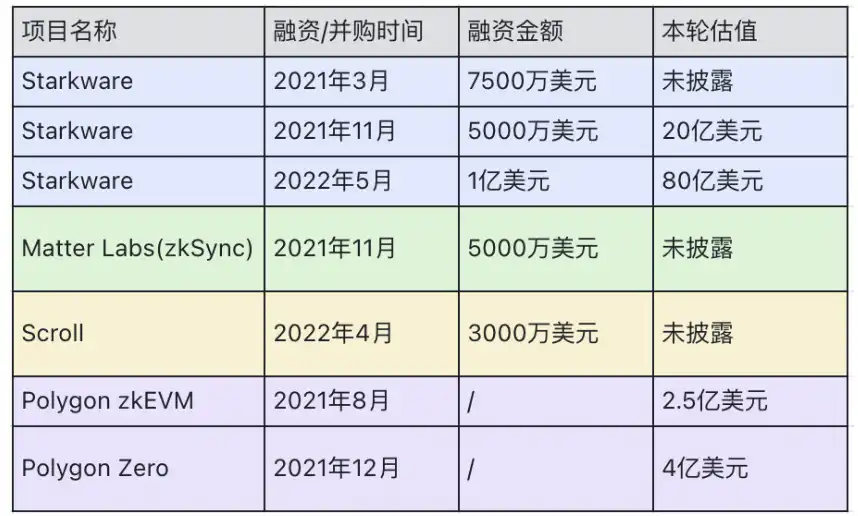
Funding information for ZK Rollup related projects since 2021
In terms of the primary market, Starkware's valuation rose from $2 billion in November 2021 to $8 billion in May 2022, Polygon's other two competitors in the ZK Rollup space, zkSync and Scroll, did not disclose valuations in their most recent funding rounds.
Although Starkware has StarkEx business in addition to Starknet, which focuses on zkEVM, and its valuation does not completely correspond to the valuation of their ZK Rollup scheme, we can ignore this impact when vertically comparing Starkware's primary market valuation. In the case of Starkware, we can roughly conclude that the market's valuation of a normally developing ZK Rollup project was 4 times higher in May 2022 than in November 2021.
If we also measure zkEVM and Zero, which Polygon acquired in 2H21, at a valuation increase of 4x, they were valued at $1 billion and $1.6 billion, respectively, in May 2022. (Again, this valuation analogy is very rough.)
Throughout Polygon's history, they have focused on expanding Ethereum from Plasma, which was phased out, to PoS+ZK Rollup, whose market capitalization has gone from $20 million at Binance Launchpad. It grew to more than $8 billion today. Objectively speaking, in the early stage of Polygon's development, the background, resources and even capital reserves of the core team did not have significant advantages in the public chain in the same period. However, relying on the outstanding industry foresight and ecological operation ability, Polygon made continuous and decisive achievements in key resources, and the market value of Polygon also moved forward to the top ten. And is expected to continue to maintain a leading position in the future public chain competition.
The next cycle is a critical time window for the entire crypto world from narrative landing to large-scale commercial use. The value of building a decentralized infrastructure that can carry the business activities of hundreds of millions or even billions of people is self-evident. If Polygon can continue to stand out from the public chain competition in the next cycle, Polygon still has a huge market cap.
The original link
Welcome to join the official BlockBeats community:
Telegram Subscription Group: https://t.me/theblockbeats
Telegram Discussion Group: https://t.me/BlockBeats_App
Official Twitter Account: https://twitter.com/BlockBeatsAsia

 Related Articles