Evmos is just the starting point? How Cevmos Detonated the Scalability of Cosmos

Original author: 0x137, BlockBeats rhythm
Evmos’ Rektdrop airdrop has created enough heat for the Cosmos ecosystem. The community has also begun to discuss the Evmos ecology more and more frequently. In these discussions, a topic about "Cevmos" has attracted special attention, which is called by many technical experts as a solution that is about to detonate the scalability of Cosmos. So what exactly are Cevmos? Why can it detonate the Cosmos ecology?
Blockchain flow processing factory
If someone asks what is blockchain, how should you answer?
Many people may say: blockchain is a distributed network ledger where users produce transactions, nodes verify validity and include them in blocks. So far, this answer is correct. Almost all blockchains today are composed of users, verification nodes, and blocks, which are used to generate transactions, verify and settle transactions, and record transaction history, respectively.
If the blockchain is compared to a restaurant, then it will be like this: this restaurant has only one waiter, and he needs to be responsible for ordering and cooking at the same time , bookkeeping and all other work involving operation and management. If this is a steamed stuffed bun shop on the street, there is no big problem with such an operation model, but if it is an Internet celebrity restaurant in the CBD, the restaurant may close down within a few days. After all, no customers will wait for a meal. For a day or two.
This is actually the problem faced by many Layer 1 Monolithic Blockchains. Taking Ethereum as an example, all transactions, settlements, and block generation are completed on the same chain, and users can only settle their transactions after the completion of the previous block. Therefore, with the large-scale popularization of Ethereum today, the problems of network congestion and soaring handling fees have emerged. In order to get their transactions included in blocks as soon as possible, people have to start expensive "gas war", and the transaction speed has become faster and faster. Slower and slower, this is the well-known "scalability problem".
Aiming at this problem, the solution given by the developer
What we are most familiar with is of course changing the consensus mechanism. Public chains such as Avalanche and BSC have adopted the new Proof of Stake (PoS) to improve the settlement and block generation speed of the network, and thus have stronger scalability. But in the final analysis, these chains just replaced their waiters with robots, and there was no innovation in the operating model. Therefore, in the case of a surge in transaction demand, the network is still facing the same problem. For example, in the recent Fantom, due to the "Solidly craze", the gas fee once soared to $3 or $4.
Another solution is Rollups, which reduces the burden on the public chain by transferring transactions off-chain. But it should be noted that the settlement and block generation are still completed by the underlying public chain. In other words, the restaurant just hired an additional waiter to take charge of ordering. So we will find that Ethereum's Rollups still faces the problem of high gas, because it has to compete with non-Rollups applications. Arbitrum, for example, spends an average of $90,000 a day on gas.
So is there a better solution? In fact, starting from common sense, we all know that the best way is division of labor and cooperation. Hire three waiters, who are responsible for ordering, cooking and accounting, so that each waiter can play their expertise and the efficiency of the restaurant can be greatly improved. That's what Cevmos does.
What is Cevmos? What is the solution for it?
Cevmos is composed of Celestia and Evmos and will be the result of the cooperation between these two teams, and is expected to be launched in Q2 next year. Celestia is an L1 public chain built using the Cosmos SDK, but unlike other public chains, Celestia is vividly called "Lazy Ledger" by its team. The reason for saying this is that Celestia’s only role is to store transaction records and provide data availability (Data Availability) through the consensus mechanism, and it doesn’t even care about the specific content it stores.
But by providing data availability, other developers can build their own settlement layer (such as EVM) and execution layer (such as EVM) on Celestia in the form of Rollups For example, the application chain), there is no need to design a consensus mechanism for its own chain, that is to say, Celestia separates the three functions of ordering, cooking, and accounting. Developers call this Modular Blockchain.
The advantage of this is that developers can give full play to their expertise to create the best EVM settlement layer or application chain interaction experience. And the block chain as a whole will be able to improve every aspect without making trade-offs. Evmos will be the first significant settlement layer built on top of Celestia.
Evmos is a combination of EVMos and CosmOS, the name clearly shows the goal of EVMOS - to become the EVM of Cosmos (Rhythm note, in "Understanding Evmos in the Cosmos Ecosystem in One Article" has an introduction to Evmos details). Evmos can integrate EVM-compatible public chains into the Cosmos ecosystem, which means that Token and NFT assets on chains such as Avalanche and Fantom can be integrated into Cosmos' IBC ecosystem through Evmo, and even EVM-based applications can also be bridged to Cosmos to go.
As a bridge connecting the IBC world and the EVM world, Evmos is obviously an important asset settlement layer of Cosmos, and will also face huge load pressure in the future. But Evmos built on Celestia will be greatly improved.
As mentioned earlier, Rollups is a solution to separate the execution layer (ie transaction) from the settlement layer. But an ideal Rollups settlement layer environment can only allow simple off-chain transfers between Rollups smart contracts and the settlement layer, and force non-Rollups applications to use Rollups smart contracts. This is because Rollups needs to compete with non-Rollups applications on an EVM monolithic chain like Ethereum, resulting in high gas costs.
Celestia uses the Optimint consensus mechanism, which only allows developers to build a Rollups chain based on Cosmos. This means that the settlement layer (such as Evmos) on Celestia will also become a Rollups, and the execution layer (ie application chain) built on the settlement layer will become Rollups of Rollups. Whether it is ZKR or OR, these execution layers will exist as independent blockchains and focus on specific areas for optimization, while sharing the consensus mechanism and settlement layer.

Why does Cosmos need Cevmos?
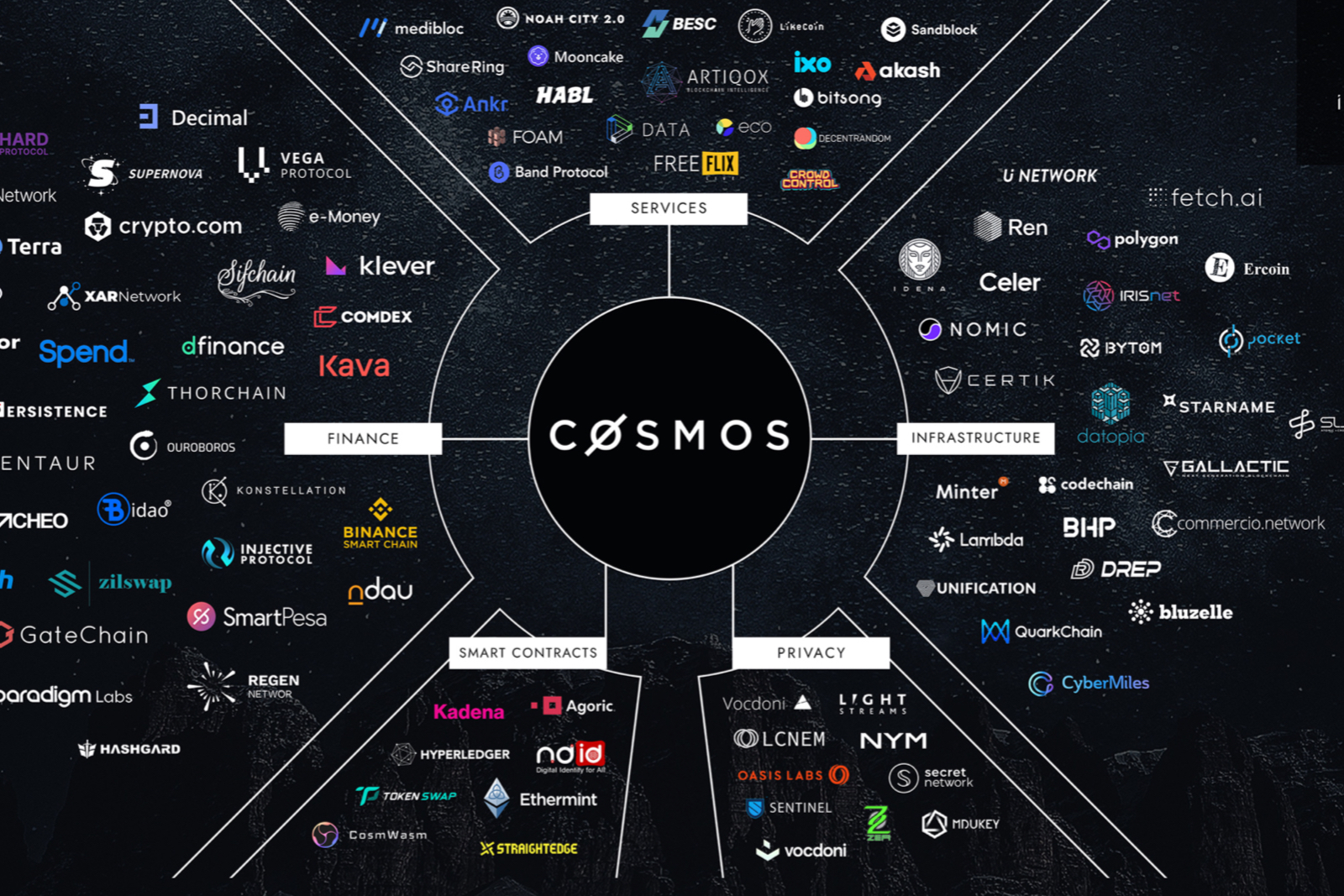
You may ask, after all this, what does it have to do with Cosmos? We know that Cosmos, as the leading project of Web3.0, has to solve three major problems: interoperability, scalability, and innovation. The following will explain how Cevmos promotes the development of the Cosmos ecosystem while ensuring security from these three aspects.
Interoperability
Although the current IBC has helped the Cosmos project achieve good interoperability within the ecology, the Cosmos chain cannot interoperate with the EVM chain outside the ecology operational. This makes projects in the Cosmos ecosystem miss out on these dividends of the EVM ecosystem, such as the previous "Avalanche Fever" and the recent "Solidly War".
What Evmos fills is the gap in EVM compatibility of Cosmos. With EVM compatibility, Tendermint PoS consensus mechanism, and IBC interoperability, developers can write or graft EVM smart contracts on Evmos, and use EVM assets on other applications in the Cosmos ecosystem.
Of course, Evmos also supports the Cosmos chain to access various protocols on the EVM, such as Aave. At the same time, ecological applications such as Osmosis will also have EVM asset pools to achieve asset diversification. In addition, Evmos can also interact with existing Ethereum clients and tools such as Metamask to further expand the user base.
In order to achieve the above goals, Evmos adopts an "ERC-20 module" to associate the ERC20 Token contract address with Cosmos Token to realize cross-chain asset expression with deals. One may ask, what is the difference between this and Gravity Bridge?
The answer is no difference. As far as the cross-chain mechanism of Evmos and Gravity Bridge is concerned, the two are the same, and both adopt the locked casting model (Rhythm note, in "When you are cross-chaining, are assets really transferred?" has a detailed explanation of the cross-chain mechanism). However, when it comes to Cevmos built on Celestia, the situation is quite different.
By providing a consensus layer and a data availability (DA) layer, Rollups clusters on Celestia only need to check whether each other's blocks are included in Celestia, or Whether it is "available", so as to maximize the trustlessness of the verification process.
This is very useful in cross-chain communication. Inter-cluster cross-chains (such as Gravity Bridge) usually come with high security risks. It relies on light clients with low security. These clients default to all transactions being honest and valid, so you must trust the cross-chain bridge. Validators cannot steal your funds.
But Cevmos built on Celestia is different, because it shares Celestia's DA layer, the light client does not need to make these assumptions, but simply Verify the availability of data, so that the security of the cross-chain bridge is improved at once.
Scalability
Since it has the ability to interoperate with EVM, Evmos will definitely be able to introduce the traffic in the EVM ecology into Cosmos, which will also bring Evmos and Cosmos ecology scalability issues. The biggest limitation of the traditional monolithic chain is what we often call the "triple dilemma", which requires trade-offs and trade-offs before decentralization, scalability, and security.
But this is not the case with the module chain. By separating the consensus, settlement and execution layers, each module can be optimized. As the bottom consensus layer or DA layer for block generation, Celestia only needs to provide data availability for the Rollups above it, without the need to execute and settle transactions.
With data availability, Celestia's light nodes do not need to verify transactions, but only check whether block data is available. Therefore, only a small part of samples in the random download block can be used to test the validity of all its data with a very high probability. In this case, the light client can even be the user's computer, which downloads relevant data and performs availability verification when the user performs a transaction.
It is not difficult to see that the security and scalability of Celestia come from the number of light clients. As the number of light clients increases, the size of each block can also be increased without affecting the security and decentralization of the network itself, and larger blocks mean higher throughput.
Therefore, contrary to the current blockchain, Celestia and Cevmos built on it will gain stronger scalability due to higher penetration, which is likely to Interesting.
Innovative
Cevmos is also a "scalability of choice" for many application developers. Different from other EVM ecology, Cosmos adopts the concept of "application chain". Based on the SDK, a blockchain can focus on certain specific areas and achieve interoperability with other application chains in the Cosmos ecosystem through IBC.
But the application chains here are different from those mentioned before, they still need to establish their own consensus mechanism and verification nodes to start the network, so we will See a variety of staking options in the wallet. But this has become a problem for application developers who are not familiar with the consensus mechanism and settlement, and it seems redundant to build the underlying architecture for specific applications.
At this time, Cevmos plays an important role, because the consensus layer and the settlement layer have been provided, and the application chain does not need a new consensus mechanism and verification nodes, and directly Can start your own network in the form of Rollups. This has brought convenience to many small and medium-sized developers, eliminating the need for complex consensus design and node development, and Cevmos and Cosmos ecological applications will be able to achieve blowout growth, further bringing higher popularity and scalability.
In addition to helping the application chain start, Cevmos also has a great bonus, which is the sovereign advantage of the module chain. By using a modular blockchain, governance rights can be subdivided into applications at the execution layer without overlapping with other applications.
On Ethereum, if an application exploits a large area of vulnerabilities, it must be approved by voting governance, otherwise the entire chain can only be hard forked , such as Ethereum Classic. The same goes for Rollups, as they both use Ethereum as the settlement and consensus layer.
But on Celestia, Rollups does not use Celestia as the settlement layer, so the application can be forked without changing the data of the consensus layer. This will also encourage developers to conduct more experiments and pave the way for ecological innovation.
Modularization, a new idea of blockchain
Scalability has been a problem that developers have wanted to solve almost since the inception of Ethereum. However, due to the huge community and divergent opinions, and interest groups also have their own plans, the expansion of Ethereum is very difficult. In the context of the current large-scale popularization of blockchain, many public chains have seized this opportunity and attracted many newcomers to encryption with high-speed and cheap networks.
However, as mentioned at the beginning of the article, what most public chains currently do is "change the soup without changing the medicine", and it will eventually Subject to the "triple dilemma". Taking Solana as an example, in order to ensure low network fees, the team made an unconditional commitment to guarantee computing power, but it also sacrificed the degree of decentralization.
Cevmos separates the consensus, settlement and execution layers through Celestia to realize the modularization of the blockchain. On the one hand, it provides a better scalability solution. On the one hand, it also guarantees the decentralization and security of the network. This model may even provide a solution for Rollups on Ethereum in the medium to near term.
According to the Celestia team, they are also developing a project called Quantum Gravity Bridge, which will allow Celestia to provide valid proofs for Rollups on the Ethereum EVM. In the future, if other EVM Rollups are unwilling to use Cevmos to bridge to the Cosmos ecosystem, they can still choose to use their own EVM ecosystem as the settlement layer, but they can also use Celestia as the DA layer to enjoy the dividends of Celestia.
In the future, there will not be only Evmos on Celestia, and there will not be only one Celestia in the encrypted world. Building a scalable blockchain in a modular way may become a new idea for the development of the encryption industry.
Welcome to join the official BlockBeats community:
Telegram Subscription Group: https://t.me/theblockbeats
Telegram Discussion Group: https://t.me/BlockBeats_App
Official Twitter Account: https://twitter.com/BlockBeatsAsia
 Related Articles