Why should you care about on-chain IDENTITY (DID) tracks?
On-chain Identity Landscape
Written by Shreyjain. Eth
TechFlow Intern
In this article, we offer a meta-review of innovations that focus on putting work, professional identity, and reputation on the chain. For the sake of writing, we don't cover services that focus on cataloging our non-professional affinity and identity. An on-chain identity is a digital representation of a person, which is data stored on blockchain services.
Why is on-chain identity important?
By proving unique identity on the chain, we are moving towards a one-man-one-vote model in the DAO domain to increase the protocol's resistance to Sybil attacks.
The current professional identity on the chain is information deficient. It takes teams of recruiters an average of 49 days and $25,000 to recruit a tech employee because they can't verify publicly available career information presented through resumes, personal websites and linkedin. Spending on recruitment campaigns serves primarily as a filter to ensure candidates are truthful about their abilities.
By putting the identity on the chain, the hiring team can rely on authentication rather than trust to complete the recruitment. For example, a piece of information like "Stripe engineer on Team X" may seem less informative and searchable to hiring managers than tasks done on the chain and peer reviews.
As daOs continue to grow in size, it becomes more difficult to be a meaningful individual contributor, increasing the importance of authorization. On-chain identity can assist in decisions about whom to entrust tokens to within a DAO, without knowing the personal profile of the principal.
There are other undeveloped use cases for on-chain identity, including optimizing DTC marketing, using on-chain identity to lower barriers, and complementing customer due diligence compliance.
An on-chain identity overview
The ownership of
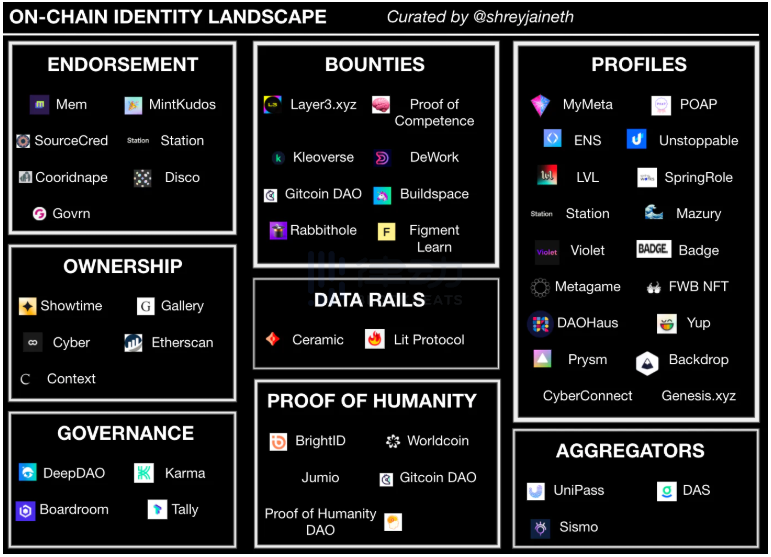
Objective data is the information that is easiest to capture on the chain and can be associated with personal identity through wallet history (such as transactions, NFT and other cryptocurrency assets owned). Use case items are: Showtime; Gallery; Cyber, Etherscan, Context.
aggregator
Personal assets, transactions, and participation in the Web3 community are done on multiple wallets and chains. With the advent of networked products that are not entirely built on blue-chip infrastructure, the fragmentation of identity through multiple wallets will become even more serious. In this case, using only a single wallet as a data source or limiting identity to on-chain transactions can create a misleading personal Web3 professional identity, and projects aimed at aggregating identities across multiple wallets were born to address this purpose. Use case items are :UniPass; DAS Systems; Sismo.
Governance in
随着我们让个人行为者通过拥有治理权力来得到更多的发言权,组织内的参与度指标正在发生变化。通过 Snapshot 之类的工具,我们就能迅速地将 DAO 中的治理参与与个人的钱包地址联系起来。当我们考虑 Token 委托人的人选,或是选择负责社区发展和参与的雇员的时候,这些数据就对指导这些人选的决策很有用。用例项目有:DeepDAO; Karma; Boardroom; Tally。
Bounty mission
Bounty missions in their current form require a lot of upfront planning, which can create difficulties for technical teams. The most useful use case for a bounty task is onboarding, where a bounty gives insight into how a particular team is working and enables the core team to analyze its early capabilities without hiring people.
Rewards are currently used for non-technical tasks such as tweeting or blogging. Since DAOs have begun to unlock the highest paying bounties to the most capable, the rewards that can be unlocked from bounty missions are closely tied to on-chain identity.
For individuals who wish to unlock these rewards, it is in their best interest to make the most of their on-chain reputation. Use case items are :Layer3. Xyz :Proof of Competence; Kleoverse, DeWork; Gitcoin DAO; Buildpace; Rabbithole; Figment of Learn.
The data layer
Web3's data layer maps on-chain keys to off-chain data stores via DIDs, changing the way we think about personally identifiable data stores. The core change is that individuals can control the discovery, sharing and access of their data. Individuals can choose how their data is stored (choosing to store it on traditional DB or blockchain data stores). Individuals can link multiple personal accounts and data sources to the same unique identity. Use case projects include :Ceramic (and IDX); Lit Protocol.
Non-robot proof
With protocols to defend against sybil attacks, we can unlock: the ability to vote democratically, to trust quadratic votes, to build credible credibility systems, and to fund public goods on a larger scale. Providing the ability to prove a unique identity while maintaining privacy unlocks a large number of options for the DAO. Use case projects are :BrightID; Worldcoin; Jumio; Non-robot proof DAO; Gitcoin DAO.
support
The more people-oriented a DAO is, the more out-of-chain activity it has. The current Web3 tool infrastructure lacks the ability to connect off-chain and on-chain data in an authenticated way that can be used to demonstrate a person's professional identity. Use case items are :Mem; SourceCred; CoordinApe; MintKudos; Station; Disco; Govrn; Lens Protocol.
General situation of
The ability to demonstrate capabilities, value, or status is not new to Web3, but to do so with blockchain technology, enabling networks to view profiles from a validation perspective rather than a trust perspective, is.
Being able to demonstrate your Web3 professional or social identity will be a key factor in future work, whether it's bounty missions or unlocking job opportunities. It involves presenting both objective and subjective data to build a holistic picture of who you are. You could think of this as a step toward the "linkedin" of Web3.
The use case projects are :MyMeta Profiles; POAP; ENS; Unstoppable Web; LVL Protocol; SpringRoleInc; Station; Mazury; Violet; Badge; Metagame; FWB NFT; DAOHaus; Yup, Prysm; Backdrop; CyberConnect.
Concerns about on-chain identity
Privacy and transparency
Our identity in Web3 can be private or public, as we choose. Because this personal identity is decentralized and can view all data on the blockchain, it can be very public or private compared to Web2 personal identity. People will be able to build unique authenticated identities for themselves that can be completely irrelevant but still remain on the chain.
The more we do to put identity on the chain, the closer we get to quantifying human value.
Lack of consistency
In a world where work always comes with some kind of reward, financial incentive, we don't do a job because we simply believe it should be done.
In a world with bounties or rewards from the start, "day one" (the person who worked for it from the beginning, regardless of the outcome) would disappear. We are currently designing for the best misalignment, while advertising that cryptocurrencies produce the best alignment. Top-up money is a potential solution to this problem, rewarding these "first days" with top-up money.
Cost of action
The number of data points that make up a person's on-chain identity is infinite, which makes design difficult and requires an agreed-upon way to collect, organize, and present to others for understanding. By isolating a number of specific identity data, we can protect ourselves financially from negative impacts (such as separating health data from insurance data). Verifying one's identity on the chain cuts across many axes of one's life (social, professional, financial), and the repercussions may lead to effects we have yet to define for you, but the effects are more severe because of the permanency, immutable, and open nature of the identity.
The original link
Welcome to join the official BlockBeats community:
Telegram Subscription Group: https://t.me/theblockbeats
Telegram Discussion Group: https://t.me/BlockBeats_App
Official Twitter Account: https://twitter.com/BlockBeatsAsia