How bad is the experience of making NFT into a Twitter avatar?
Original author: Tascha Che, founder of Tascha Labs
Original compilation: 0x137
This article is based on the views of Tascha Che, the founder of Tascha Labs, on his personal social media platform.
In order to make an NFT avatar, I spent a full 15 hours and paid an extra $1,000. In my opinion, blockchain technology as a digital identity solution does have a long way to go.
First of all, let me talk about why I want to make an NFT avatar. As a crypto KOL, people often impersonate my Twitter account. These people sell fake investment courses or paid memberships in my name, which has a very bad impact on my reputation.
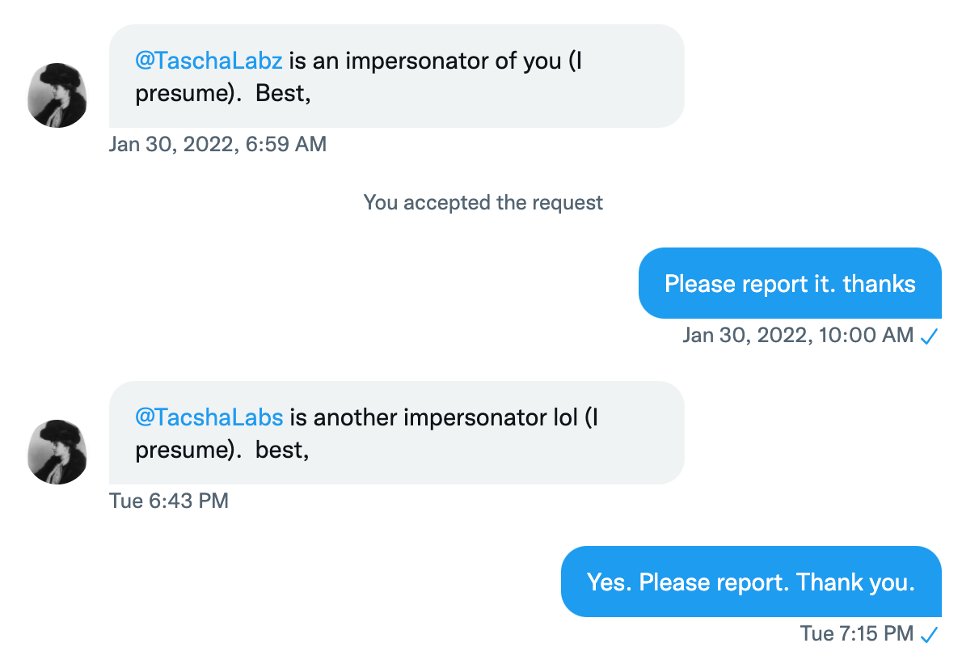
Worst of all, I asked Twitter many times Authenticating my account, all rejected...

< br>
So, when Twitter Blue launched the NFT avatar function, I had an idea: since NFT is a non-homogeneous token that can be tracked on the chain, then I You can make an NFT called "Tascha Che" and connect it to my twitter account for verification, just like an ID card in the metaverse.
I immediately found a computer graphics artist from Russia who made a really nice header image from my Youtube video.

But when I try to turn it into NFT , the problem comes. Below I will expand the whole process of making my NFT avatar step by step. After reading it, you will understand why I say that the era when everyone has a Metaverse identity is far from coming.
Step 1: Write NFT contract
Since I need to have my own ID, it doesn't make sense to create an NFT through a platform like OpenSea since they use their own shared contract. Also, on OpenSea, your NFTs are not minted until sold or transferred.
So I created a contract from scratch. It's actually very easy, just copy and paste a few lines of code, but here's the problem, you can't expect everyone in society to manually deploy their own contracts, can you?

Step 2: Deploy the contract
After writing the contract, I have to think about a question: should I deploy it to a new chain like Avalanche or Polygon, or stick to the old Ethereum Fangzhu.com?
Since Twitter obtains NFT data from the Metamask wallet, all EVM compatible chains can be connected through custom RPC, so technically speaking, from other public It should be no problem to extract NFT data on the chain.
It only costs me $10 to deploy the NFT contract to Avalanche, but it costs $1,000 on the Ethereum mainnet, so there is nothing good at all in comparison considerate.
But if the cost is too low, will other impostors use the same elements to make an NFT exactly like me? Although the hash value is unique, the metadata is not. Who can decide whether the Token ID "0x98a4ff8d..." is the real Tascha? In the real world, where your identity is defined by social context, the context of the virtual world is much weaker. While blockchain can help to some extent, it cannot fully solve the problem.
I finally decided to deploy to Ethereum because I think very few imposters are willing to incur such a huge cost. To a certain extent, this is also a "distorted" Proof of Stake mechanism.
I find this extremely ironic. Just as luxury and slowness have become the value pillars of equestrianism today, high cost and low speed have now become the value pillars of Ethereum.
In order to realize its potential as a value network, the blockchain needs to be the car or the plane, not the horse. Requiring people to verify the validity of their IDs by paying high fees is not scalable. But unfortunately, the average value of Ethereum NFT is much higher than that of NFT on other chains. Not only is the cost of deployment high, but it has gradually become a game for the rich.
Step 3: Minting NFT
As you know, the metadata of NFTs - images, videos, text, etc. are not stored on the blockchain because there is limited space on the chain. This is one of the reasons why many people question NFT, because the creator can change the metadata after the contract is deployed, or swap the image file stored off the chain. Whether this is actually a flaw in NFTs is up for debate.
On the one hand, allowing metadata to be changed without restrictions does undermine trust in any identity system, even if the metadata is not changed by the majority of creators motivation. On the other hand, as the holder of the Metaverse ID, you should also have the right to change metadata, just like you change your ID photo every few years.
At the end of the day, NFT is a general-purpose technology, and we currently don't have tools mature enough to meet the needs of different use cases.
In the end I decided to create a repository on Amazon AWS to store all the metadata and included the link in my NFT. In hindsight, being able to change metadata was a real blessing for me, and I'll tell you why below.

Step 4: Render NFT on OpenSea and Metamask
After casting the NFT, I plan to go to OpenSea to see the final effect. Normally, when you connect to Metamask, OpenSea will automatically render any NFT you create, but strangely, my newly minted NFT showed a blank page with no name or description...
 < br>
There is no website page Given any error message, after various attempts to no avail, I went to NFT guru CHANCE (lead developer of Nuclear Nerds) for help, and finally he found an extra comma in my metadata JSON file.

After fixing the metafile in AWS, the NFT image showed up. Imagine that if the metadata cannot be changed, the 0.5 ETH I spent before was wasted, and the exchange is a waste product that does not display anything.
You may say to me: "Tascha, the test network is used to prevent this situation, you should deploy it on the test network first!" Yes , I admit that I am stupid, but it should not be difficult to make OpenSea or Metamask pop up an error message, right? Sometimes I feel that Web3.0 is a bunch of idiots leading a group of even more idiots around...
My NFT rendered anyway. Everything should be fine now, right? The answer is no.
Step 5: Connect NFT to Twitter
I entered "Edit Profile Picture" and selected the rendered NFT. After being directed to Metamask, the app prompted me that my NFT data could not be extracted.

After researching for a long time, I found out that you must enable OpenSea API in Metamask security settings, because both Metamask and Twitter rely on OpenSea to query the NFT you hold.

That's right, behind the much-hyped blockchain-endorsed ownership, my Metaverse identity still relies on a SQL database in an OpenSea cloud server.
Nevertheless, I enabled the OpenSea API and my NFT head image finally appeared on Twitter. Only then did I realize that actually the only difference in the NFT header is that there is a hexagonal frame, to outsiders it looks almost indistinguishable from a normal header, you have to click on the image from the profile page To get the details of NFT.
I think there is a reason why Twitter blurs the distinction between NFT headers Own expensive NFT, or to drive the development of metaverse identity?
After the whole process, I'm still not sure if my NFT ID will really help people identify me as an imposter, only time will tell up.
Don't get me wrong, I have no doubts about the massive impact of blockchain and NFT as a general-purpose technology on the world. But we are in the nascent stage of development, both the execution of the application and the infrastructure of the actual use cases are poor, so it is not a bad thing to take a rational view of the development status of the industry.
Original link
Welcome to join the official BlockBeats community:
Telegram Subscription Group: https://t.me/theblockbeats
Telegram Discussion Group: https://t.me/BlockBeats_App
Official Twitter Account: https://twitter.com/BlockBeatsAsia

 Related Articles