



What are the current Web3 reputation identity systems?

Original Title: "Web3 Reputation Market Map"
Original Author: Kerman Kohli, Founder of ARCx / Investor of 3Box Lab
Original compilation: Peter Pan, Rhythm BlockBeats
In the age of Web3, decentralized identity is becoming more and more widely adopted. Part of a person's online activities are public on the chain and can be searched through encrypted wallets. What users create, contribute, earn and own on the chain reflect their preferences and gradually accumulate into the user's property and reputation.
Decentralized reputation and identity systems thus serve as an important category for unlocking a whole new use case in the crypto market, this article will attempt to analyze the various digital Categorize reputation items and ultimately determine how they play a key role in defining our digital identities.
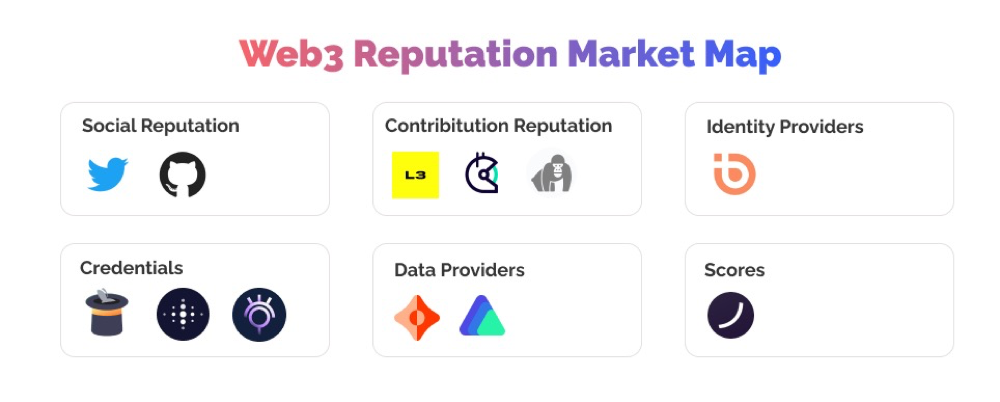
Social Reputation System
This is the main category that currently exists where user generated content can be uploaded and users can create identities and communicate with each other within that particular ecosystem. Over time, social reputation systems and users will build an associated social graph. Here are two classic examples that fit the bill:
Twitter< /h4>
Users can upload tweets containing text, pictures, videos, etc., and other users can follow each other, as well as like, retweet, and comment to create a social network of perceived value Atlas.
Github
GitHub is a software source code hosting service platform controlled by Git, and developers can write code in a public repository. And as a major contributor in a repository with many Github stars, they will create a certain status and reputation in developer circles. As a major core Bitcoin/Ethereum developer, you can gain a lot of reputation in the crypto circle.

However, I'm sure there are many other social reputation mediums, but they will not be dominant in Web3.
Contributing to the reputation system
Unlike social reputation, a contribution reputation system will be more objective, based on actual work done by a user rather than what other people think of that user's work. At the same time, the contribution reputation system is often combined with DAO, which has the characteristics of decentralization and transparency, showing strong competition.
Layer3< /h4>
Layer3 is a mechanism for coordinating, tracking and rewarding contributors, providing a bounty market that complements the missing piece of the DAO toolkit. Users can earn governance tokens by posting tweets or redesigning the front-end.
In this way, anyone can contribute to the DAO, and these contributions can be tracked both off-chain and on-chain. Ultimately, the best users have more data points that can be tracked over time.

Gitcoin
Gitcoin is an open source software development incentive platform, which aims to support various open source projects through the blockchain and promote the development of the open source movement. On Gitcoin, a project can create bounties or tasks for others to complete, and users can earn tokens for completing said tasks. Each user's contribution to tasks will be traceable on-chain and help build a reputation for completing tasks with clear goals.
While this may have similarities to Github, the difference is that this particular reputation vector is highly defined and narrowly scoped, ie: 0xabc is Project X completes the writing bounty of Y amount Token.

Coordinape
< br>
Coordinape is Yearn's decentralized salary management system for DAOs, allowing decentralized teams and DAOs to automatically issue rewards or grants to contributors without top-down management or hiring HR.
Coordinape is a powerful tool for tracking contribution reputation in a DAO's native context. Many contributors in a DAO can evaluate each other's work to judge who has contributed the most and created the most value, while when evaluating the work of other members, it is often the quality of work and workload rather than social influence.

Identity Provider
BrightID< /h4>
When people think of authentication, they usually mean a provider that bridges on-chain to off-chain identities. But I personally don't think this is the future of how you scale trust in a decentralized system, although I admit at the same time that they have their own use cases for certain needs.
In my opinion, the biggest reason to use an identity provider is to provide hard Sybil protection at the cost of introducing some user friction into the privacy tradeoff. The main player in this space is probably BrightID, which requires users to prove they are human through some novel mechanism. It's not as strict as KYC, but it's still a bit of a hassle.
BrightID is a decentralized social identity authentication system in the Web3 era, which is mainly developed based on Ethereum, and also combines the authentication methods of non-private information channels such as off-chain conference videos . Through BrightID, individuals do not need to submit sensitive information such as identity materials, but authenticate accounts on the chain through a trust mechanism between acquaintances.

Voucher
The most recent category of reputation systems to emerge may be credential applications due to the open and public datasets available in cryptocurrencies. Many credential providers and applications check to see if a user has performed a certain action at a certain point in time and issue an in-app badge or on-chain NFT to recommend this credential.
RabbitHole< /h4>
RabbitHole creates tasks for users, users can get free Token after completing the tasks, and users' Web3 operations and behaviors will also be "authenticated". What's cool here is that users can see the composability between RabbitHole and BrightID. I do think we're going to see composability of reputation and identity becoming a big topic for digital reputation.

Project Galaxy
Project Galaxy is an NFT infrastructure service provider and Web3 authentication data network, and aims to build their GalaxyID product into an identity provider. Compared to RabbitHole, Project Galaxy usually cooperates with projects and holds competitions to create credentials for users, but more is around "mini-challenges" and "mini-loyalty" activities that will guide users to collect NFT.

Sismo
< br>
Sismo builds its Ethereum profile by using zero-knowledge proofs to issue badges (NFTs) to users' other accounts such as ENS and twitter or github, and users can share Its reputation is aggregated into a public profile. This approach is novel because it shows how zero-knowledge proofs can work in the next crypto space.

POAP< /h4>
POAP also known as Proof of Attendance Protocol, NFT is issued to those attending virtual or physical events , and can even prove that they did participate. Users can then leverage these NFT credentials in their wallets to create collections of badges that show their history of engagement.

Data Solutions
This is probably one of the more novel and exciting areas that we will start to see more take off in the coming years. The concept of self-sovereign data and storing it in a decentralized way is something we are still in the early days. There are two well-known contenders that are digging deep in this area that I'd love to draw attention to:
Ceramic< /h4>
Ceramic is a decentralized data network for building Web3 applications with composable data. The network consists of three core components; a scalable, decentralized data infrastructure; open APIs for storing, modifying, and retrieving data; and a community-created marketplace for reusable data models. (The author is an investor in Ceramic developer 3Box Lab.)
The whole idea is a bit like Amazon S3, but the database is authenticated over a permissionless data network, and database operations use private/public keys to authenticate users verify. Unlike IPFS, users can update data, but there is more granularity in how data is changed, updated, and stored.

Spruce
< br>
Spruce is a digital identity system dedicated to protecting user privacy and is reimagining the way businesses and governments interact with each other with confidence. And, Spruce is creating open source software products to help its customers move from untrusted data to verifiable information that can be shared privately.

Points
ARCx< /h4>
ARCx continuously evaluates users' behavior through predefined algorithms, and users' scores are dynamic, data-rich and verifiable. Unlike other digital reputation vectors we've seen in the past, ARCx can pull data from both on-chain and off-chain sources and quantify it. Given the potential of using ARCx on-chain, they will be able to create meaningfully differentiated user experiences in a way that best suits the protocol.

Summary
As you can see, the emerging reputation and identity in cryptocurrency is very exciting and there will be many in the coming months and years Interesting applications hit the market. Even more subtly, many of these reputation vectors can be combined with each other and at the same time mixed as an API, which is not really possible in Web2 yet.
Welcome to join the official BlockBeats community:
Telegram Subscription Group: https://t.me/theblockbeats
Telegram Discussion Group: https://t.me/BlockBeats_App
Official Twitter Account: https://twitter.com/BlockBeatsAsia







