The man-machine war starts again: Web3 identity management logic and practice
原文标题:《 IOSG Weekly Brief | 人机之战再次打响——Web3 身份管理的逻辑与实践 #111 》
原文来源: IOSG
Part.1 Insight
Author: Chloe, & have spent IOSG Associate
Editor: Elaine, Investment Relations
This article is for the purpose of industry learning and exchange only, and does not constitute any investment advice
DID & PoP authentication and management
Last time, The Game between Man and Machine has Just Begun, we talked about why DID and PoP are so important in Web 3.0. This week, we're going to dig into the concepts of DID and PoP, and introduce you to a few PoP Validate methods and header items.
PoP(Proof of Personhood) and DID(Decentralized Identifier) are both concepts of identity management. When it comes to "identity management", the first thing we think of is the ID card. Everyone has an ID number, a string of numbers that goes with a person for life. When we need to verify our identity, we pull out our id cards, which have our picture printed on them. In this way, one person and one witness can prove that "I am me". We can't live without this small document. We need ID cards to attend college entrance exams, open weibo accounts, and pay social security when we get a job. As a result, more and more "identity information" will be attached to the id number, forming a person's identity in society.
Universal identity management logic
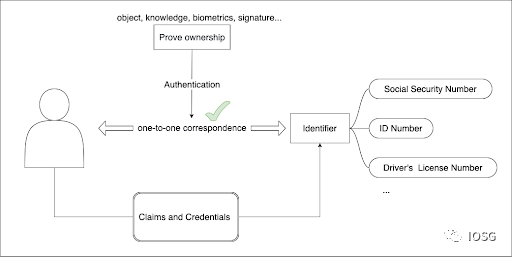
Both identity management in the real world and DiD in Web3.0 follow this logic.
- Mark individual. First, we need a identifier to "mark" a person. This identifier must be unique and unchanging, such as an ID number.
- Verify your identity. Second, we need to validate the identifier. Real world authentication is usually done through proof of ownership, such as holding an id, or through biometric verification (fingerprint identification, facial recognition, etc.). When a person has a unique identifier identifier and this correspondence is verified to be correct. A biological person is synonymous with an identity.
- Transfer data. Eventually, the person's data will be "transferred" to the identity, including social data, geographic location, workplace and other relevant information attached to the identity. This is the general process of identity management in the real world.
(Image: IOSG Ventures)
What's special about DID
So what's so special about DID? The first is DID on the "decentralized" aspect. Different from traditional identifiers controlled by centralized authorities, DID's identifier It should be self-owned, independent and dependent on P2P decentralized networks. Secondly, the authentication method of DID is different. It is not proved by holding a certain certificate, but by using the encrypted public-private key to verify the signature. Finally, the emphasis on personal information is different. This information is mainly about on-chain activities, such as what NFT was purchased, how many transfers were made, what games were played, etc., which on-chain data will be attached to the Identifier.
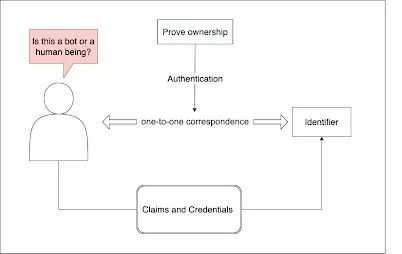
This process does not seem fundamentally different from centralized identity management. However, DID does not require an in-person visit to an organization. It is done online. This creates a lot of problems that real-world identity systems have never encountered, namely, how do you verify whether the AI or the biological human is in front of the screen before all the identity management programs are launched? The official solution to this problem in our last article, "The Man-machine Game is Just Beginning," can be found here and will not be described here. Here, we introduce some of the major PoP validations.
(Image: IOSG Ventures)
Various practices of PoP
Proof of Personhood, as the name suggests, is biology-based authentication, so how can you tell a creature from an AI? Now, the development of artificial intelligence has reached the extent that it can beat human beings in many fields, such as AlphaGo beating the world Go champion. Therefore, in order to successfully identify AI and biohuman, we also need to start with the weaknesses of AI.
First of all, the simplest and most straightforward logic is that people don't look like AI. AI can mimic human thinking, but it is difficult to mimic human appearance, such as pupils, skin texture and other biological features. So the most direct way to get people to tell each other apart through biometric displays is known as Pseudonym Parties. Just like going to an interview, users need to show off their face, voice and other biometric features by attending online and offline gatherings to prove they are biometric.
Second, another feature that distinguishes humans from AI is social. Humans are social animals and are bound to have social connections with people around them in ways that robots don't. Therefore, the Web of Trust takes advantage of this feature and verifies through people's social attributes. If a user uses multiple social platforms for a long time and has more interactions with other people, the less likely that person is to be a bot.
Moreover, unlike AI, humans are very good at logical thinking and pattern recognition, which is something that machine learning has struggled to crack. Reverse Turing Tests make use of this feature. The inverse Turing test has been around for many years and is widely used. When surfing the Internet, you've probably come across a pop-up window that contains nine blocks, asking the user to select a block that contains a traffic light, a motorcycle, or a zebra crossing. This is the application of the inverse Turing test.
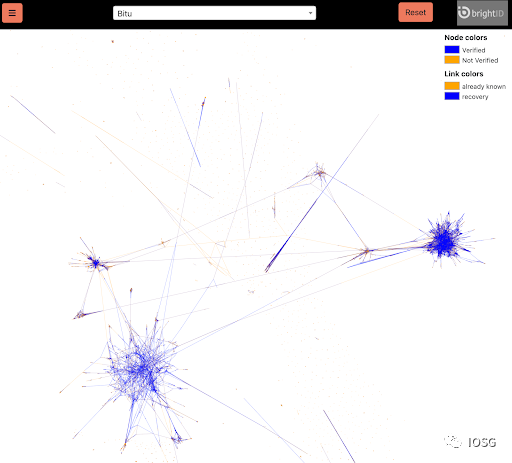
At present, most of the head projects of PoP track use one or more of the above verification methods. Examples include Proof of Humanity and BrightID through anonymous gatherings and social connections. The logic of both projects is similar, and both are validated by a small group of video consensus. BrightID also builds on this with a new way of verifying your location on the social network graph, called Bitu verification. Bitu validation measures how close each user's social relationship is to the center of the network. Users are penalised for associating with strange accounts that have no overlap, increasing the cost of "doing evil". However, Proof of Humanity and BrightID still have some problems. The first is requiring users to "show up" and publish some personal data, at the expense of their privacy to some extent. Another drawback is the high cost of organizing meetings, manual validation, and maintaining the PoP network, which reduces scalability.
When it comes to the authentication method with high scalability, we have to mention another frontrunner -- Idena Network. In order to be authenticated from Idena Network, users need to be qualified to participate in the test, i.e. get an invitation code from an authenticated user. This is Idena's first "checkpoint" for users, requiring some actual human connections to get a captcha. After obtaining a captcha, users must take the online reverse Turing test at a specified time in global synchronization. After participating in the test, users are also required to design new tests. It takes a lot of hurdles to get the "Human" certification. Theoretically, this protocol has the highest scalability and efficiency in the PoP industry. However, in essence, all picture topics are uploaded by users, which is quite tedious and time-consuming, and the quality of the topics is low. In the long run, it's only a matter of time before the problem is solved by AI. The project mechanism design also requires users to re-pass the verification at regular intervals, which is time-consuming and laborious. Overall, this solution is no better than social verification.
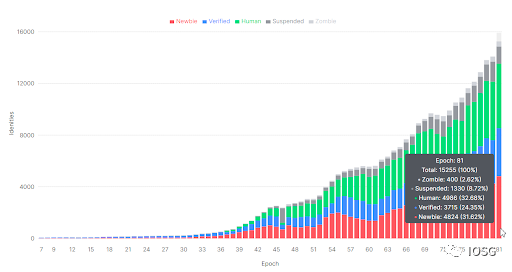
Idena User authentication level and number
There is still a long way to go to explore DID and PoP. Currently, most DID solutions are focused on accumulating on-chain/off-chain data for users, such as the recent SocialFi projects, CyberConnect, Galaxy, etc., which build social graphs and user profiles for users. However, discussion and exploration of "identifiers" has lagged behind, and Web 3.0 identifiers are commonly equated with wallet addresses. A person can only have a unique identity, but can apply for countless wallet addresses. Fortunately, Sismo is the first step in this direction. Sismo is a DID solution that utilizes ZK technology and issues badges to users based on on-chain activities.
Users can specify other wallet addresses, and the active badges of other wallet addresses are all aggregated under the same ENS domain name. In this way, the conflicts of multiple wallets and unique identities are solved, and user privacy is protected. However, users can still claim more than one ENS domain name. Currently, the industry is exploring different approaches to identifier, but there is still a long way to go before these applications are widely used. As the foundation of Web3.0, DID will surely be explored by more innovative projects in the future. Keep an eye on IOSG and we'll be back with more Web 3.0 articles.
Part.2 Investment and financing events
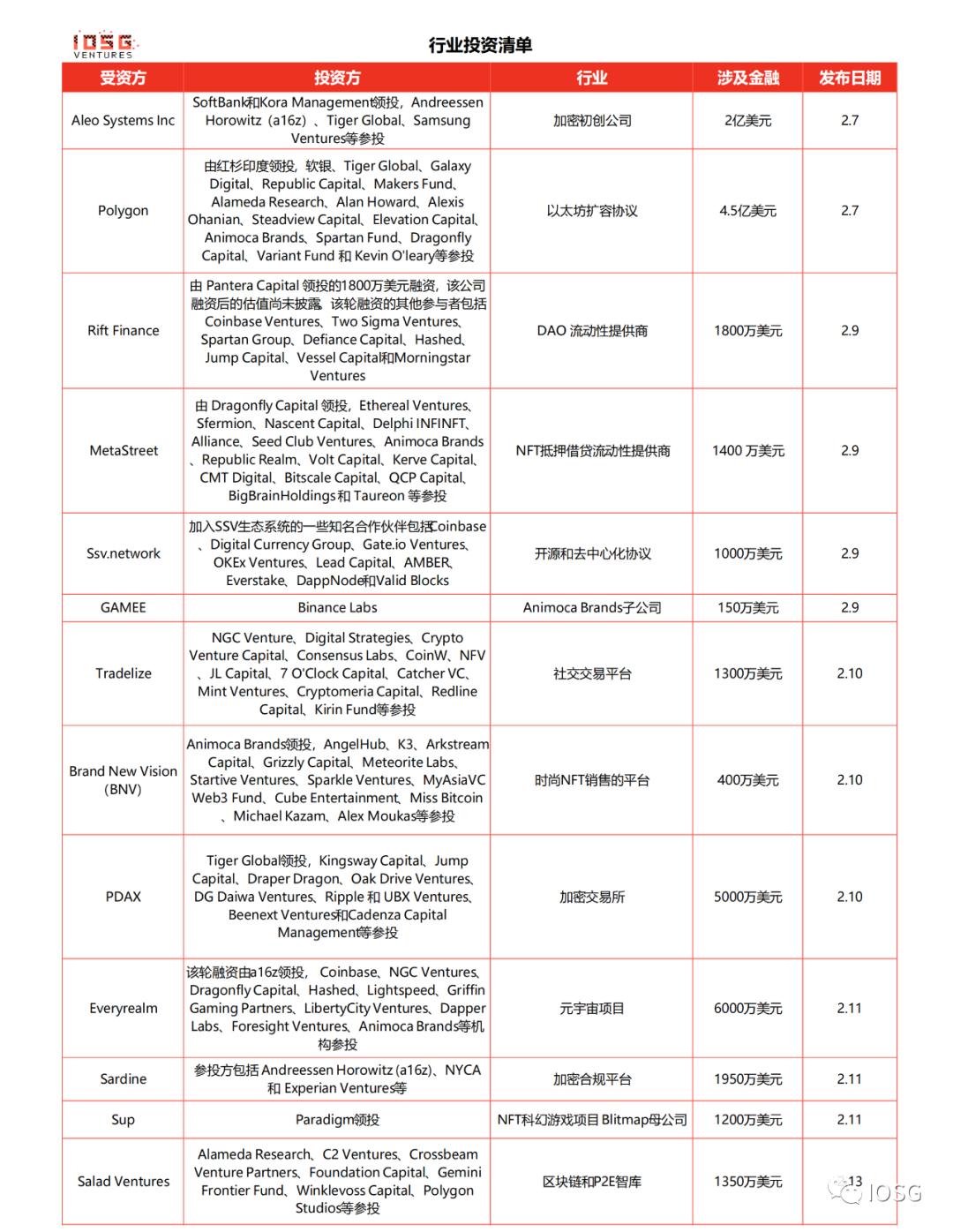
Aleo Systems Inc. (NASDAQ: Aleo) raised $200 million in Series B financing with a16Z and other investors
* Infrastructure (Zero-knowledge proof)
Crypto startup Aleo Systems Inc has raised $200 million in Series B funding, led by SoftBank and Kora Management, Andreessen Horowitz (A16Z), Tiger Global, Samsung Ventures and others participated. Aleo uses a new computing system called Zexe (Zero Knowledge Execution) that helps with off-chain calculations through on-chain validation by default for scalability and privacy. Aleo is currently in beta, and its main network is scheduled to go live in the third quarter of this year.
Polygon closes $450 million round, led by Sequoia India
* Ethereum expansion protocol
Ethereum expansion agreement Polygon recently closed a $450 million funding round led by Sequoia India, SoftBank, Tiger Global, Galaxy Digital, Republic Capital, Makers Fund, Alameda Research, Alan Howard, Alexis Ohanian, Steadview Capital, Elevation Capital, Animoca Brands, Spartan Fund, Dragonfly Capital, Variant Fund, Kevin O 'Leary, To aggressively expand its portfolio of Ethereum scaling solutions and focus on attracting a larger developer ecosystem. Polygon officially revealed that it has spent nearly $1 billion on acquisitions in recent quarters to expand its product range.
Rift Finance closes $18 million in funding, led by PanteraCapital
*DAO liquidity provider
Rift Finance closed an $18 million round led by Pantera Capital at an undisclosed valuation. Other participants in the round include Coinbase Ventures, Two Sigma Ventures, Spartan Group, Defiance Capital, Hashed, Jump Capital, Vessel Capital and Morningstar Ventures. Rift allows DAOs to deploy governance tokens from their vaults without relinquishing ownership. The Rift protocol then creates pools of liquidity by pairing governance tokens with Ethereum from retail and institutional depositors, creating higher returns for depositors. Last year, Rift launched its beta offerings on the Ethereum main network, including premium DAOs like Fantom, Terra, Injective, and Ramp. The beta reached its $50 million total lock-up value (TVL) ceiling in just a few days.
MetaStreet raised $14 million, led by Dragonfly Capital
*NFT liquidity provider
MetaStreet, a provider of mortgage liquidity to NFT, has announced the closing of a $14 million funding round that includes $3 million in seed funding and $11 million in initial liquidity. The round was led by Dragonfly Capital, Ethereal Ventures, Sfermion, Basic Capital, Delphi INFINFT, Alliance, Seed Club Ventures, Animoca Brands, Republic Realm, Volt Capital, Kerve Capital, CMT Digital, Bitscale Capital, QCP Capital, BigBrainHoldings and Taureon participated. MetaStreet was founded in 2021 by David Choi, Ivan Sergeev and Conor Moore as a liquidity and scaling solution for THE NFT mortgage platform. MetaStreet is the largest provider of funds to DAI on NFTfi.com, accounting for the vast majority of NFT mortgage transactions.
Ssv.net Work raised $10 million through the DAO Partner Program
* Open source and decentralized protocols
Ssv.net Work has announced a $10 million funding round that will be used to upgrade ethereum 2.0's decentralized pledge infrastructure ahead of the upcoming Merge. Ssv.net Work says it has received funding through its DAO Partner Program, which was launched in October 2021 to expand its "community and strengthen DAO partnerships." So far, the project has conducted its first and second DAO partner programs, Some notable partners that have joined the SSV ecosystem include Coinbase, Digital Currency Group, Gate. IO Ventures, OKEx Ventures, and Lead Capital, AMBER, Everstake, DappNode, and Valid Blocks. As the DAO Partner program continues, the project hopes to attract more companies, kols, and grants.
GAMEE received a $1.5 million strategic investment from Binance Labs
* game
Binance Labs has announced a $1.5 million strategic investment in Animoca Brands subsidiary GAMEE to support the development of GAMEE blockchain games. GAMEE is a highly participatory gaming platform where users can participate in competitions and complete tasks to earn rewards. The tokens GMEE has launched Uniswap, Kucoin, BitMart and MXC. GAMEE now has over 40 million users.
Compute North closes $385 million funding round
* Infrastructure providers
Crypto mining infrastructure provider Compute North has closed a $385 million Series C and debt round. Mercuria and Generate Capital co-led the $85 million Series C round. The debt financing totaled $300 million and was financed by Generate Capital. The new financing is used to continue the development of new data centers in the United States. Minnesota-based Compute North focuses on providing scalable infrastructure to customers in blockchain, cryptocurrency mining, and distributed computing.
OpenNode completed A round of financing of $20 million, with Participation of Twitter and others
* Bitcoin payment provider
Bitcoin payment provider OpenNode has raised $20 million in Series A funding at A valuation of $220 million, led by Kingsway. Other players include Twitter, venture capitalist Tim Draper and Avon Ventures, a venture capital fund owned by Fidelity Investments. The new money will further fuel its global expansion. Los Angeles-based OpenNode was founded in 2018 to process and settle bitcoin payments instantly over the Lightning network. Its systems for enterprises and platforms include payments, managed checkout, e-commerce plug-ins and an optimized version of the application programming interface (API). According to the company's website, OpenNode charges a flat transaction fee of 1%, and retailers don't have to pay 2% to 4% to banks or credit card companies.
Tradelize closed its seed round at a valuation of $13 million
* Social trading platform
Tradelize raised its seed round at a $13 million valuation, NGC Venture, Digital Strategies, Crypto Venture Capital, Consensus Labs, CoinW, NFV, JL Capital, 7 O 'clock Capital, Catcher VC, Mint Ventures, Cryptomeria Capital, Redline Capital, Kirin Fund and others participated. Tradelize was founded in 2018 by former Wall Street trader Anton Zapolskyi as a professional cryptocurrency trading terminal for advanced traders, according to the press release.
Brand New Vision (BNV) has closed A $4 million Series A funding round led by Animoca Brands
* fashion NFT
Brand New Vision (BNV) announced the closing of A $4 million Series A funding round led by Animoca Brands, AngelHub, K3, Arkstream Capital, Grizzly Capital, Meteorite Labs, Startive Ventures, Sparkle Ventures, MyAsiaVC Web3 Fund, Cube Entertainment, Miss Bitcoin, Michael Kazam, Alex Moukas, etc. This funding will enable BNV.me to further expand its ability to create enhanced NFT experiences in existing and in-development metaverse products and increase its visibility and influence in the fashion, gaming and crypto communities. Brand New Vision Ltd is understood to be the company behind BNV.ME, which was launched in April 2021 and is based in Hong Kong. It is the platform for fashion NFT sales, bringing fashion to Web3.0 through 3D product creation, NFT sales and future wearability.
Crypto exchange PDAX has raised $50 million in Series B funding, led by Tiger Global
* exchange
PDAX closed a $50 million Series B round led by Tiger Global, Kingsway Capital, Jump Capital, Draper Dragon, Oak Drive Ventures, DG Daiwa Ventures, Ripple and UBX Ventures, Beenext Ventures And Cadenza Capital Management. The exchange has been licensed by the Central bank of the Philippines and proceeds from the round will be used to build quality infrastructure for the digital asset ecosystem. PDAX has previously partnered with the U.S. Treasury Department and United Bank of the Philippines to launch Bonds, a blockchain-based bond trading program, and PDAX had nearly 500,000 users as of July 2020. In August 2020, PDAX closed a $12.5 million funding round led by BC Group, with CMT Digital, UBX, Beenext Ventures, and Ripple among others.
Everyrealm has raised $60 million in Series A funding, led by A16Z
* yuan universe
Alternative asset crowdfunding platform Republic's Meta-universe project Everyrealm has announced it has raised $60 million in what it calls one of the largest Series A funding rounds ever by A company led by A female CEO. The round was led by A16Z, Coinbase, NGC Ventures, Dragonfly Capital, Hashed, Lightspeed, Griffin Gaming Partners, LibertyCity Ventures, Dapper Labs, Foresight Ventures, Animoca Brands and others participated. Everyrealm is shaping the metasomes by investing in, managing and developing assets, including NFT, virtual real estate, metasomes platforms, games and infrastructure, Janine Yorio said, adding that the company wants to be "the gateway to the entire metasomes ecosystem." The company paid a record $4.3 million for a plot in The Sandbox in November and also owns plots in metauniverse games such as Decentraland and Somnium Space. The company has over 3,000 NFT in total and has invested in 25 different game worlds.
Sardine completed $19.5 million series A financing, a16Z and other investment
* Cryptographic compliance platform
Sardine, A crypto compliance platform for the fintech industry, announced that it has raised $19.5 million in Series A funding from Andreessen Horowitz (A16Z), NYCA and Experian Ventures, among others. As part of the investment, A16Z's general partner Angela Strange will join Sardine's board of directors. SAN Francisco-based Sardine, which launched in 2021, uses ARTIFICIAL intelligence to provide real-time fraud ratings based on a user's identity, device, and behavior patterns at the time of account creation and account funding. The platform checks for fraud during every login, deposit, and withdrawal. The Sardine platform adds instant bank Automated Clearing House (ACH) transfers for encryption, eliminating the 3 - to 7-day waiting period for consumers to receive funds. Sardine has grown to more than 50 clients, including Neobank Brex, cryptocurrency exchange FTX, Bakkt and crypto platforms MoonPay and Candy Digital. Sardine, a digital fraud prevention solution, raised a $4.6 million seed round in March.
Blitmap's parent company Sup has raised a $12 million seed round, led by Paradigm
* NFT project
Loot founder Dom Hofmann's NFT sci-fi game project, Sup, parent company of Blitmap, has completed a $12 million seed round of financing led by Paradigm. Blitmap is a decentralized NFT sci-fi game project where users with Blitmap NFT can jointly determine the content of the story world, with potential P2E capabilities. As of now, the floor price of Blitmap NFT is about 9 ETH.
Salad Ventures has raised $13.5 million in private equity
* Blockchain think tank
Blockchain and P2E think tank Salad Ventures have raised $13.5 million in private funding, Alameda Research, C2 Ventures, Crossbeam Venture Partners, Foundation Capital, Gemini Frontier Fund, Winklevoss Capital, Polygon Studios, etc. The new money will be used to build GuildOS, the operating system that runs the P2E gaming guilds. The company plans to launch GuildOS in the first half of 2022. To date, Salad Ventures has raised a total of $15.5 million in two rounds of funding.
Part.3 Project progress after IOSG investment
Team behind Aave launches Polygon-based Social media platform 'Lens'
*DeFi
The team behind Aave on Monday announced the polygon-based Web 3 social media platform "Lens," a permission-free, composable, decentralized social media protocol that allows anyone to create unhosted social media profiles and build new social media applications. Interoperability and composability are key features of the platform. Lens is now available on the Polygon Mumbai Test website. Lens Protocol has basic social media functions, such as profiles, comments, retweeting posts, etc., but unlike social media in the past, Lens Protocol is powered by NFT, so users own and control all of their personal content, the team said. Lens Protocol is fully open source and available to the community, allowing users to build social applications, analytics platforms, validation systems, DAO tools, and more.
Binance will launch WOO Network today at 2:30 PM
*DeFi
Binance will launch WOO Network (WOO) on February 08, 2022 at 14:30 (East 8 District Time), and open WOO/BNB, WOO/BTC, WOO/BUSD, WOO/USDT trading pairs. WOO top-up channel is now open, and WOO Withdrawal is expected to open on February 09, 2022 at 14:30 (EAST 8th District Time). The WOO Network is a liquidity Network that connects traders, exchanges, institutions and DeFi platforms through its suite of products including WOO X, Wootrade and WOOFi. WOO is the platform's native token; Users can use the WOO as collateral, provide liquidity, and earn rewards by making bets.
Swivel Finance will open the main network and launch airdrops on February 10
* Decentralized protocols
Swivel Finance, a decentralized fixed-rate lending and Token cash flow protocol, will officially open its main network to the public on the evening of February 10, with a retrospective airdrop of 4.5% of the total SWIV tokens to the community and 0.5% to protected lenders. 1% to proven community contributors, 1% to Gitcoin Core alumni and mentors, and 2% to Compound, Aave, FEIRari (Fei + Rari) & AMP; Gitcoin chain governance participants, snapshot time is February 8, a total of 1852 addresses meet the requirements. Participants who qualify for the airdrop are required to receive a certain amount of SWIV, and 100 swiVs are unlocked for every $2,500 (nominal value) traded. Swivel Finance is a new decentralized protocol that supports fixed-rate loans and interest rate derivatives, simplifying the transaction process. In October last year, IOSG Ventures and Multicoin Capital raised $3.5 million.
Project Galaxy announced that it would issue tokens, code-named GAL; Project Galaxy will go on public token sale on Coinlist on February 17
*NFT infrastructure service provider
Project Galaxy, an NFT infrastructure service provider, announced a public token sale on Coinlist on February 17. Registration is now open. This project plans to sell a total of 10 million GAL units (200 million GAL units in total) at a unit price of $1.50, which will be unlocked weekly for 12 months. Project Galaxy also announced the details of the token allocation. At the same time, Project Galaxy said it would airdrop some NFT holders, Among them are Galaxy Brain, Galaxy Meta Cowboy NFT Series, Galaxy Girl and Reindeer NFT, Shadowy Coder NFT Series, Galaxy End of the Year AMA, Galaxy AMA #2, CoinList FiaWorks 3000 NFT, CoinList FiaWorks 222 NFT, etc., snapshot dated February 8.
StarkWare releases The StarkNet Roadmap that will improve throughput, reduce costs, and decentralize
* Ethereum Layer2
Ethereum Layer2 development team StarkWare has released a three-phase Roadmap for StarkNet, saying that StarkNet has achieved its first goal of "availability" and will improve performance in the next phase, with the final goal of decentralization.
MakerDAO launches the $10 million bug bounty program on Immunefi
* Stablecoin DAO
MakerDAO announced it was partnering with Immunefi, a cryptography security service, to launch a bug bounty program that promises to pay $10 million to white hat hackers who discover vulnerabilities in its smart contracts. The MakerDAO bug bounty program includes smart contracts, websites and applications within the ecosystem, and the size of the bounty depends on the amount of vulnerability assets. Immunefi currently hosts Synthetix, Chainlink, SushiSwap, PancakeSwap, Bancor, Cream Finance, Compound, and more.
Binance Labs has strategically invested in Automata Network, a cross-chain privacy middleware project
* Privacy middleware project
Binance Labs, Binance's venture capital arm and innovation incubator, has announced a strategic investment in Automata Network, a cross-chain privacy middleware project. The new funding will support the expansion of Automata Network, which includes product development and technology research. Automata Network has established more than 11 local communities around the world. The project has more than 160,000 followers on Twitter.
Part.4 Industry pulse
RSS3 will issue the RSS3 DAO governance token $RSS3
*Web3.0 information infrastructure protocol
RSS3's official blog post states that it will issue a governance token, $RSS3, in the near future to better decentralize the development of the protocol and its developer community. $RSS3 will facilitate the decentralized governance of the RSS3DAO in terms of electing global index and service nodes, determining the maximum number of RSS3 files per node, module upgrades, and funds repositories. According to the official RSS3 blog post, 64 percent of the 1 billion coins will be distributed to the community, 15 percent to the team, 15 percent to seed and private round investors, 5 percent to the founding company Natural Selection Labs, and 1 percent to project advisors. Most of the tokens will be locked up for a long time and released within five years. The future of the protocol ecosystem and the growth of the vault will come from value-added services, SocialFi activities and transaction taxes.
BitTorrent has released version 2.0 of the DLive protocol
* Decentralized streaming
BitTorrent (BTT) announced on its official Twitter account that "Version 2.0 of DLiveProtocol has been released". BitTorrent explains that "in D-Live 2.0, all channels support up to 1,000 simultaneous connections and more than 250 chat users." DeLive is a decentralized streaming platform that was previously acquired by BitTorrent in 2019.
HydraDX wins Polkadot network 9th parallel chain slot Auction
*Polkadot slot auction
HydraDX won the Auction by locking 2462543 DOT on Polkadot's 9th parallel chain slot Auction. As the second round of Polkadot slot Auction is held every two weeks, the next 10th Auction will be held at 3am Beijing time on February 18, 2022. Interlay currently collects the most DOT of all active Crowdloan campaigns, followed by Equilibrium, Nodle, Litentry, Phala and Darwinia. All six Auction winners in the second batch will connect to the Polkadot relay chain and go online on the main network on March 11, 2022.
Ubisoft has teamed up with The Sandbox to create a metasurverse with its well-known IP
* game
Gaming giant ubisoft is continuing to explore new frontiers with Web3, announcing a partnership with The Sandbox that will bring its famous gaming franchise into The ethereum-based metaspatial gaming world. In addition, Ubisoft plans to bring in other IPS from its huge and popular game franchise. Ubisoft's top video game franchises include Assassin's Creed, Just Dance, Far Cry, and Tom Clancy's Rainbow Six. It is understood that Ubisoft will have its own LAND in the shared online world of sandboxes, which the company can customize and monetize on demand. The publisher will launch its Rabbids franchise interactive space in a sandbox, bringing blocky replicas of rabbit-like alien creatures that users can use in the Game's VoxEdit and Game Maker tools.
MoonDAO books blue Origin space travel tickets and will create associated NFT
* Space exploration DAO
According to official news, MoonDAO, the first decentralized autonomous organization for space exploration, tweeted that it has officially booked blue Origin space travel tickets for 2022 and will create NFT related to space travel tickets.
India's digital rupee will run on a state-backed electronic wallet
* India CBDC
The Reserve Bank of India (RBI) digital rupee will run on a govt authorised electronic wallet, which will enable the central bank to act as a middleman between merchants and customers, a senior go nment official told PTI. The country's central bank digital currency (CBDC) could be launched early next year, the government official said. Digital currencies will be numbered in units, just as each legal tender has a unique number. In her recent budget speech, Finance Minister Nirmala Sitharaman announced that India would launch its own CBDC, along with a 30% tax on all revenue from cryptocurrencies.
The Russian government and central bank agreed on cryptocurrency regulation, treating crypto assets as money; Russia plans to treat cryptocurrencies as property and subject them to income tax
* Crypto tax
The Russian government is talking about taxing cryptocurrencies. Ivan Chebeskov, director of financial Policy at the Ministry of Finance, said cryptocurrencies could be equivalent to property and subject to income tax. Mining taxes are a separate topic. In general, it is assumed that digital currency will be equivalent to some kind of property. And as property, for example, if it is used to earn income, it will be taxed." In addition, Ivan Chebeskov said the question of whether there will be a transition period is being discussed, noting that a bill to regulate cryptocurrencies will be ready and presented to the government by February 18.
The original link
Welcome to join the official BlockBeats community:
Telegram Subscription Group: https://t.me/theblockbeats
Telegram Discussion Group: https://t.me/BlockBeats_App
Official Twitter Account: https://twitter.com/BlockBeatsAsia
 Related Articles