Will Assembly, based on IOTA 2.0, be the rising star of the modular blockchain ecosystem?
Original Article Title: "The Journey of Exploring Modular Public Chains in the Web3 Era - Assembly Based on IOTA"
Original Author: Xi Li, LD Capital Research
Trend of Modular Public Chains
If you have been keeping an eye on the evolution of public chain technology, you must be familiar with the term "modularization."
In 2022, as Web3 emerged as a mainstream concept, new requirements naturally emerged for the underlying infrastructure that embodies this concept - the public chain. Although single chains still have the best composability at the base layer, Solana seems to have excelled in terms of TPS. However, constrained by the classic impossible trinity, compromises - or sacrifices - have been made in decentralization and security. The recent consecutive downtime events seem to have revealed the limitations of single-chain systems (of course, Solana can theoretically also deploy Rollups for scaling in the future).
On the other hand, ETH L2 has finally officially launched. Arbitrum and Optimism have shown us the feasibility of fraud-proof Rollup L2, while Starkware with Zk-Rollup's cryptographic validity proof and Zk-sync are expected to be officially launched in 2022. ETH has set a good example for modular public chains through L2 extension.
However, this brings about a new consideration - is ETH the best Layer1 choice to support modular public chains?
Is ETH the Best Modular Choice?
Currently, we can see three main issues:
1. Strong liquidity fragmentation between multiple L2s - There are currently 8 familiar players based on ETH Rollup L2: Arbitrum, Optimism, Starkware, Zk-sync, Polygon, Aztec, Boba, Metis. It is believed that 10-20+ Rollups may appear in the future. Although cross-chain bridges can alleviate this issue to some extent, Vitalik Buterin has recently stated: "The future will be 'multi-chain' rather than 'cross-chain,' as cross-chain bridges have fundamental security limitations."【1】
「2」The timing of ETH 2.0's transition from POW to POS is uncertain, and even sharding is temporarily on hold, leading to significant uncertainty regarding the timeline for full scalability - all due to ETH's technical historical baggage.
「3」A third point that many people may not be aware of, but perhaps the most important, is ETH's ecological historical baggage - ETH's own L1 will compete for resources with L2, at least for the foreseeable future years.
Let's elaborate slightly more on this point, which is very important and is also one of the key reasons why we invest in Assembly.
ETH's current scaling solution is Rollup, whether it's Optimistic Rollup or ZK-Rollup【2】, where L2 acts as the Execution Layer (EL) and then batches and compresses all transactions, periodically posting them to ETH L1. Here, ETH L1 plays two roles, serving as both the Rollup's Settlement Layer (SL) and the Rollup's Data Availability Layer (DA).
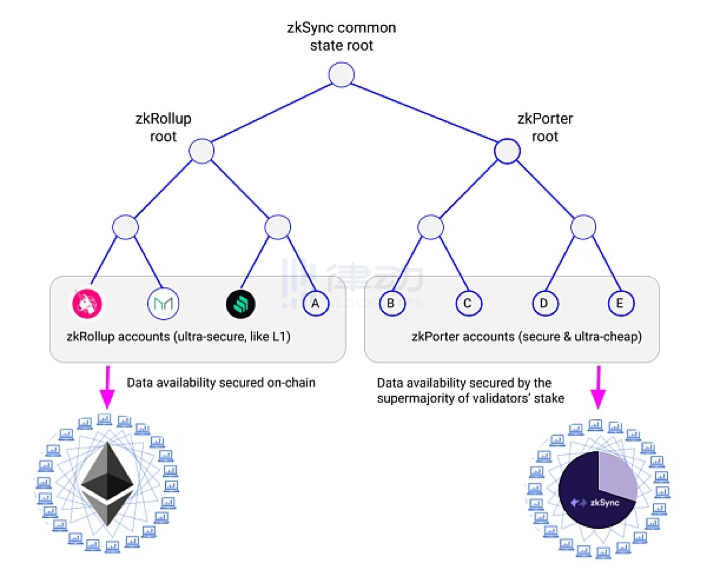
Image Source: https://coinyuppie.com/understand-zk-rollups-how-to-bring-a-paradigm-shift-in-the-crypto-ecosystem/
From the SL's perspective, all settlement transactions have to compete with native DApps on ETH L1 for resources. This is usually not a significant issue in normal circumstances. However, during a Gas War (if there's a large-scale liquidation on L1 or a hype NFT causing a Mint competition), all Rollup performances will be significantly affected.
From a DA perspective, storing data on Ethereum L1 is a very expensive option, which is why currently the transaction fees on Arbitrum and Optimism are much cheaper compared to ETH L1, but still expensive compared to Alt L1 - because DA layer fees cannot come down (ZK-Rollup theoretically can have lower fees compared to Optimistic Rollup due to higher data compression ratio).
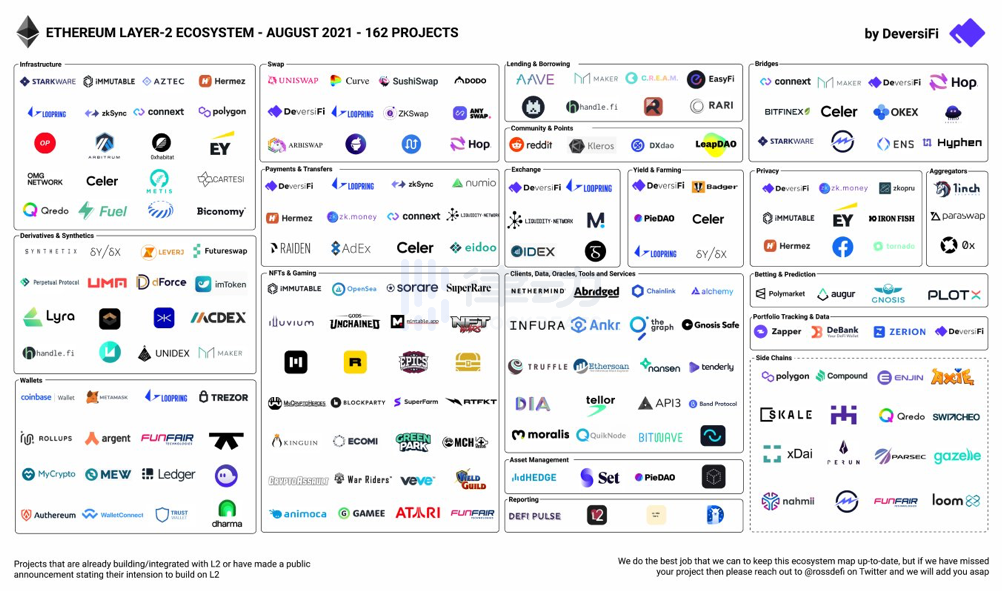
Image Source: https://twitter.com/deversifi/status/1424732007431643137
All of this stems from the historical baggage of the ETH ecosystem - that is, in the visible future years, DApp economic activity on ETH L1 will not stop, and all of this activity will compete with Rollups for the expensive and scarce resources on ETH L1.
Is it possible for a Layer1 to solely focus on SL+DA without engaging in any Dapp EL?
Of course, it is possible. The new generation of public chains like Polkadot, where the relay chain is only responsible for SL+DA, with all data processing done by parachains. On the Cosmos side, there are even designs like Celestia【3】, which extract the DA layer separately to provide DA services for all other Rollups and focus solely on this service.
Of course, we can argue that ETH L1 security is the best, and security in SL and DA is the optimal choice. However, if the market purely values security, the colorful multi-chain era we have now would not have emerged, even Ethereum's orthodox L2 solution Starkware provides users with a DA layer placed within Starkware itself rather than on ETH L1 for a "cheaper" option. In the trade-off between security and performance, we will undoubtedly see various modular solutions. And based on IOTA's Assembly smart contract layer, it is another modular direction that we believe is worth exploring.
The Journey to Modularity Based on IOTA
IOTA, perhaps a project that has faded from the memory of many old investors and has not been heard of by many new investors.

However, back in the 17-18 era, IOTA was one of the three pioneers of the DAG (Directed Acyclic Graph) data structure. With its innovative Tangle ledger architecture and high TPS, it held a spot in the top ten market cap rankings of cryptocurrencies for quite some time. Later, as the entire blockchain industry transitioned into the DeFi era dominated by smart contracts, IOTA gradually faded from people's view, and representatives of DAG-based public chains were replaced by the new generation supporting contract models such as Fantom, Avax, and others.
The characteristics of the IOTA 1.0 era were as follows【4】:
1. High throughput, high TPS
2. Based on UTXO model, no Gas fee
3. Does not support smart contracts
4. Centralized Coordinator (provided by the foundation)
It can be seen that although IOTA had low fees and high TPS, its lack of contract support and the way of centralized node operation are quite different from the current mainstream blockchain development, which is also the main reason why IOTA has faded from people's view in the past few years.
However, with the arrival of the 2022 trend of modular chains and the release of IOTA 2.0 and Assembly, we have reason to believe that IOTA has the potential to secure a place in the modular chain market.
Assembly, in conjunction with IOTA 2.0, can provide all the requirements of the modular chain for the Web 3.0 era:
1. High TPS - The underlying Tangle ledger DAG data structure ensures high concurrent TPS
2. Scalability - A multi-chain network similar to Cosmos or Polkadot, allowing the continuous deployment of new contract chains
3. EVM compatibility, while also supporting Web Assembly
4. Developers can flexibly customize incentives and fees for each chain
5. No MEV
6. Shared security
Introduction to Assembly Technology
The technical whitepaper of Assembly has been released, and here is a brief summary introducing some of the core technical features of Assembly.
Image Source: https://assembly.sc/
1. UTXO-based DAG at the Base Layer
The UTXO ledger, represented by BTC, features concurrent write capabilities, providing significant advantages in scalability compared to the account-based model represented by ETH. However, due to the global and objective state present in the account model, it is naturally suited for smart contracts, with its Turing completeness and functionality far surpassing the script based on UTXO. This is why the vast majority of smart contract chains are currently based on an account model rather than UTXO. But conversely, in a modularized stack, what if an L1 based on UTXO only needs to handle settlement without dealing with any contracts or running DApps?
The lack of smart contract support has become an advantage, as there will be no DApps from L1 competing for resources with L2. Additionally, L1's processing, under the UTXO and DAG models, can theoretically support massive scalability and high concurrency, thus having a significant advantage in the number of supported L2s.
2. Assembly - Layer1.5
Assembly can be seen as a 1.5 layer, which is a smart contract architectural layer, where various smart contract chains built on Assembly are the true Layer2.
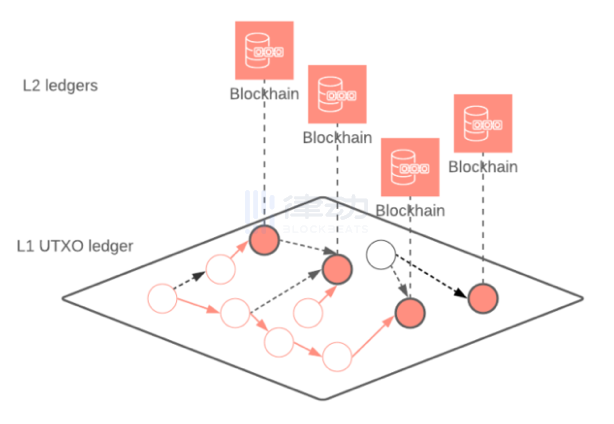
Image Source: https://www.iota.love/202201/iota-smart-contract-whitepaper/
For better understanding, you can consider the entirety of IOTA+Assembly as similar to a Polkadot relay chain in Layer 1, where all smart contract chains accessing Assembly are like parachains on Polkadot, appearing as L2.
Assembly itself, similar to node validation on other public chains, provides staking of its native Token ASMB for POS, and in case of errors or malicious behavior, penalties (slash) will be imposed. The ASMB Token is also the governance credential for the entire Assembly ecosystem, including chain configurations, committee rotation parameters, gas fee settings for each chain, and more.
3. Shared Security
In a multi-chain parallel structure, shared security is an unavoidable topic. As long as there are cross-chain invocation scenarios, a chain with weak security will inevitably become the weakest link in the bucket theory, thus affecting the overall security of this bucket. In the new "native modular public chain," Polkadot achieves strict shared security through slot auctions.
Cosmos is currently a loose collection of chains, with no shared security whatsoever (Cosmos 2.0 in 2022 will also introduce shared security through the Atom Hub). Avax, on the other hand, achieves a degree of shared security by allocating "a designated subset of the overall validator pool for each subnet." It is easy to see that Polkadot has the highest security requirements, but the slot auction has left many projects in awe; Cosmos is the most flexible, but its security is currently in question; Avax's subnet validation design falls between the two, striking a relative balance.
Assembly uses a form similar to an ETH2.0 Fraud Proof Rollup, where each validator pledges assets as security collateral. Any third party can provide fraud evidence by monitoring chain activity when a validator incorrectly updates the chain state, and receive a reward. This ensures that as long as there is one honest validator in the validator committee, the chain's state will be protected from malicious changes.
Of course, you may have a question about ETH, where validator asset staking, "dispute" fraud proofs, and asset slashing are completed through smart contracts on the ETH main chain. This smart contract acts as the "Supreme Court" and indirectly achieves shared security for all Rollup chains. However, IOTA's L1 itself does not support smart contracts, so who will take on the role of the Supreme Court?
The answer is—creating a separate smart contract chain on Assembly to implement all necessary "Supreme Court" logic and be responsible for the security of all other smart contract chains. This special chain is called the "root chain." The reason the root chain has the highest security is that its validators are a special group of nodes - according to the whitepaper, in the IOTA 2.0 ledger, validators of the root chain will be selected from so-called high mana nodes. High mana validators are owners of L1 IOTA nodes, chosen in a decentralized manner on L1 nodes based on access mana and consensus mana as weighting factors.
This also introduces an unavoidable topic, which is the underlying L1 of IOTA 2.0 and its Mana system.
4. IOTA 2.0
Compared to version 1.0, IOTA 2.0 has undergone many technological updates and iterations, with the two most important ones summarized here:
First, Removal of the Coordinator - The Coordinator is a special node in the network that can protect the network from attacks and assist in confirming transactions, but the Coordinator provided by the foundation leads to a high level of centralization in the whole network. One of the most important improvements in IOTA 2.0 is the removal of the Coordinator (to be achieved in three stages, currently in the first stage and about to enter the second stage).
Second, Introduction of the Mana System - Any blockchain or distributed ledger system, preventing Sybil attacks and controlling network congestion are the most core security and functional requirements. Consensus mechanisms like POW and POS are also largely based on this. IOTA is not strictly a blockchain, so it does not have POW and POS in the traditional sense; instead, it uses the Mana system.
Mana is used to measure the influence of different modules, including FPC voting, dRNG (distributed random number generation), autopeering, and congestion control. Simply put, you can think of it as a reputation system for nodes, where nodes with higher Mana values have higher credibility and security. Similarly, the vested interests on Layer 1's ledger are also closely related. Therefore, as mentioned above, by having high Mana validators to validate the base layer, the security assumption of the L2 smart contract chain can be roughly equivalent to the security assumption of the IOTA L1 ledger.
Final Words
To conclude this article, let's revisit the initially proposed modular public chain structure. If a Layer 1 has a Layer 2 similar to Rollup technology and can also achieve:
Security relative to - 16 years of mainnet operation with no major incidents;
High TPS, low fees, scalability;
No competition for resources between any L1-based DApps and L2 - L1 only for settlement or settlement + DA.
IOTA 2.0 is indeed such a Layer 1 that we have found. We have no doubt that, under the wave of modular public chains, ETH will continue to lead technological innovation in the public chain race. Meanwhile, with the support of the Assembly smart contract layer in Layer 2, we are very optimistic that IOTA 2.0+Assembly will gain a foothold in the modular public chain market in 2022.
References
【1】twitter.com/VitalikButerin/status/1479501366192132099
【2】docs.ethhub.io/ethereum-roadmap/layer-2-scaling/zk-rollups
【4】www.iota.org/solutions/technologies
【6】www.iota.love/202201/iota-smart-contract-whitepaper
Disclaimer
The information in this research report is sourced from publicly available materials, and the views expressed in this document are for research purposes only and do not constitute any investment advice. The opinions and forecasts issued in the report are only for analysis and judgment as of the issuance date and do not have permanent validity. Additionally, under no circumstances will this institution and the author be liable for any losses incurred by anyone using any content in this report.
Original Article Link
Welcome to join the official BlockBeats community:
Telegram Subscription Group: https://t.me/theblockbeats
Telegram Discussion Group: https://t.me/BlockBeats_App
Official Twitter Account: https://twitter.com/BlockBeatsAsia