Interpretation of Ve(3,3), "Curve + Olympus"
Original title: "Ve(3,3) = Curve ^ Olympus"
Original source: OKLink OKLink
On January 26, Ve(3,3), a new project initiated by AC, the founder of Yearn Finance, announced that it will be launched soon and will be renamed as Solidly.
From the naming point of view, Ve(3,3) can be disassembled into two parts: Ve&(3,3). Ve comes from Curve's VeCRV model, and (3,3) comes from OlympusDAO's 3v3 game. The combination of the two attempts to balance the holder and trader in the supply, bringing more agreement income to the projects (especially the initial projects) that join the Ve(3,3) agreement, and at the same time improving the lease liquidity. The efficiency of the reward.
So, what inspiration did Ve(3,3) draw on in the CRV and OHM projects? What improvements and combinations have been made? Is it worth getting involved?

1. VeCRV Evolution
First of all, let's review Curve AMM mechanism and VeCRV model. Curve provides three incentives for liquidity providers (LP):
(1) 50% of the transaction fee in the liquidity pool
< p>(2) CRV Reward(3) The remaining 50% of the service fee is exchanged for stable currency reward
Ve is Voting Escrow (voting Escrow) is the abbreviation of exchanging Curve's governance token CRV for VeCRV's pledged lockup to obtain more rewards as LPs.
VeCRV is a Proof of Stake that allows you to accelerate the accumulation of LP's CRV rewards (2) with the same LP stake amount. At the same time, it can also be used to earn stable currency rewards (3). In addition, the proof can also vote to determine the proportion of the total weekly reward (reward) shared by each liquidity pool in (2), and the project party can use VeCRV voting to strive for more CRV reward distribution share (emission) for its own pool , to attract more LPs. Finally, the number of pledges and the remaining time are used to quantify how much equity this certificate is endowed with.
Most of the current AMMs (automatic market makers) are encouraging people to increase the liquidity of the pool, but the liquidity Subsidies are actually an act of increasing debt. The project side hopes that the liquidity of subsidies will be long-term rather than temporary leased. Once other pools have higher subsidy liquidity, they will be withdrawn accordingly, which will bring downward pressure on the price of Token used for subsidy. It is not a long-term solution to fight a price war. In this case, it is better to leave the decision to the staker, let them decide where the subsidy should be given, and give corresponding rewards.
Therefore, Solidly made the following modifications to the Ve model on the basis of VeCRV:
< br>
(1) The incentive release plan is changed to release at the inflation rate based on the circulation every week to compensate for the inflation risk of the locker
In order Encouraging staking and voting, SolidlySwap will compensate users for the inflation risk caused by lock-up, and make up for the lockers with the additional tokens issued in the emission, ensuring that VeToken will not be diluted.
For example, the total amount of tokens issued is 20M, 50% of which is locked, and the remaining 10M is used to issue incentives. In this 10M, 1M is added to the supply every week, that is, the tokens in the hands of the locker will be diluted by 5% (1M/20M) every week. Correspondingly, according to the rules, 5% inflation needs to be added to the locker: 0.5M(10M*5%)
(2) The token used for incentives has been changed from homogeneous to non-homogeneous tokens (NFT)
Solidly has two types of tokens, one is for issuing The rewarded emission, we temporarily call it EMI, is a homogeneous token. The other is the VeToken generated after SLD is pledged. Since the amount of EMI pledged each time and the lock-up time are different, in order to facilitate management with one address, each lock is packaged into an NFT to store data such as the number and time of lock-up. There is a similar approach in Olympus V2 - holding bonds in the form of NFT, giving liquidity to pledged assets and reducing time costs.
We guess that Solidly may also learn from some other ideas in Olympus V2 in the next step, such as adding options for pledge expiration.
(3) ve(3,3) ouroboros
Similar to VeCRV, the voting rights are quantified according to the number of VeToken pledged by lockers and the time. In order for the lockers to select the pool that can generate the most cash flow (Fees), Solidly will give all transaction fees to the voters. This is done to help the agreement automatically find the best pool to distribute subsidies, that is, the pool with more Fees has a larger transaction volume and better depth, which can also generate more agreement income. Once the transaction volume drops, the agreement does not need to continue wasting subsidies.
But the difference is that Solidly is not a "big pot" like Curve when distributing Fees - no matter which pool you vote for, you can get the handling fee, and Ouroboros are "small stoves" - lockers only collect transaction fees from the pools they voted for. That is to say, when the pool you vote for does not generate any handling fees, this kind of "small stove" cannot provide you with any income, nor will it share the handling fees generated by other people's voting pools with you. This approach is fairer and makes voting closer to the vital interests of the lockers, who are more cautious when voting.
(4) Transaction fee settlement assets and third-party cooperation
If a third party wants to access the liquidity pool, Curve can only provide incentives and no fee income. In Ve(3,3), the handling fee will be given to LP, and all handling fees will be obtained. To this end, the project party can add Liquidity to the corresponding pool.
Second, 3 V 3
OlympusDAO's 3v3 It is the result of the game between the two parties under different choices under the two incentive mechanisms of bonding and staking, showing how the participants should cooperate to achieve the maximum benefit. Similarly, participants in Ve(3,3) choose between the two incentives of locking positions (Ve) and providing liquidity, and also present similar game results.
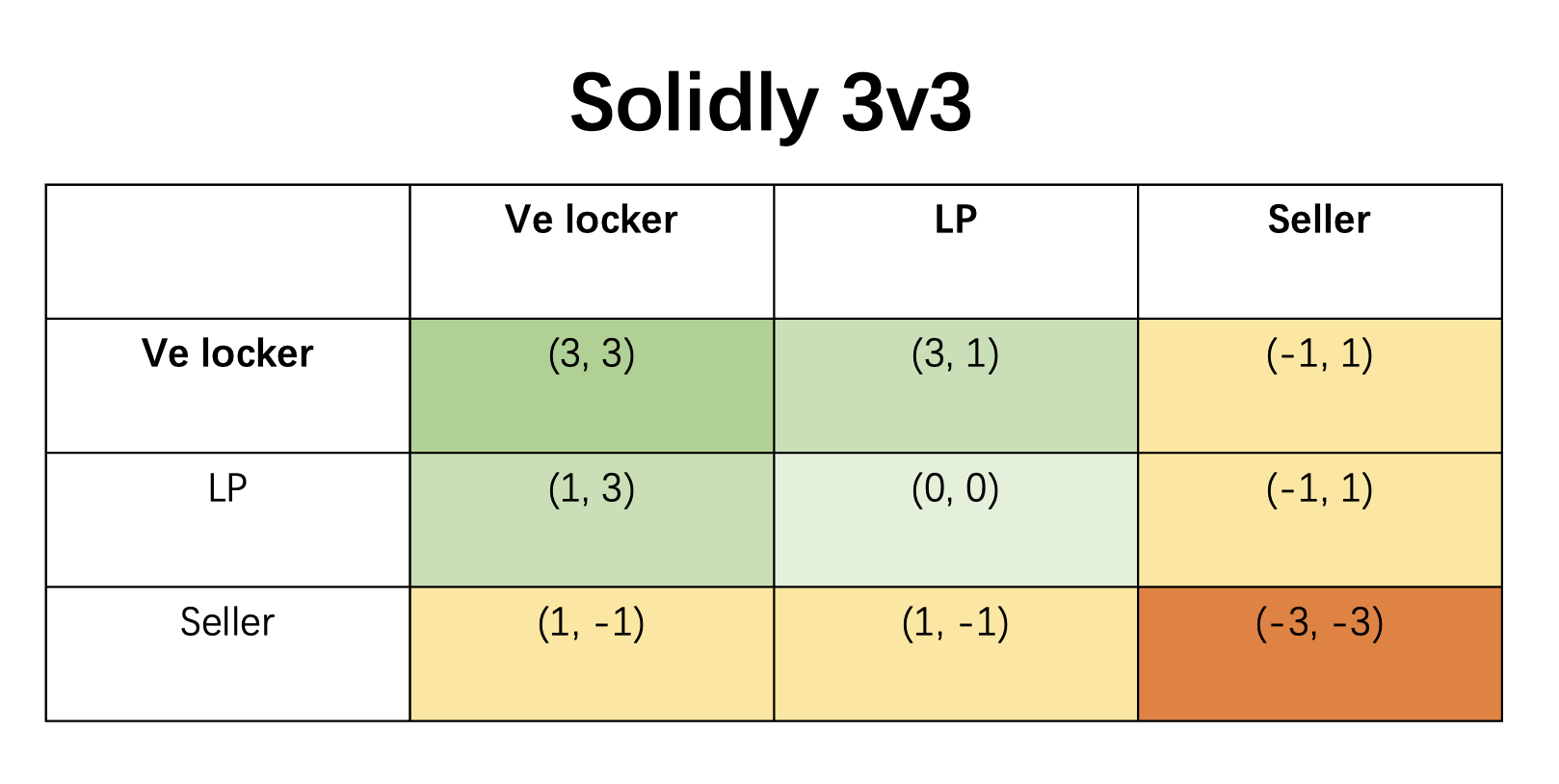
If the amount of locked positions increases and the corresponding reward expenditure decreases, the income of the project will increase and the debt will be reduced, which will be of great help to the project's finances. If both parties in the game choose to be lockers, it is a win-win situation, and both parties are in the maximization of interests (3, 3).
Of course, the more locked tokens, the better. Both the protocol and the lockers need the LP pool to generate enough Fees to support cash flow. If all the circulation is locked in locks, there will be no tokens in the pool, the circulation will be 0, and no transaction fee (Fees) will be generated.
If all tokens They are all in circulation and not in the locks, so there will be no voting rights, the cash flow of the project will decrease, and there will be downward pressure on the price (-1).
Both parties sell their tokens at the same time, regardless of the Either the parties or the agreement is the worst choice: (-3, -3)
3. Summary
In general, the design of Ve(3,3) is mainly for the protocol The optimization optimizes the way of subsidizing liquidity, and allows the initial protocol to have liquidity in more pools.
Due to the saturation of the AMM market, the way to make the idea of Ve(3,3) more widely adopted is not to restart an AMM project, but to build on the original AMM A protocol-to-protocol architecture is built on the basis of AMM to provide components and interfaces for the existing AMM.
Note: The above is based on the analysis and speculation of the concept article published by the project. Since the project has not been officially launched, the details have not been announced, and there may be deviations from the real situation of the project.
This article is from a contribution and does not represent the opinion of Rhythm BlockBeats
Welcome to join the official BlockBeats community:
Telegram Subscription Group: https://t.me/theblockbeats
Telegram Discussion Group: https://t.me/BlockBeats_App
Official Twitter Account: https://twitter.com/BlockBeatsAsia

 Related Articles