Dialogue with Ethereum researcher Polynya: About Rollups and the future of Ethereum

Original title: "Conversation with Ethereum researcher Polynya: Why is L2 the future?" "
Original source: Bankless
Original compilation: Nanfeng, Unitimes
This article is a record of Bankless co-founder David Hoffman interviewing Ethereum and Crypto anonymous researcher Polynya . In the interview Polynya lays out some of the best ideas about L2, zk-Rollup and the Web3 world. The following is the main content of this interview:
David Hoffman: Besides Ethereum, your favorite L1 What is a chain?
Polyna: L1 chains are boring, with one notable exception - with validity proofs/ ZK (zero knowledge) L1 chain, such as Mina. But what needs to be noted here is that ZK-Rollups are better!
ZK-Rollups gain almost all the long-term benefits of ZK-L1 chains, while also inheriting the highest security, sustainability and liquidity properties , with greater flexibility to focus on building the best performing layer. Fortunately, ZK-L1 chains also have the easiest path to convert to ZK-Rollups, if this is a better solution for a particular ZK-L1 chain project!
David Hoffman: What would a decentralized L2 network look like? What exactly is the realization of decentralization?
Polyna:A decentralized L2 network is such a Rollup, It has a secure "bridge" to L1, and an escape mechanism to withdraw back to L1, even if the Rollup fails completely (including the funds in the smart contract).
(Transaction) Sequencing and proofs in a decentralized Rollup network are permissionless, which means a failed Rollups can be seamlessly restored by the community. Contract upgradeability is also decentralized, at least through governance, but some key modules, such as bridges that hold funds, are immutable.
Ideally, we would like to end up with fully immutable "ossified" Rollups. There should be easily accessible tools to allow people to enter or exit a Rollup without any assumption of trust. If all of this is achieved, then Rollup is practically as secure and decentralized as L1.
David Hoffman: Are all L2s safe to use?
Polyna: Absolutely not! The L2Beat.com website provides detailed descriptions of the security risks of each Rollup network. This is an early stage technology, so proceed with caution!
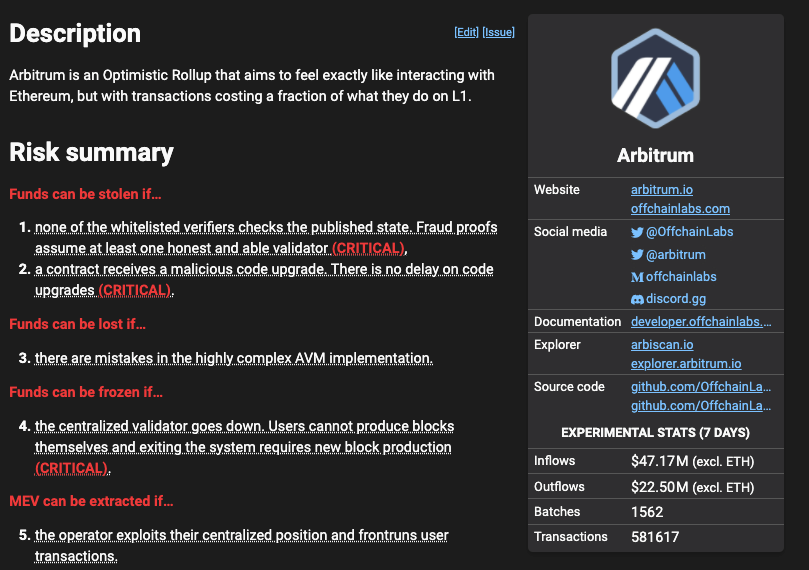
Above: L2Beat.com website risk summary for the Arbitrum network.
David Hoffman: What are the biggest risks of using an L2 network?
Polyna:Currently, many Rollup networks have multi-signature upgradeability ( multi-sig upgradability).
Multi-signatures can conspire to steal funds in Rollups. Of course, there is a spectrum in this regard: how distributed are the multisig groups? How transparent is it? Are there timelocks for upgrades?
Practically, I think there are two risks:
1) the occurrence of A Dr. Strangelove type situation where many people (multi-signers) lose their minds and decide to create chaos.
2) More likely, regulators order enough multi-signers to shut down a rollup. The second situation can be alleviated to a large extent by a form of community multi-signature distributed all over the world, and zkSync has done a good job in this regard.
Currently, most Rollups have a centralized sequencer (sequencer), so the biggest risk may be the sequencer's downtime machine, it may be very difficult, expensive, or impossible to transact during its downtime (depending on the specific Rollup). But be aware that your funds are never at risk.
The good news is that most of the Rollup team is committed to a gradual path towards decentralization. I'm optimistic that by this time next year, many major rollup network risks can be ignored.
David Hoffman: Do you think that for an L2 network that has not issued coins, if it wants to compete with other L1 chains, is it necessary to issue L2 local tokens? Very necessary?
Polyna:Yes, I think it is necessary. Of course some Rollups can be fine without issuing native tokens, but community ownership (by issuing native tokens) seems to be a requirement if a rollup wants to become a large-scale network.
David Hoffman: What does "Ethereum alignment" mean to you? Why is this important? How do you evaluate different L2 networks in terms of their "Ethereum camp"?
Polyna: To me, that means being pragmatic. Ethereum has the highest security, liquidity, and network effects, while also having the most ambitious technology roadmap for scaling Rollups. So it makes perfect sense for Rollups to focus on the Ethereum network. Many L2 teams are ideologically aligned with Ethereum values that are not available elsewhere. And some other teams may focus on Ethereum, because Ethereum is where the most liquidity and opportunities are. Of course, we will definitely see some forks of L2 networks on other L1 networks besides Ethereum.
David Hoffman: How do you think the L2 composability problem will be solved?
Polyna: All Rollups are fully composable. We may have a super awesome Rollup network in the future, capable of handling millions of TPS (if possible), this Rollup is fully composable. In addition, the scalability potential of Rollups is necessarily higher than that of L1, so the fragmentation scope of Rollups is smaller. Of course, just as there are composability breaks between different L1 networks, there will be composability issues between different Rollups. However, Rollups offer better interoperability possibilities because Rollups share the same L1 settlement layer between them. Therefore, we can have solutions like dAMM that enable liquidity sharing between multiple Rollups networks; and solutions like DeFi Pooling that allow multiple Rollups to access dApps on L1.
Unlike the bridge between L1 networks, the bridge between Rollups is very secure. With Danksharding this brand new sharding design, ZK-Rollups will be able to operate synchronously with L1 . Also, we may end up with multiple ZK-Rollups that are internally combined so that to L1 it looks like these ZK-Rollups use a single proof to achieve a single composable state (a single composable state). state).

Tweets: https:/ /twitter.com/ethconomics/status/1486225224693551104?s=20&t=HvgU14A6AZCLdv2eDSfV4g
Of course, this is speculation, but the point is, Rollups The design space is wider, making the composability and fragmentation problems between Rollups much smaller than between L1s.
David Hoffman: How will Ethereum's L2 ecosystem start to become more relevant?
Polyna: by abstracting all of this (L2 complexity) from the user side . Users just use a smart wallet like Argent, they don't need to know what Rollup network they are using. They just use the applications and use cases of their choice, and all blockchain related stuff is seamlessly pulled out in the background. Of course, this is a long-term vision that will take several years to realize. At this point, we already have a fairly seamless "bridge" and DeFi Pooling solution. For example, social recovery wallet Argent’s integration with Ethereum’s L2 payment scheme zkSync.
David Hoffman: How will the Ethereum L2 network attract users who are already using other L1 networks?
Polyna:It's simple - in the long run, Rollups have more High scalability potential, functionality, programmability and user experience are required.
The real game changers will be unique and innovative applications in L2 networks that are not even possible to deploy on L1 networks . For example, we have seen on Twitter that @guiltygyoza has built a physics engine and 3D model on top of the Ethereum L2 network StarkNet (see image below). In the long run, users will use Rollups because Rollups are far superior to L1 networks in every aspect. In the short term, developer adoption and token incentives may be effective for L2 to attract new users.
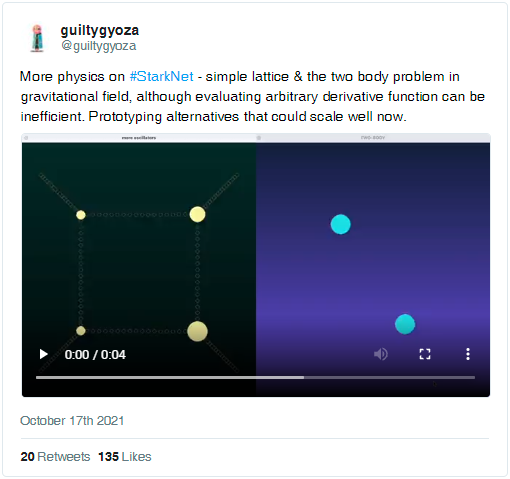
Tweet: https://twitter.com/guiltygyoza/status/1449637155001798657?s=20&t=A9sM9H8sMD4EB8ASUBo9dA
< b>David Hoffman: What do you think is the most achievable goal for developers that can greatly improve the Ethereum ecosystem?
Polyna: Not sure, I'm not a developer. I don't know what the easiest goal to achieve is. While not an easy goal to achieve, let me say this: the current user experience is terrible and fragmented. I think we need some standardization - more initiatives like "Sign in with Ethereum" so that there is some sort of coherent user experience.
David Hoffman: Are you worried that the increase in block space capacity brought by L2 will exceed the increase in transaction demand?
Polyna: Yes! Of course, these existing applications do not require the kind of capacity that Rollups & data sharding can provide. My hope is that with higher capacity and better functionality, we will see new types of applications with a wider user base. But that's just hope. We will wait and see!
David Hoffman: Is this a race to the bottom? Exponential growth?
Polyna: There must be an upper limit to meaningful transaction needs. Of course, if you make something cheap enough or free enough, it will be riddled with junk deals. But I think these are parasitic and should be avoided.
David Hoffman: Regarding the future of the encryption industry, there is something that only a few people understand, but it is crucial to the success of the industry important?
Polyna:Trust is a fundamental human principle - trust is highly valued by most people. The goal of the encryption industry should not be absolute trustlessness, but to improve our trust system through fair competition.
David Hoffman: In your opinion, under what circumstances will Ethereum fail?
Polyna: Because it is not decentralized enough, and the "ossification" is not fast enough. Something completely revolutionary came along and made Ethereum obsolete because Ethereum at that time was already "ossified" & very decentralized so couldn't react quickly to it. Also, it's worth noting that I believe ETH as an asset and Ethereum as a network may have different fates. (This is almost certainly the case with BTC and the Bitcoin network.)
David Hoffman: New Universal Data Availability (DA ) Can the project gain traction? If so, could such projects exploit network effects and launch a settlement layer to steal Ethereum’s market share?
Polyna: are two different things. Generic DA projects can certainly gain traction. But this network effect is largely irrelevant to what is required to be a settlement layer (including high-quality currency, high economic security, wide token distribution, breadth and depth of liquidity, Lindy effect, etc.). Additionally, Ethereum is building its own highly scalable DA layer to complement its established settlement layer. Now, there may be some applications that don't care about this, in which case I would say that these applications have a different target market than Ethereum.
David Hoffman: Can ZK-Rollups have EVM equivalence?
Polyna: Yes! ConsenSys' application R&D team has developed a detailed specification: A zk-evm specification - General Layer 2 - Ethereum Research: https://ethresear.ch/t/a-zk-evm-specification/11549 Ether The Square Foundation (EF) is working with several other teams; Polygon Hermez and Scroll are also building an EVM equivalent of ZK-Rollup along very similar concepts. It is increasingly believed that native implementations of zkEVM may arrive by the end of this year; however, they may take some time to mature and scale.
David Hoffman: How do you see the distribution of winners in the encryption field? Do the winners get most of the benefits? How much is this "majority"? What is your reason?
Polyna: Obviously the winner will get most of the benefits. Or an oligopoly. This is exactly how technology has always worked, and there is stronger social consensus pressure in the crypto space. Strangely, I think due to the "religious" nature of the crypto industry, there may be a long tail.
David Hoffman: You tweeted a string about the cumulative value of the different layers (execution layer, settlement layer, data availability layer) (See the picture below), do you think the fat protocol theory (fat protocol thesis) is invalid?
Polyna:I added a reminder to this long tweet: Premium Currency ;(quality money). Also, it depends on the use case. If you can create good money, and the main use case is DeFi, then this underlying asset generates a lot of value.

Tweets: https:/ /twitter.com/epolynya/status/1475719519603609601?s=20&t=h8vJ_A42CWZoQvEwOCJ0_Q
David Hoffman: Also, can you talk about the When a Rollup-centric pattern is fully established, what will the supply/demand flows of ETH be like? When do you expect to reach steady state?
Polyna:ETH will be used as currency throughout the ecosystem. Rollups will pay transaction fees (in ETH). While the fees per transaction are small, they can add up to a large number. I don't want to talk too much about this because it's too early!
Off-topic communication
David Hoffman: You Do you hold NFT? If so, which do you prefer?
Polyna: Yes, mainly to try. Nothing special, although I did miss minting free CryptoPunks because I sold all my ETH at the time and was too lazy to buy some back to pay for gas!
David Hoffman: Where did you accumulate your blockchain knowledge? Is it self-taught?
Polyna: just years of curiosity, reading and watching people build things, Talk to some of them and more. Rollups are fun, and you can read about them. To be very clear, I have only a superficial understanding of Rollups. I'm definitely not an expert, just a well-informed amateur
David Hoffman: Do you hold traditional stocks? Which industries/companies?
Polyna:The majority of my portfolio is private equity! AMD is the only public stock I currently own.
Thanks Polynya for participating, And answer our questions about the future of Ethereum, Rollups and more
Original link
Welcome to join the official BlockBeats community:
Telegram Subscription Group: https://t.me/theblockbeats
Telegram Discussion Group: https://t.me/BlockBeats_App
Official Twitter Account: https://twitter.com/BlockBeatsAsia
 Related Articles