The Path to a Modular Blockchain Future: Unveiling Rollups-as-a-Service
Original Title: "The Road to a Modular Blockchain Future: Unveiling Rollups-as-a-Service"
Original Source: Biteye
We have previously discussed what the future of millions of blockchains look like, some being general-purpose mainnets, but the vast majority being for specific applications, i.e., appchains.
The emergence of modular blockchains, Ethereum's rollup-centric vision, and the centralization admitted by Vitalik for scalability in his "Endgame" almost make this future vision inevitable.
So we arrive at the logical conclusion that there will be millions of modular chains for specific applications in the future — but how are they built? Through Rollups-as-a-Service (RaaS), of course!
Many application teams do not want to think about running infrastructure. Just as AWS abstracted the complexity of hosting servers, RaaS projects are also doing the same for building and maintaining blockchains.
In the near future, deploying a new chain will be as easy as creating a new webpage or scaling an application up and down, much like what we do now with Docker containers and Kubernetes.
Just in the past 6 months, we have seen a slew of RaaS project announcements — building minimal code products for lightweight, configurable rollups.
Below, I will introduce a comprehensive list of currently available modular blockchain solutions, i.e., RaaS projects.
01 Introduction to Relevant Projects
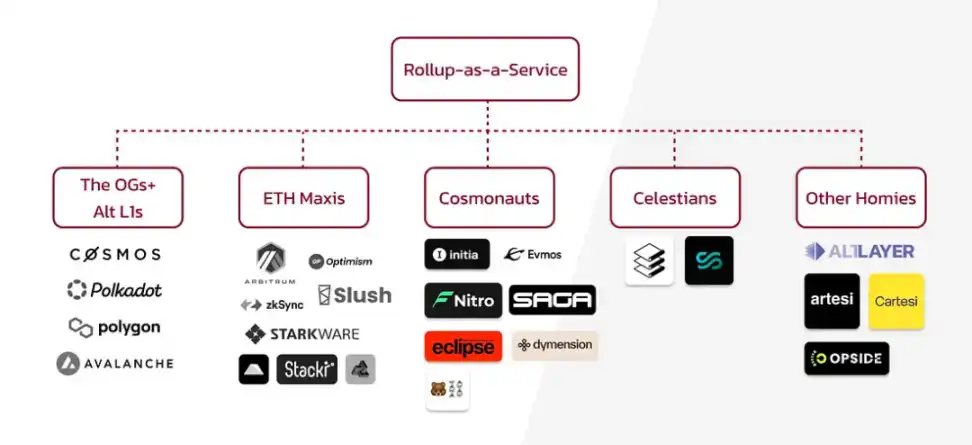
OG: Cosmos and Substrate
The Cosmos SDK and Substrate SDK have been around for years, allowing developers to create their sovereign chains (hence not technically modular) or, in Substrate's case, to connect as a parachain to the Polkadot relay chain for shared security.
Alt-L1s (Alternative L1 Chains)
Polygon and Avalanche were hot projects in early 2021 in the Alt-L1 narrative. They established prototypes of a modular framework: Polygon Edge and Avalanche Subnets.
Notably, Avalanche has partnered with games like Crabada and DeFi Kingdoms, allowing these games to create their dedicated subnet.
Polygon expanded the scope of Edge — now called Polygon Supernets. Through the Supernet, dApp teams can leverage the stake of existing Polygon PoS validators and create a separate environment for a specific application.
Over time, Polygon Supernets will also enable dApp teams to use Polygon ZK technology to create ZK rollups.
The Ethereum Maxis
Many L2s on Ethereum are contemplating what these application-specific rollups will look like on their networks, with Scroll, Fuel, Mantle, Boba, Metis, Consensys' zkEVM, and Loopring notably missing the mark.
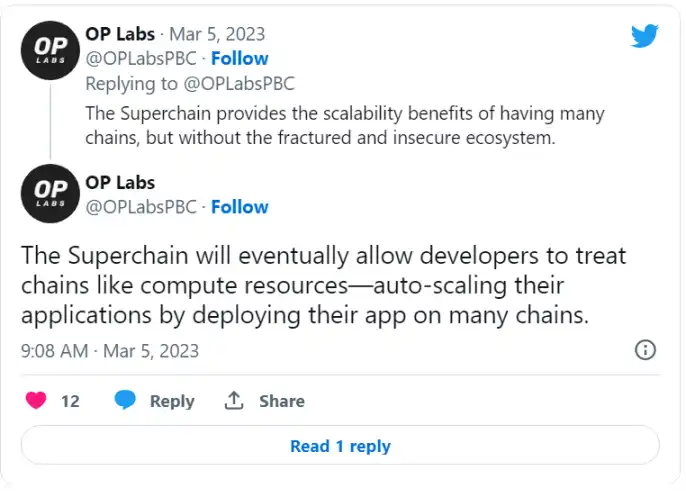
OPStack is a modular stack for Optimism, architected by Base, playing a significant role in Base and other branches (e.g., Minecraft games). They envision a superchain with a shared sequencer to provide synchrony and atomicity between rollups.
The vision of the OP Labs team is to make RaaS L2s the "experimentation layer" above Ethereum. For example, Ethereum developers could easily spin up new rollups to test new ERCs and EIPs in production, rather than waiting for Ethereum L1 to fully upgrade, or even after other more mature L2s have upgraded (such as Optimism's mainnet).
Arbitrum AnyTrust and its first game-optimized deployment, Nova, are modular solutions for Arbitrum that allow the use of Arbitrum's Nitro execution layer, with the ability to use DAC for off-chain data availability and automatic failover to Ethereum L1 in case of any issues on L2.
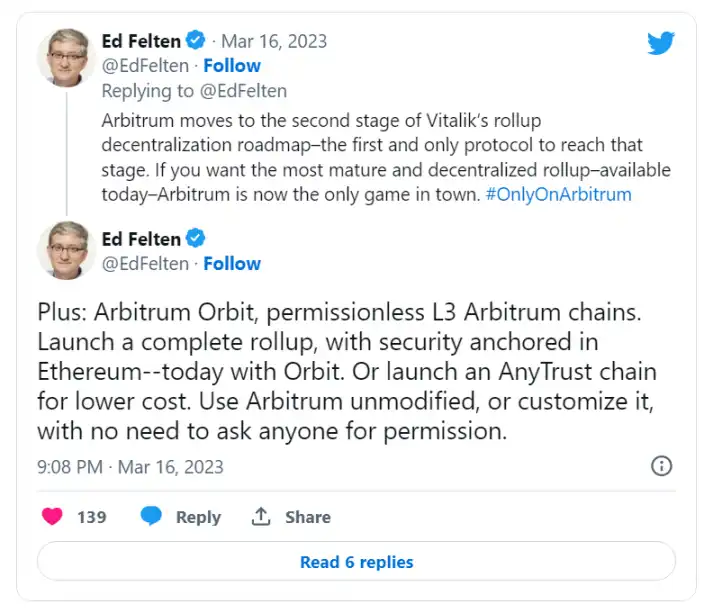
Last week, alongside the airdrop announcement, Arbitrum announced the launch of Orbit, a developer solution to start L3 on Arbitrum in either a full rollup or AnyTrust instance.
Paired with Stylus, Orbit allows developers to build applications using C, C++, and Rust while also supporting EVM languages such as Solidity. Offchain Labs expects to leverage L3 for rapid experimentation, such as introducing new governance mechanisms, modifying Nitro, and more, all achieved through permissionless rollup operations.
Slush is built on top of StarkNet, providing an SDK to build zkVM L3 on StarkNet. Starkware introduced the concept of Fractal Extension, considered the pioneer of L3s.
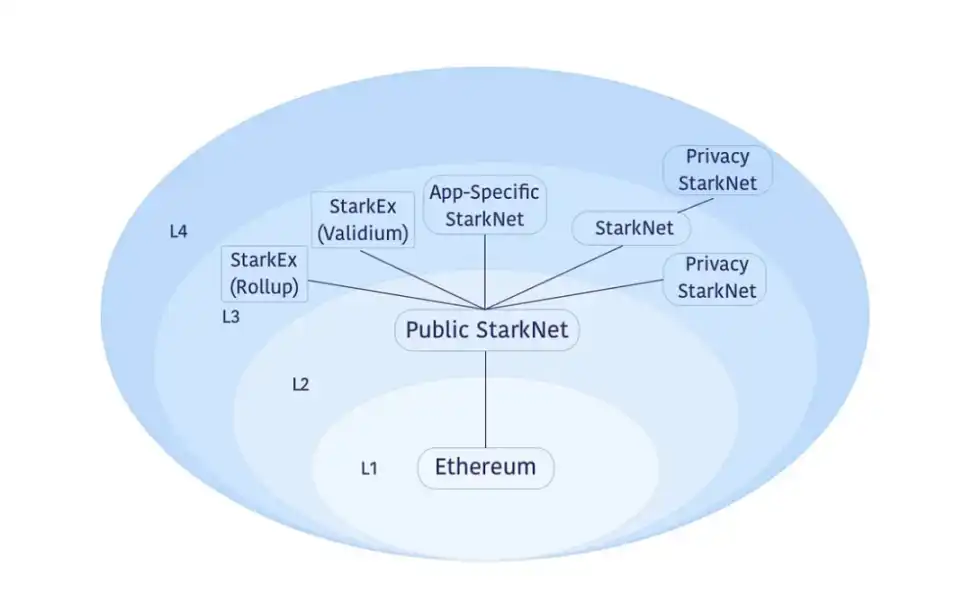
zkSync is also exploring Fractal Extension and L3, referred to as "Hyperchains." Hyperchains utilize LLVM technology, are fractal instances of zkEVM running on the L1 mainnet, and can operate in parallel. By settling on the L1 mainnet together, interoperability across Hyperchains is achieved.
Anyone can deploy a Hyperchain permissionlessly, using a customizable modular zkEVM chain stack supported by a zkEVM engine identical to the main zkSync L2. Developers can choose different virtual machines (e.g., MoveVM), different rollup designs, and different data availability schemes (zkRollup, zkPorter, and zkValidium).
In addition, the Matter Labs team has a certain vision for the future execution environment on Hyperchains that can become very short-lived or temporary. For example, it would be possible to quickly create a rollup to easily mint millions of NFTs, then transfer these NFTs to another execution layer, and finally close the temporary rollup.
Caldera, on the other hand, has a vision for one-click deployment of a modular chain, initially starting from optimism's rollups. They have already conducted online demos of optimism rollups on the testnet and have collaborated with gaming clients like Curio to begin their deployment on the mainnet.
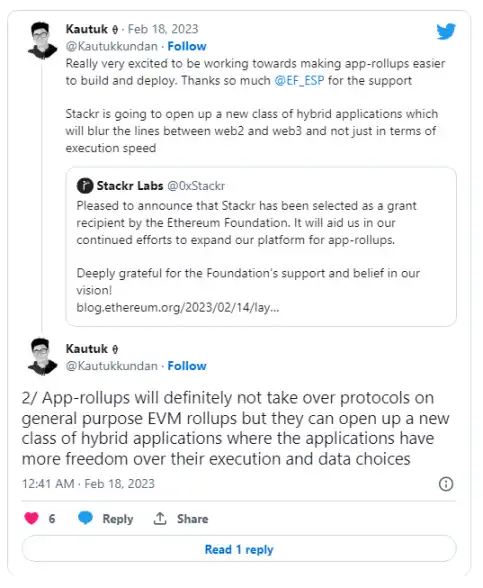
Stackr is still very early stage, but they are winners of ETH Global and seem very promising. They aim to leverage a "micro-rollup" to create "hybrid applications," allowing rollups to freely choose execution, data storage, and full decentralization.
Currently, there is not much information about Conduit, but it is related to OPStack, and they are also dedicated to achieving a "one-click deployment" experience.
The Cosmonauts (Cosmos Ecosystem Supporters)
The RDK of Dymension allows the creation of RollApps connected to the Dymension Hub on Cosmos. Dymension RollApps are built using the same tools as the Cosmos SDK, with the main difference being the replacement of the consensus-free blockchain module (i.e., no validator rotation logic), and they are expected to be more scalable than Vanilla Rollups, as bandwidth issues for data publication will not become their bottleneck.
The Dymension Hub will allow for hub-style IBC connections between RollApps and other IBC-enabled chains, benefiting not only users but also elevating the Dymension Hub as an autonomous network.
(Translator's Note: Hub-based IBC connection is a method of achieving cross-chain communication in the blockchain world. In a traditional hub, a set of wheels rotate around a central axle, with each wheel connected to the center axle, and there is no direct connection between the wheels.
Just like in blockchain, where each chain can only communicate with the main chain and not directly with each other, the emergence of hub-based IBC connection has changed this structure. This change allows different blockchains to achieve closer interoperability, enabling reliable, secure, and efficient cross-chain communication through direct connections, providing a broader range of use cases for blockchain applications.)
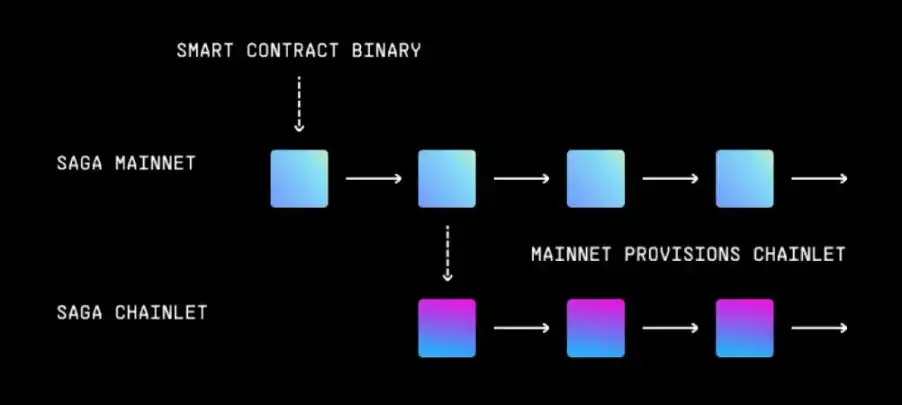
Saga is an elastic blockchain space platform that allows developers to deploy fully secure, decentralized "chainlets" as needed and leverage the security of its main validator node set.
Saga supports multiple underlying platforms for chainlets, including Cosmos appchains, Celestia rollups, and Polygon Supernets. Like other RaaS projects, Saga focuses on the gaming sector and supports any technology needed by the gaming industry.
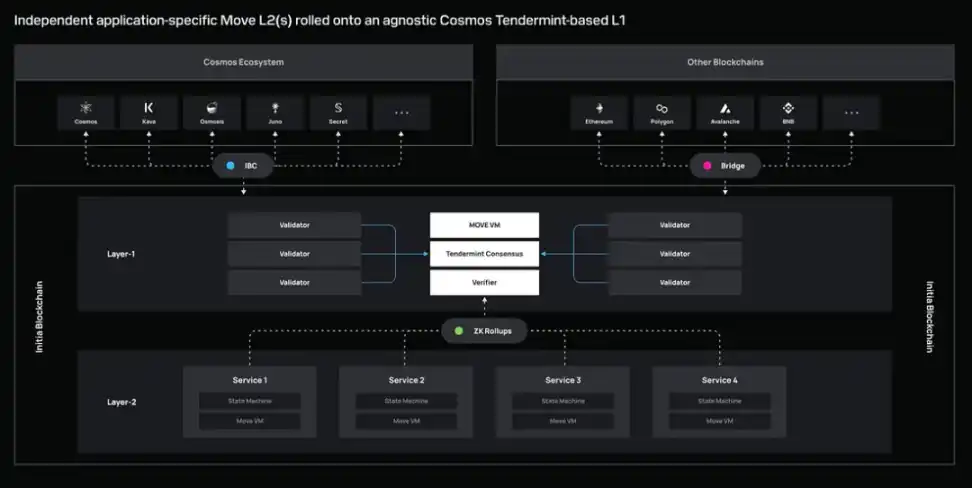
Initia is a modular solution also targeting the gaming market. They utilize MoveVM as the execution layer, ZK proofs, and Cosmos SDK for fast settlements and data availability.
Initia plans to enhance their L1 ecosystem through the so-called "The Lobby Thesis," providing a platform for L2 projects to communicate and collaborate with each other, achieving composition and cross-chain interactions between L2s, rather than solely focusing on L2 infrastructure.
Evmos plans to develop the Evmos SDK to enable developers to easily build and launch new EVM-compatible app chains on Cosmos using Ethermint.
Berachain recently announced the launch of Polaris, a revamped blockchain framework that supports integrating the Ethereum Virtual Machine with any consensus mechanism, including Cosmos SDK/Tendermint, among others. The team will also build additional developer tools and infrastructure to streamline building with Polaris—such as block explorers and wallets, and more.
Eclipse is building a Settlement Rollup that allows for the construction of SVM and other VM execution layers on top of it, using Cosmos and Polygon, and eventually other L1s for data availability.
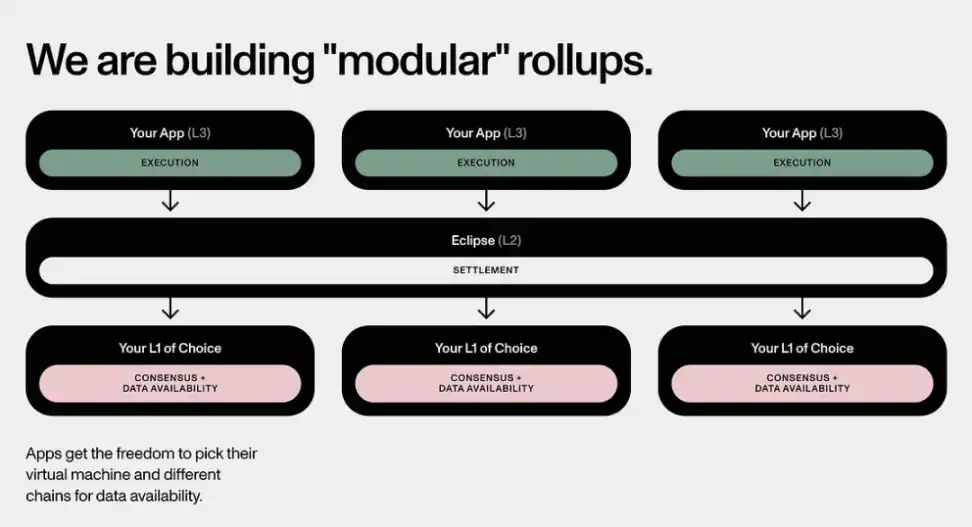
(Eclipse Working Theory)
The Celestians
The Rollkit of Celestia (formerly Rollmint and Optimint) is a modular framework for creating a Sovereign rollup or an Optimism rollup (soon to be released) with modular data availability components.
Rollkit has a generic Data Availability Layer (DA Layer) interface that can plug into any DA layer, including dispute integration with Bitcoin.
Astria is a Settlement rollup execution layer that uses Celestia for data availability.
Fractal is a hub providing support and resources for building zkVM rollups.
Sovereign Labs is building the Sovereign SDK for the "Internet of Rollups," using any L1 for data availability and sequencing, and leveraging any LLVM-compatible proof system for zk-proving (e.g., RiscZero or Nil Foundation) to create Sovereign zk-rollups.
Other Teams
Artesi is building "full-stack" rollups using off-the-shelf tools like block explorers and MPC wallets.
Alt Layer focuses on creating "flash layers" for short-lived use cases with a time constraint, which are temporary trust rollups. They are using the Substrate SDK.
Cartesi (not to be confused with Artesi) is creating a blockchain SDK for Optimism Rollup, featuring a Linux OS that can be compiled to Risc-V.
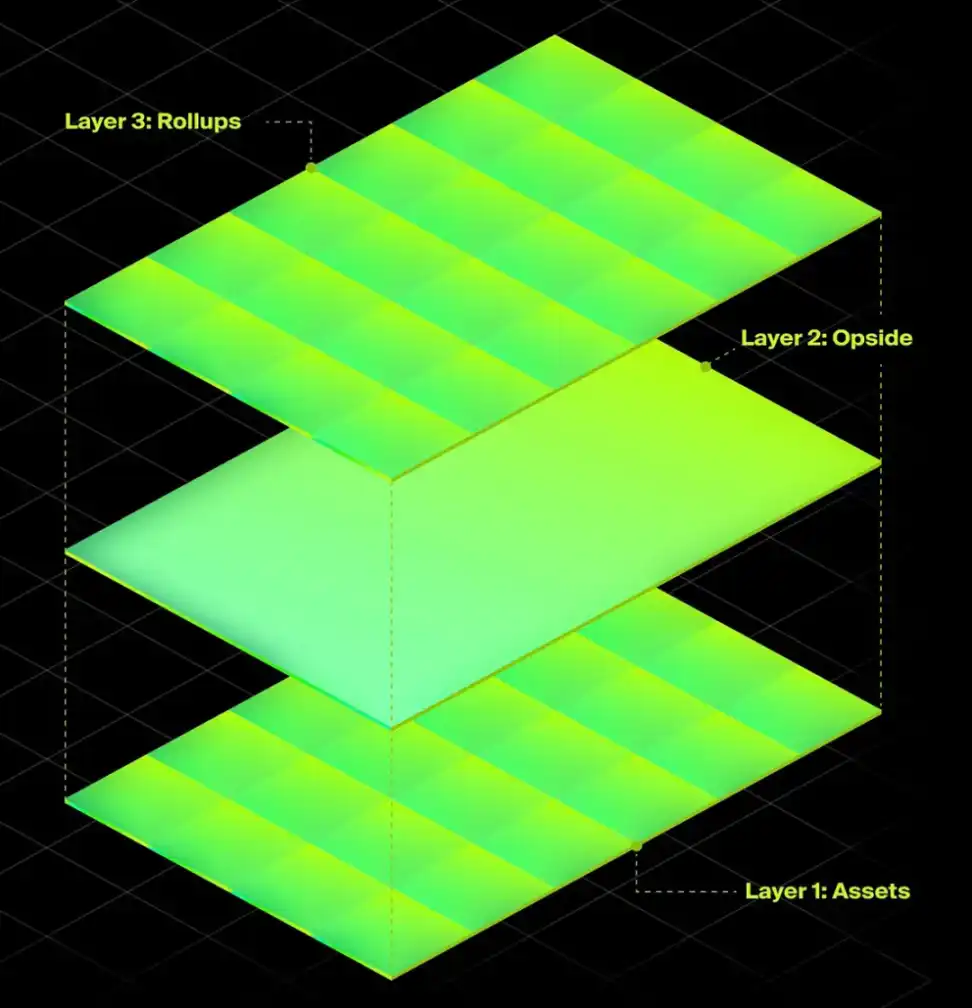
Opside offers zk-rollups as a service, using its innovative "Layer 3" platform.
02 dApp-Chain Team
We've now looked at all the solutions that can make building modular chains easier, but who's actually building new chains?
There are mainly three categories: Gaming, DeFi, and Creator Economies.
Gaming
So far, gaming has been the most frequently mentioned RaaS project use case—many of which focus only on gaming use cases.
GameFi has always been a goldmine in the blockchain space, with "gaming chains" emerging over the years, such as Efinity, Flow, Enjin, ImmutableX (initially StarkEx, now on Polygon zkEVM), and other projects.
It makes sense. Unlike financial applications, games require completely different parameters: lower security, higher throughput, higher storage capacity, etc.
RaaS projects are entering the competition for Web3 gaming.
DeFi
More specifically, standalone financial applications.
Applications that do not need shared execution layer composability perform well in a modular environment. For example, payment (Terra's Chai) and derivatives (e.g., dydx, perps, structured products), among other use cases.
Creator Economies
This is a bit like a catch-all term, but Web3 social, token gating, and community/social token projects are also actively developing their own application-specific modular blockchains.
It makes sense too as these applications are also self-contained and not plagued by the current lack of composability in cross-chain consensus.
03 The Long Road Ahead
I am very bullish on leveraging modular stacks and RaaS (Rollups-as-a-Service) solutions to promote blockchain technology.
However, I also realize that, just as I have seen throughout my five-year cryptocurrency career, we are still in a very early stage.
Modular projects like Fuel, Celestia, and zk rollups have yet to launch. Most RaaS projects are still in alpha testing or have been permissioned manually.
Not to mention application protocol teams considering deploying their own dapp chains in the new ecosystem. The current state is that building an application-specific modular chain is not a walk in the park for any development team:
Once you depart from a shared state machine, connectivity and composability are impacted.
Existing infrastructure such as RPC endpoints, block explorers, and wallets cannot be used off the shelf, and running on your own infrastructure is costly.
Liquidity is fragmented, and community-building needs to start from scratch. There is no network effect inheriting the underlying base chain.
Lastly, there is a lingering concern that this is all just "a road of digging and shoveling."
(Translator's Note: Here, "a road of digging and shoveling" refers to concerns and apprehensions about cryptocurrency and blockchain technology, suggesting that the entire industry is just repeating the same actions, similar to gold miners during the Gold Rush digging and collecting gold.)
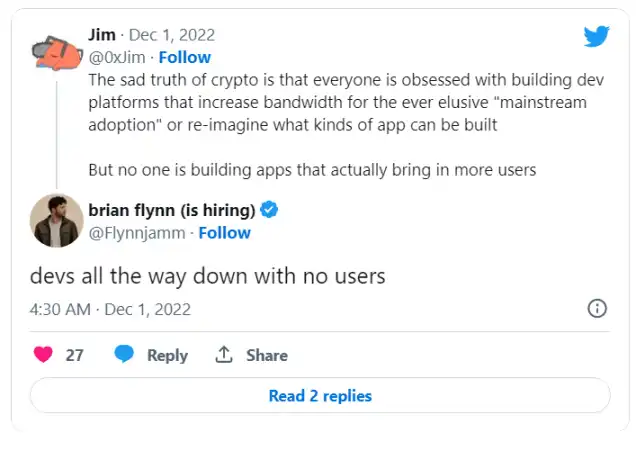
In addition to powerful development tools, the space also needs iconic applications to onboard a new wave of users in the next bull market.
They need to address real user pain points, which will emerge in a future world of a million chains: composability issues, cross-chain value movement, and even full chain abstraction.
04 Translator's Summary
This article explored the future development trends of blockchain technology, mainly mentioning the concept of Rollups-as-a-Service (RaaS). RaaS projects aim to provide development teams with a lightweight, configurable Rollup solution to help them rapidly build and maintain internal blockchains.
Similar to AWS in cloud computing, RaaS projects abstract the complexity of the underlying infrastructure from developers, allowing them to focus on application development and operations.
The article listed various solutions and projects in the current RaaS space, including:
Cosmos and Substrate: These two platforms are the earliest blockchain development frameworks with years of development history. Their key feature is supporting the creation of sovereign chains and connecting to the Polkadot Relay Chain as a parachain through Substrate.
Polygon and Avalanche: Initially targeted for large-scale applications, these two platforms feature modules such as Edge and Subnet to meet diverse business needs. Recently, they have also begun to support Supernet solutions, allowing development teams to potentially build custom ZK Rollups.
Ethereum L2: Due to the congestion and efficiency issues on the Ethereum network, many L2 projects are emerging to provide more efficient and cost-effective solutions for digital asset transactions and use cases. For example, Optimism and Arbitrum have introduced their own Rollup and L2 architectures to help developers quickly build applications on the Ethereum network and support more diverse scaling solutions.
Blockchain projects such as Slush, RollKit, and Fractal based on StarkNet take ZK Rollup as a core technology to explore faster, more secure, and more flexible Rollup application scenarios.
In fact, with the increasing number of digital asset applications, hard forks and soft forks are no longer able to meet the specific needs of various blockchain application scenarios.
The rise of RaaS projects has helped developers quickly build modular blockchains that can be scaled and upgraded according to requirements, thus providing efficient, secure, and durable solutions for digital assets, gaming, social, DeFi, and other scenarios.
Of course, many blockchain projects and platforms have planned to launch similar services in the past. However, due to reasons such as developers' lack of skills and knowledge, the actual implementation of these plans faces many challenges. Therefore, the solution of RaaS still needs further development and improvement.
Original Article Link
Welcome to join the official BlockBeats community:
Telegram Subscription Group: https://t.me/theblockbeats
Telegram Discussion Group: https://t.me/BlockBeats_App
Official Twitter Account: https://twitter.com/BlockBeatsAsia