



Functions and development plan of EOS ecological secondary crowdfunding platform Pomelo
Original source: EOS Network Foundation
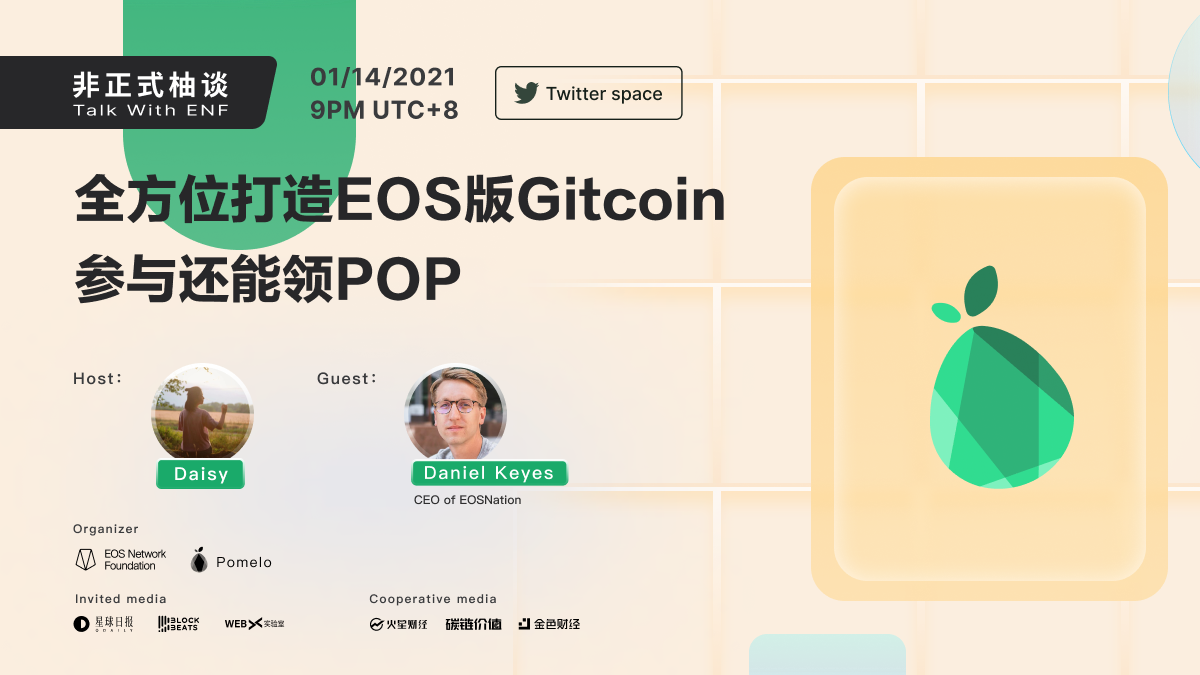
On January 14, 2021, at 21:00, Talk With ENF, the Informal Talk With ENF, launched by the EOS Network Foundation, is 002! In this issue we have invited Daniel Keyes, CEO of EOS Nation, to talk about Pomelo and Grant.
As we all know, Grant plays an important role in promoting ecological prosperity and development in public chain ecology. It provides funds, technology, marketing and other support for ecological development. Success - Feedback - success & GT; The virtuous cycle can promote the vigorous development of public chain ecology.
On December 1, 2021, the first phase of funding for Pomelo, the EOS Ecological secondary financing platform, officially ended. A total of 209 APPLICATIONS for EOS ecological projects were received, covering DeFi, wallet, NFT, infrastructure and other categories. 1,022 independent users made 5,796 donations for their favorite projects. With the high level of ecological discussion and participation, we also began to think deeply about how Grant funds should be allocated in order to be more democratic, scientific and transparent, more in line with community demands, and more accurately fill the gaps in ecological development.
On top of that, we have a triple bonus bonus stack for you:
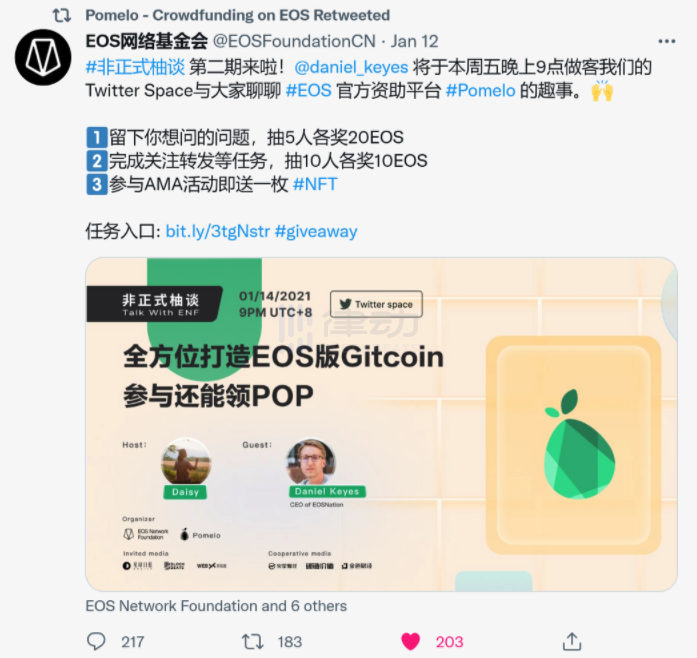
First surprise: In the run-up to the event, leave your questions on the EOS Network Foundation's twitter feed, and the five lucky questioners selected to answer will each receive 20 EOS.
Second surprise: we will draw 10 lucky prizes from users who complete the Twitter activity task, and each will receive 10 EOS;
Third surprise: Everyone participating in AMA can receive a POP Token NFT.
Full of dry goods, many benefits, wonderful can not be missed! This article is an edited review of the highlights of the AMA.
Daniel shares Pomelo's functions and development plans
Thank you very much for joining us. I am honored to speak with you about Pomelo, his role in supporting the EOS community, and the experiences and reflections we have had along the way.
We believe there are three key elements that communities need to thrive in the digital age:
First, effective coordination of public infrastructure funding;
Second, provide rich income opportunities for ecological participants;
Third, increase investment opportunities for idle capital.
Here, I want to share with you the powerful synergy between Pomelo and these three key elements.
Pomelo is the secondary financing platform of EOS Ecology and is committed to promoting the development of EOS ecological public basic products. Pomelo aims to be a self-funded, community-driven portal that provides funding for projects created based on EOSIO. By participating in a quarterly grant program sponsored by Pomelo, developers receive funding. We use a secondary financing mechanism where EOS token holders can decide for themselves how to allocate matching pool funds.
At the heart of Pomelo is a secondary financing mechanism in which the number of donors is more important than the amount. This mechanism was first proposed by Ethereum founder Vitalik Buterin and first practiced on Ethereum through Gitcoin. This mechanism has repeatedly been shown to be the best way to allocate funds for public goods in democratic communities. To date, Gitcoin has raised approximately $50 million for thousands of open source technology projects built by the Ethereum community.
Matching pools funded by partners such as the EOS Network Foundation make this possible. The EOS Network Foundation provided $500,000 in funding for the first round of Pomelo.
Using the secondary financing method, the amount of funds that each project party receives from the matching pool is the square root of the sum of funds that each user voluntarily contributes to the project party.
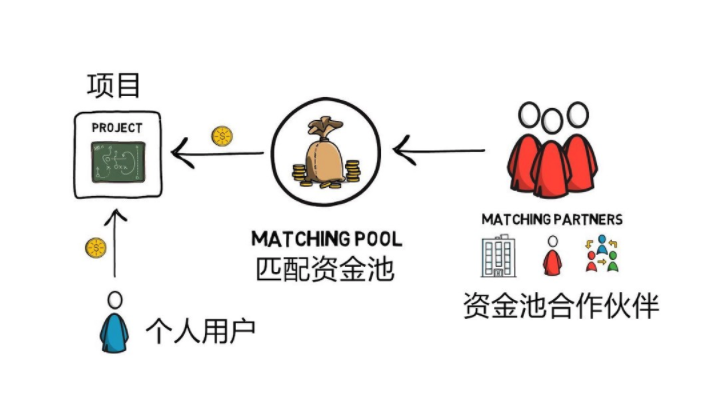
Simply put, under such an algorithm, the role of ordinary users is greater, the proportion of large users is appropriately reduced, and the rights of retail investors are increased, so that a larger portion of the matching pool will be allocated to the projects most supported by community members.
Public infrastructure goods are essential to the prosperity and development of a society because they create the basic infrastructure that allows other aspects of social development to continue to expand. Unfortunately, public goods tend to be underfunded because they are harder to capture value than private ones.
As the world continues to evolve into the digital age, public goods are facing new challenges. Geography is no longer a decisive factor in shaping or restricting the development of a community. Modern communities are formed around shared values, often across multiple languages and geographic time zones.
This is why we believe that communities that respect the values of their members and effectively coordinate the deployment of shared resources are the ones most likely to thrive in the Web 3 era.
The key design principle of Pomelo is accessibility.
From its first day of operation, Pomelo has been available in multiple languages, providing the most approachable localized experience for EOS wallets, using technology that is easily accessible anywhere in the world.
Given the diversity of the EOS community, we believe the extra effort to overcome challenges such as accessibility is worth it, and Pomelo will continue to focus on lowering barriers to access.
Pomelo Grants provide the community with a way to keep track of where the money is going. This directly affects the allocation of funds for each round of project. When community members donate through Pomelo, they show their support, voice and vote for the project. Their participation determines how much funding the project receives from the matching pool, and their votes have a secondary effect. Therefore, public infrastructure goods that best embody community values are the most successful to be funded.
In November, more than 1,000 users participated in the first round of Pomelo donations, raising more than $135,000 for 75 projects. Together with the $500,000 matching pool provided by the EOS Network Foundation, funding for the development of public goods in the EOS community has exceeded $630,000, including:
- 35% allocated to infrastructure projects; 30% for EOS ecological development;
- 11 per cent for communities;
24% for DeFi, privacy, developer tools, governance, arts & Media, etc.
And it's only just begun! Pomelo will be held for four seasons each year, and it is believed that the true value of Pomelo will be realized through the participation of community members one after another. In the short term, continuous income can attract more new projects; In the long term, it also gives the project exposure.
The secondary financing mechanism allows developers and project owners to focus more on building rather than making a living. This is why we believe that providing rich income opportunities for ecological participants is one of the key elements of the success of modern communities.
In the first round of Pomelo grants, the most popular projects will receive matching funds of up to $60,000. There are four grants a year and they have the opportunity to receive additional funding every three months.
This demonstrates the high value that members of the EOS community place on the various project parties.
One is free to concentrate on meaningful work. We can't wait to see: With incentives that match community values, Pomelo is able to maximize the independence of each community member over time.
The more success each project has, the more energy they can devote to the success of their community. Each project gains more reputation in the community over time and has more opportunities to create value.
Regardless of what matching funds the first-round projects received, they gained widespread attention from the community and were more likely to be funded in the future. This provides a great opportunity for VCS and the EOS Network Foundation to identify up-and-coming projects in time, invest in them, and keep them going.
Venture capital funds that use the wisdom of crowds to spot good projects at an early stage can also spot opportunities on platforms. There is a lot of capital looking for investment opportunities, and what Pomelo is doing is helping that capital invest in community-supported projects.
That's why we think investment opportunities for idle capital are one of the keys to the success of modern communities. That's why we're constantly exploring ways to enhance synergy with Pomelo.
Pomelo supports open Web development, but beyond that, we see Pomelo as an important experiment in secondary financing. It is extremely important to test the scientific nature of secondary financing, as we believe that such mechanisms are the best way to finance public goods on democratic principles and could become the primary means of allocating public resources.
Each phase of Pomelo's grant program provides more opportunities for the EOS community to learn and test the system, and the probability of success increases with each funding round. So at the end of each funding round, we take a short pause to reflect on the successes and difficulties of that round, and learn how to better support the community, improve the integrity of the system, and improve the transparency of the process.
The secondary financing mechanism is impressive in amplifying the contributions of ordinary users, but it also raises some unanswered questions about how to prevent witch attacks and collusive attacks. As a crowdfunding platform for public infrastructure products, Pomelo sees the issue in a different way.
From a certain perspective, it makes sense that each round of funding is a giant red-and-blue team battle field, a real-world practice run on secondary financing mechanisms.
Our approach is iterative. The goal of each round is to establish a blue team defense by identifying and classifying attacks from the red team so that the EOS community can defend against attacks from outside. In this way, we can expand the positive impact of the secondary financing mechanism even beyond the EOS community.
While we found no evidence of witch attacks or similar attacks in our first round of funding, we predict that the likelihood of such attacks will increase over time as the stakes increase and more people become aware of the opportunity in the future.
In the future, one of our biggest challenges will be witch attack defense mechanisms and achieving wider accessibility.
Our team has the courage to rise to the occasion, and we are thrilled with the support and engagement we have received from the community so far.
Pomelo aims to provide everyone with a path to financial independence so that ecological participants can focus more on community work.
We see the secondary financing facility itself as a public good, so we think what you see is what we care about. I am very glad to have the opportunity to share the journey and experience of the Pomelo team along the way. Thank you for joining us!
Daniel answers questions from five lucky users
First question: from user viX1024
Many projects in Gitcoin are just fraudulent donations. How do you deal with this situation?
Daniel answered:
As I shared earlier, one of the challenges we faced was how to defend against witch attacks, because on Pomelo, a crowdfunding platform with a lot of people involved, there were definitely a lot of people motivated to do these attacks. We continue to improve every season and every round to address these kinds of things and improve our defense mechanisms, which is a major goal for us right now.
In the first quarter of funding, we did not see a huge attack, of course, we also made some attempts to improve the defense, for example, we required participating projects to be associated with EOS accounts, associated with social media, and adjusted some algorithm mechanisms. In addition, we build trust in the community by having all community members act as endorsers and witnesses for project trust.
In various ways, we hope to minimize such attacks.
Second question: from user Yayayang
What can be done to encourage people to donate?
Daniel answered:
We started by giving away money. We found that many members became individual donors when they saw the value of Grants, and that every community member saw tangible benefits that they could gain through ecological public infrastructure development.
We found that the most successful projects in the first quarter of funding were those that encouraged community participation and actually provided benefits to community members.
Third question: from user bloks.bit
How does Pomelo monitor that the projects that receive the money are doing something instead of throwing it away?
Daniel answered:
We basically don't provide supervision because we don't want to play the role of police. We want to provide a platform for the community to choose the projects they want to support. So with each round of giving, community members are watching to see which projects actually bring tangible benefits to the community.
The projects that will be successful on Pomelo's platform are those that will make lasting contributions and benefits to the ecology. If you want to be successful, you have to be responsible for donors, platforms, ecology. Those with good credit will be funded in each future round of financing.
Fourth question: From user A Fei
Will Pomelo fund for-profit projects? The real prosperity of ecology needs more for-profit projects!
Daniel answered:
Yes, we are, to some extent, supporting the development of for-profit projects, as long as they provide value to the public ecosystem, they can be funded by us. An open source App interface suite team, for example, can receive ongoing funding from Pomelo as long as they can demonstrate their value to the ecosystem.
Fifth question: From user Mario's garden
Will Pomelo become a DAO?
Daniel answered:
Very good question, but to be honest, I don't know.
In our opinion, now we only know that we have a priority, which is to let more people know about Pomelo platform, understand that Pomelo can provide a channel for them to obtain funds, and encourage people to participate in the governance of Pomelo platform. DAO itself is also an attempt of better governance. It may also be the most feasible approach.
However, we are not sure whether Pomelo will firmly develop in the direction of DAO in the future. The only certainty is that we will try to get more people to participate in our efforts to build Pomelo.
Wonderful sharing always makes people feel that time flies, unconsciously this AMA is coming to an end.
Thank you for your wonderful speech, thank you for your active participation tonight, and thank you for the strong support from planet Daily, Block Rhythm, WebX LABS, Carbon Chain Value and Golden Finance, the cooperative media of this event.
In the future, the work related to EOS Network Foundation and Pomelo will continue to advance at a high speed. We look forward to the next chapter of the booming development of EOS ecology with the joint efforts of EOS Network Foundation and Pomelo.
Meet up for the next informal Talk With ENF, and we'll be there.
Talk With ENF
The Informal Talk With ENF was initiated by the EOS Network Foundation to listen, communicate and connect the blockchain community at home and abroad. The EOS Network Foundation will invite leaders of high-quality projects in the blockchain industry from time to time to talk about hot topics in the field of encryption, share the development trend of encryption technology and reveal the story behind the encryption world. In addition, EOS Network Foundation will prepare surprise benefits for everyone in each program. If you actively participate in the live q&A, you will have a chance to win benefits.
About the EOS Network Foundation
The EOS Network Foundation is a non-profit organization whose mission is to listen to, communicate, and support the development of community quality projects. It serves as an information sharing bridge for the EOS community and provides financial, technical, operational, future planning, ecological construction and other critical infrastructure support for EOS Ecology. Further unleash the full potential of EOS as the fastest governance blockchain in the world.
The original link
Welcome to join the official BlockBeats community:
Telegram Subscription Group: https://t.me/theblockbeats
Telegram Discussion Group: https://t.me/BlockBeats_App
Official Twitter Account: https://twitter.com/BlockBeatsAsia
 Related Articles








