How did The traders of Terra Ecology arbitrage LUNA and bLUNA?
原文标题:《 Here’s how Terra traders use arbitrage to profit from LUNA and bLUNA 》
原文来源: ELAINE HU,Cointelegraph
Chain catcher
Terra Market Analysis
The end of the year is usually a time to rest and prepare for the holidays, but the crypto market shows no signs of "resting" in the final weeks of 2021.
One of the most notable news was Terra's all-time high in TVL (total lock-up value), which surpassed BSC to become second only to Ethereum. DeFi Chain. After hitting the $20 billion mark on December 24, Terra's TVL has fallen to around $19.3 billion at the time of writing (not a bearish signal), according to Defi Llama.
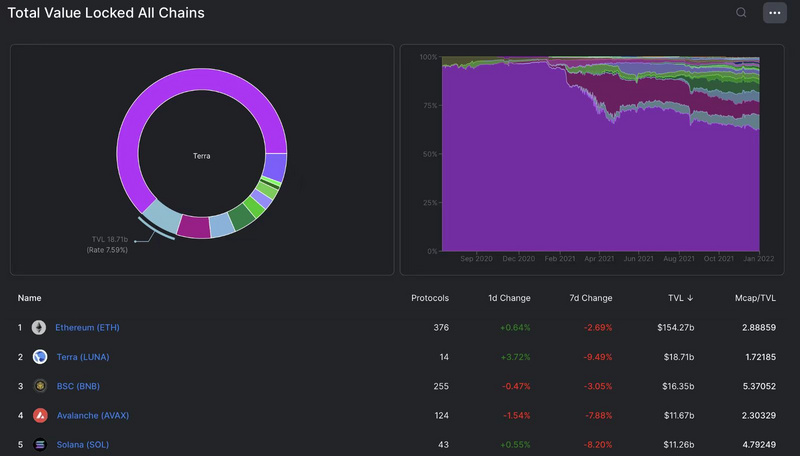
Lock the top five male chains. Source: Defi Llama
Currently, Terra has only 14 protocols built on the chain, compared to 257 protocols on BSC and 377 protocols on ethereum. Terra's protocols have been very successful in attracting liquidity, and the recent release of the Astroport protocol has coincided with Terra's local governance token LUNA's rapid rebound to an all-time high on December 26, 2021.
In dollar terms, TVL has experienced exponential growth since September 2021 compared to LUNA, while the latter has remained fairly flat over the same period. It's not hard to see that the main reason for the recent TVL dollar price increase is the LUNA price increase itself.
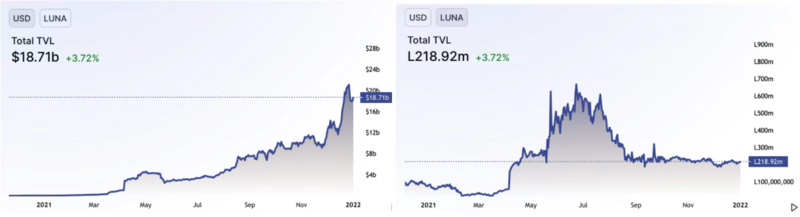
Terra total dollar lock-up value compared to LUNA. Source: Defi Llama
While the rise in the price of governance tokens is usually a sign of investor confidence in the corporate chain and protocols, it also appears to be due to the emergence of more lucrative arbitrage opportunities.
Let's take a look at some strategies for arbitrage between LUNA and its guaranteed asset, bLUNA.
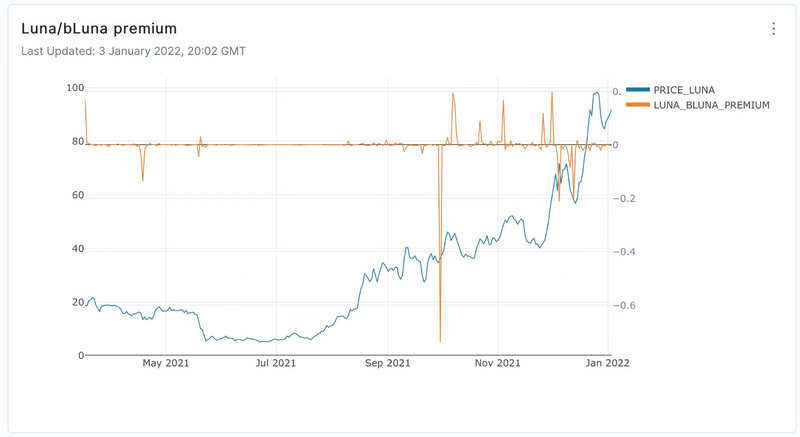
LUNA VS price; LUNA /bLuna premium ratio. Source: Flipside Crypto
Why is this happening in Terra's market?
LUNA is the governance and pledge token of Terra Public Chain, while bLUNA is the token of pledged LUNA and its corresponding block rewards. Because bLUNA, like LUNA, is homogeneous and tradable, it also trades on Terra's decentralized exchange.
Like other currency or token trading pairs traded on exchanges, LUNA/bLUNA trading pairs traded on different decentralized exchanges (DEX) may have different prices due to price inefficiencies on different platforms. Arbitrageurs will profit by buying from one agreement at a lower price and selling from another at a higher price, helping platforms address price inefficiencies and eventually reaching a fair price across all exchanges.
In addition to the common cause of price inefficiencies, there are other factors, such as the nature of bLUNA, that make LUNA/bLUNA prices different between protocols.
BLUNA price is higher than LUNA on Anchor agreement. This is because bLUNA, once used for collateral and casting on Anchor, can only burn and trade into LUNA after 21 days (plus 3 days of processing time) unless it burns immediately.
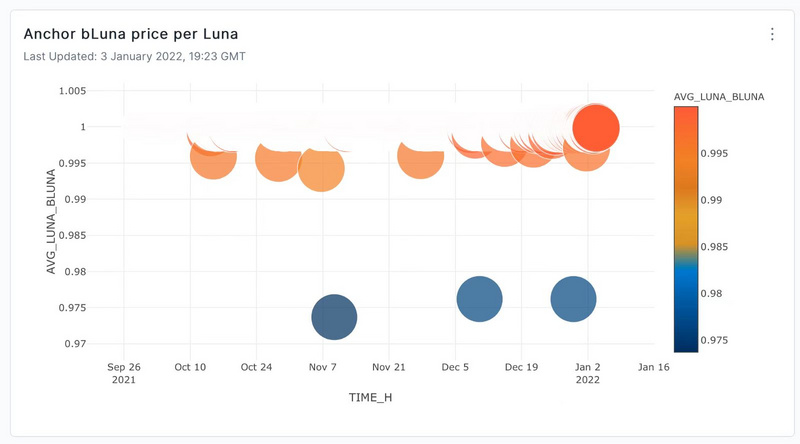
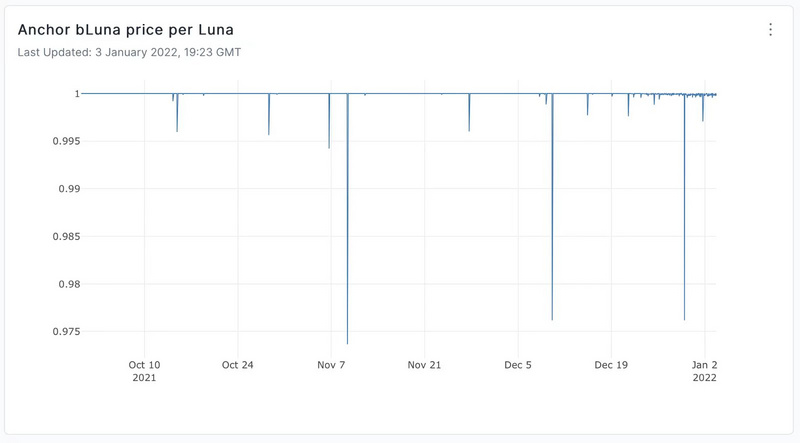
Since bLUNA represents not only the value of LUNA held, but also the block reward of LUNA held during the 21-day lock-up period, it is consistently worth more than LUNA. As shown in the figure below, the price of bLUNA on Anchor is slightly below 1 most of the time, and three different outliers show that bLUNA is more valuable at 0.97 (bLUNA/LUNA) ratio.
LUNA is typically more expensive on exchanges than bLUNA, probably because of:
Selling bLUNA is more than buying bLUNA on DEX (hence bLUNA & NBSP; Less valuable) because it takes 21 days to burn bLUNA on the Anchor protocol if it is not burned immediately. So, if users want LUNA right away, they need to go to DEX and sell bLUNA. For bLUNA that burns instantly on the Anchor protocol, the rate is the same as TerraSwap.
Unless users need to use them as collateral on the Anchor protocol, they won't expect to get other LUNA series assets as they do with bLUNA. Currently, Anchor provides the binding function to perform LUNA and bLUNA at a ratio very close to but slightly less than 1. To trade between. That is, investors get slightly less than 1 bLUNA for 1 LUNA. Although the exchange rate is better on DEX, since traders can get more than 1 bLUNA for 1 LUNA on DEX. But users tend to look for the most convenient way to get their bLUNA using Anchor Bonds so they don't have to switch between different protocols.
How to take advantage of Terra's arbitrage opportunities
According to the explanation of price difference given above, there are two main ways to arbitrage LUNA and bLUNA.
TerraSwap, Loop Markets and Astroport all offer LUNA/bLUNA deals. There are often small price differences between these exchanges, creating arbitrage opportunities for traders to buy the pair at a lower rate on one trade and sell it at a higher rate on another.
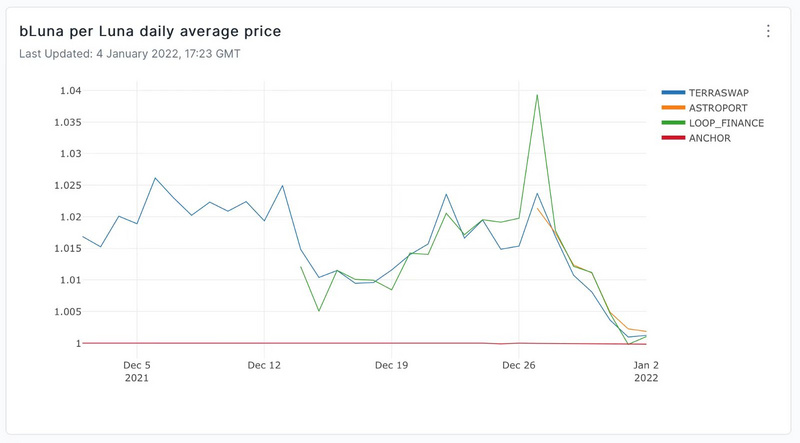
LUNA/bLUNA price comparison on DEXs. Source: Flipside Crypto
The chart below shows the average daily LUNA/bLUNA transaction price for different platforms during December 2021. This ratio is the total number of bLUNA actually received (after fees and expenses) divided by the total number of LUNA provided for transactions. As explained in the previous paragraph, due to the increased demand for LUNA on the DEX, one LUNA can be traded as multiple bLUNA on the DEX.
The chart below calculates the arbitrage daily return on any two of the three exchanges. The best opportunity came between TerraSwap and Loop on December 15, with an annual return (APY) of nearly 600%.
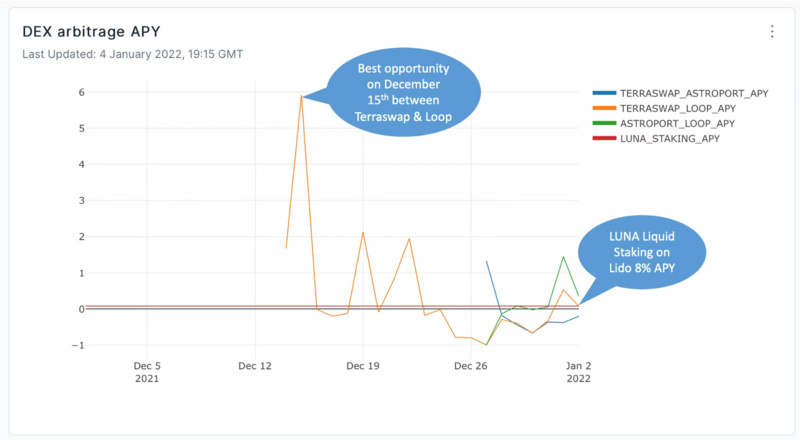
Arbitrage LUNA/bLUNA trading pairs between different DEXs. Source: Flipside Crypto
Arbitrage between DEX and Anchor protocol
Investors can trade LUNA to one of the DEX with the highest bLUNA per LUNA, burn bLUNA on the Anchor agreement, and wait 21 days (plus 3 days) for more LUNA. Note that burn on the Anchor protocol must be a normal "slow" burn. Since the transaction rate is the same as TerraSwap, "instant burn" will not work.
Based on 24 days (Anchor Burned 21 + 3 day treatment), the figure below shows the annual return rate (APY) of arbitrage between different DEX and Anchor.
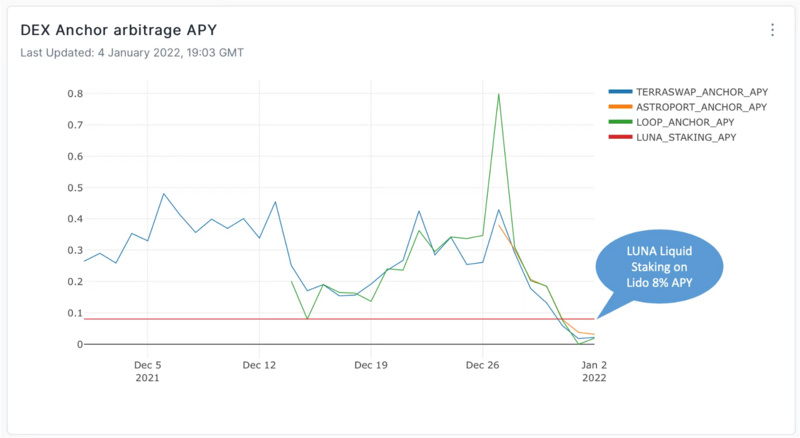
DEX and Anchor annual earnings vs.& NBSP; LUNA pledges an arbitrage between annual returns. Source: Flipside Crypto
Lido The 8% annual average return from LUNA's liquid pledge was also added to the risk-free benchmark return comparison. In December, the peak annual average yield reached 80% on December 27, and has since fallen sharply to below risk-free returns in the New Year.
This may be because Terra's greater adoption and greater user participation in different Terra agreements has helped rationalize prices across platforms, reducing price inefficiencies and arbitrage opportunities, and thus creating a fairer price.
Smart investors are always rubbing their hands, waiting for the next opportunity
From the trading data observed in December 2021, there are arbitrage opportunities for LUNA/bLUNA trade pairs between different protocols on Terra. Traders can choose the riskier way to arbitrage between different DEX platforms (such as TerraSwap, Astroport and Loop Markets) or the safer way to arbitrage between these DEX platforms and the Anchor protocol, That is, if they are willing to hold bLUNA for 24 days.
In December 2021, the annualized returns of the DEX and Anchor agreement arbitrage strategy consistently outperformed the risk-free Lido liquidity pledge. Until recently, that return all but evaporated on January 1, 2022.
This may be due to increased user participation and price rationalization in the Terra agreement. Arbitrage opportunities may arise again in the future due to fluctuations in trading volumes and participation rates, or due to the introduction of new DEX protocols.
The opinions expressed in this article are the author's own. Every investment and trade has risks. Do your own research before making a decision.
The original link
Welcome to join the official BlockBeats community:
Telegram Subscription Group: https://t.me/theblockbeats
Telegram Discussion Group: https://t.me/BlockBeats_App
Official Twitter Account: https://twitter.com/BlockBeatsAsia

 Related Articles