2021 Required Course for Public Chain Development: Embrace DeFi
Original title: "2021 Public Chain Development Required Course: Embracing DeFi"
Original source: OKLink
As The industry's infrastructure, the public chain carries people's expectations for the blockchain as the underlying network of Web3. In the past year, Ethereum has undergone a London upgrade and continues to move towards ETH2.0. Emerging public chains rapidly develop the ecosystem on the chain by embracing DeFi, and become the big winner in the encryption world in 2021. We try to compare and analyze the hot spots of the public chain and DeFi in the past year through the data on the chain, and explore the core value of the public chain and the DeFi protocol.
As the leader of the public chain, Ethereum is still the main battlefield and the birthplace of innovation in this field. Over the past year, several metrics on Ethereum have achieved ETH Flip BTC.
After the implementation of Eip-1559, the volatility of Ethereum Gas fees has decreased, and the miners' income curve has begun to move closer to the Staking model.
Layer-2 starts to emerge, Arbitrum takes the lead, and zk-Rollup is ready to go. How to get through the liquidity of assets on Layer-2 is the key to development.
The new public chain has risen rapidly by embracing DeFi, and multi-chain deployment has become the choice of many protocols, but it is not a rational choice to blindly deploy multi-chain.
The release of Uniswap V3 is a major event in the DeFi field in the past year, and higher capital utilization lays the foundation for more capital to enter the market. The emergence of Convex allows Curve users to get more generous rewards, but it also brings challenges to community governance.
Security issues have become a hot word in the DeFi field in the past year, and the importance of data and tracking on the chain has begun to highlight; supervision has brought pain to the development of DeFi, Leading DeFi protocols have begun to respond to regulatory pressure.
1. Ethereum & Public Chain
1. Ethereum vs Bit
2021 is a proud year for Ethereum, with a market capitalization of up to US$562.491 billion, an increase of 568% from the beginning of the year, while the exchange rate of ETH/BTC broke through 0.08 , a new high in the past three years, an increase of more than 350% from the beginning of the year.

Data source: OKLink
Since the beginning of 2018 , the exchange rate of ETH/BTC began to decline from 0.1, and fell below 0.02 during the period. ETH holders have witnessed Ethereum moving from Constantinople to London and recovering in the past year. With the upgrade and activation of EIP-1559 in London, Ethereum officially opened the road to ETH2.0. But the hash rate of the Ethereum network has continued to soar over the past year. As of writing, the hashrate of Ethereum’s entire network is 866 TH/s, an increase of 208% from the beginning of the year, while the hashrate of Bitcoin has increased by 17.62% over the same period.

Data source: OKLink
Ethereum Many applications contribute a large amount of transaction fees.
The amount of Ethereum consumed by NFT transactions on OpenSea alone exceeds 130,000 ETH, while all kinds of DeFi and NFT chains The activity greatly consolidated Ethereum's status as an application and settlement infrastructure, and also brought huge profits to Ethereum miners.
As of December 22, ethereum miners earned more than $17.7 billion for the year, compared with $16.2 billion for bitcoin miners during the same period. Since May this year, the monthly income of Ethereum miners has been consistently higher than that of Bitcoin miners.
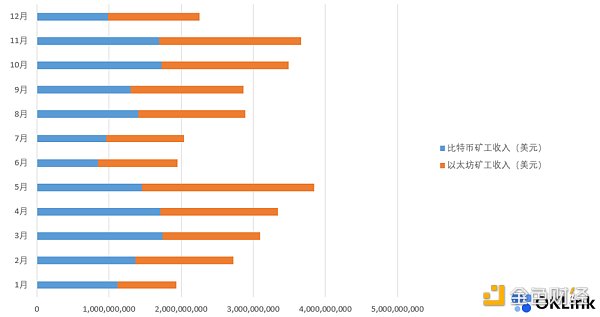
Data source : On-chain masters of Okey Cloud Chain
Miners provide computing power guarantee for the network, and the corresponding block rewards are the "security expenditure" of the network. To put that in perspective, Ethereum has surpassed Bitcoin in security spending over the past year. Of course, this is due to the huge rise in ETH over the past year.
On the other hand, we can use FRM, that is, "total revenue of miners/fee revenue" to quantify the impact of fees generated by on-chain behavior on miners' income extent, and the security of the network after block reward cancellation.
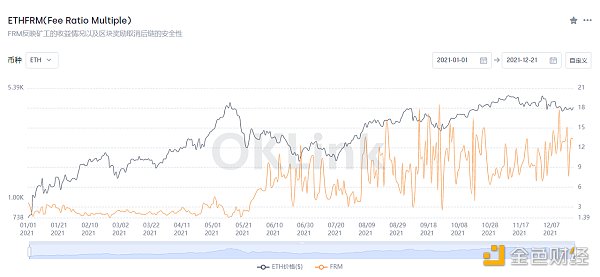
Data source : On-Chain Master of Okeyun Chain
In the past year, the average FRM value of Bitcoin was 39.74, while that of Ethereum was 6.2, which means that the user’s Fees have already accounted for more than 15% of the annual income of Ethereum miners, while the proportion of Bitcoin is only 2.5%.
We also compared The difference in the number of new and active addresses between Bitcoin and Ethereum:
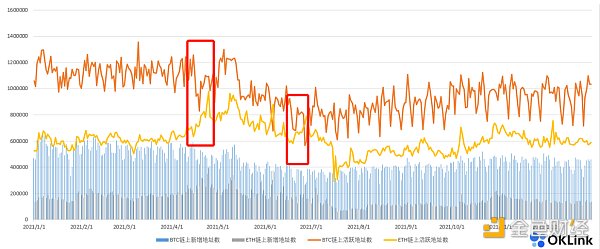
Source of data: Okey Cloud chain master
As of December 31, Ethereum’s annual The average number of new and active addresses per day is 161,700 and 615,000 respectively; while Bitcoin is 445,800 and 979,900 respectively. It is worth noting that in terms of the number of active addresses, Bitcoin and Ethereum show a certain degree of tacit agreement: when Bitcoin’s daily activity plummeted several times, the number of active addresses of Ethereum surged. The reason for this phenomenon is not yet clear, but combined with the market performance of the two, it seems reasonable to say that Ethereum took over funds after Bitcoin peaked.
In addition to the indicators on the chain, we have indeed seen that funds from traditional institutions and fields not only flow to Bitcoin, but also start to invest in Ethereum and even more encrypted assets types of investments.
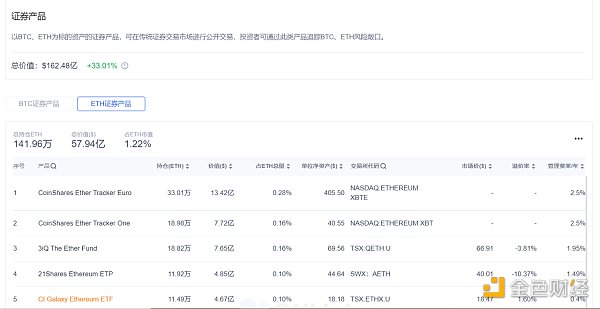
Data source : Master of the Oukeyun Chain
As of December 22, the value of securities products related to Ethereum was close to 5.8 billion US dollars, while similar products of Bitcoin in the same period The value is $10.5 billion.
About Ethereum surpassing Bitcoin
Ethereum in The past year has been stellar enough that the ETH FLIP BTC talk has resurfaced, but we still don't think that vision will materialize in this market cycle.
Bitcoin is continuously consolidating its status as digital gold, while becoming the legal tender of El Salvador in 2021, and is the first choice for the vast majority of investors entering the crypto asset industry.
As a representative of blockchain 2.0, Ethereum still needs to face tests and competitions from many parties: the progress of network expansion and upgrade, governance issues after turning to POS consensus, etc. It is a foreseeable challenge.
2, EIP-1559: Stepping out of uncertainty
On August 5th, Ethereum reached the [London Upgrade] scheduled block height, and the scheduled 5 EIP proposals were activated. Among them, the EIP-1559 proposal brought new token supply to ETH by destroying the Base Fee of on-chain transactions. Variation.
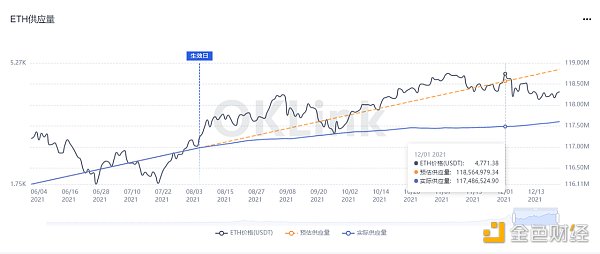
Data source: Okey Cloud Chain Master
As of December 23, the amount of Ethereum destroyed has reached 1,248,400 ETH, the average value of a single block destroyed It is 1.395 ETH, which means that the activation of EIP-1559 will reduce the current inflation rate of Ethereum by nearly 70%.
Going one step further, OpenSea, Uniswap, and Tether have become the "backbone" in terms of the destruction progress of Ethereum. So far, 130,700, 111,400, and 66,500 ETH.
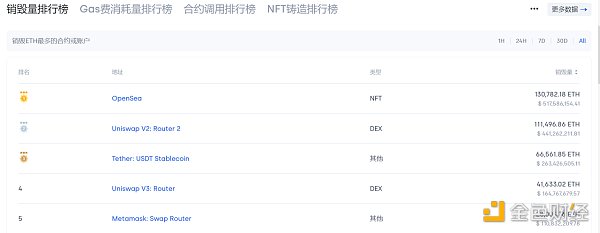
Data source : On-chain Master of Okeyun Chain
DeFi, stable currency and NFT related activities have become the current main use cases of the Ethereum network, and are also the development ecology of other public chains
At the other end, changes in miners’ income and transaction fees after the upgrade in London have become another focus of our attention.
p>
In terms of miners’ income, from the activation of EIP on August 5th to December 22nd, a total of 139 days, the income of Ethereum miners during this period was 2.1185 million ETH, of which the handling fee was 24.16 million ETH, accounting for 11.4%. In the same period last year, Ethereum miners earned 2.9966 million ETH, and the handling fee was 1.0997 million ETH, accounting for 36.69%.
Considering the DeFi Summer experienced in the same period last year, we also summed the earnings of Ethereum miners for the same 139 days from March 19 to August 4 this year, a total of 2,843,100 ETH, with a handling fee of 976,200 ETH, accounting for 34.33 %.
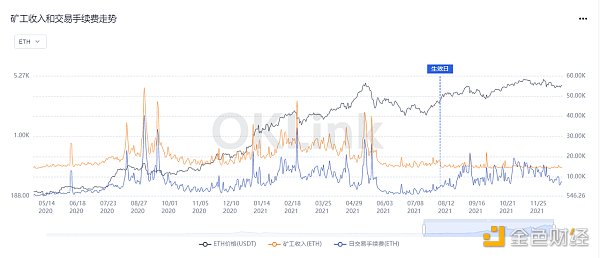
Data source: Master on the Okey Cloud Chain
From this we can conclude that after the implementation of EIP-1559, the miners’ ETH standard income is as expected, There has indeed been a decline. But at the same time, the overall extreme fluctuations in handling fees have also eased compared to before. The daily income of Ethereum miners no longer fluctuates as much as before, but fluctuates up and down in a narrower range, which is closer to the possibility of staking under the POS consensus. Foresight benefits.
When ETH2.0 is officially launched and the current POW chain and POS chain are merged, the inflation rate of ETH will further drop significantly. At that time, the POS rewards for participating in the pledge will become the only source of additional issuance of ETH.
If 30% of Ethereum participates in the pledge, the annual additional issuance will be around 1.75 million ETH. The current annual burning volume of Ethereum is expected to be 3.2 million ETH, and Ethereum will move from inflation to deflation, with a deflation rate of more than 1.2%. On the other hand, although the activation of Ethereum EIP-1559 has reduced the previous high gas costs under extreme conditions, it still has not solved the fundamental problem of high gas costs in Ethereum, especially as the price of ETH rises , the interaction cost between users and Ethereum remains high.
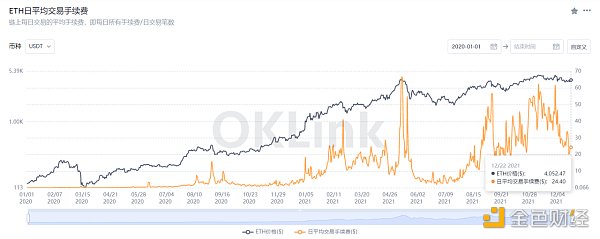
Data source : Master of Oukeyun Chain
At the beginning of December, Ethereum once approached the $5,000 mark, and the average daily transaction fee reached $61.86. Even with the recent market enthusiasm It has subsided, and the average daily fee for a single transaction on Ethereum is still above $20. High interaction fees have hindered the enthusiasm of retail investors and even developers for Ethereum:

Data source: Okey Cloud Chain Master
Since August this year, the number of daily new contracts on Ethereum has dropped significantly. During the same period, several new public chains began to rise, and the market value and ecological development entered a period of acceleration. The high interaction cost of Ethereum has caused user spillover, and it will take time for ETH2.0 to be officially launched. The new public chain seized this opportunity and began to make efforts.
3. Public chain war: data does not lie
How to judge the value of public chain It is still an unresolved issue. We compare and analyze the on-chain activity data of the public chain and try to draw some conclusions.
Data source : On-chain master of Okey Cloud Chain
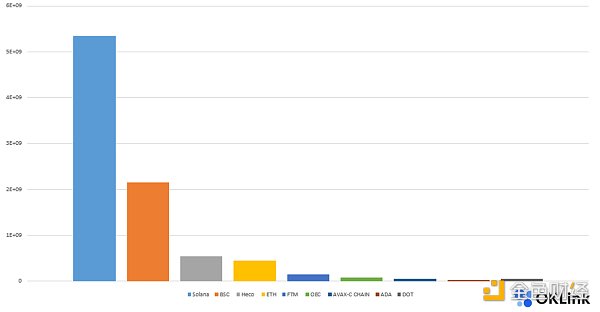
The number of transactions is the first indicator we think of. Due to the adoption of the POH consensus mechanism, Solana has The advantages are obvious. As of December 25, the number of transactions executed on the Solana network in 2021 has exceeded 5.3 billion, which is even higher than the sum of the annual transactions of public chains such as BSC, HECO, and ETH included in the statistics.
ADA and DOT, on the other hand, rank low in terms of the number of transactions. The Alonzo upgrade for ADA to support smart contracts began in late September this year. The DeFi ecology including Dex and lending is still in its infancy; while the DOT’s parachain card slot auction was officially launched in early November, and the subsequent ecological development will take time.
< /p>
Data source: Master on Okey Cloud Chain
The number of active addresses is another indicator we use to consider the operation of the public chain, and its significance is to reflect the real number of users on the chain.
The number of active addresses of Ethereum remains within a relatively stable range. For most of 2021, the number of daily active addresses on Ethereum will remain above 500,000. This also means that the current network utilization rate of Ethereum may be close to the carrying limit, and expansion is needed to accommodate more users.
At the same time, the number of active addresses of Ethereum has a significant positive correlation with the market heat. In the hottest April-May month, the number of active addresses of Ethereum Also reached the peak of the year.
Besides Ethereum, the number of active addresses on BSC has surpassed that of ETH since May, and it has been realized with the help of hotspots such as GameFi during October-November The number of active users in a single day reached 2.271 million during the year, which is significantly higher than other statistical public chains, and it is also the only public chain that surpasses ETH in the number of daily active addresses.
DOT reached the $50 mark for the first time in May, and the number of active addresses in that month also set a record high for DOT in a year. And as the market picked up in October, the number of active addresses on the DOT chain also picked up.
Avax started to make efforts in the second half of the year, and it has incubated several applications with a TVL of more than one billion US dollars, but the number of users is still far behind public chains such as ETH There is a large gap.
On the whole, the number of active addresses and fluctuations of different public chains are closely related to the market heat and the timing of the public chain's own efforts. The market value of the public chain shows a clear positive correlation with the activity on the chain. More users and transaction activities mean higher adoption and market acceptance. For public chains, no indicator is more important than adoption.
4. Layer 2: Ethereum’s counterattack
Although the public chain has There are rising stars such as Solana and Avalanche emerging on the track, as well as exchange public chains such as BSC entering the battlefield, but it is undeniable that Ethereum is still the innovation center in the field of public chains. Whether it is DeFi, GameFi or Dao, most of its concepts and prototypes come from the Ethereum ecosystem and community. Emerging public chains "cross the river by feeling Ethereum" with lower interaction costs and faster confirmation times.
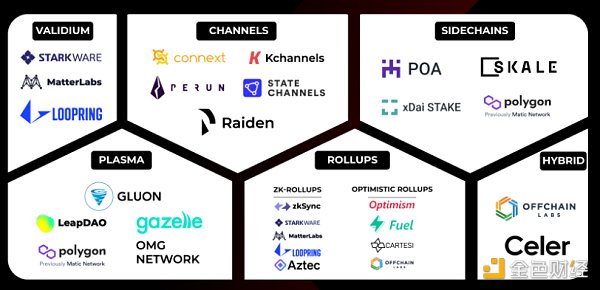
Faced with this situation, the Ethereum community chose Layer-2 as the expansion solution before the official launch of ETH2.0. Arbitrum and Optimism are based on Optmistic Rollups technology, while Zksync and Loopring use zkRollup based on zero-knowledge proof, and Polygon and Xdai use sidechain-like solutions for capacity expansion.
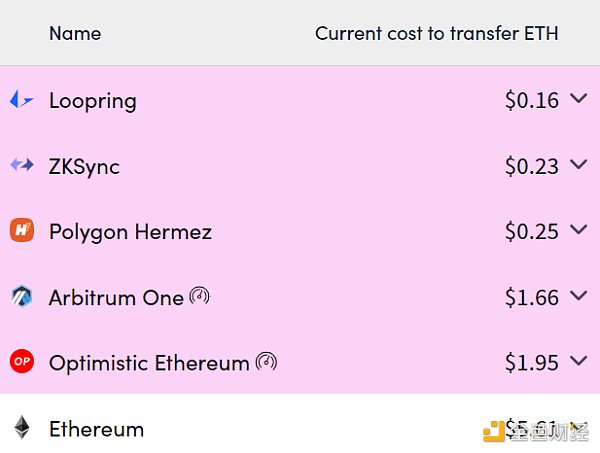
From the perspective of handling fees, the current Layer-2 fees are indeed significantly lower than those of the Ethereum mainnet:
Data source: l2beat.com
The current cost of ETH transfer on Loopring is about the Ethereum mainnet 3%, and Zksync and Polygon are 4% of the Ethereum mainnet. Arbitrum and Optimistic have slightly higher fees, around 30% and 35% respectively.
The comparison of Swap on the chain is more obvious: the transaction fee of DEX on Ethereum is often more than 25 US dollars, while Zksync and Loopring only need 0.56 and 1 USD, Optimistic and Arbitrum are only 2-3 USD. From the perspective of handling fees only, zkRollup-based Loopring and ZKsync seem to be more dominant.
However, since Optimistic and Arbitrum have not yet issued their own tokens, and are still in the early stages of development, the user base is small, and ETH is still used as the transaction fee, so The handling fee is relatively high.
Regarding the competitive relationship between zk-Rollup and Optimistic-Rollup, V God also expressed his opinion. He believes that with better compatibility with EVM, Optimistic-Rollup It will seize the market in the early stage of Layer-2 development, but as ZK-SNARK technology matures, zk-Rollup will move towards more use cases in the middle and late stages.
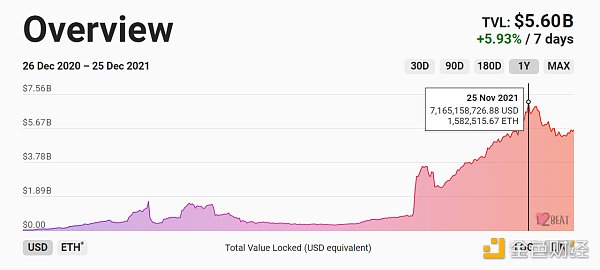
On the other hand, the current TVL on Layer2 has reached 5.6 billion US dollars, and the amount of deposited funds on different Layer2s is uneven.
Data source : l2beat.com
Arbitrum has accounted for nearly half of the Layer-2 funds with a TVL of 2.5 billion US dollars. Dydx based on Starkware and Loopring using zkRollup are respectively 960 million US dollars and 580 million US dollars ranked second and third.
Data source: Okey Cloud Chain Master
With the first-mover advantage and the easy-to-deploy features of Optmistic Rollups, Arbitrum has become The fastest-growing protocol in the Layer-2 ecosystem, the mainstream CEX platform has also gradually supported the deposit and withdrawal of assets on Arbitrum, which will bring advantages to the development of the Arbitrum ecosystem. Users no longer need to go through the waiting period for withdrawing from Layer-2 to the main network, and the convenience is greatly improved. Due to the difficulty in development of zkRollup, the current main application scenarios seem to be concentrated in the payment field, and it seems that it will take time to see more complex applications deployed on Layer-2 of zkRollup.
5, ETH2.0: Slow is fast
Layer-2 becomes the current ether Fang’s medium-term solution for capacity expansion, while ETH2.0 is the end point in the Ethereum roadmap. In order to achieve this goal, the Beacon Chain will be officially launched at the end of 2020, and the pledge of validator nodes will be started, which will kick off the curtain of Ethereum 2.0.
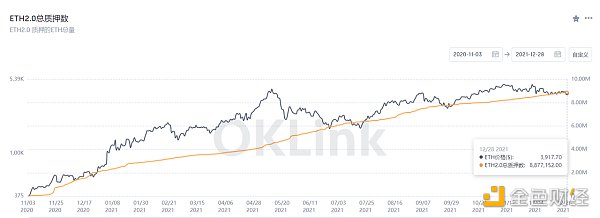
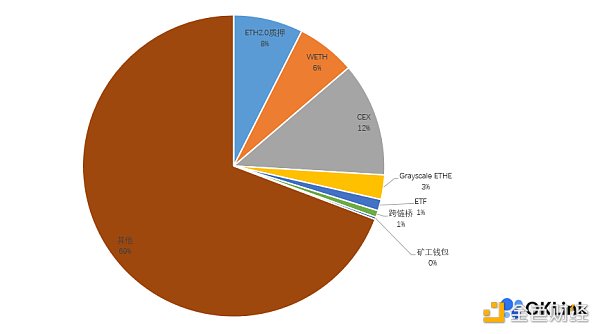
After the token chain is launched, users can participate in the ETH2.0 ecology by pledging 32ETH. In the past year, the Ethereum 2.0 deposit contract has jumped to become the address with the largest ETH balance. More than 8.87 million ETH has been transferred to the smart contract, worth more than 3 billion US dollars, which also means that the pledge rate of Ethereum has reached 7.5 %.
Data source: Europe On-chain master of Keyun Chain
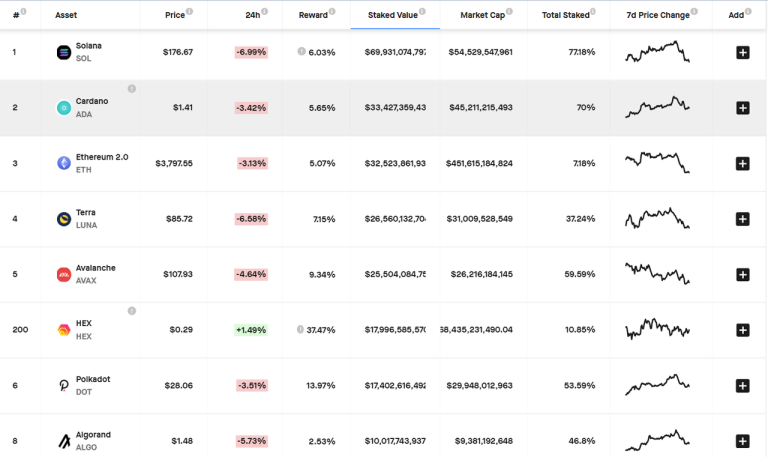
However, compared to other public chains with a pledge rate of more than 50%, Ethereum's current pledge rate of 7.5% is still low. The main reason may be that the launch time of ETH2.0 is still to be determined. Participating in staking now means locking ETH until 2.0 goes online, and the risk of price fluctuations during this period may be unacceptable to most investors.
Data source: stakingrewards
Compared with other public chains, the pledge rate of Solana and Cardano reached 70% .Avaxlanche and Polkadot are more than 50%, Algorand and Terra also have 46% and 37% respectively.
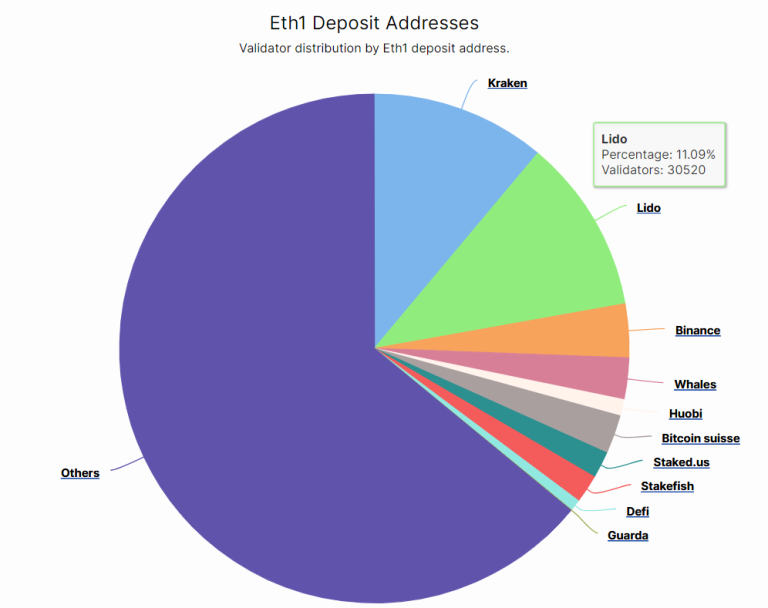
From the data on the chain , the addresses currently participating in Ethereum 2.0 pledge include centralized exchanges and POS service providers, decentralized pledge agreements such as Lido, and Ethereum whales.
Data source: Beaconcha
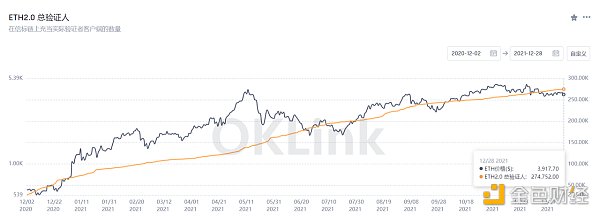
After deduplicating the addresses that have participated in the pledge, we found that there are more than 59,500 The address has been pledged on the chain of 32ETH at least once, and the current number of nodes in the beacon chain exceeds 270,000, which means that each address currently operates an average of more than 4 nodes, and the number of pledged ETH is more than 128ETH.
Data source: Europe Masters on the Keyun Chain
Except for 7.5% of ETH pledged in the Ethereum 2.0 deposit contract, the number of Wrapped ETH has also reached more than 7.5 million, accounting for More than 6.3%.
The amount of ETH in centralized exchange wallets continued the downward trend since the DeFi boom in 2020, and fell to 14 million ETH in early December .
Data source: Masters on the Okey Cloud Chain
Various ETF products and Grayscale ETHE Trust hold 1.45 million and 3.11 million ETHs respectively, of which ETFs will be held in 2021 obvious increase.
In addition, the official cross-chain bridge of the second layer network also undertakes a considerable amount of ETH, and the official cross-chain contracts of Polygon and Arbitrum store 510,000 and 35 ETH, this number still has a lot of room for growth with the further expansion of the expansion plan among users in 2022.
Although Ethereum's plan to turn to POS consensus has been disclosed in the roadmap early on, when it is actually implemented, progress in all aspects still seems to be slow. The reason may be that on the one hand, it is necessary to consider the demands and balance of the interests of all parties including miners, the community, and the market; on the other hand, it is how to complete the consensus transformation of the network without reducing the current decentralized nature of Ethereum.
2. DeFi: A year of narrative and momentum
1. DeFi Multichain Flowering: What's the Difference?
In the past year, emerging public chains have attracted a large number of users and capital accumulation by embracing DeFi. The path of stable currency-loan-DEX-financial management has become a clear and feasible development model for the new public chain DeFi ecology. And some leading DeFi protocols have also started multi-chain deployment and provided liquidity incentives for users. Despite this, the degree of development of different public chains in the DeFi field is obviously uneven, which is especially obvious in the amount of locked positions (TVL) on the chain.
Data source: Europe The Master of Keyun Chain
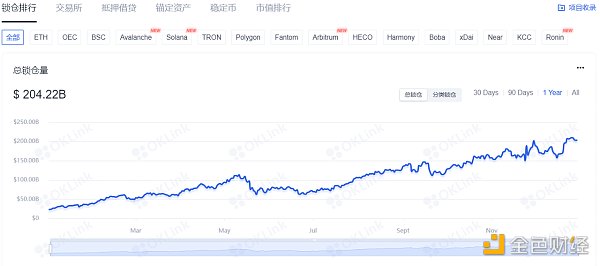
Currently, the total TVL of various public chains has exceeded 200 billion U.S. dollars. Among them, the TVL on Ethereum exceeds 150 billion U.S. dollars, still It is the main battlefield of DeFi.
Avalanche, BSC and Solana have maintained a momentum of rapid development in the past year, and the TVL has reached 10 billion US dollars; Polygon, The TVL of Fantom and Arbitrum is on the order of one billion US dollars.
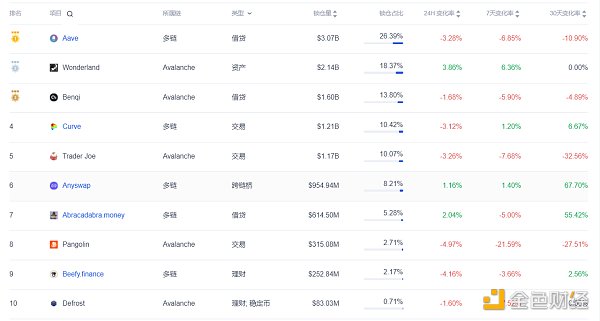
A horizontal comparison between protocols, among the top ten protocols by TVL, Curve, Aave and other 5 1 protocol has carried out multi-chain deployment, and 5 protocols such as Maker and Convex focus on the Ethereum ecosystem.
Curve has become the current DeFi with a TVL of more than 20 billion US dollars The name of the locked position of the protocol.
Data source: Master on the Oukeyun chain
In addition to Ethereum, we found that the DeFi protocol that cultivates our own ecology is the common cause of the rise of emerging public chains features.
Avalanche’s ecological lending agreement includes Benqi, Dex Swap has Trade Joe and Pangolin, and asset management and farming has the hot Wonderland at the end of the year. The trading volume of Pancake on BSC has long been at the forefront of Dex on the entire network, and the second and third ranked Venus and Tranchess TVL are both higher than 1 billion US dollars.
Solana has incubated multiple applications such as Raydium, Marinade, and Tulip, covering the main use cases of DeFi such as lending, DEX, and wealth management mentioned above.
Data source: Europe Master on the chain of Keyun Chain
However, at the level of a single DeFi protocol, whether multi-chain deployment should be carried out is related to its own business direction.
< p>
Data source: Okey Cloud Chain Master
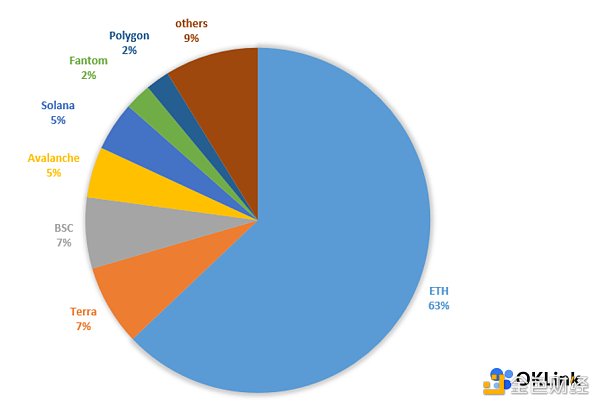
Currently, the overall lock-up volume of DeFi is close to 250 billion US dollars, and the TVL on Ethereum exceeds 150 billion US dollars, accounting for more than 60%. If a DeFi project is deployed on multiple chains, its TVL on different public chains can be compared with the TVL ratio of the public chain in the above figure to initially determine whether the deployment has attracted enough capital attention.
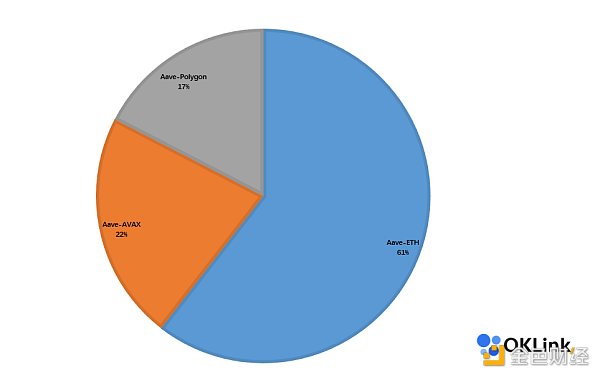
Taking Aave as an example, the current TVL on Aave exceeds 14 billion US dollars, which is distributed on the three public chains of Ethereum, Avalanche and Polygon, accounting for 61% %, 22% and 17%, the TVL on Avalanche and Polygon has brought nearly 40% of the funds to Aave, and the multi-chain deployment has greatly boosted the development of Aave.
Data source: Europe Master on the Keyun Chain
Another classic case of multi-chain deployment is the cross-chain protocol Multichain (formerly Anyswap).
Data source: Okey Cloud Chain Master
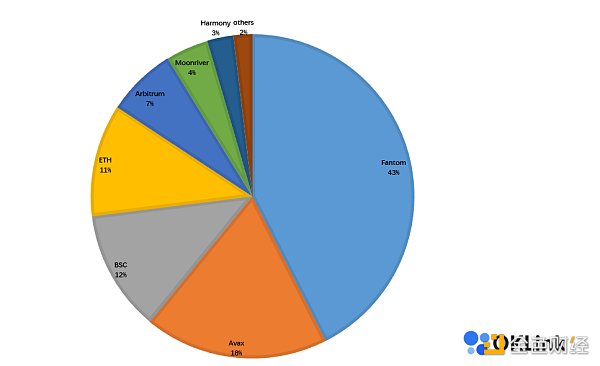
Multichain is currently the leading cross-chain bridge player with a TVL of more than 5 billion US dollars. The multi-chain deployment also fully meets the needs of its cross-chain business and helps it reach different Users on the public chain, so as to seize the opportunity.
As a comparison, Sushiswap has also deployed multiple public chains across chains, but compared with the first two, the effect does not seem to be significant.
Data source: Okey Cloud Chain Master< p>Sushiswap's current TVL has reached US$5.3 billion, of which US$4.2 billion is on Ethereum, accounting for more than 80%. Its TVL ratio on several networks such as Polygon and Avalanche Both are lower than 10%.
The reason behind this may be that DEX is an important basic application of the DeFi ecosystem, and the public chain community is often willing to incubate its own Dex protocol. Like Quickswap on Polygon, Trade Joe on Avalanche, etc., Uniswap is also focused on the Ethereum ecosystem.
At the same time, the start of DEX mostly needs the form of LP Farm. Excessive multi-chain deployment will inevitably affect the Token distribution of the project itself, falling into a dilemma Situation: Failure to provide sufficient incentives and attractive yields will cause users and funds to flock to other DEXs, while excessive yields will bring selling pressure to the market.
On the whole, the multi-chain deployment of DeFi in the past year has become a way for it to reach a wider range of users, and the new public chain has also developed its own DeFi ecological aggregation users, the two complement each other. But at the level of a single DeFi protocol, multi-chain deployment is not a panacea, and whether to implement multi-chain deployment still needs to be considered in conjunction with its own business direction.
2. New ways of DeFi: Uniswap V3 and Convex
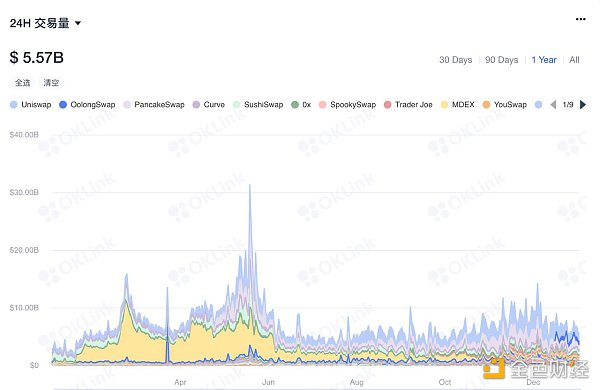
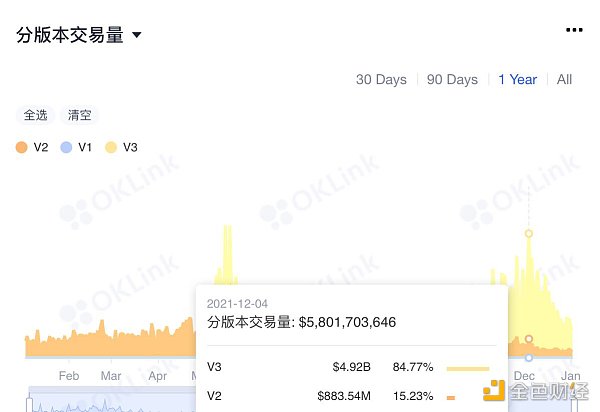
Dex in the past year The transaction volume in the platform exceeded 1 trillion US dollars, a quarter-on-quarter increase of 762%. Uniswap still leads the Dex track, and released the Uniswap V3 version in early May, becoming one of the most important innovations in DeFi this year.
Data source: Europe
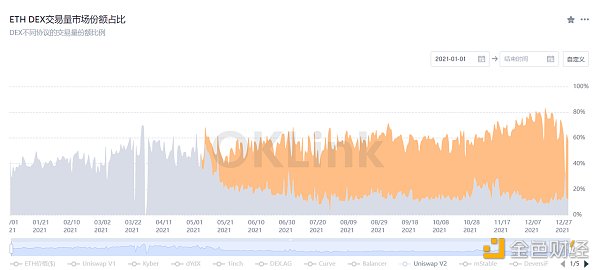
Since its release in May, the trading volume of Uniswap V3 has continued to grow, and the trading volume from May to the end of the year is about 340 billion US dollars. The trading volume in 8 months accounts for 34% of the total Dex trading volume in the whole year.
Data source: Okey Cloud chain master
The higher capital utilization rate is Uniswap The killer feature of V3.
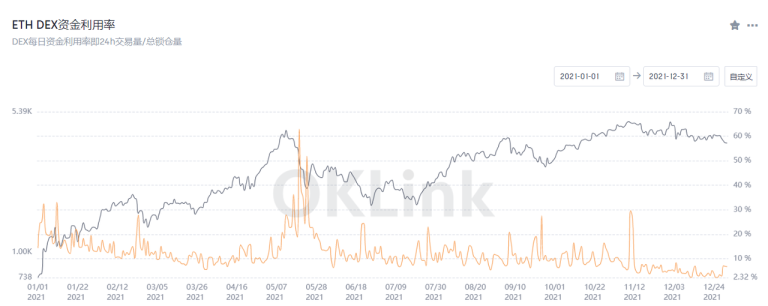
Compared with Uniswap V2, the capital utilization rate of V3 has been greatly improved. The transaction volume and TVL of Uniswap V2 and V3 in December were intercepted for comparison: the average TVL value of V3 in December fluctuated between 4 billion and 4.4 billion US dollars, the monthly transaction volume was 69.74 billion US dollars, and the capital utilization rate exceeded 50%, while Uniswap V2 in the same period The utilization rate is around 7.5%.
Data source: Europe Master on the Keyun Chain
If you compare the ETH-USDC trading pair, the seven-day trading average on Uniwap V3 is 3.59 billion US dollars, and the TVL seven-day The average value is 282 million, and the fund utilization rate is as high as 181%. The figure of Uniswap V2 is 8.65%. Horizontal comparison, the current fund utilization rate of Dex on Ethereum fluctuates around 10%.
< /p>
Data source: Master on the Okey Cloud Chain
With the deployment of Uniswap V3 to Polygon and Liquidity incentives will be opened, Dex’s capital utilization rate should be improved, and Uniswap’s market share may be further expanded.
Another bright spot may be the launch of Convex. As a focus on The protocol that improves the rate of return of Curve users and holders, the emergence of Convex not only allows Curve's LP Farmer to easily get the highest reward, simplifies the cumbersome process of staking Crv, but also realizes the liquidity of pledged assets through the design of cvxCrv.
Data source: Europe Master on the Keyun Chain
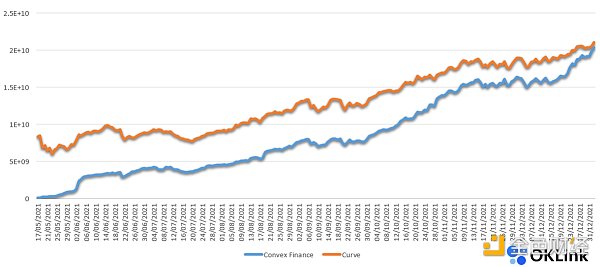
The current TVL of Curve and Convex are more than 20 billion US dollars, occupying the top two of DeFi protocol TVL.
Data source: Ooke Cloud Chain Master
After the launch of Convex in May, Curve’s TVL on Ethereum and Convex’s TVL kept pace with each other, and both started an upward trend. During the same period, Crv’s token The market value also continued to rise in the second half of the year.
Of course, the growth of the TVL of the two still relies on providing high incentives for pledgers, so as to achieve a reduction in the circulation of tokens. This method is more or less It makes people feel familiar. At the same time, the community voting rights and governance issues brought about by Crv locked in Convex are also difficult to ignore. Perpetrators can drive Convex-locked veCrv to vote for their projects by purchasing CVX, thereby increasing the APY of the corresponding Curve fund pool, attracting users to provide LP, and launching Rug Pull at their own choice.
3. Governance, Security and Supervision
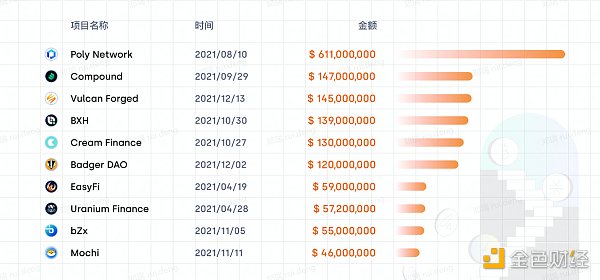
As mentioned above, with DeFi With the continuous expansion of the scale (TVL exceeding 200 billion US dollars), the issue of community governance has begun to become prominent. At the same time, on-chain security incidents have also become hot news in the past year. Hacking incidents costing tens of millions or even hundreds of millions of dollars have caused the market and capital to pay attention to business directions such as smart contract auditing and on-chain fund tracking.
Image source: Europe Keyun Chain Master
In the security incident of Poly Network, more than 600 million US dollars of funds were stolen, which was the largest chain security incident involving the amount of money this year 。
At the end of September, the lending protocol Compound found a loophole after the upgrade, which would cause some users to obtain additional Comp governance tokens. Since the protocol upgrade needs to go through 7 Days of voting, during which over $140 million in Comp was at risk.
In November, the Mochi protocol for the decentralized stablecoin USDM passed the acquisition of CVX Raising the income of USDM's liquidity pool on Curve attracts users to form stablecoin LP mining, thereby taking away more than 40 million US dollars of funds in the pool.
And After the hacking incident, the centralized platform often locks the flow of funds through on-chain data and tracking, thus cutting off the hacker’s idea of withdrawing money through the centralized platform. Some project parties will choose to replace the contract with a new token contract. The stolen tokens, so as to recover the loss. Tether, the stable currency issuer, also froze more than 33 million US dollars of USDT in the Poly Network incident.
Image source: Twitter
All parties work together to face the problem and try to solve it, of course it is the hacker And the positive side of the security issue. But in the blockchain world that believes in "code is law", how to protect user safety and interests while ensuring innovation may be a required course before DeFi enters the wider world.
In terms of supervision, Gary Gensler, chairman of the US SEC, has repeatedly stated that DeFi "needs regulatory compliance". The agreement has already been prepared for this.
In mid-July, Uniswap Labs removed a total of 129 synthetic stocks and derivative tokens.
At the same time, Uniswap funded a "DeFi Education Fund" during the year to deal with legal analysis and other work. The proposal passed the community vote in June and received 1 million UNI funds, and the legal heads of leading protocols such as Aave and Comopound also participated.
In addition, Andre Cronje, the founder of the wealth management agreement YFI, also initiated a proposal to fund the DeFi legal advocacy organization LeXpunK_DAO with 1 million US dollars. He revealed that the Curve and SushiSwap communities also participated in the event.
Aave launched Aave Pro for institutional investors in July, which provides liquidity pools for Bitcoin, Ethereum, USDC and AAVE, and It will not be launched publicly, but will only be available to qualified institutional investors through KYC and whitelist mechanisms, and will provide protection against money laundering and fraud.
Image source: Twitter
< /p>At present, regulation has become the main problem that needs to be solved before DeFi enters the broader market. Head protocols such as Uniswap and Aave have also made corresponding preparations for this. At the same time, although the regulatory layer has been criticized by the community for lack of transparency and Clear standards, but it seems to agree with the view that DeFi can bring real innovation. I believe that in the new year, DeFi can bring more funds and users into the market under the premise of satisfying regulations.
3. Summary
As the most original infrastructure of the blockchain, the public chain carries the industry's support for decentralization In 2021, the emerging public chain will take the initiative to undertake the spillover value of Ethereum, and in the process let more users learn about cutting-edge concepts such as DeFi and NFT. In the new year, we expect to see emerging public chains The chain can go a little further, and explore areas that Ethereum has not been involved in.
On the other hand, we also see that the data on the chain will increase in 2021 Enter the vision of more users. Whether it is focusing on DeFi smart money or tracking the funds involved in hacking incidents, more and more people are beginning to use the data on the chain as the basis for judgment. With the continuous accumulation of data, The importance of data analysis capabilities has begun to emerge, and the data service track in the blockchain field will also attract more attention.
Original link
Welcome to join the official BlockBeats community:
Telegram Subscription Group: https://t.me/theblockbeats
Telegram Discussion Group: https://t.me/BlockBeats_App
Official Twitter Account: https://twitter.com/BlockBeatsAsia







 Related Articles