Ft: How did NFT grow into a $40 billion market by 2021?

Financial Times: How NFTs could become a $40 billion market by 2021
Original author: Old Yuppie
2021 was a breakthrough year for NFT, with buyers spending almost as much on digital collectibles as on traditional art.
In early 2021, only a niche of cryptocurrency enthusiasts knew what an unforgerable Token (NFT) was.
But by the end of 2021, the latest figures available, nearly $41 billion had been spent on NFT, making the market for digital art and collectibles almost as valuable as the global art market.
"This year has seen the NFT market explode from a sub - $1 billion market to a multi-billion dollar industry," said Mason Nystrom, research analyst at Messari, a crypto data group.
NFTs are essentially digital certificates of ownership registered on a blockchain -- a record that cannot be altered or tampered with.
These tokens are typically created or minted using smart contracts -- self-executing contracts written into blockchain code -- and can be traded on the secondary market in exchange for cryptocurrency.
NFT mania went mainstream in March, when a collage by the artist Beeple sold for $69.3 million at Christie's, the auction house's first NFT sale. The artist, Mike Winkelmann, responded on Twitter: "Holy fuck!" .
While it first caught on in the art world, corporate players in sports and music -- even former US first Lady Melania Trump -- have embraced the concept to cash in on the hype and find new ways to interact with fans.
The NBA, an American basketball league, created its own NFT marketplace for buying, selling and trading video collections of its players, called NBA Top Shot.
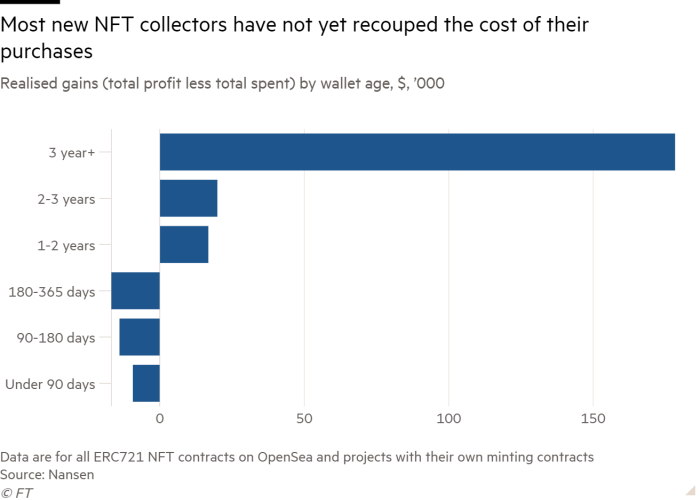
Other popular products include numbered collections of NFT, including CryptoPunks and Bored Ape Yacht Club, which say their NFT represents their owner's Club membership status and can be used as a social media avatar.
"The core value is still exclusivity, "Nystrom said, noting that expensive collectibles also offer buyers access to an access channel on chat platform Discord, as well as access to gatherings and parties.
He added: "They are country club: there are high barriers to entry -- cost of capital -- and you are in a high-net-worth circle."
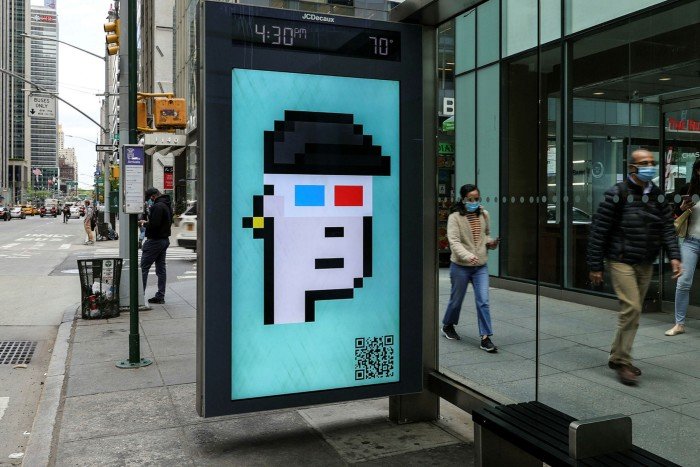
Advertising for CryptoPunk NFT in Manhattan © Dia Dipasupil/Getty
In the year to December 15, a total of $40.9bn was invested in the Ethereum blockchain contracts commonly used to create NFT, according to Chainalysis, a cryptocurrency analytics group. If NFT minted on other blockchains, such as Solana, is included, the total is even higher.
By comparison, the global art market was worth $50.1bn last year, according to UBS and Art Basel.
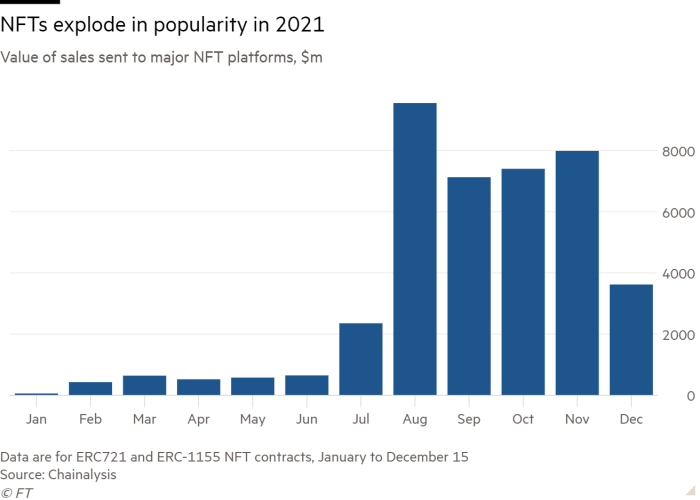
Chainalysis found that NFTs introduced a large number of retail investors to the cryptocurrency world, with small transactions under $10,000 accounting for more than 75% of the market.
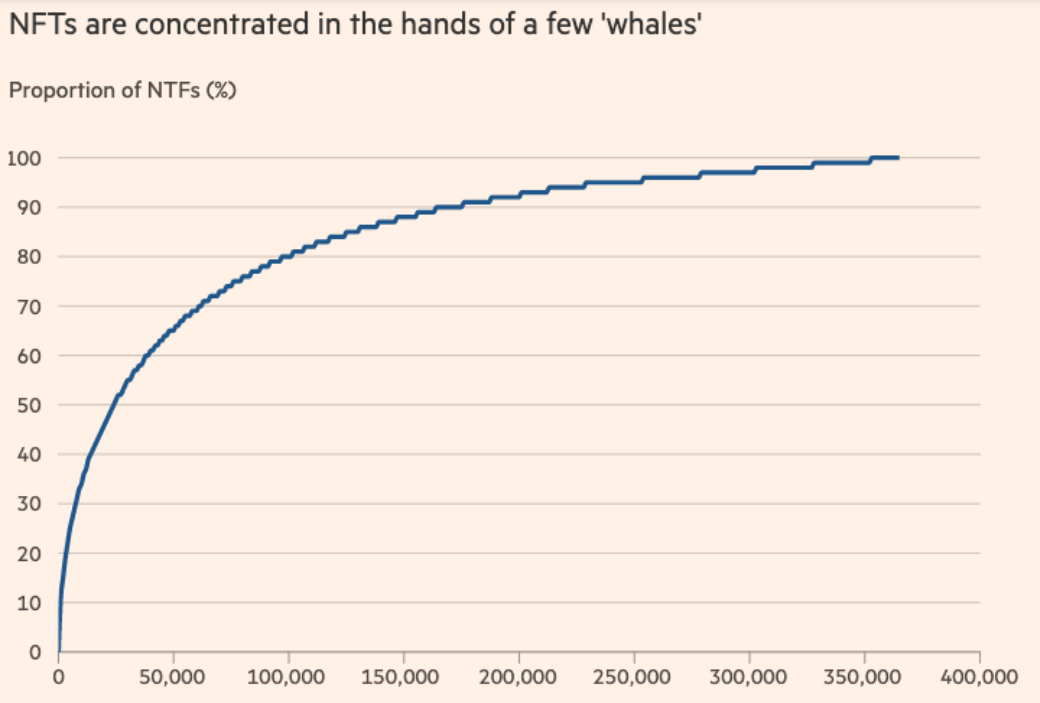
But like the cryptocurrency market, it is still dominated by a few big players, or "whales."
Between the end of February and November, there were 360,000 NFT owners holding 2.7m NFT between them. Chainalysis found that about 9 per cent of them -- or 32,400 wallets -- held 80 per cent of the market value.
Stephen Diehl, a crypto-skeptic software engineer, said many whales "have hundreds of millions of dollars in cryptocurrencies" from the cryptocurrency price boom and "want to turn their cryptocurrencies into more cryptocurrencies."
Others say they approach the market as professional traders and collectors. One well-known NFT investor, known as Pranksy on Twitter, started with an initial investment of $600 in 2017 and now has an NFT portfolio worth more than $20 million, they said.
They told the Financial Times that they were investing in a mix of projects, "some with high daily volumes and some with less traction". In addition to "hyping" lucrative projects, Pranksy said they have "specific pieces that I plan to keep as long-term investments."
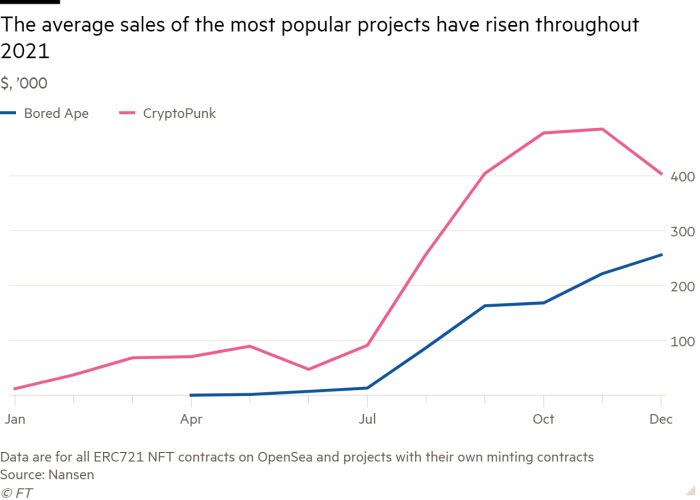
So far, most new NFT collectors in the secondary market have yet to recoup their purchase costs, and early collectors have benefited from the rise in NFT prices as well as cryptocurrencies used for transactions, according to an analysis for FT by Nansen, a blockchain analytics platform.
Unregulated Spaces are also plagued by fraud, scams and market manipulation, especially because the true identities of buyers and sellers are difficult, if not impossible, to discover.
Nansen's analysis found $2 million in suspicious activity in the CryptoPunk and Bored Ape collections in the 30-day period ending in mid-December. For example, some NFTS are sold at a 95% discount to the average sale price, which could be due to buyer and seller error, tax write-offs or some other scam that exploits the ignorance of small white users.
The researchers also warned that the market was likely to be exaggerated by laundering - when one trader takes both sides of a trade in order to give the illusion of demand.
Rudiger K Weng, chief executive of Weng Fine Art, which is based in Germany, said: "You can buy and sell NFT on a public platform and make it look like there are a lot of people interested in the work, when in reality you are just driving up the price.
"It happens in the traditional art world," he says. But he added that if the manipulators consigned an artwork to Sotheby's and tried to clean it, they would have to pay the auction house 25 percent of the sale, making it an expensive enterprise.
"With NFT, the cost is a fraction of that," he said, referring to the transaction fees needed to forge or buy an NFT, known as gasoline, which can fluctuate according to demand.
Still, many supporters believe the market is maturing and will eventually offer a range of features, such as allowing artists to collect royalties in perpetuity.
"What can you do because it's software?" "Asks Benedict Evans, an independent technology analyst and former venture capitalist. "It could be things like the artist getting share and subsequent resale," he said, noting in particular the early innovation around music rights.
So-called NFT financialization has taken place in some communities -- for example, the use of NFT as collateral for loans, or the decomposition of ownership of individual works into smaller pieces, known as fragmentation.
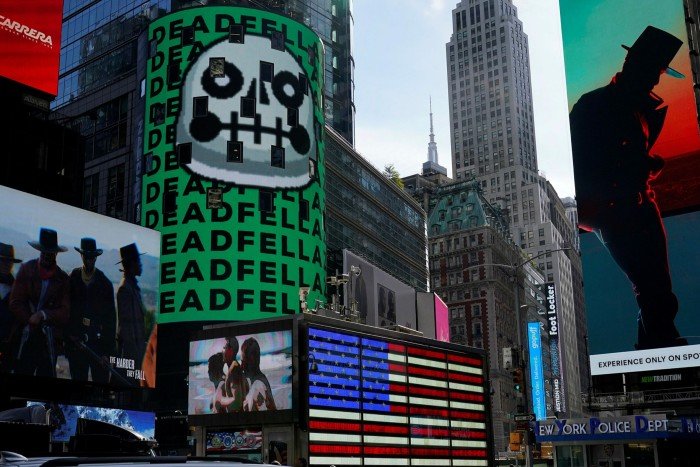
NFT video displayed on a billboard in Times Square, New York © Seth Wenig/AP
从长远来看,爱好者们希望 Token 有朝一日能够为任何元宇宙或元宇宙(未来的数字化身填充的虚拟世界)的电子商务提供动力。在这里,NFTs 可以指定虚拟商品的所有权,无论是数字化身的服装还是数字房屋墙壁上的艺术品。耐克公司最近宣布,它已经收购了一家虚拟鞋业公司,以铸造虚拟运动鞋。
In any case, the future of the NFTs market will also depend on the stance taken by regulators in this free-flowing market.
Even among corporate issuers, there are concerns that NFTs share characteristics with some digital investment vehicles and could therefore be considered securities by regulators.
Devika Kornbacher, a partner at Vinson and Elkins, said companies that want to issue NFTS often ask: "Will this NFT be considered a financial instrument? Will it be considered a security of our company?"
Meanwhile, NFTS have not been dealt with directly by tax agencies such as the US Inland Revenue, but some experts believe they could be considered "collectibles", meaning they would be subject to capital gains tax.
"This is an immediate survival issue for the industry, "White & AMP; Platin Vallabhaneni, a partner at Case law firm, said of the coming regulation.
The original link
Welcome to join the official BlockBeats community:
Telegram Subscription Group: https://t.me/theblockbeats
Telegram Discussion Group: https://t.me/BlockBeats_App
Official Twitter Account: https://twitter.com/BlockBeatsAsia
 Related Articles