Animoca Brands co-founded Yat Siu: the road to a new type of capitalism
Original title: "Cars, Ownership, Capitalism, NFTs, and the Metaverse"
Original author: Yat Siu, Co-founder and Executive Chairman of Animoca Brands< p>
Original compilation: Gong Quanyu, chain catcher
In 1886, Karl Benz launched what is widely regarded as the first commercially available The Mercedes-Benz of automobiles, thus creating the era of horseless carriages. Benz may not realize that his invention marks the launch of a platform that will eventually enable Uber, Lyft, Grab, gas stations, spare parts suppliers, repair shops, custom products, auto mechanics, and countless other car-related businesses. The existence of the product becomes possible. In general, the value of these enterprises far exceeds the automobile manufacturing industry itself.
From property rights to automobile economy
Mercedes-Benz patented automobiles represent the technical foundation of the commercial automobile industry , but it is the guarantee of ownership that allows other companies to provide services directly to car owners without intermediaries. As suppliers of goods and services compete for the car owner's business, building their offerings on top of what already exists (the car) enables the pursuit of capitalist opportunities and spurs innovation.
Service can significantly increase the value and usefulness of a car. For example, consider restoring a classic car, applying a scratch-resistant paint coating, upgrading to expensive seats, or installing top-of-the-line shock absorbers and springs. These and many other services can provide useful social benefits, and their value increases with the number of car owners—the network effect.
In this way, the ability to own assets as the foundation of a platform is far greater than the sum of its parts.
The car is a platform where the entire car ecosystem and connected industries and services are powered by car owners—decentralized private individuals— -provide support.
Content is the platform
As early as 2018, we explained that content is the platform, And NFTs provide a viable framework for making digital content (finally) a real asset: no longer just an item licensed to you to use in a purely consumable model within a walled garden, but an actual, possible asset with property rights attached. own property. Owned by a decentralized private community, these assets form the basis for a vast, world-changing ecosystem. Much like early commercial vehicles.
This ownership effect applies to any property we can own - for example, real estate ownership makes owning a realtor and broker , mortgage providers, interior designers, furniture designers and many others. In the Metaverse, this is easily seen in games like The Sandbox, where creators offer various items for other creators to use.
We’ve explained it before, but it needs to be emphasized again: NFTs represent a paradigm shift in the online world, as it is now possible to Truly own your digital assets in a scalable and scalable way.
The tree that took four years to bear the fruit of the Metaverse
2022 will be Driven by NFT games, hundreds of millions of users will enter the year of nascent open virtual worlds. I'm not referring to the proprietary business nightmare driven by big tech companies or the existing highly controlled walled garden gaming world, but to an open, decentralized connected by all important concepts like ownership, interoperability and community system and environment network governance.
Four years ago at Animoca Brands we decided that NFTs and digital titles were the perfect match for gaming. In 2018, we acquired an emerging project called The Sandbox, and supported and invested in Sky Mavis (Axie Infinity), OpenSea, and Decentraland, among others. Since then, we've been pitching our vision for the future, and I don't mind saying it's hard at times.
But today the field has advanced by leaps and bounds, and Animoca Brands is proud to be at nearly every major milestone in the development of true digital property rights through NFTs Made a difference: from our early support of Dapper Labs (NBA Top Shot and CryptoKitties), our 2019 Most Valuable NFT and 2020 Most Valuable Game NFT sold on OpenSea to play to the dawn of economic revenue.
There we helped develop Axie Infinity and the game guild model spearheaded by YGG (see Why We Invested in Yield Guild Games"), of course, we are interested in many NFT Extensive (and growing) investments in the company GameFi.
The past year, despite the turmoil, has greatly increased our optimism about the future of the Open Metaverse, without any Doubtless, it will have important economic and social impacts.
Towards a new capitalism
We as operators and investors of blockchain products The ability of the author allows us to glimpse an opportunity that goes far beyond another capitalist endeavor that is primarily concerned with maximizing profits. No, we believe we have an opportunity to frame a more sustainable, ethical and fair capitalism.
Web 3.0 enables all participants to create and own a part of the digital world that forms an open metaverse. This means not only benefiting from your creations and properties, but also sharing in the larger overall network effect, which will make your assets appreciate in value as the entire ecosystem grows.
Like classic capitalism, this kind of ownership encourages innovation, entrepreneurship and risk-taking, but unlike classic Capitalism is different in that its outcomes can benefit all stakeholders involved. The net change in wealth or income need not be zero.
The end of the zero-sum game
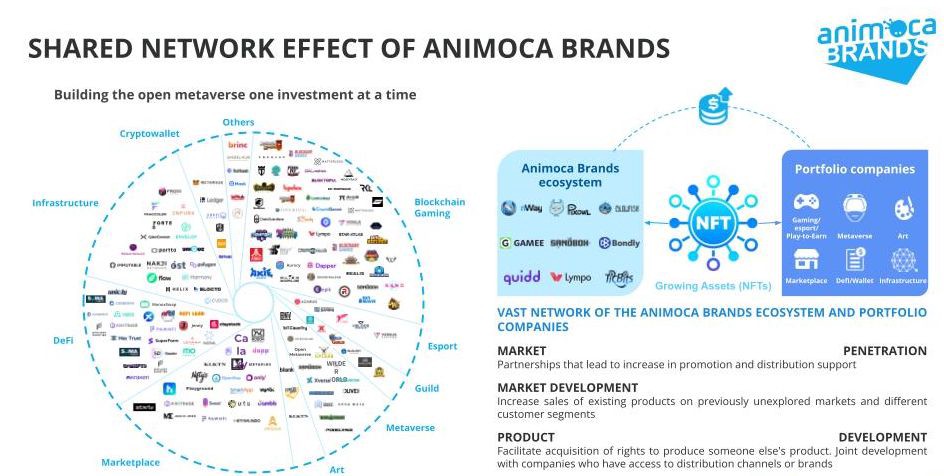
How we build on the blockchain This notion of mutual benefit is best illustrated by a quick overview. Let’s take two popular blockchains as examples: Polygon and Flow. We are creating various new experiences on Polygon (e.g. REVV Racing, Crazy Defense Heroes, Arc8) and Flow (e.g. MotoGP™ Ignition, Olympic NFTs).
These products obviously generate sales, but that's not all. We become stakeholders, validators and contributors to the blockchain itself by holding and staking their tokens (MATIC Token and FLOW Token in this case). This means that when our products generate sales and attract more participants to these blockchains, the tokens of these chains will appreciate in value. We also generate more of these tokens through staking.
For simplicity, all parties benefit from mutually shared network effects active across the blockchain. This benefit is not limited to us or any entity selling products on the network, but is distributed throughout the value chain, including end users, the entire blockchain and all its native products, and of course Animoca Brands and our shareholders. We do this with all the blockchain ecosystems we support, such as Hedera, Harmony, and various others.
The shared network effects of Web 3.0 have the potential to end the classic capitalist zero-sum game approach to business as growth comes from And benefit from communities that have traditionally been the targets of exploitation by capitalist institutions: consumers and wage workers as drivers of network effects.
In an open metaverse, any ordinary end user can (through true ownership and control of a digital asset), or by creating something original (such as a new gaming experience for The Sandbox) or composing music on an existing asset (similar to how an aftermarket car seat manufacturer builds on an existing on the car).
Of course, the entire field of GameFi - including the very attractive P2E movement - also provides incentives throughout the value chain and rewards.
An open metaverse gives us the opportunity to benefit all participants, ending the traditional zero-sum way of thinking.
Customer Owner
The most valuable resource in the world is data. Every time you use any online service, data is generated—whether by uploading photos, viewing products or information, engaging with existing content, or any other activity. Service providers monetize your data in various ways, often to your annoyance (for example, by selling your personal data to advertisers).
As the originator of this data, you should be able to benefit from it, but you can't because it doesn't belong to you - it does The platforms that generate this data, you must agree to give up that data if you want to use their services. These platforms get rich by harvesting your data and exploiting the network effects you and a host of other customers facilitate.
Like the oil that ultimately powers your car, the data itself has no value - it has to be extracted and processing is useful. But data should still be subject to property rights. If you suddenly find out that your real estate is rich in oil, you might feel a little frustrated if an oil company goes into the business of drilling for oil on your land without compensating you.
However, this happens to our data every day. But what if we could own and benefit from our data? Welcome to the open metaverse, because that's exactly what we're trying to achieve.
The resulting network effects of digital property rights and participation are not only important precedents for true data One of our biggest problems—inequality—provided a solution and laid the groundwork for an unprecedented wave of creativity and innovation. Think of how Karl Benz's invention revolutionized the entire planet, except that change would be at a digital pace: exponentially faster and bigger.
In short, each customer also becomes an owner.
One of the most powerful effects enabled by Web 1.0 is the fair distribution of knowledge. Internet connectivity, for example, enables far-flung farmers to fairly assess the value of their goods, helping them receive fair compensation for their goods.
The blockchain can do some very similar things with our data, except we don't need to extract natural resources from the physical world - We just create data through our online presence. This most valuable resource is created automatically by our activities, which means we have the ability to create our own assets.
We should be able to have it.
Fair New Year
It's hard to express how excited we are about the opportunities and possibilities on the path to the Open Metaverse.
We do not for a moment think that this is a task that can be accomplished by one company, which is why our corporate strategy over the past few years has not only To develop our own Metaverse products, while also providing seed funding to the wider community. We've invested in over 150 companies, handpicked by us based on their ability to contribute to the open metaverse and shared network effects.
Our approach is not to have an open metaverse - which cannot and should not be owned by any single entity - but is based on Openness, fairness, user ownership, property rights, and non-zero-sum methods.
The open metaverse is like a new country or a new society. Interestingly, countries and societies that do not offer strong property rights tend to be worse off economically. Better property rights mechanisms lead to higher economic growth.
As in the real world, the economic potential of an online society lacking stable and durable property rights will be far less A society that guarantees these important rights. We believe this is where the metaverse is headed, which is why the eventual closed metaverse product won't be as successful.
With the Metaverse, we have an incredible opportunity: not only are we building in an exciting new space , and we've also been able to help shape it from a centralized structure to a really open structure.
I thank all of our shareholders, partners, ecosystem participants and other supporters for their confidence in Animoca Brands, and I deeply appreciate A deep thank you to all of our talented teams who are committed to this exciting new future. May your 2022 be open and fair!
Original link
Welcome to join the official BlockBeats community:
Telegram Subscription Group: https://t.me/theblockbeats
Telegram Discussion Group: https://t.me/BlockBeats_App
Official Twitter Account: https://twitter.com/BlockBeatsAsia
 Related Articles