



Animoca Brands' turnaround from mobile developer to NFT racetrack unicorn
原文标题:《 从被迫退市到成为加密市场大赢家,Animoca Brands 是怎样炼成的? 》
Chain catcher
Animoca Brands has been one of The biggest winners of this year's NFT and metasomes craze, with The Sandbox, one of The hottest NFT projects, In addition, he has been an early investor in Axie Infinity developer Sky Mavis, Decentraland, Dapper Labs and many other star projects. He has invested in over 150 NFT/ metauniverse projects.
In fact, Animoca Brands was delisted from the Australian Stock Exchange two years ago for a variety of reasons as a traditional mobile game developer. Today, with $670 million in revenue in the first three quarters alone, the project is the unicorn of NFT tracks.
Animoca Brands, a long-established unicorn in the space, emerged in the second half of this year with the explosion of chain games and meta-universe racetracks.
Animoca Brands, founded in 2014 and based in Hong Kong, is The maker of linked games such as The Sandbox and F1 Delta Time. In addition to product development, Animoca Brands has been an early investor in NFT star projects including Axie Infinity developer Sky Mavis, Decentraland, Dapper Labs, and has invested in over 150 NFT/ metauniverse projects.
To most people, Animoca Brands looks more like a crypto powerhouse out of nowhere. So how did it get rich, and where is it going?
One, bring back the dead
The company, co-founded by tech entrepreneur Yat Siu in 2014, was a little-known developer and publisher of mobile games, including e-books, until it moved into blockchain in late 2017.
Animoca Brands listed on the Australian Stock Exchange (" ASX ") in January 2015, but has had a lackluster track record and has repeatedly raised capital to replenish cash flow. Animoca Brands raised a total of $34.3 million in nine post-IPO rounds from 2015 to 2019, according to Crunchbase, to boost its various mobile games, e-books, VR, online games and more, with little success then.
As of the fourth quarter of 2017, its quarterly operating cash flow has been negative. Data show that in August 2017, the company's share price fell from the previous high of 0.2 Australian dollars to less than 0.01 Australian dollars, a drop of more than 95%.
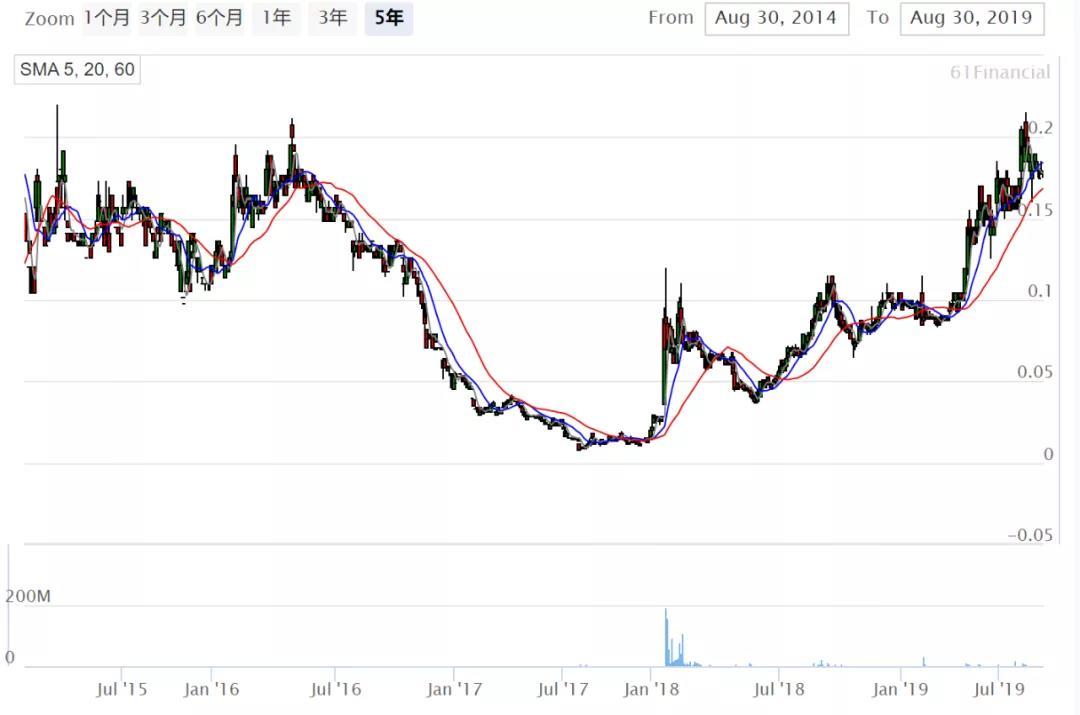
Source: 61 finance
In the second half of 2017, under pressure from ASX's results inquiry, Animoca Brands made three cost-cutting and revenue boosting changes: a restructuring of directors' pay structure, the sale of non-core assets and job cuts, including a 50 per cent pay cut for all senior executives. During the year, the company sold 318 of its 524 mobile games -- most of them casual -- for a total of $8 million, and reduced its headcount from 110 to fewer than 70.
By early November, the company had 527 employees worldwide, making it an NFT track giant. What happened in between?
The change began in early 2018. Yat Siu, executive chairman and co-founder of Animoca Brands, told Chain Catcher at the time that Animoca Brands acquired a gaming company that had been involved in Cryptokitties development. Cryptokitties was a first-generation blockchain game that was hot at the time.
"This is our first participation in blockchain games and NFT. "We immediately realized the power and benefits of this, and how NFT could revolutionize the existing gaming industry by providing digital property to gamers," Said Yat Siu. Animoca Brands has since focused on NFT games.
Animoca Brands signed a one-year licensing and distribution deal with Axiom Zen, Cryptokitties' developer, in January 2018. Animoca Brands has the right to distribute Cryptokitties exclusively in China for 30% of the net revenue.
In August of that year, Animoca Brands acquired Pixowl, The developer of UGC (user-generated content) gaming platform The Sandbox, for $4.875 million. According to an Animoca Brands announcement, The Sandbox had over 1 million monthly active users at The time. There are also plans for a blockchain version of Pixowl.
"We acquired Pixowl and Sandbox for less than $5 million, which proved to be a very successful investment." Yat Siu said to the chain catcher.
The Sandbox is currently one of Animoca Brands' most successful projects. As of Dec. 21, The Sandbox token SAND had a total outstanding market capitalization of $4.7 billion, ranking 37th in Coinmarketcap, and a diluted market capitalization of $15.3 billion. Meanwhile, The Sandbox's virtual land transaction volume is high, with Republic Realm breaking The virtual land sales record with a $4.3 million purchase on November 30.
Yat Siu tells Chain Catcher that there are many reasons for the 18-year acquisition, including the fact that Martin Varsavsky, one of Pixowl's backers, is a good startup friend of Yat Siu's, and that Pixowl has accumulated a lot of brand IP, "But most importantly, Pixowl and its founders have a deep insight into blockchain and NFT." According to Yat Siu, these elements will enable the team to take the lead in both blockchain and traditional gaming.
Animoca Brands subsequently invested in Decentraland and Dapper Labs in October and November, respectively. In January, Animoca Brands partnered with WAX blockchain to bring user-generated items to The WAX platform for its game The Sandbox, in an equity swap that exchanged $250,000 worth of The company's stock for WAX tokens.
Animoca Brands' revenue through the end of fiscal 2018 was still largely driven by sales of traditional mobile games, with only a million yuan loss from cryptocurrency-related investments.
In November 2019, Animoca Brands made another major investment, leading a $1.465 million funding round for Sky Mavis, the then upstart developer of Axie Infinity, for $420,000, Located in the forefront of the chain tour income list. At the same time, through cooperation and acquisition, it has acquired IP rights in sports such as FORMULA One, American Professional Baseball League and German Bundesliga league, so as to accumulate resources for blockchain games and NFT development in the direction of sports IP.
At this point, ASX sent a letter of inquiry and delisting warning.
According to Animoca Brands' subsequent disclosure, ASX alleged that the company had three issues: internal governance issues, extensive involvement in cryptocurrency-related activities, and trading irregularities. Among them, the company did not back down from accusations of involvement in encryption activities; In response to questions about internal governance, Animoca Brands acknowledged alleged irregularities in its operations but did not provide details.
In March 2020, ASX formally removed Animoca Brands from its listing, citing a "lack of adequate resources, systems and controls to meet its obligations under listing rules." At the time, the company had a total market value of $124 million.
In fact, the delisting has been more of a prestige issue than a profit -- the stock price has rarely risen significantly in the five years since its ipo. Delisting instead gives Animoca Brands room to move beyond concerns about violating public company rules and into the deep waters of NFT.
Animoca Brands will focus more on the development and expansion of its own assets in 2020: The Sandbox has issued SAND tokens and launched Binance. Its F1 Delta Time game launched REVV tokens, and ecological activities such as NFT pledge mining and NFT auction have also been launched from Time to Time.
On the other hand, Animoca Brands has acquired NFT marketplace QUIDD, sports NFT ecosystem Lympo, Prediction Market project Prosper, indie game developer Blowfish Studios, NFT solution provider Bondly, and more in recent years A crypto company.
At least eight Animoca Brands subsidiaries have issued tokens, but with The exception of The Sandbox, Animoca Brands has had only modest market impact and token price. Animoca Brands also plans to launch AAA Phantom Galaxies next year and work with the popular NFT project Bored Ape Yacht Club to launch a new game in the second quarter of next year.
More like the A16Z of NFT than game developers
While Animoca Brands spent its first three years in the crypto world expanding its network of resources and building in-house like any new-to-be, more recently the company has been expanding its tentacles into the crypto industry through a wide range of investments, building a vast ecosystem around NFT and metasomes.
Animoca Brands number of investments per quarter in recent years source: Crunchbase
Animoca Brands' investment pace has picked up significantly as it enters 2021. As of December 24, Animoca Brands has accumulated at least 81 crypto-related public investments, including Yield Guild Games, Bloktopia, GuildFi, ConsenSys, DeHorizon and others. In addition, the number of investment in the fourth quarter of this year accounted for 51% of the whole year, leading projects accounted for more than 36%.
Animoca Brands also launched a $200 million online game investment fund with BSC in December, and the pace of investments is likely to continue. Currently, the company's website shows that it has invested in more than 150 NFT/ metaverse projects.
Yat Siu told Chain Catcher that he believes that in the blockchain space, metasurse-related projects are more likely to drive mainstream adoption. And "NFT represents the best opportunity for an open metasemes." Yat Siu said.
Animoca Brands saw a significant increase in investment size and lead times in 2021, averaging an investment every six days. This is partly due to Animoca's own revenue growth and significant funding.
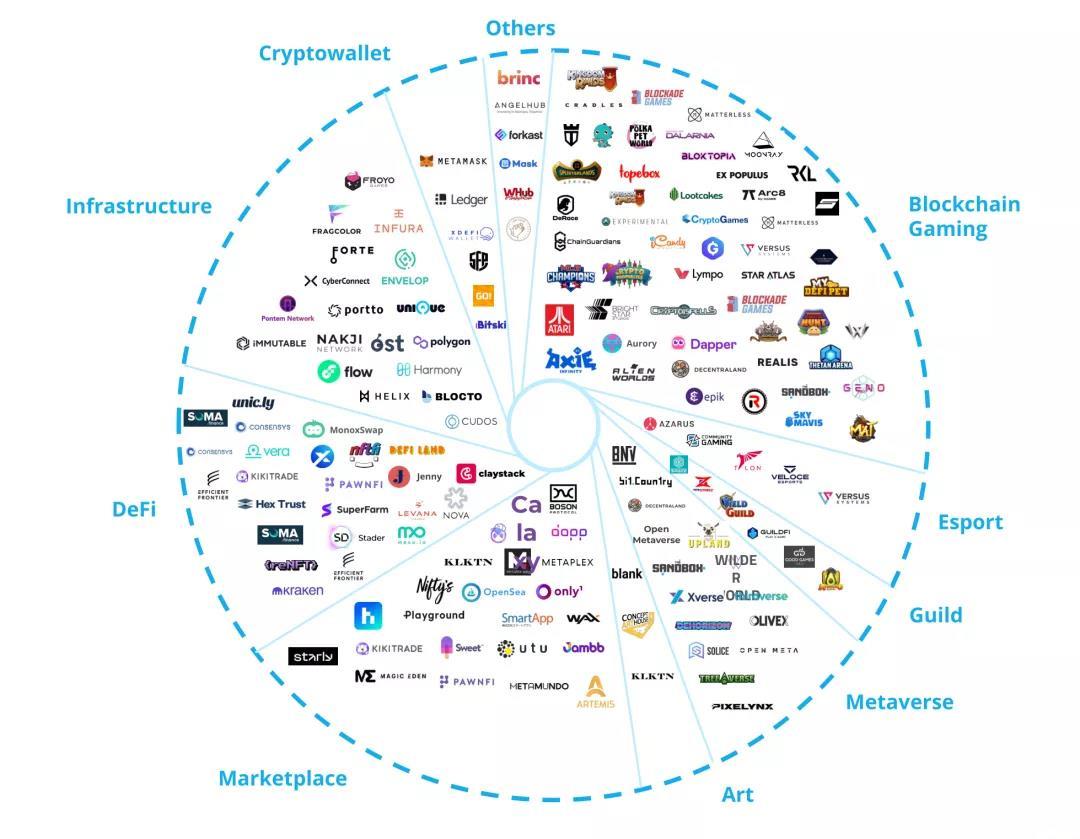
Source: Animoca Brands
Animoca Brands reported revenue of $670 million in the January-September period, with investments and gains from digital assets accounting for 79% of that, or about $529.6 million, according to the company's earnings report in early December. As of the end of November, the company held $15.87 billion worth of digital assets in reserve, including $112.1 million in mainstream tokens such as BTC, ETH and USDC, and $456.3 million in third-party liquid assets such as AXS and FLOW. In addition, most of them are ecological currency assets such as SAND.
Animoca Brands also received major funding rounds in May, July, and October from crypto and legacy stars including Coinbase Ventures, Samsung Ventures, Sequoia China, And Blue Pool. It even attracted the venture capital arm of AAA gaming giant Ubisoft, which was last valued at $2.2 billion.
In a march conversation on why to invest in Yield Guild Games on Animoca Brands' blog, Yat Siu attributed the company's aggressive investment to an "ecosystem argument." The logic is that Animoca Brands is investing in builders of the NFT ecosystem, even if it's a competitor, and ultimately Animoca Brands will "benefit from the ecosystem" as a producer of both online games and NFT.
"We believe that true digital ownership (virtual property rights) is the cornerstone that underpins the entire open virtual world: ownership of digital assets can control them, leading to economic freedom, leading to the unleashing of economic opportunities, which leads to GameFi opportunities and opens the way to a more equitable society." Animoca Brands said on its website.
Yat Siu's investment choices are often "values-oriented" in its claims. Yat Siu told Chain Catchers that Animoca Brands prioritized investing in projects to develop an "open meta-universe," rather than teams with boundaries and barriers like Apple and Google.
In an interview with Decrypt, Yat Siu said he saw a confrontation between the open, decentralized digital world and tech giants such as Facebook, the Web2.0 social media giant, which used its name change at the end of October to describe to the public the virtual empire it is trying to build.
Rather than regulation, Mr Siu sees the real "threat" from tech giants such as Facebook and Tencent, which often monopolise data ownership. Animoca Brands' "eager" investment is to make that former open meta-universe happen faster.
In fact, Animoca Brands' investment style is easily reminiscent of A16Z, which is also high, high frequency investment, weaving a huge network of resources and relationships within the crypto ecosystem. Currently, many emerging crypto projects are behind these head venture capital institutions.
However, this investment style is also drawing criticism. For example, The founders of Twitter recently tweeted that Web3 is not actually owned by users, but by venture capital firms (VCS) and their LP (limited partners), and that Web3 is ultimately a centralized entity with a different label, It even implies that A16Z controls the Web3 concept.
In his view, VCS actually control the token share of a large number of Web3 projects and make huge profits, which is far from their vision and contrary to the spirit of Bitcoin, and should be used to fund true free and open source software.
These comments have caused a lot of backlash in the crypto industry, but they certainly give us more perspective on how VCS balance their institutional and public interests, something that a16Z, Animoca Brands, and others may need to revisit in light of the controversy.
The original link
Welcome to join the official BlockBeats community:
Telegram Subscription Group: https://t.me/theblockbeats
Telegram Discussion Group: https://t.me/BlockBeats_App
Official Twitter Account: https://twitter.com/BlockBeatsAsia







