For future Web3 games, P2E is the base layer
原文标题:《 Play to earn economies as base layer protocols for games 》
Peter' Pet3rpan ', MetaCartel Ventures
Kxp, BlockBeats
Player retention is important for any game.
Nevertheless, publishers will continue to optimize their bottom line at the expense of player value and well-being. They can do so because they have end-to-end ownership and control over the development, distribution and management of their games. A case in point is Electronic Arts (EA), a game publisher that is notorious in the gaming world for not considering the player experience as important as its microtransaction monetization model.
, & have spentIn 2017, EA released Star Wars Battlefront II, in which players had to play for 40 hours to unlock a character (like Darth Vader) or pay for it. The company's response became the most trod Reddit comment in history, illustrating the tension between game publishers and gamers.
, & have spentAround 30% of the company's total revenue comes from the sale of FIFA Ultimate Team (FUT) loot boxes, and leaked company documents indicate that the company has focused on microtransactions. They said,"All roads lead to FUT", because "FUT is the foundation of everything, and we're doing everything we can to get players involved".
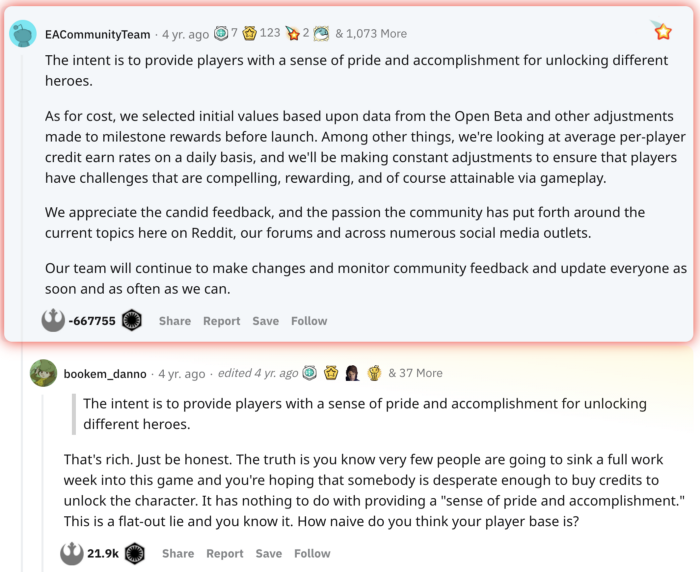
EA's response on Reddit -- the most trampled comment in Reddit history
The core vision behind P2E is to address these issues by providing players with true ownership of in-game assets and the game world, ultimately improving engagement and community retention. withA mobile game with a 30 day retention rate of 3% worldwideBy contrast, the P2E ecosystem has had good results from the start, such as Axie Infinity's & NBSP;The 90-day retention rate is 40%.
(Editor's note: Not everyone who downloads Axie Infinity plays the game, so the actual 90-day retention rate is much higher than 40%.)
The remaining problems with Web 2.5 games
The success of Axie Infinity led many P2E ecosystems to follow suit, leading to the emergence of a new crop of P2E ecosystems. Still, many game projects want to keep control and end-to-end production in their own hands, but they are likely to suffer from the same structural misalignment as traditional games.
These Web 2.5 games want to take better advantage of "Crypto" by using NFT to acquire ownership of digital assets, or erC-20 to gain financial rights in the game economy. At the same time, however, they also want to limit participation using other, more Crypto properties of ownership, such as governance. Typically, the teams behind Web 2.5 games want to create a well-developed but closed ecosystem with unified control over the player experience. These games tend to think of themselves as putting gameplay first, and most of them are still optimized for Web 2 metrics, so their value systems are essentially the same as those of traditional game publishers.
"We're launching NFTS because we believe in their profitability. Players are willing to pay for NFTS if they feel they can appreciate in value." -- A game studio [name not published]
Similar to CeDeFi, these games want to build a closed-loop, controlled gaming ecosystem on top of Crypto's previously open, permissive network.
While we know that the P2E ecosystem will not be decentralized from the start, it will have one like Axie InfinityA process of gradual decentralizationBut we also feel that Web 2.5 game developers do not have a clear understanding of composability, interoperability, and decentralized coordination techniques.
Our view
In our opinion, Web 3 games will prevail over Web 2 and Web 2.5 games because they know how to use community ownership, real economic value, and native composability to drive downloads and retention. Building the P2E ecosystem with Web 2.5 is not enough to give the community a voice because the end-to-end development and management of the game economy and the end player experience are still controlled by a single coordinator. Instead, what the P2E ecosystem really should be is an open source public good that allows everyone to participate in the management and construction of the game economy and player experience.
The verifiability of the system makes people trust that it can do all the things it is supposed to do, and the consensus of the participants on the information in the database establishes an indisputable truth. -The tokenism theory of 1KX
With Token incentives and community ownership, we can unlock more roles for game publishers by bringing in a bottom-up group of contributors, players, and guilds, which will further drive world building, product development, and governance. By making these responsibilities public, we will no longer rely on one company to achieve the goals of an entire ecosystem, but can leverage the open source contributions of anyone on the Internet.
We see P2E not as a stand-alone game or 'app', but as an ecosystem that helps build a national virtual industry economy that community members trust, operate, own, and build on.
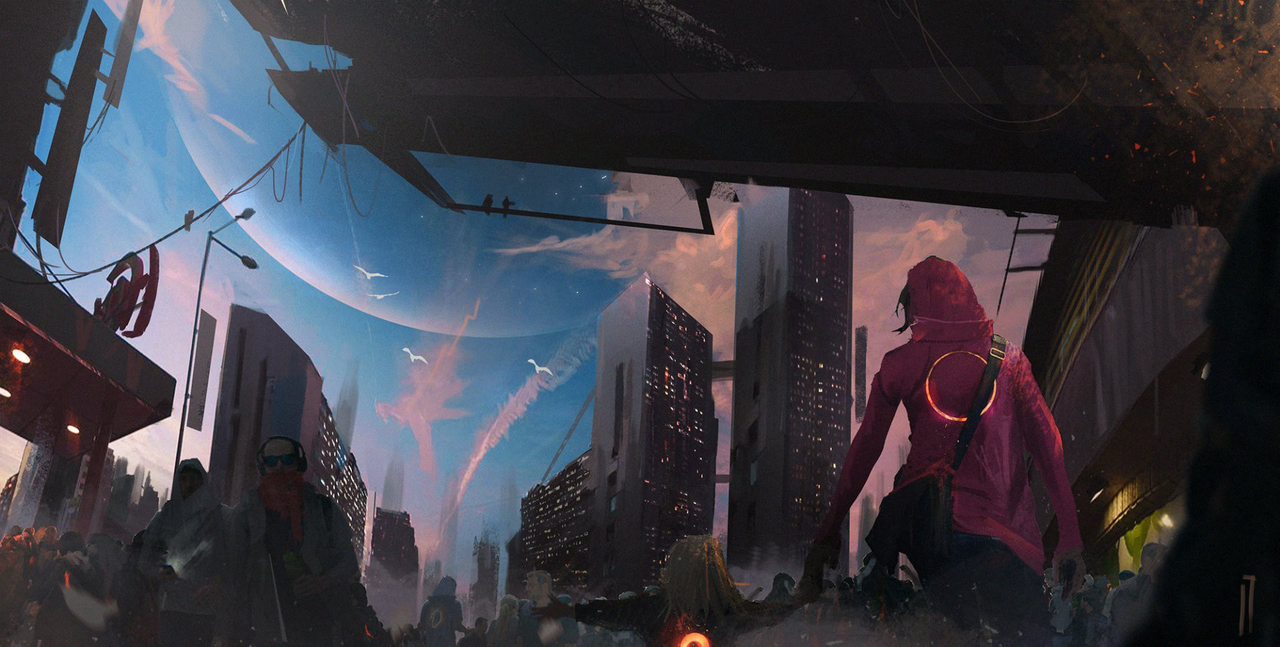
P2E economy as a virtually-managed country
With the P2E market still very active, the importance of the P2E game economy is poised to take a new level. These game economies are not only a source of entertainment for community members, but also a place for them to make money, earn money, store digital assets, work, and fulfill their duties.
We can think of the P2E economy as a virtual state in which citizens want to live in a beautiful, democratically-governed state with endless choices in entertainment, work, social life, culture and so on. In order for these virtual economies to retain their community members, they must make fair and transparent decisions that have a significant economic impact on their citizens, such as:
, Economic policy: Such as asset supply and balance mechanics in the game
, & have spentRealization model: such as value accumulation mechanism and transaction cost
, & have spentAllocation of funds: e.g. which community activities should be funded
, & have spentIntellectual property: how should ecosystem INTELLECTUAL property be licensed, for example
If the P2E economy can be run by the community, in addition to increasing the number of users, the community will also strive to optimize functional governance and improve the "quality of life", "GDP" and economic stability of community members. In this way, as communities make decisions that are more in the interests of their members, they can not only retain current community members, but also rely on their safe, reliable economy to attract better quality members (Pool of public goods and agreementsTheory). As we spend more and more of our time in virtual worlds and are able to move identities, friends and assets from one place to another, the analogy of the P2E economy as a virtual state is likely to become a reality in the future.
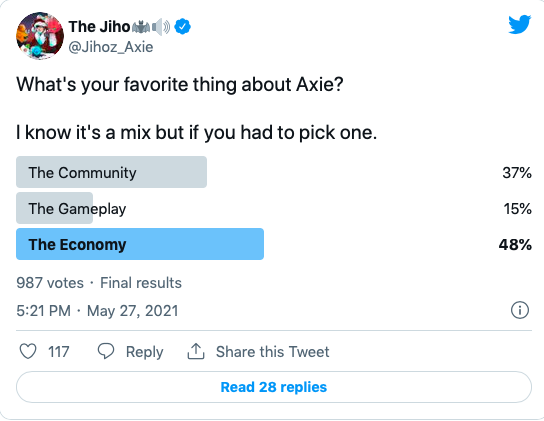
P2E Economy serves as a community distribution platform for builders and creators of open source ecosystems
Unlike Web 2 games, where data is sealed off in a central database, the P2E economy can be an open, interoperable SDK-style platform on which contributors can build freely without any licensing. Thus, the P2E economy is also a foundation-layer agreement for other community-generated games and experiences, each of which will serve as a channel for the ecosystem to acquire new users, as well as another driver of existing community engagement.
This gives developers the opportunity to develop and publish for a vibrant and vibrant community from day one.
In the case of the Axie Infinity ecosystem, this might seem like funding a new mini-game to advance some of the Axie ecosystem's goals, such as attracting quality players to the app, and the creators of the mini-game will be rewarded with tokens in real time based on the success rate of the app's entry. If you can get out of the monopoly of a single team and build in an open environment, then the depth and breadth of the game can be greatly enriched, and the development of the game can be completed in a more scientific and engineering way.
This approach can be applied to all other business areas of the P2E ecosystem, from community development to world building and game design (think of those in the traditional model)Generally cannot be cashed in"Such as fan fiction or other derivative works). Grassroots capital allocation can be accomplished through large-scale community funding mechanisms, such as dimensional funding (quadratic funding), or even player-owned guilds that manage certain work tasks, such asAxie P2E Scholarship Association to facilitate fund allocation.
 https://twitter.com/The_ReadingApe/status/1440292285309022221
Players will have more control and flexibility in the metasverse, and interoperability will be a central driver of cross-world distribution in the future. As these economies, games and worlds become more open and integrated, creativity will be further developed through experimentation and permissionless integration, opening up more possibilities for the P2E ecosystem. We believe interoperability allows you to do more than just move your game assets:
, & have spentAppearance and Visual Effects (VRM avatar, cross-world visual features, etc.)
, & have spentPlayer interaction (on-chain physics engines can be used as a common standard for FPS games, assets can be kept intact in multiple worlds, such as plants watered in the same way in multiple worlds)
, & have spentEconomic interoperability (allowing users to buy and sell assets with tokens from other games, or use tokens from other games to get discounts)
, & have spentReputation (verifiable credentials across the world)
, & have spentAchievements (Complete reward quests in one game and earn badges in another)
, & have spentEconomic pool and Faucet (consume assets in different games to produce game equipment)
, & have spentIntellectual property (see the gameplay and characters in a P2E world in another virtual world)
, & have spentAccess (Use in-game items to gain access to virtual Spaces of multiple worlds)
We believe that the opportunity cost of not building interoperability will be greater than the net cost of building interoperability.
P2E economy as pool and faucet
Sustainable economic growth occurs when the value flowing into a system is greater than the value flowing out. In game design, the mechanics that affect the flow of value in the economy are pools and faucets.
, & have spentPools take assets out of the economy
(e.g., spend a lot of SLP breeding in Axie Infinity in order to build stronger teams and get higher rewards by breeding)
, & have spentThe spigots inject assets into the economy
(e.g., earn SLP by completing missions or battles)
In order to achieve sustainable economic development, the outflow of assets through the pool should be greater than the inflow of assets into the economy. Otherwise, over time, the supply of assets will increase and their prices will naturally fall.
An example of a future Token pool is Axie's vertically integrated upgrade mechanism for body parts, and regardless of its equipment accessories or scarce items, should use SLP to buy. Currently, the only SLP pool in the game relies excessively on horizontal asset production, where Axie can cluster together and breed new ones, but the quality and appearance of each Axie remains largely unchanged.
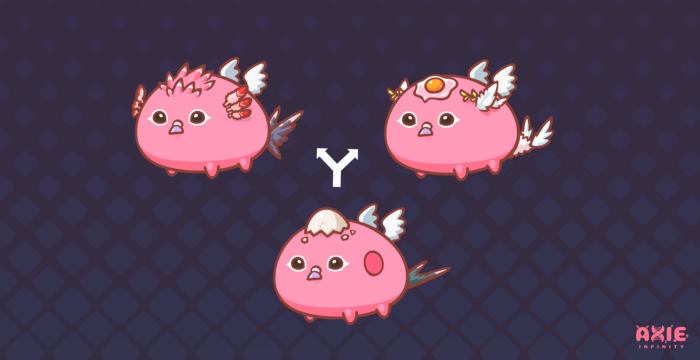
Vertically integrated Token pool
We'll see this adjustment in other emerging P2E games as they strive for economic sustainability. In the future, communities will crowdsource games and player experiences and integrate them into the player economy as a new pool or faucet, further reinforcing the sustainability of the economy.
We could even see alliances of other virtual countries integrating the pools or taps of another economy into their own, helping to tide over another economically unstable P2E ecosystem.
Minimize the rise of viable games
The largest P2E ecosystem of the future is possibleVery small and subtle in the beginning.
P2E economy can be regarded as the economic and social foundation layer of the whole game ecosystem. In my opinion, the establishment of a P2E ecosystem is not only about the development of games, but also about the construction of the game world, game culture and the design of the incentive mechanism of the bottom economy.
While a good game design can attract and retain a large number of players in the long run, we don't think you need to have a great game to start with -- a minimum viable game (MVG) is enough to complete the cycle of economic value accumulation.
One of Crypto's strengths is that it can quickly launch the Token economy from the start and start to build mechanisms to minimize viable economic value accumulation long before the end player experience is complete. This is in stark contrast to the waterfall development approach of traditional game studios, where a perfect game is produced from the start.
The process of making a minimum viable game might look something like this:
1.Create an ideal world for the player (design the concept, story setting and interface, create the backstory and assets)
2.Distribute the world's assets to the community (tokenize future game assets as NFT and distribute them to early community members and players).
3.The community launched economic tokens, thus driving economic development
4.The community raised money for a shared vault
5.Communities launch minimal viable games with Token pools
6.Minimizing viable games removes economic tokens from the supply (this is done by the interaction of players in the game, for example, if the player thinks it's worth spending their tokens)
7.Remove the Token from the circulating supply, thereby increasing value in the economy
8.The added value is put back into the game
9. Create higher quality games and Token pools
10.Repeat steps 7 to 9
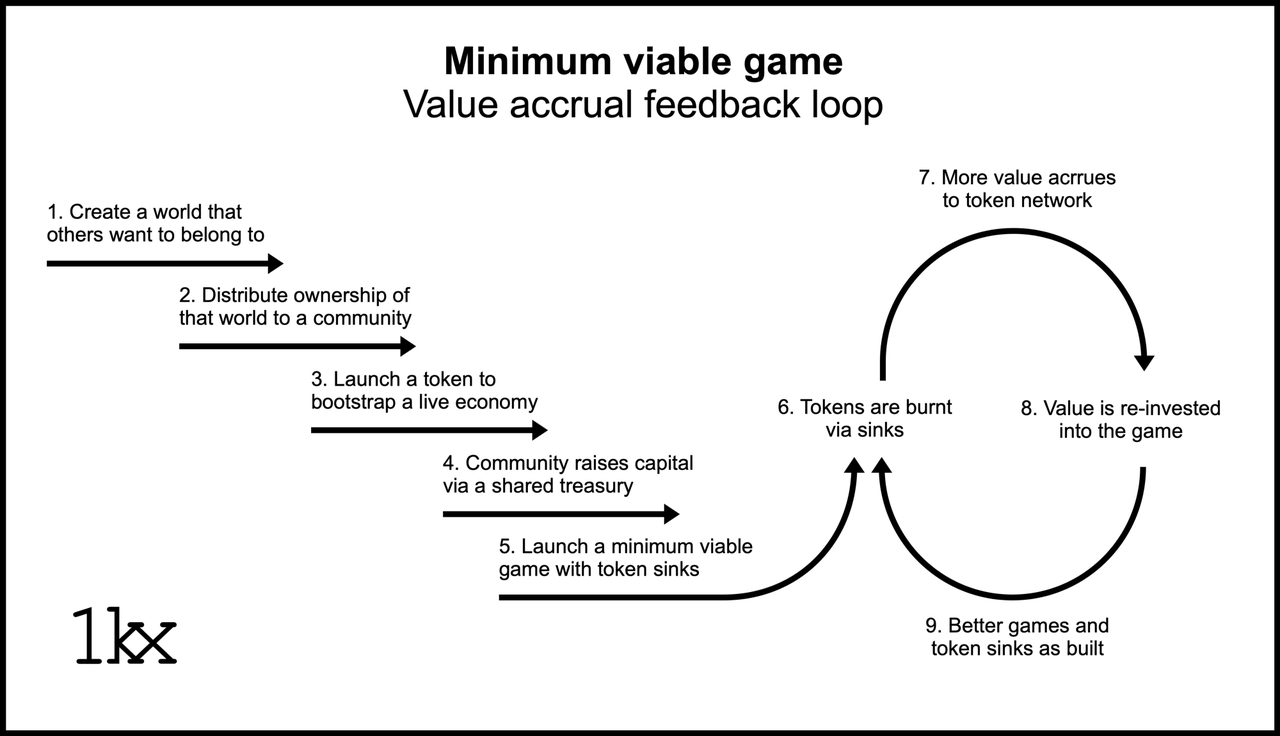
We believe that building a complete cycle of economic value accumulation early on allows the P2E ecosystem to build games in a streamlined and iterative manner and reduce upfront start-up costs.
Axie Infinity perfectly exemplifies the concept of minimizing viable games, as its first major financing was done before the spawning and combat components were released.
, & have spentDecember 2017: Concept building and launch of game development
, & have spentFebruary 2018: Origin Axie presales raise 900ETH (approximately $720,000)
, & have spentMay 2018: Spawning game launch (introducing dragon head)
, & have spentOctober 2018: Idle Combat game released (introduced to pool)
, & have spentJanuary 2019: First land sale: 3200ETH (about us $400,000)
, & have spentDecember 2019: The card Combat game is released
, & have spentMay 2020: Land sales 4600+ETH (approximately US $1 million) in q1
, & have spentNovember 2020: AXSToken Strategic Sales ($860,000)
, & have spentApril 2021: Move to Ronin chain
, & have spentSeptember 2021: AXSToken pledge
Although Axie Infinity has more than 2.5 million daily active users, its growth is far from over. Axie Infinity's emphasis on community building and their iterative approach to development demonstrate that MVGS can be used to guide large-scale virtual economies.
Build the P2E ecosystem in a community-first way
We have a lot of experience building Token networks, so we can honestly say that the SUCCESS of the P2E ecosystem will focus on community and culture rather than pure gameplay.
World building, culture building and incentive design are crucial to building a thriving P2E economy.
World Building -- "Let's Build a World together"
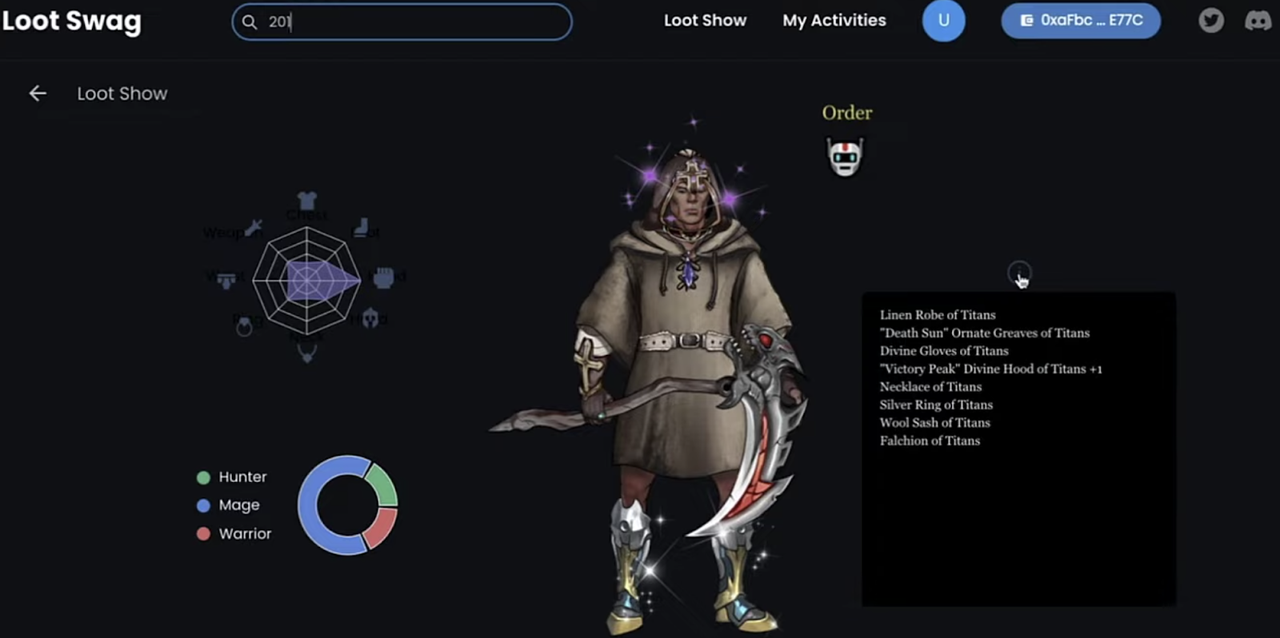
The collaborative world building of early P2E community members was an important driver of engagement in a model that minimized viable games. Therefore, we can predict that more and more P2E ecosystems will adopt content-first strategies in the future (e.g.,Loot,Treasure,CryptoManga). In the future, the relationship between the P2E ecosystem and early adopters will be more like a group of experienced dungeon masters working with the community to build a D&D world, especially when there are no mature games, or even games in development.
Loot is one of the platforms that does this. The equitable distribution mechanism and creative potential of textual NFT, like That of Yearn, gave dozens of developers hope of building a new digital economy. Over the next few months, the birth of 86 community projects opened the door to more possibilities for Loot, including new spin-offs, tools, and guilds focused on game gear, scene maps, gameplay and visuals.
While we don't currently have a world building tool that fully engages players, we believe this will change over the next few years. Generative AI will play a key role in content creation as we move from being content creators to curators. In our view, world building is a concerted effort by people, who may have formed a community of potential players and other contributors before the game was even released.
Cultural Construction -- "Come for culture, but stay for ownership"
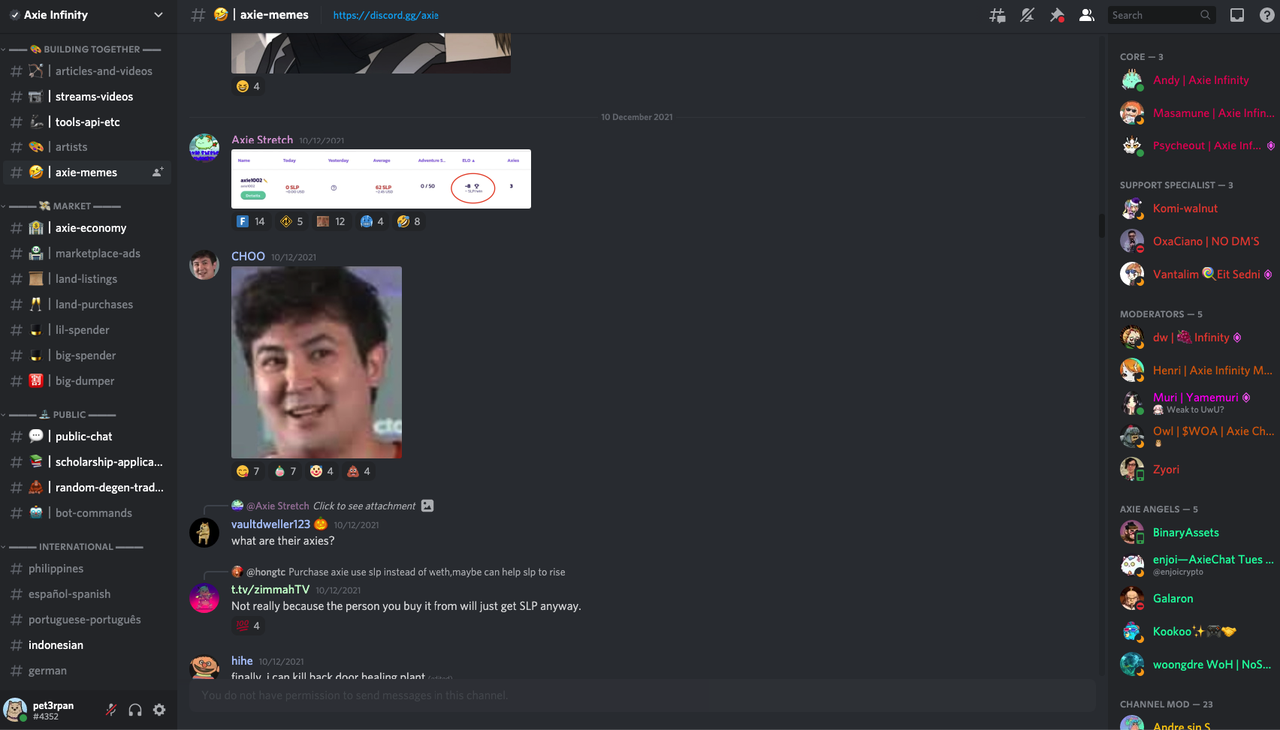
People join a community because they resonate with its culture, and they stay because they eventually become owners of the community. A good community culture must be supported by a complete set of values and principles, and such a community culture will attract others to follow suit. Culture is co-created by community members, so the selection of early community members is crucial.
Traditional metrics focus on "number of players in the game", but we think the real focus of the P2E ecosystem is "who are the players and who are the contributors". For this reason, we strongly encourage the P2E ecosystem to carefully select its early community members and players, either by creating an artificial whitelist or limiting participation by committing contributions.
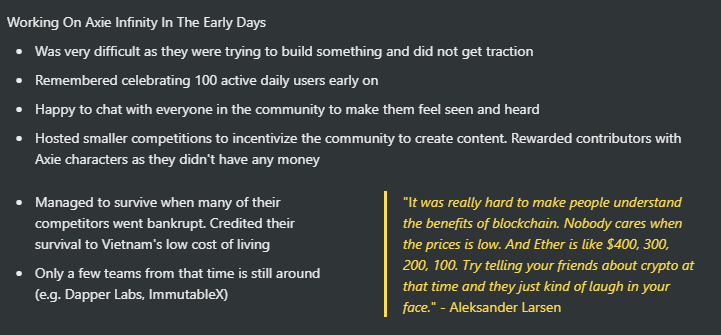
"In the early days, it was important that a lot of our community members put their hearts and minds into the game and expected Axie to make money," he says. "Now, it's easy to see the VC effect in the NFT community, where they put too many eggs in too many baskets and don't care about individual projects." "In the past, there was no concept of diversification, and the sheer amount of investment demand created sweepstakes and defenses against Sybil attacks that prevented people from getting the allocations they wanted." - Jiho (Axie Infinity)
After the bondage of game publishers who untied, the concept of "P2E game community" will encourage more consistent with the values of the community participants join in, have beneficial effects on the economy of the game, and let them get its deserved in the process of construction of ownership, and all these can be in the team building under correct culture be realized.
Axie Infinity Discord
Incentive Design -- "Rewarding valuable contributors"
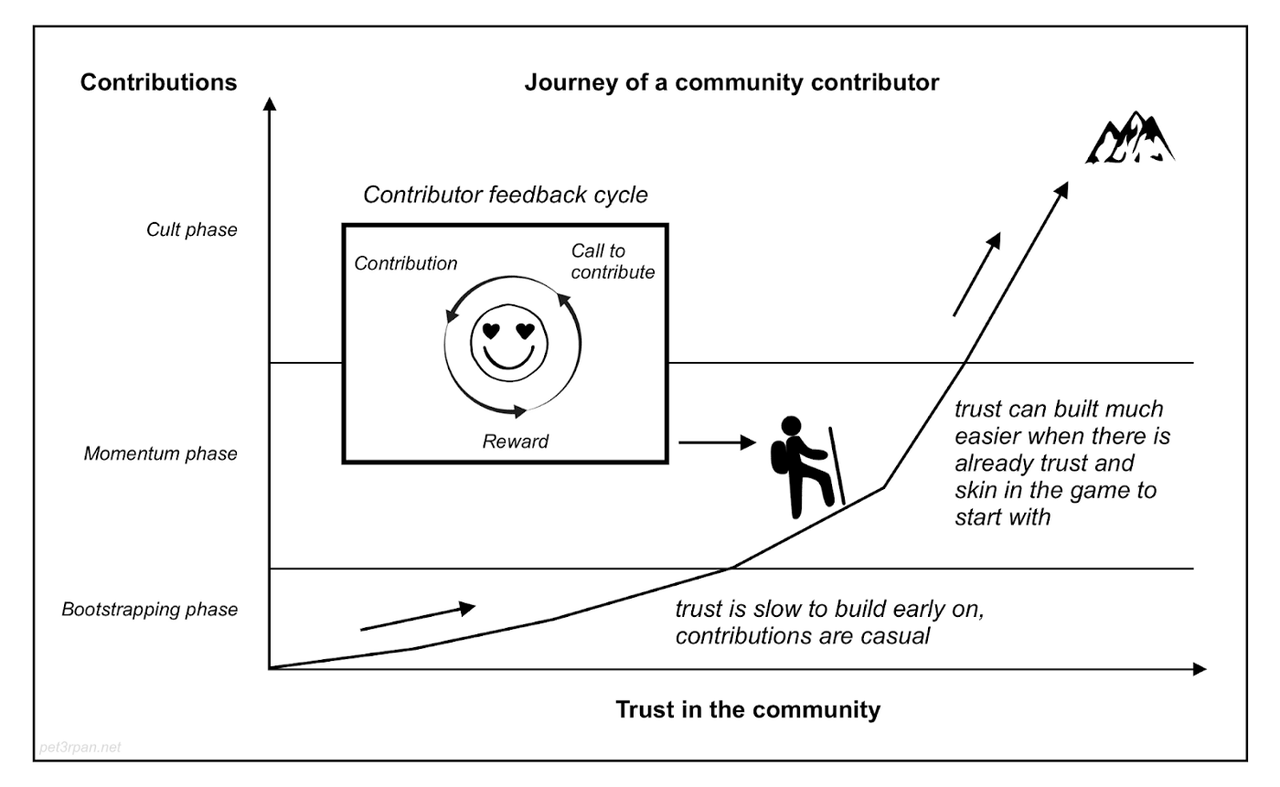
While a community culture may initially attract members and contributors, they will stay in the community only if they are reasonably paid for their work and have a sense of ownership.
"The difficulties of community buildingThe chart in the article
When designing asset distribution in games and shared revenue in the economy, game studios should ensure that the most valuable community members and contributors are paid what they deserve. Only when this contributor feedback loop works well will they have enough trust, loyalty, and passion for the community.
Token rewards are scarce resources and should be allocated carefully and on merit to the most valuable community members. Of course, we expect more models to emerge for Token ownership and game asset allocation in the future, such as:
, & have spentOnly guilds of a certain size or "experience" can purchase exclusive assets such as virtual land.
, & have spentSome in-game accessories can only be acquired by completing a rigorous game knowledge test to prove that you have a good knowledge of the game's mechanics.
, & have spentBy completing in-game missions (whether in-game missions or community bounty missions), players can add themselves to a whitelist and receive exclusive in-game equipment, whose presence also serves as a "badge" to demonstrate the reputation they have earned.
In our opinion, P2E games should be careful when designing play-based incentives only, as such a design is likely to attract a large number of mercenaries who will move from one game to another in search of higher revenue (similar to DeFi mobile miners moving their mining locations). The P2E economy should focus more on retaining loyal users when designing its incentive mechanisms, rather than pursuing higher user numbers.
conclusion
We believe that the success of P2E games must be based on a thriving culture, community and vibrant economy, not fancy charts and multiple rounds of funding.
We're still new to how to build in an open environment, but we want to be investors that can help build my next big P2E ecosystem.
If you are involved in the construction of this area, welcome to discuss with us.
"If you want to accelerate, you have to do it alone. But if you want to do it for the long term, we can do it together."
The original link
Welcome to join the official BlockBeats community:
Telegram Subscription Group: https://t.me/theblockbeats
Telegram Discussion Group: https://t.me/BlockBeats_App
Official Twitter Account: https://twitter.com/BlockBeatsAsia
 Related Articles