Your attention is the scarcest resource in the crypto industry
Tokens in the Attention Economy
Original author: Cobie
原文编译: 董一鸣,链捕手
People often talk about the scarcity of cryptocurrencies. Whether it's through NFT to enforce digital scarcity, or through the idea that there are 55 million millionaires and only 21 million Bitcoins.
In fact, the only scarce resource in cryptocurrencies is attention.
Risk-seeking capital is certainly not scarce. People joining cryptocurrencies in the summer of 2021 are raising billions of dollars to explore the "meta-universe" and a decentralized Uber. A billion dollars isn't a lot of money anymore.
Crypto assets are not really scarce. Bitcoin and Ethereum themselves are scarce due to their hard-top supply or deflationary token designs, Crypto Punks are scarce because the supply is limited and fixed, but the number of things you can speculate on in cryptocurrencies is ever-increasing and theoretically endless. To be more specific, billions of risk-chasing dollars are not entirely spent on crypto OG projects.
Yes, there are only 10,000 CryptoPunks. But there are also 10,000 BayCs, maycs, a bunch of cool ArtBlocks, CoolCats, Meebits and Hashmasks. Of course ethereum came out with EIP1559 and they are burning billions of dollars of ETH and its scarcity is increasing over time. But if people feel they're too late to own ETH now, there's AVAX, SOL, LUNA, ONE, NEAR, and even ADA.
Over time, truly valuable crypto assets have proven to be scarce. The number of crypto assets that have outperformed bitcoin in more than one bull/bear cycle is limited, and most tokens are dead entirely. People will wake up naked after the carnival. Recovering from a manic episode. Reflecting on these decisions we made during this out-of-body experience smacks of reality and shame. Capital will return to value. And the pool of "value" for today's euphoric investors may be much smaller than previously thought.
attention
Attention is the currency of the modern web. Web2 companies figured this out a long time ago. Users pay for services with their attention. The company captured that attention and eventually sold something to users at some point. Often companies are not in the business of selling things themselves, but rather serving as brokers between users' attention and the businesses that sell things.
The fact that attention can be used as money is even more obvious and straightforward in a token economy. More than 50 IDOs happen every day, all competing with each other to get your money and add you to their community. Over the past 12 months, airdrops have been a steady stream, offering financial rewards to users who use and support their products.
Traditional companies will pay you $5- $10 to use their products. When you sign up, you get $10 off your first Uber ride. In web3, the battle for attention is so great that nine-figure reward programs are the new normal, and five-figure user drops are not uncommon. Encrypted YouTube KOL costs five to six figures per video AD. Attention is scarce and in high demand.
Asset valuation based on attention
In the lastThe article"I wrote that the bullish crypto market is more like a video game than an investment. If cryptocurrency is a massively multiplayer game scored in dollars, then attention dictates a lot of short-term sub-strategies.
Most people who play multiplayer crypto games cannot fully evaluate the technical and fundamental merits of the project themselves. Instead, retail investors rely heavily on signals and social proof in their decisions.
If you oversimplify crypto prices to an equation of suppliers/sellers and demanders/buyers over time, you can explore the effects of scarcity of attention.
Obviously, if there is more demand or fewer sellers, the price will go up. But the underlying factors affecting demand and supply haven't changed as quickly as the pace at which participants are playing video games in the crypto bull market.
More specifically, the value creation of protocol developers and builders takes place on a multi-year timeline, whereas in the crypto bull market "trading players" operate for weeks at most and often less.
Attention is the only factor that affects the supply and demand variable, and it changes at the same pace as the "trading players" because it is directed and controlled by the participants.
The preference is
In the stimulus phase of a bull market, good players do not try to buy the "best" assets. Instead, they try to buy assets that are about to cross the attention gap or realise their valuation potential.
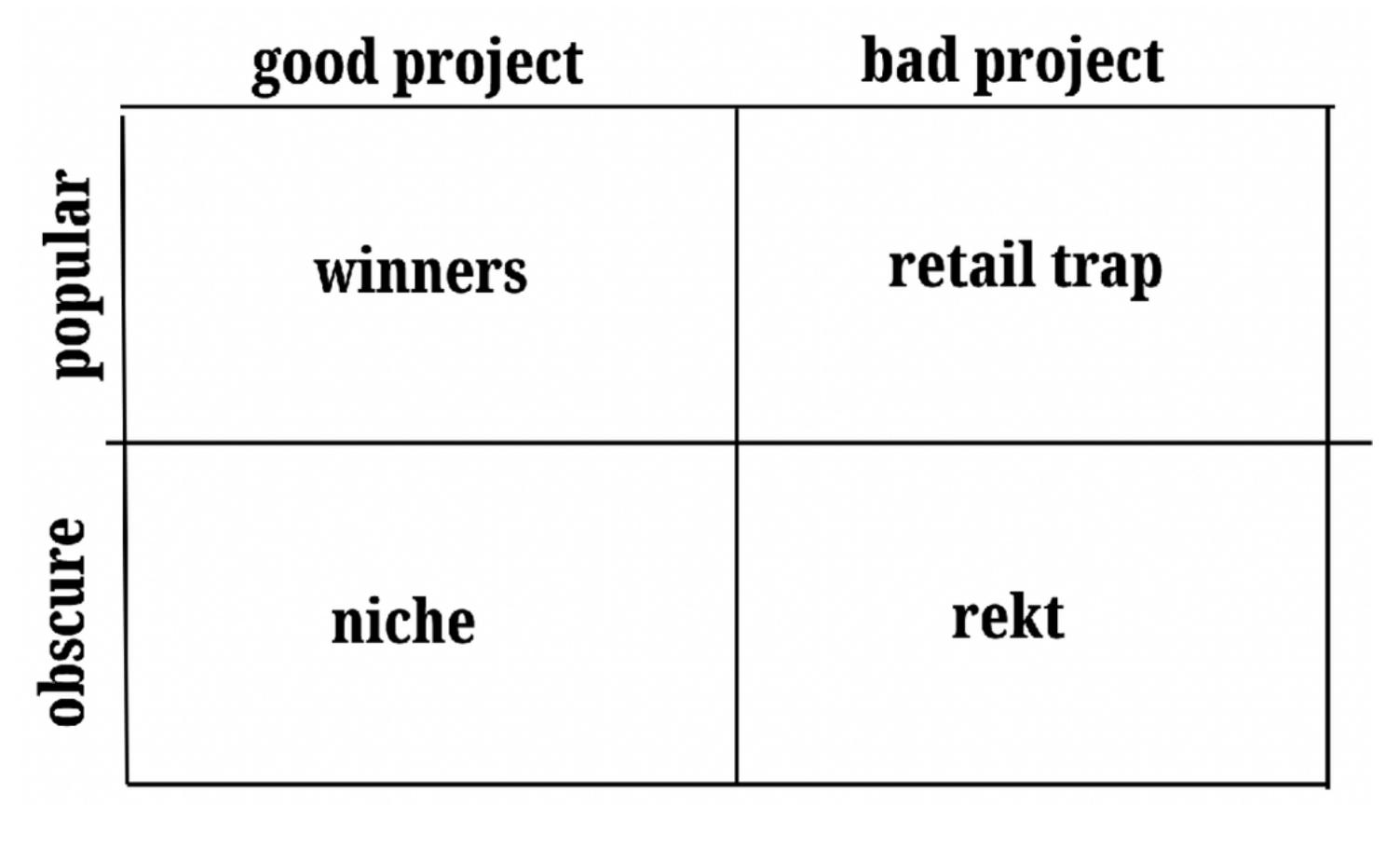
A. Winners AND losers b. Winners and losers C. rekt D. Retail Trap
Good traders know they really want to buy the "Winners" to get the maximum return. They want to buy something that will change from "niche" to "Winners." They are even more willing to buy projects that have the opportunity to move from "Rekt" to "Retail Trap", even though they know this is obviously riskier because a bad project is less likely to become popular. Projects can also be transferred from Rekt to Niche projects through product fulcrum, technological change or leadership change. Traders know that any item in the chart that moves up or to the left presents an opportunity.
The "Winners" are the best assets for long-term investors and retail investors because they are easy to identify. But for "crypto players" who trade every day, there is likely to be a lack of relative opportunity, as they are likely to get closer and closer to the market average, and good traders want to significantly exceed the market average. A typical example of a "Winners" is Ethereum. Of course, the Winners also have downside risk because over time, as the cryptocurrency landscape changes, they can slowly shift to 'niche' or even 'Rekt'.
"Retail Trap" may also lack relative opportunities relative to the market average, but also have more risk than "Winners", probably because the technology or team of the project is not good and the long term prospects are worse. They may turn out to be good projects, but the chances are slim and it may take a long time. At best, they continue to be close to the market average. To make matters worse, they switched from Retail Trap to Rekt because the market realized they were a bad project and they lost popularity.
As projects grow in popularity and visibility, they will be favored by traders. This "in favor" period is the period of greatest change in asset valuations.
Once a project becomes popular, the number of market participants owning the asset increases to saturation. Once saturated, it will require either (a) the growth of the entire cryptocurrency market for the asset to continue to grow, or (b) the underlying fundamentals of the asset to continue to improve relative to the market. This is why having "Winners" (or "Retail trap") during the stimulus phase is not ideal for the most hardcore "crypto players" because (a) and (b) are too slow for these video game addicts. The opportunities in the crypto market are huge, and so are the opportunity costs.
Good crypto gamers try to find projects that are well below their potential valuation, and then sell those good projects when they get close to their potential valuation. They are "Winners" in the coordinates when they are looking for a better deal.
Long-term investors don't care much about games. They are happy to buy the "Winners" and bet on them, expecting them to grow along with the overall market or become more important over time.
SOS, Loot, BAYC
There are plenty of examples of sudden attention to markets.
The recent SOS airdrop is worth thinking about. SOS are airdropped to Opensea users by a third party based on their previous NFT purchase history. This is interesting because giving a certain amount of free money to almost every serious crypto "gamer" is a great way to quickly raise the profile of all crypto gamers.
Keep in mind that SOS has no product or fundamentals at this point, it is purely a speculative market catalyzed by the crowd's desire for OpenSea tokens or competitors.
When players turn their attention to SOS, they have three main options:
1. Sell their airdrop tokens for DOLLARS or ETH
2. Take their airdropped tokens and see what happens
3. Buy more SOS from airdrop sellers
As attention turns to this new market, crypto gamers will ask themselves "How do I make money from this new thing?" This, of course, is the ultimate point of video games. If enough people decide to act on (2) and (3) so that the price in (3) is greater than the price in (1), the price of SOS will go up and the SOS chart will look good.
If the graph looks good, more people will talk about SOS, showing more people and a new group of people the same decisions described above. Now, market participants who have never used OpenSea or are underusing OpenSea to get good airdrops must decide in one of two directions:
1. Buy SOS and participate.
2. Wait or ignore the market completely.
Some of them will choose (1), which in turn will cause prices to accelerate further. While prices are rising, people are happy to make money and keep talking about this trendy new thing.
But ownership caught people's attention and the project quickly moved from niche/ REkt's popularity/awareness level to the Winners/Retail Trap level.
As prices rise, more people will be happy to sell their airdrops. As charts stagnate and attention drops, fewer and fewer new people decide to own SOS. Because SOS was less shiny and suddenly just a token without a product, few people talked about it and the spread of assets slowed. Because the initial level of attention is unsustainable, most of the rest comes from existing holders.
Once an asset has entered the consciousness of many players, it is much easier to get all players to rethink the asset, but much harder to achieve sustained attention without a product and an audience.
I think you could argue that Loot probably followed the blueprint to some extent. This may also explain why BAYC, the best-performing NFT of the year, was able to quickly surpass Punks' floor price, while rivals launched at a similar time became worthless. BAYC focuses on building community by creating value for the community, and the participating community becomes a permanent facilitator, creating sustained or increasing attention.
Doge (Dogcoin)
Dogecoin is another interesting focus for 2021.
Throughout history, Dogecoin has fluctuated fairly frequently relative to Bitcoin. However, from inception to the end of 2020, these fluctuations remained in almost the same range. As you can see in the chart below, from 2014 to the end of 2020, there is basically a zigzag movement of about seven years.
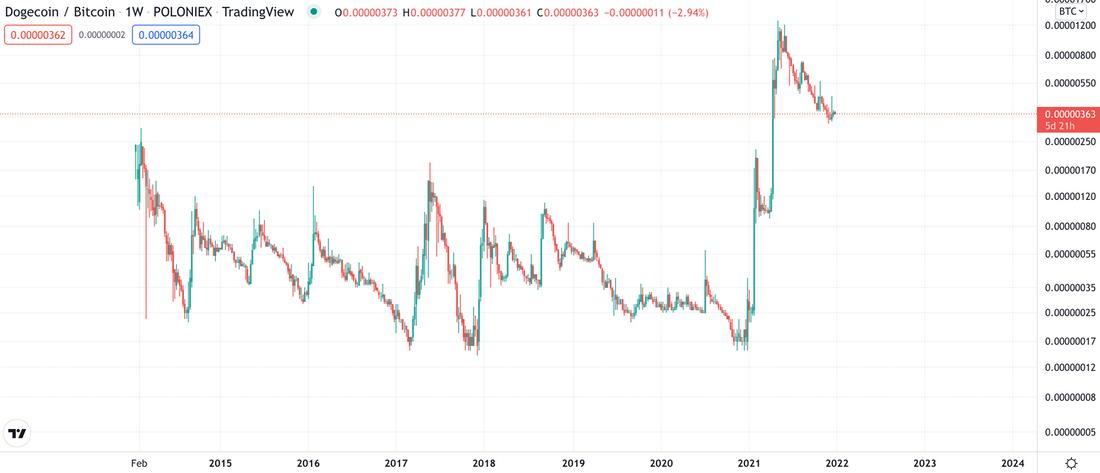
When people learn about dogecoin, they have two options:
1. Buy dogecoin
2. Ignore it
As you can imagine, the proportion of decisions has remained roughly the same for seven years. Let's say for every 100 people, 90 of them ignore it and 10 of them buy dogecoin.
Then, in 2021, a new attention catalyst was introduced. Elon's emergence as a dogecoin cheerleader changed two things:
1. More crypto locals were persuaded to buy dogecoin
2. For the first time, brand new market participants were persuaded to buy cryptocurrencies, starting with Dogecoin
So when Elon started bidding up dogecoin, it was actually a very interesting moment in the market. You can say to yourself: If Elon continues to draw attention, what is the largest audience it can reach? How will the buy/ignore ratio above be affected?
Thinking about it this way makes it very easy to bet on dogecoin in some capacity. If he continues to try to drive up the price, the added attention will dramatically change supply and demand in favor of dogecoin holders for a while -- maybe you can estimate a five - or 10-fold upside. If he doesn't, you could lose 33% of your investment. Look at the risk/reward imbalance this way.
Eventually, though, almost everyone in the world who feels like they might decide to buy Dogecoin already knows. At this point in time, attention remains stable at best, as the number of people who know about Dogecoin is saturated and those who have been persuaded to buy it have already bought it. Attention is now focused on perplexed observers and those who have already bought as much as they are willing to. The rate of change in attention has dropped, resulting in far fewer new participants willing to buy, and it has become the focus of the only remaining coin holder.
With ownership and valuation drawing attention, smart traders have started selling their tokens.
ADA
Cardano is another interesting example. While the core argument behind the asset is the same, its performance throughout 2021 is very different from Avalanche, Solana, and Luna.
At the start of the bull market, Cardano attracted a lot of attention. It became crypto YouTube's favorite token, with all the famous names and faces listing it as one of their top three assets. Of course, the founder is also a crypto YouTuber himself, with Charles' video streams regularly reaching 50,000 viewers.
Since the beginning of 2021, however, ADA's price relative to SOL has fallen 93 percent.
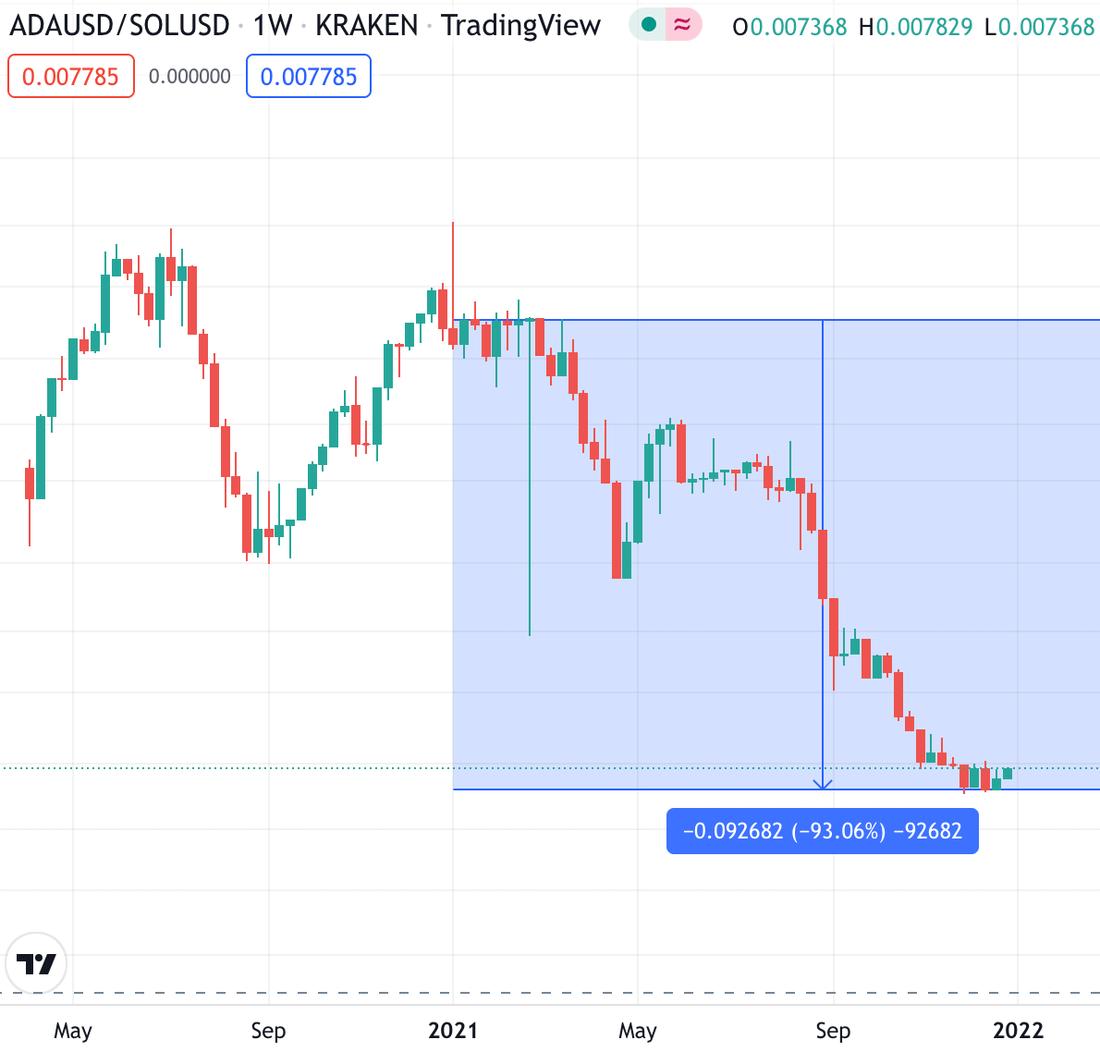
Perhaps this can be explained in the way we describe SOS or BAYC.
When projects get a lot of attention beyond ownership, they are usually re-priced upwards. By late 2020 and early 2021, Cardano was the retail "Ethereum killer" leader. In addition, the bull market has just started, so many new participants have entered the market and are further in the spotlight.
But throughout the year, other L1 companies like Avalanche and Solana have created vibrant and engaged ecosystems -- similar to BAYC's approach. They are constantly getting greater sharing of ideas and attention from users, developers, and speculators. New projects and money-making opportunities are starting quickly on these L1s.
These communities become constant enablers, and since crypto gamers don't like to be idle, these DeFi/ games/any projects become a positive feedback loop for constant attention. Because attention is scarce, all these L1s are competing and sharing ideas at the same time. Solana and Avalanche have gained user attention, which is a loss for other L1S.
Cardano is very popular, but with users currently unable to do much there, and without an ecosystem of crypto gamers who live on Cardano every day to earn points in crypto games, it feels like it's turning into more of a 'Retail Trap' than a 'Winner'.
conclusion
Attention is the only scarce resource in cryptocurrencies.
The rate of change of attention and saturation of ownership are useful indicators of observation or estimation when evaluating crypto assets or playing "massively multiplayer crypto trading video games".
The best traders are looking for assets that are relatively unpopular -- there is plenty of room for their valuations to grow if they can bridge the gap from obscurity to popularity. When ownership gets people's attention, they sell them.
Holding "Winners" during the shaking phase only applies to people who are mentally stable, functioning and living balanced lives. Maybe one day I'll be one of them.
Oh, and don't listen to most crypto youtubers. They are turning your attention into products for their advertising business.
The original link
Welcome to join the official BlockBeats community:
Telegram Subscription Group: https://t.me/theblockbeats
Telegram Discussion Group: https://t.me/BlockBeats_App
Official Twitter Account: https://twitter.com/BlockBeatsAsia

 Related Articles