How will blockchain equity financing evolve in 2021
原文标题:《 The Year In Funding - 2021 》
原文作者: Joel ,Decentralised.co
Kxp, BlockBeats
Over the past year, the blockchain industry has experienced a funding blowout, which is unique in the technology field. A16z, Sequoia, Tiger Fund and other top institutions have galloped around the blockchain industry in 2021, supporting a number of start-up projects in DeFi, NFT, Metaverse and other fields.
Everyone wants to be able to judge the future of the industry, so can we find some patterns and evolution in the data that VC's are throwing out with $17 billion in real money? Joel from Decentralised. Co has combed through 1,278 equity fundraises this year and found some patterns. BlockBeats has translated the full text.
In today's post, I want to explore how equity financing in the blockchain ecosystem has evolved over the past year. I've excluded financing through Token sales, borrowing and donations to give you a better idea of what long-term investors are doing. Before I start this article, I want to be clear: I'm writing this from the perspective of someone who is actively involved in fundraising and helping founders raise money. So all the numbers you'll see in this article will be more conservative than other industry reports. Without further ado, let's begin.
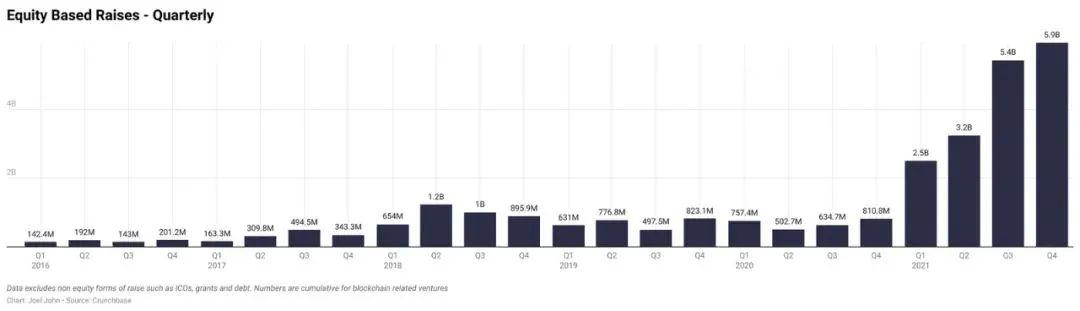
A total of $17 billion has been raised in blockchain ecological equity financing this year
We raised $3.7 billion in equity in 2018, compared to $1.3 billion in 2017. The increase is mainly due to the weak market response to the IC0 caused by idle funds. In 2019 and 2020, equity financing hovered around $2.7 billion. So can you guess how much money has been raised so far this year? The answer is, $17 billion! In other words, blockchain-related companies are raising an average of $20 million a day. This trickle-down effect of capital explains the surge in advertising in stadiums and big-name outfits such as the cricket league. The irony, however, is that while more capital has flowed into the sector, the number of rounds of funding has not increased.
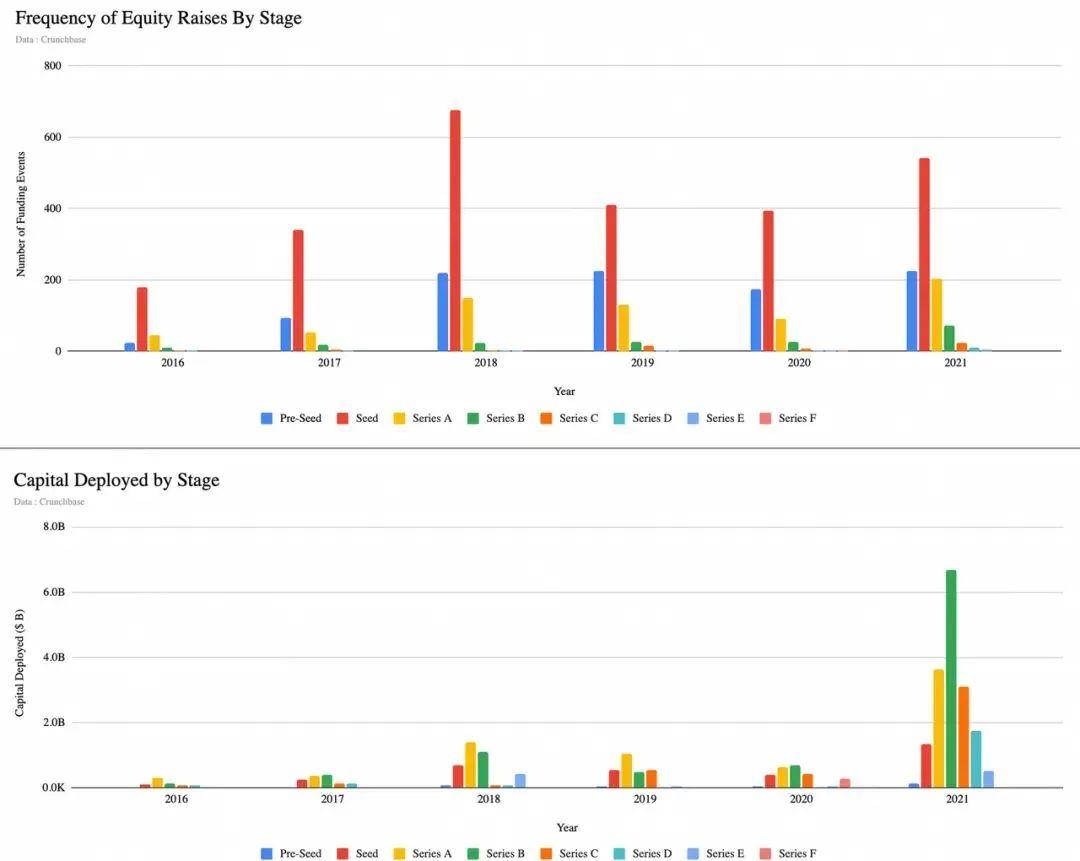
To put the numbers into perspective, there were 1,289 rounds of equity financing in 2018, more than the 1,278 rounds in 2021. That means fewer companies were funded over the course of the year, even as the industry had more capital. In 2017 and 2018, when the blockchain industry was still in its infancy, there was also a lot of seed investment. Venture funds are smaller, so they tend to invest in early-stage organizations, and by 2021, many early-stage financiers had secured enough equity funding to exit. Large venture capital firms have moved into the space after acquiring positions in startups with high growth potential, and early-stage funds have the liquidity to raise large sums of money. However, there is a timing difference between the raising of new capital and the exit of an early investment because of the legal differences between capital withdrawal and the creation of a new fund. So if these numbers are any guide, we'll likely see a burst of early-stage funding in the second quarter of 2022. In the interim, however, the market is signaling that early-stage funding for blockchain companies will remain as difficult as ever. In order to understand the causes of this phenomenon, we analyze the frequency and distribution of capital financing of venture capital enterprises in recent years.
The trickle-down effect
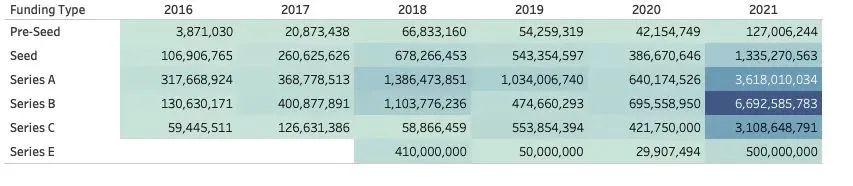
The graph below tallies the number of rounds of funding over the years and the amount of capital funding across the ecosystem. It can be seen that in 2021, the capital of all financing stages will increase on a large scale, but B and C round financing still account for the largest proportion, in which the B round financing jumps from 695 million DOLLARS to 6.692 billion dollars, an increase of nearly 10 times. There was a similar increase in Series C funding, from $421m to $3.1bn. Most of the capital went to later rounds, but in terms of dollars raised, seed and Series A rounds surged about five times from last year.
There are a lot of numbers involved, so let me summarize the impact:
1. Large, long-established fund firms like Tiger and Sequoia Capital are entering the round through late-stage equity investments. Rather than participate in small projects, they are building their portfolios by investing large sums in projects where there is a good product-market match.
2. The proceeds from past investments and Crypto public markets are coming back into seed financing. As a result, while funding rounds (as described above) have remained flat, companies in the seed stage have been able to raise more money.
3. Early funding is still consensus-based because founders allocate smaller amounts to each of multiple funds in order to create a healthier equity mix. As a result, we are likely to see multiple foundations co-investing to bring in more money at the seed stage. This is partly explained by the fact that the average seed stage funding rose from $1.5 million in 2020 to $3.3 million this year.
If you want to get a better idea of how much money has been raised at different stages of investment over the years, check out this link.
This influx of capital has changed the direction of venture capital in the industry. The founders quickly realized that the benefits of public market trading would lead employees to seek higher wages, which could lead to record salaries. As more institutions start to support early-stage venture capital, they are likely to add substantially to their investments for growth. So they don't think about the public market at all, and are intent on recruiting top talent at a higher price. For most early-stage founders, they may need to reward new employees with equity or tokens. At the same time, founders should also let employees know that these ventures could generate millions of dollars in future revenue, which is critical to building strategic employee teams. The same trickle-down effect of capital on founders applies to audit firms and service providers such as media.
Faced with rising demand, any service-oriented organisation will find it impossible to increase working hours proportionately without diluting capital. Moreover, it takes time to onboard and train new employees, so as more founders seek out these services, their prices naturally rise. In such a market, when the opportunity cost of recruiting top talent is too high for self-made founders to compete with their peers on huge compensation packages, it's a good idea to lay out the company's vision to employees. At the same time, they can choose to spend a lot of time developing early team members so that they don't have to hire high-end talent. If founders are willing to take the time to train people, there is a market full of people who want to get into this space. (I'd really like to talk more about the DAO's role in this, but this article is already long enough, and talking about DAO doesn't quite fit the topic of the article.)
We'll talk more about where the capital is going soon, but before we do, let's look at the total amount of equity raised at different stages over the years.
Money to
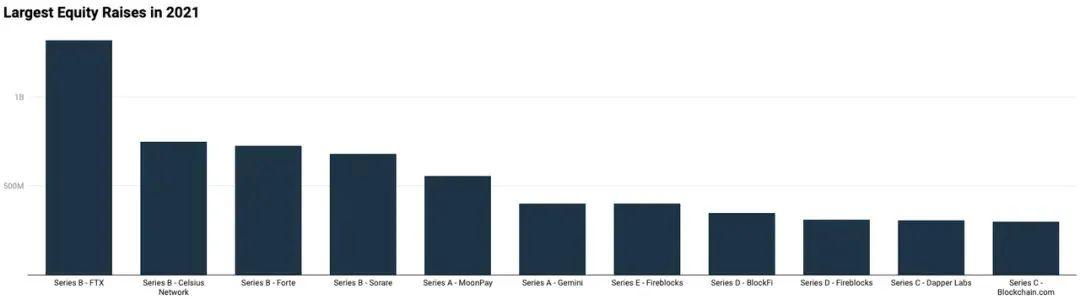
In 2021, nearly 50 companies raised more than $100 million. By comparison, only eight vc firms raised $100 million or more in 2018, and perhaps only five in 2019. Part of the reason for this is that start-ups take years to mature. For example, the number of companies founded in 2015 is likely to be a small fraction of those founded around 2018. After three years of product-market matching, it is only natural that more institutions will raise significant funds in 2021. Interestingly, many of these are retail-focused businesses.
Blockchain funding used to be dominated by fintech, exchanges, or institutional platforms, and it still is. FTX, Celsius, Gemini, and Fireblocks are the top 10 most critical funding projects. Then there are Sorare, Moonpay, Forte and Dapper Labs, each of which wants to bring the next billion users to the digital asset ecosystem. From the founders' point of view, this was a critical turning point. In the past three years, most of the capital has gone to finance-related startups, and in the future, any founder that works with consumers will need to make the transition from a traditional business to a Web3 unicorn -- which is why so many finance workers are entering the field in one cycle. In the next cycle, musicians, artists and gamers will all get involved. When we look at the venture funds that have participated in the largest fundraising rounds, the shift is actually quite dramatic.
The table below summarizes some of the major venture funds investing in this area. In each case, the funds presented were the primary investors in the round.
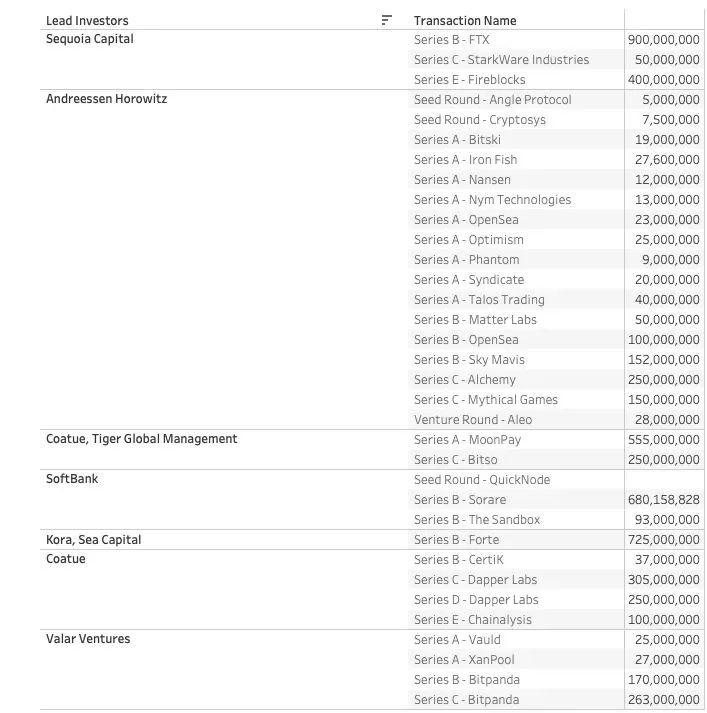
As you can see, the biggest venture capital investors in digital assets are no longer the "Crypto native" funds of the past, but traditional, well-known companies that invest in equity at a later stage and want to exit through an IPO. To me, this is a clear demonstration of the evolution of the ecosystem. Funds no longer participate in large investments and want to exit immediately with tokens alone. While these things do happen from time to time, the industry is now more about gradual, strategic large-scale capital flows. This gives growing-stage companies more time and capital to keep pace with their traditional peers in the future, which is perhaps why this year's ecosystem is fundamentally different from the 2017 cycle. Many point to the multibillion-dollar funds that have sprung up in the past few months as a potential 'support' for asset prices if there is a pullback.
In my view, this analysis does not work because these large funds may manipulate the market in three ways:
1. Instead of using discounted financing in exchange for discounts (such as Sushi), they will buy assets in the spot market and work with agreements. In that case, the investment would be more like a type of private equity.
2. If they are going to invest in Layer 1, they can supplement that investment by supporting applications built on top of Layer 1. In this case, most new funds will assume the role Consensys plays in Ethereum. It's not easy without a big team and deep pockets.
3. Instead of minting their own tokens, companies will go straight to equity financing, as they find that large financing is the way to go. However, equity financing requires not only patience, but also an ability to take risks and a network to access information about equity transactions. OpenSea is one of the funds trying to adopt a model where new funds invest in large notes in product-market matching projects and plan to exit at IPO time.
In the event of a full-blown regulatory-induced bear market, that capital could be invested in gaming, social transactions, or other areas that VCS have invested in over the past decade (such as mobile apps and food delivery). They may not be eager to buy yours from the spot market
Altcoin. Not only that, BUT I also looked at financing in different cities over the years. I found that while regional hubs like Singapore and London attracted a lot of capital, the amount was actually half that of San Francisco and New York. Big Indian cities like Mumbai and Bangalore are hardly on the list, as Indian blockchain companies have raised only $400 million so far.
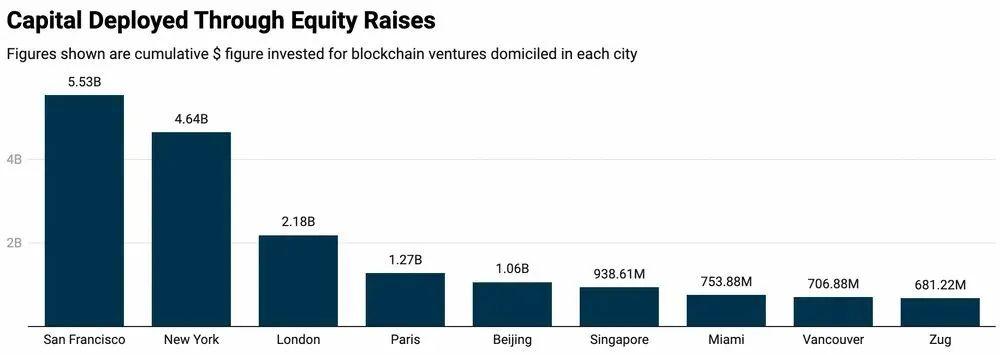
In my view, San Francisco and New York attract a lot of capital inflows because they are home to a lot of talent in capital markets and technology. However, the global boom of unicorns in the blockchain industry has yet to come. Given the lagging nature of the capital investment market in terms of venture capital, there is every reason to believe that billions of dollars of future funding for blockchain-related companies could occur in Southeast Asia and Europe. As U.S. investors exit, in part through ipos, traditional investors in Europe and Southeast Asia become more willing to invest and will hunt for lower prices in the industry. As a result, the amount of financing for other ecosystems will rise accordingly.
follow-up
Next, I will make a summary of the above text and charts:
1. Seed funding has not increased in frequency, but it has nearly doubled in size. Now, the signals sent by early supporters are more important.
2. This year 75% of the money is in 5% of trades, and the power-law distribution is going to get more extreme.
3. The Crypto funds you see on Twitter are not going to determine the future of the industry at a later stage. Power brokers are becoming established investors with the human resources and capital needed to invest billions of dollars.
4. We are moving towards the era of large-scale use of blockchain applications in the retail industry, and the financialization of the blockchain industry has become a reality in the past few years, laying the foundation for the purchase and transaction of assets such as NFT. Now we need users to join us.
For fund managers and founders in the ecosystem, the world has changed dramatically. Previously, it was enough for them to understand the development of the Token economy and do the basics of marketing, listing on exchanges and community building. At that time, there were many unknown risks in the field, so there were not many competitors for the early entry.
It is now a "consensus" that the move to Web3 is a smart move, just as it was with the Internet in the early 2000s. In other words, when a move moves from risk to consensus, the whole picture changes. From a financial perspective, this is the equivalent of a hot trade. There will be an exponential increase in the competitiveness of startups and a significant increase in the amount of money invested in these companies. Discussions on Twitter about the role of venture capital in digital assets are often bitterly divided between established investors and new entrants. Much of their disagreement is over whether VCS should exit after their early investments, or continue to invest more and end up investing more than the founders invested. When a fund like Tiger Global is spending $4 million on P2E games, you know the industry is growing and it's time to change.
In my article on ecosystem funding scale in Q1 2021, I suggested that the division's expertise would drive the annual return on investment, and it did.
The fund has been finely differentiated around the following points:
1. Developer and governance knowledge acquisition -- 1KX is an incredible example
2. Geographical visits
3. Industry knowledge (e.g., building primitives for DeFi and helping it expand)
I think in the future, for early-stage venture capital backers, they will probably do all of the above. For example, a venture capital fund may not be the best fund to invest in India, but it knows best how to extend the DeFi primitive in a regional regulatory environment. Instead of blindly chasing the success of every early deal, you should draw these Venn diagrams to figure out what works best for you, because the survival rate of blockchain-related businesses is as low as, or even lower than, traditional startups.
(Side note: I'll post some numbers on this soon)
So what should founders do? With the continuous influx of capital, the industry will become more and more competitive. In the market bubble of 2021, being "on the chain" will help you raise more money, but with fOMO and burnout easing next year, things will change. Capital will dry up as people stop worrying about missing out on investments, and labour-market prices will rise further as they stabilize their burnout. We are now moving towards an era where major players in each field have effectively transferred some ownership to their communities, with Uniswap and ENS being prime examples. Next year, the strongest driver of growth must be through providing space for community development so that wealth can be created for all stakeholders. If you don't believe that, consider why Axie Infinity is the hottest P2E game brand of 2021.
I'll explain how this theory forms the basis of Web3 in my next article on imitation theory.
The original link
Welcome to join the official BlockBeats community:
Telegram Subscription Group: https://t.me/theblockbeats
Telegram Discussion Group: https://t.me/BlockBeats_App
Official Twitter Account: https://twitter.com/BlockBeatsAsia

 Related Articles