Cross-chain NFT ENVELOP how to solve NFT three problems?
Dec 20th, ENVELOP CROSS Chain NFT ENVELOP CEO Alex Shedogubov did an online chat with users to finish it off with: "ENVELOP: Wrapped NFT will be a New Direction ", explains what problems wNFT technology can solve, why Wrapped NFT is a new direction in the market, and shares my views on the current development of NFT.
ENVELOP is a cross-chain protocol that supports storing NFT as a cryptocurrency or other NFT. You can add any digital asset to AN NFT using this protocol. These assets, also known as collateral, range from static to dynamic, with a customized preset fee charged for each transaction and stored in a vault for later retrieval.
The following is a transcript of the online conversation
BlockBeats: Please introduce yourself first. How did you get into the NFT field?
Alex Shedogubov:Our team has diverse experience, consisting of professionals with blockchain, crypto trading and start-up backgrounds, which is our strongest and core competitiveness. Our team members have over 8 years of professional experience in the crypto industry and 15 years of management experience in fintech, e-commerce, IT consulting and other fields. In addition, we have successful high-tech project start-up experience. Having such a team will help us succeed in this emerging market.
Since we often exchange ideas with each other -- in the fall of 2020, we saw the rise of NFT and saw the lack of hedging tools for NFT depreciation -- we came up with an idea for the initial phase of the project.
BlockBeats: Why do Envelop? What problem are you trying to solve?
Alex Shedogubov:First of all, we chose to create ENVELOP because we saw that there were issues in the market that were preventing further development and innovation in the industry. Broadly speaking, the problems are: currency devaluation, liquidity and royalties.
We did a bit of a brainstorming and came up with a protocol that addressed it, and it was ENVELOP. It is a flexible cross-chain toolset that provides new functionality for any NFT (economic Settings, on-chain royalties, leasing mechanisms, time/value/event locking), an anti-fraud system for depreciation protection, and can be easily implemented in GameFi, Marketplaces, Art, metasexes, and unsecured NFT leasing.
BlockBeats: What is ENVELOP?
Alex Shedogubov:Envelop is a DAO built in 2020. It consists of four elements: protocol, Oracle, index, and Token.
The "Agreement" protects NFT purchasers from complete asset depreciation by creating a collateral storage facility and applies only to on-chain activities.
The Predictor protects users by analyzing the on-chain and off-chain behavior of assets within the NFT. It creates a map of NFT casting generation, transfer, freeze, and other transactions. In addition, Oracle considers the major players associated with NFT: issuers (publishers), distributors (platforms, etc.), buyers, etc.
The Predictor also includes a scoring system for evaluating assets, as well as an anti-fraud system. On the one hand, it can notify the owner of changes to the asset data embedded in wNFT; On the other hand, it provides complete information to all parties involved in transactions such as buying, selling, leasing, and pledging.
"Index" aims to tokenize market segments and industries by using secured wNFT as micro index; The summation of wNFTs can provide industry data, summation of industry indexes, market indexes, etc. At the same time, the final index is not directly linked to any fiat currency basket or cryptocurrency assets as it is merely an objective indicator of the NFT segment.
BlockBeats: Can you explain wNFT technology in more detail? What can wNFT pack? What problems can be solved?
Alex Shedogubov:As a cross-chain protocol, Envelope allows your NFT to be used as a store for other cryptocurrencies or NFT. It also allows creators to add some unique Settings to their NFT.
For example, increase royalties, replenish internal coffers with transaction fees, or add a temporary time lock on deposited assets. Envelop solves 3 main issues in the market: devaluation, liquidity and royalties.
The depreciation part includes the ineffectiveness and opacity of NFT price discovery mechanism; Most NFTS lose value in the medium term; The purchaser does not obtain any financial benefit/guarantee from the purchase of the NFT.
Isn't it great that Envelope solves all these problems and makes the market better?
BlockBeats: How does Envelop help NFT to improve liquidity and solve royalty issues?
Alex Shedogubov:Liquidity issues mean that most NFT sales are complicated because there is not enough liquidity in the market; The existing NFT liquidity pool is not good for prices; There is no guarantee that NFT products will be sold.
When we talked to artists, another big issue they mentioned was royalties. The author can only earn royalties in the market where the NFT is minted, but the market does not set royalties in advance.
As a flexible cross-chain toolset, Envelope can provide any of NFT's new features (economy Settings, on-chain royalties, leasing mechanisms, time/value/event locks) to protect a devaluation anti-fraud system. It is now easily available in GameFi, Marketplace, Art, Metaverse and NFT Rentals.
Thus, the project creates a complete insurance cycle for NFT users at each step in any form of relationship: NFT derivative leasing, transfer, mortgage, direct buying and selling, exchange, tokenization, etc. In this case, not only individuals and legal entities can be participants, but also any active object: scripts, networks, AI, and other NFT publishers.
BlockBeats: Envelop How does it work? How to help NFT assess value?
Alex Shedogubov:The predictor includes a scoring system for evaluating assets, as well as an anti-fraud system that notifies owners of changes to the asset data embedded in wNFT; On the other hand, it provides complete information for the parties involved in the sale, lease and pledge transactions.
BlockBeats: Envelop Token economy? What is the use of Token in ecology?
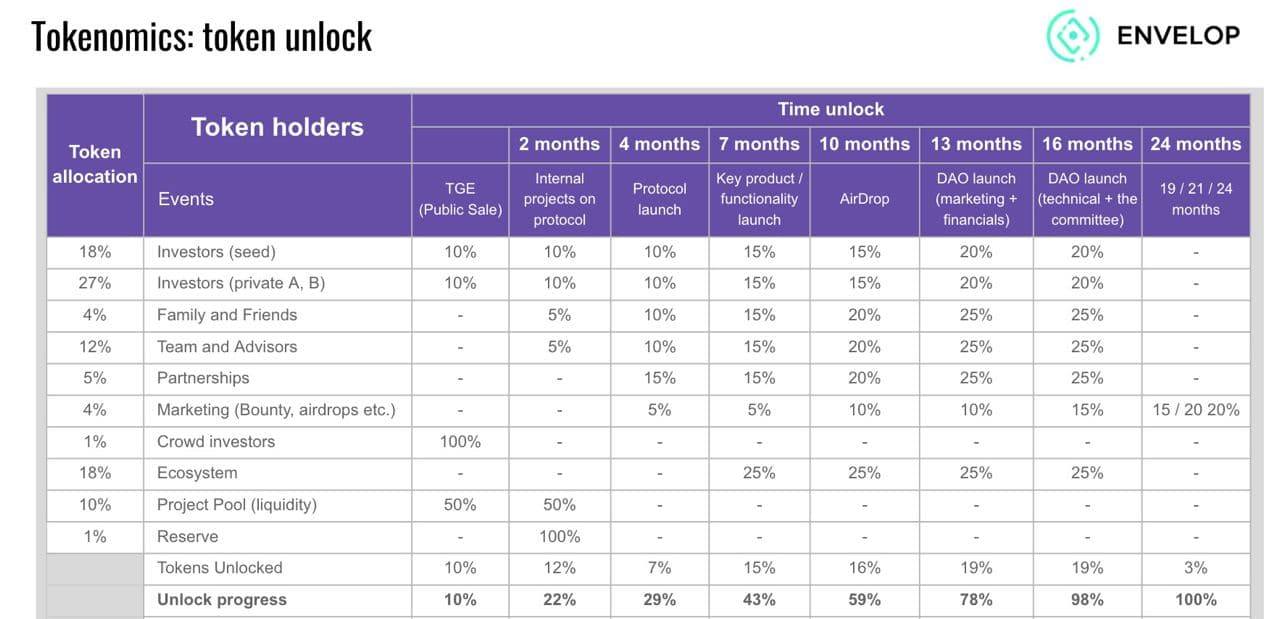
Alex Shedogubov:Token is a connection element of protocol, Oracle, and index that can be used.
Externally, through the structure of a micro DAO, when everyone can become a member of such a DAO through NIFTSY pledge, the portion of expenditure and possible income is distributed in proportion to the contribution. Internally, royalties can also be paid using NIFTSY tokens, but they are not required. Here is our Token allocation table:
BlockBeats: How do you see the current development of NFT? Is there a bubble?
Alex Shedogubov:As we mentioned earlier, we have identified several issues such as depreciation, liquidity and royalties.
Depreciation includes that NFT's price discovery mechanism is not efficient and transparent; Most NFTS lose value in the medium term; The buyer receives no financial benefit/guarantee from the purchase.
Liquidity problems mean that most NFT sales are complicated because there is not enough liquidity in the market; Existing NFT liquidity pools offer poor prices; There is no guarantee that NFT will be sold.
When we talked to artists, another big issue they mentioned was royalties. The author can only earn royalties when casting NFT, subsequent transactions are not profitable, and there is no advanced setup for royalties in the market.
All these problems seriously hinder the healthy development of NFT market and ENVELOP project is committed to solve the direction.
BlockBeats: Envelop Any plans in the near future?
Alex Shedogubov:We've already signed deals with PureFi, DotOracle, DeathRoad, WOW Summit, and ScaleSwap. Beyond that, we can't reveal the names of our other partners, but you can subscribe to our channel for updates.
Our CBDO, Alexander Kuzin, is working hard to bring in as many partners as possible to help us not only develop Envelope, but to further grow the entire ecosystem.
That's the end of this conversation.
Welcome to join the official BlockBeats community:
Telegram Subscription Group: https://t.me/theblockbeats
Telegram Discussion Group: https://t.me/BlockBeats_App
Official Twitter Account: https://twitter.com/BlockBeatsAsia
 Related Articles