Future work will not be limited to enterprises, but also in DAOs and encrypted networks
The Future of Work is Not Corporate -- It is DAOs and Crypto Networks
原文作者: Ben Schecter
原文编译: 谷昱,链捕手
Recently, A16Z released on its official website. RabbitHole The article by Ben Schecter, head of operations, argues that with the development of encryption protocols, the future of mass employment is not enterprise but DAO, and the future of revenue is "X-to-earn".
"In a world of complex information and peripheral stakeholders, companies are no longer suited to help coordinate our activities. Encrypted networks create better consistency among participants, and DAOs will become the coordination layer in this new world."
The average person probably won't work for a company in the future. Instead, people will earn their income in non-traditional ways through activities such as playing games, learning new skills, creating art or curating content. This shift in the way we work is not unusual or unexpected -- the idea that most people would be employed by big companies seemed crazy to some in 1800.
This new future work is made possible by networks formed around cryptography protocols that are emerging as new ways to coordinate, measure, and reward contributions to complex ecosystems. This shift has begun to unlock new revenue generating potential for individuals and is leading to an increasing shift in value capture from organizations to people participating in encrypted networks as individuals.
The traditional way to make money is "work for money," but the future of income is "X-to-earn" -- play for money, learn for money, create for money, work for money.
However, this won't happen magically -- it will require new decentralized autonomous organizations (DAOs) that can coordinate all these new activities in the context of enterprise systems. This article provides a framework for understanding the options available for future work.
01
Limitations of the corporation as a coordinating mechanism
First, we need to explain the inadequacies of existing monetization models. Traditional corporate employment is rapidly becoming obsolete as a means of coordinating activities in the information age -- we are already seeing this in the emergence of alternative forms of income, such as influencers, contractors, creators, gig economy participants, etc. These ways of making money don't necessarily feel like "work," but they are all examples of people participating in complex networks as providers of personal value and earning income through their contributions.
However, these non-traditional opportunities are limited in number and often undervalue contributors when they are available. This is because these efforts are still based on the Web2 paradigm, in which the company continues to control the business model.
More and more traditional companies have "peripheral stakeholders". That is, an actor who blurs the line between internal and external members of the organization. Think of Apple and the developers, YouTube and creators who create Apps on the App Store, or Uber and their drivers -- participants contribute to the company's growth from the outside, but companies struggle to align incentives with those stakeholders.
As companies grow, they are no longer able to maintain sustainable relationships with these external network participants. The relationship between companies and players becomes a zero-sum game, and companies begin to extract value from these players in order to maximize profits.
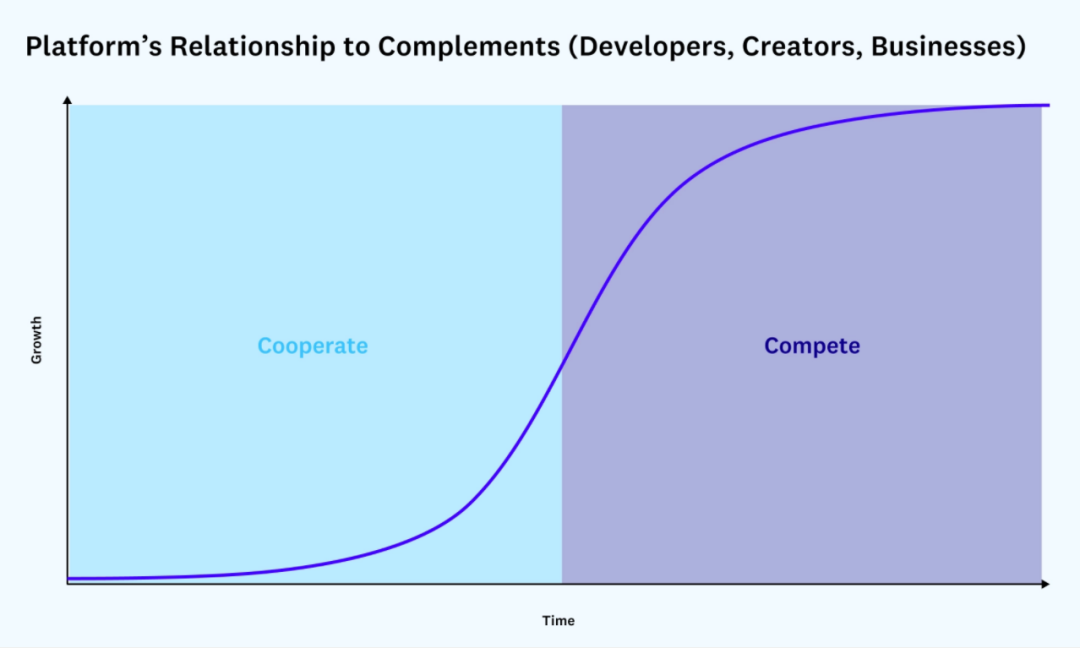
A firm model with rigid boundaries between inside and outside may have made sense in the industrial age, but in the information age it leads to misaligned incentives and unsustainable extraction. In our world of complex information and peripheral stakeholders, companies are no longer suited to help us co-ordinate our activities.
Cryptographic networks create better consistency among participants, and DAOs will be the coordination layer in this new world.
02
DAO as the new coordination layer
Daos will eventually replace traditional models. The DAO is an Internet native organization whose core functions are automated through smart contracts and made up of people who do things that automation cannot do (such as marketing, software development). In practice, not all DAOs are decentralized or autonomous, so it is best to think of DAOs as internet-based organizations that are jointly owned and controlled by their members.
Although DAOs are still in their early stages of development, they are no longer just a promising concept. They are real organizations that manage billions of dollars of capital, deliver real products and services to millions of people, and create new ways for people to make money.
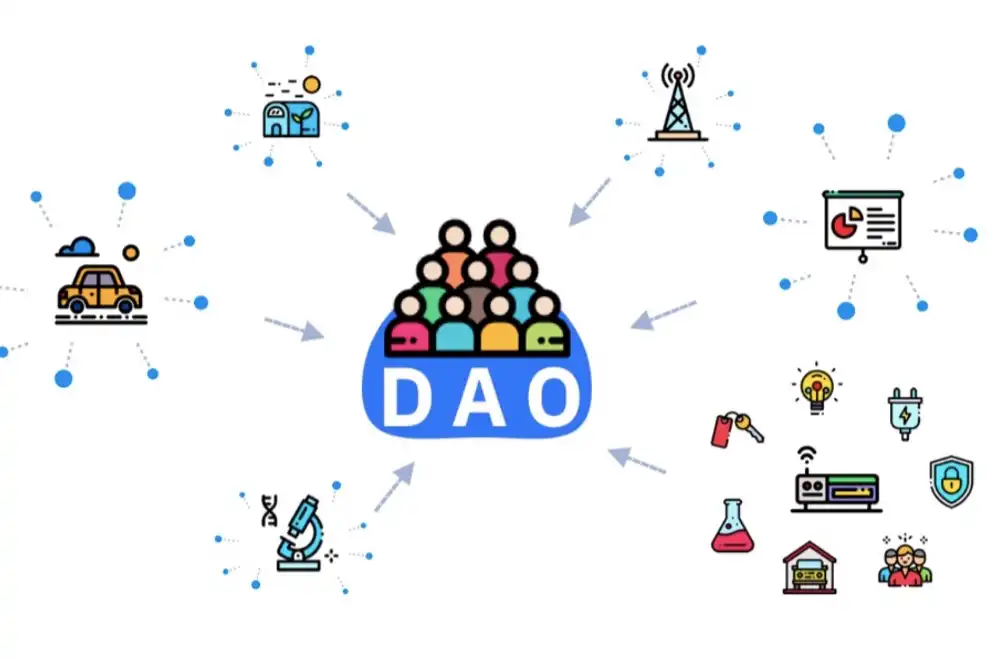
Here's a good overview of the current DAO landscape by Cooper Turley:
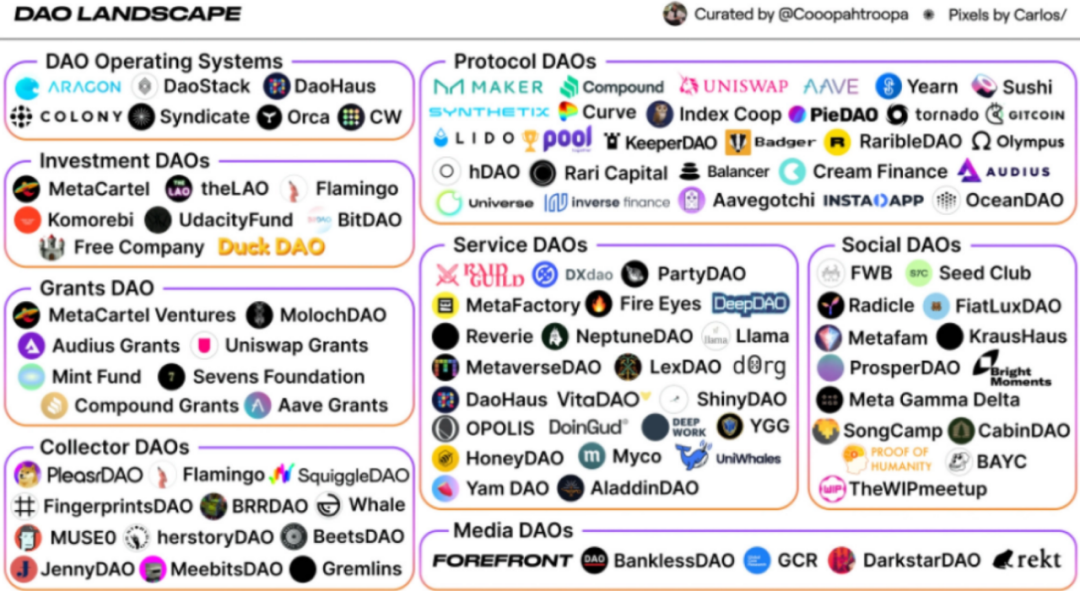
Daos come in many different types and sizes: DaOs that manage encryption protocols (protocol DAOs), DAOs that do venture capital (investing DAOs), DAOs that provide services to other DAOs (service DAOs), DAOs that buy NFT (collector DAOs), and many more.
But among all DAOs, there are some common threads that set them apart from traditional organizations (these are generalizations, so note that they vary from instance to instance) :
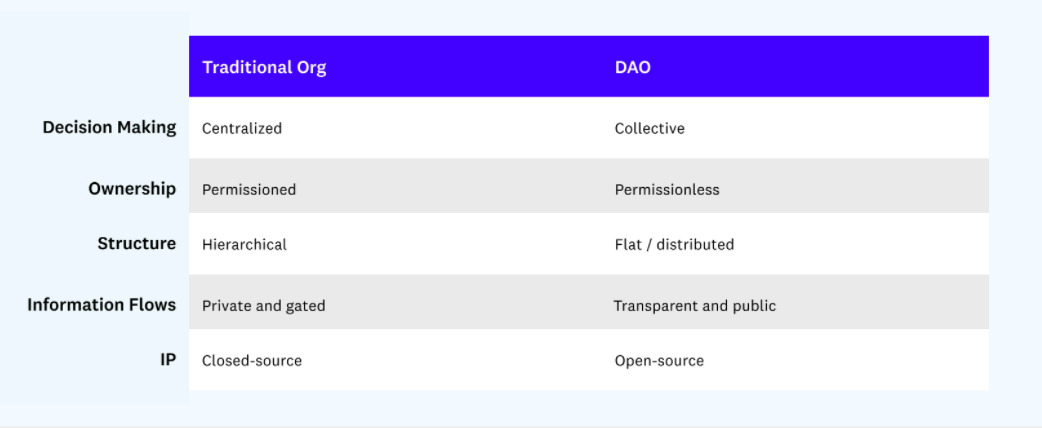
These elements that separate daOs from traditional organizations actually enable DAOs to establish a more symbiotic relationship with their stakeholders and participants. The DAO functions as an open economy, encouraging the accumulation of value wherever it is provided, not based on arbitrary legal boundaries. As Chris Dixon pointed out:
Encrypted networks use a variety of mechanisms to ensure that they remain neutral as they grow, preventing bait and switch from centralized platforms. First, the contract between the encrypted network and its participants is executed in open source code.
Second, they control through "voice" and "exit" mechanisms. Participants gain a voice through community governance, both "on the chain" (through agreements) and "off the chain" (through social structures around agreements). Participants can exit by leaving the network and selling their tokens or, in extreme cases, by branching out.
The DAO's structure is open and accountable in nature, a mandatory feature that shares value with the participants who create it. Otherwise, other DAOs will outcompete them, or their participants will leave to find other opportunities.
In fact, the best DAOs are those that reward participants and are the foundation of the ownership economy. This emerging positive-sum dynamic is the foundation of the X-to-earn trend that will shape future work.
03
DAO The future of work
To better understand the options available to people, we must explore the concrete structure of the DAO:
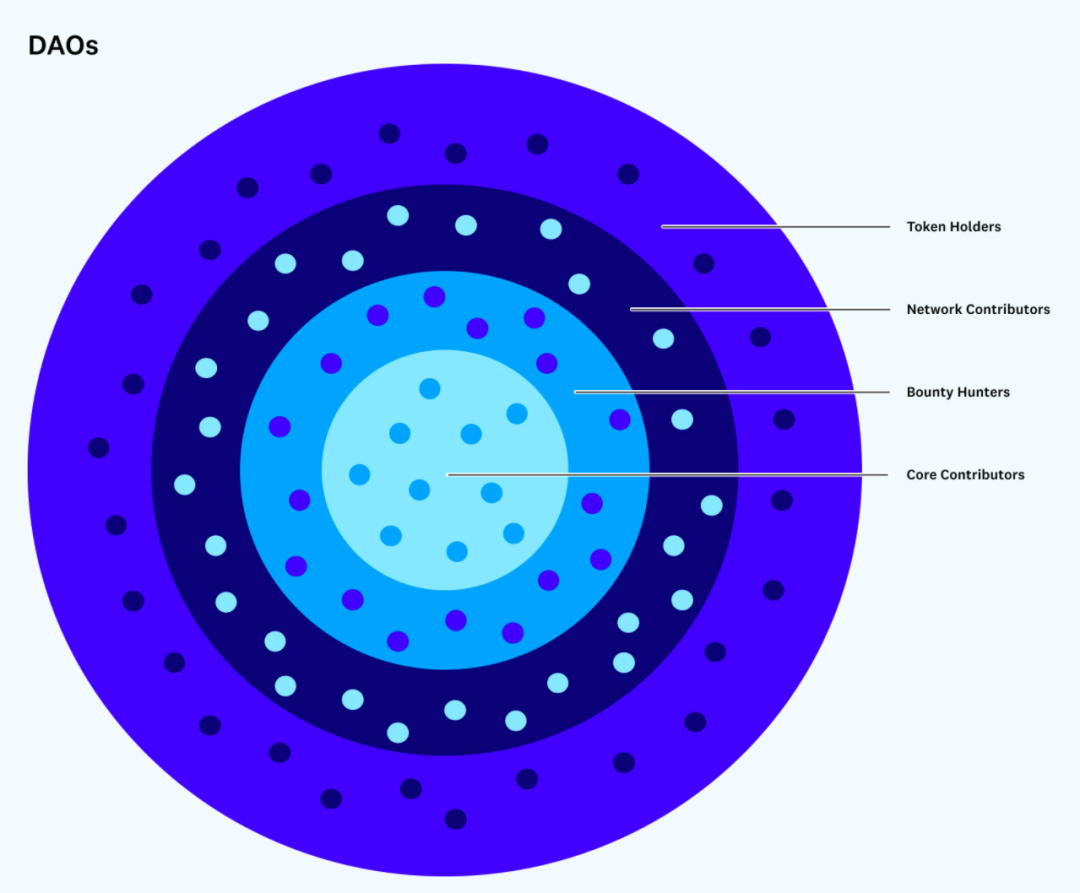
Graphic inspiration from Brian Flynn, Zakku and the Orbit team
The DAO as an open economy will drive the trend toward X-to-earn, which will make work more flexible, fluid, and fun than the 9-to-5 we're used to.
The openness of these crypto economies will allow people to participate in multiple DAOs and crypto networks, mixing and matching different revenue streams and ownership returns (remember, the best DAOs distribute ownership to their participants through their own native tokens).
People's income will be a mix of things we already do in our lives (e.g., playing games), things we think of as traditional work (e.g., bonuses/contracts), and things currently only available to a small percentage of people (e.g., investments, passive income). In other words, the DAO will expand the types and number of opportunities open to multiple types of participants, including token holders, bounty hunters, and core contributors.
For example, token holders may receive grants from major DeFi agreements, passive income income from various tokens, etc.; Bounty hunters earn by completing incentive on-chain actions; Network participants can earn money by playing Axie Infinity or other upcoming P2E games.
In this new future job, work will be more transient and dynamic -- switching costs between jobs will be lower, opportunities will be more visible, work will be reduced to more atomic units, and the whole world will be unified under a single workforce for all opportunities. We will identify new opportunities based on our chain history, ownership and reputation, and we will match our contributions to where we have the best comparative advantage.
Here are details on how participants can see money-making opportunities through the DAO.
Core contributors: work-to-earn
Core contributors are what we typically think of employees today -- people who work full-time on one (in some cases maybe 2-3) projects or organizations. A single focus enables individuals to immerse themselves in the project and accumulate contextual and strategic knowledge.
The need for dedicated and embedded workers will never go away, but in Web3, there will be far fewer of them than ever before. Software and, to a greater extent, smart contracts enable small groups of people to make a big impact. Instagram is 10 by Facebook; $100 million for a team of 13 people. This type of outcome will become common in the future, as the power of software automation and a larger network of smaller contributors will keep the number of core contributor team members in a small range.
Going forward, working for this team won't be significantly different from working for the company -- the DAO will still have core contributors whose interests are most directly aligned with the health of the organization. Because DAOs are more transparent than corporations, and can be held accountable by a larger community, there is, however, more pressure (think of the scrutiny of public officials).
Bounty hunters: contribute-to-earn
"Bounty hunters" perform well-defined work for an agreed price and/or duration. These people are typically functional experts in areas such as finance, development, and design, serving multiple DAOs simultaneously and performing specific tasks with clear boundaries.
The bounty is usually publicly posted for anyone to claim, and can sometimes be competitive, rewarding the best submission based on merit and value for contribution after the fact, rather than on a pre-application process or bidding war.
Many bounty hunters will band together to form their own service DAOs -- seeing these organizations as outsourcing help to DAOs who don't have the skills they need. These service DAOs appear to accomplish tasks that require functional knowledge, such as money management (for example, Llama), software development (for example, RaidGuild), governance (for example, Fire Eyes), and so on.
While bounty hunters and service DAOs may sound like contractors and professional service firms, they will be different and more popular among DAOs for several reasons:
Smart contracts will automate a large portion of the DAO's core functionality, leaving more peripheral work that is clearly defined, functively specialized, and well captured through the bounty.
While DAOs deliberately try to push work to the periphery to maintain decentralization and avoid large hierarchies, bounties create a sustainable way to do this.
The transparency of the DAO will reduce the coordination cost of the bounty.
Network participants: participate-to-earn
This is the latest, and perhaps the most exciting, part of the work ahead. In any given DAO, this is where most people will fall.
The web gains power with more activity and more participants, yet users, consumers, and participants have been adding value to the web for years without taking their share of the value (for example, Apple app developers, YouTube creators, and Uber drivers).
More like an open economy than a closed organization, daOs reward individual contributions based on the value they provide, regardless of who it comes from. This means that everyday activities that are valuable to the network translate into revenue opportunities.
Almost everyone can earn some income by simply living online, using products and participating as a user. Earning income feels like a game to people who are paid for participating in the network.
Play-to-earn
Play-to-earn is a new type of game model that rewards players for playing and achieving in a game. The traditional game model involves a unilateral transfer of value to the game creator or platform, while games earn games and reward users.
The function of playing money-making games is similar to that of an economy: players provide labor (their time and energy) and capital (often purchased NFT to participate in the game), and are rewarded with replaceable tokens for their achievements and progress in the game. Earning currency from games is nothing new, but rather than rewarding players with in-game currency that is limited to in-game use, the game is rewarded with in-game distribution of replaceable tokens that can be exchanged for other crypto tokens or fiat currency.
This means video game players can pay their bills through their in-game achievements, especially for people in countries with lower wages and living costs. The phenomenon has become a source of income for millions, especially through Axie Infinity.
Axie is a popular blockchain game in which players buy pets NFT (Axies), breed them, fight them and trade them. These actions take place within the game, but each user actually owns the Axies they bought or created. The game has exploded in popularity over the past few months, grossing more than 200,000 ETH in July and August (currently $860 million) (these numbers have since declined and are the subject of a heated debate I discuss below).
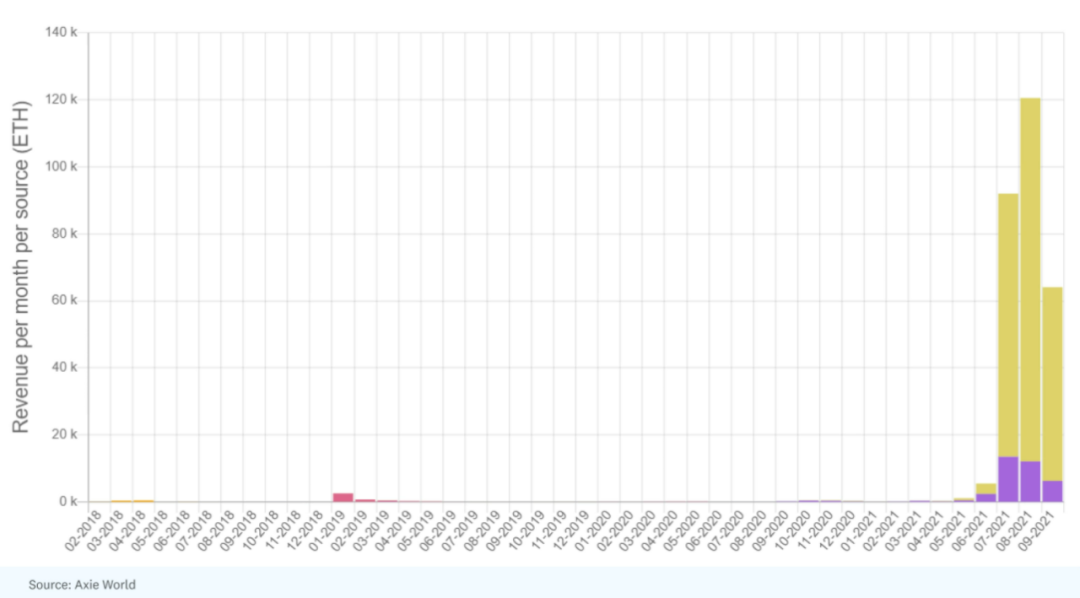
Credit: Axie World
This explosive growth is attributed to the incentive alignment between Axie and its users, which Axie describes as follows:
Axie has a 100% player-owned real currency economy. Instead of selling game items or copies, game developers focus on developing players into player economies and monetizing them for a small fee. Axies are created by players using in-game resources (SLP and AXS) and sold to new/other players. AXS tokens are held by governments that receive tax revenue. Game resources and items are tokenized, which means they can be sold to anyone, anywhere, in an open peer-to-peer market.
Axie opens the way to earning revenue, and more importantly, it opens the door to the larger X-to-earn trend, showing how people can earn revenue by contributing to the network.
Learn-to-earn
Learning-to-earn is a new model of education in which a person is actually paid for proving that they have learned something, rather than paying to Learn. This is possible when a person learns skills, knowledge or information that adds value to the network and the network is willing to fund learning.
On RabbitHole, encryption protocols pay for tasks that incentivize users to perform specific actions on the chain. When users complete these actions, they receive a reward from the agreement. While bounty hunters often contribute to the construction of agreements, these on-chain actions are often associated with participating in agreements.
This new positive-sum interaction helps all parties:
Users learn to use new skills or methods in the crypto industry and earn coins for them
Encryption protocols gain knowledgeable new users
RabbitHole gets a percentage of the revenue to facilitate interaction
This new model is similar to Google sharing a portion of their advertising revenue to learn about new products, or paying your university for strengthening their alumni network. In both cases, you were providing value to the network without being rewarded, but now you can.
Since its launch, RabbitHole has distributed over $750,000 in rewards, paid for by some of The largest cryptographic protocols (e.g. Uniswap, Aave, Compound, The Graph, Pool Together, and Polygon). While it's early days for this space, the potential for earning rewards through learning is huge when you consider the education and ad-generated revenue that users currently don't get.
Create-to-earn
Cryptocurrencies have created new wealth and digital scarcity, which has paved the way for the explosion of the NFT market in the past few months. This has provided artists around the world with the opportunity to make a living, and in some cases, a fortune passed down through generations.
But this is functionally no different than any artist getting paid when their work is successful. More interestingly, creators are paid for the added value they add to the network, not just the personal profits they make from their work.
For example, NFT marketplace SuperRare airdropped 15% of its tokens to early adopters, collectors, and artists on its platform in recognition of the role these value creators played in its early online success.
Audius is a decentralized protocol for music streaming that allows creators to earn substitution coins by uploading music and curating playlists. Audius grants ownership to creators for the value they bring to the network.
Token holders: Invest-to-earn
Anyone with an Internet connection and a crypto wallet will be able to invest in high-growth opportunities.
In a world where every network has a token, tokens are earned by participating in the network, the ability to buy tokens is permissive, and everyone becomes an investor.
Investment will become the main source of income for a growing number of people. Not every investment will appreciate, but individuals will have access to opportunities previously reserved for the few and will unlock a whole class of income-generating opportunities.
04
Start & have spent What does the future of DAOs and work entail
Only when DAOs become mainstream will X-to-earn opportunities become mainstream. Daos show a lot of promise, but they are still in the early stages and have a long way to go before future work can be implemented. In a recent survey of 422 DAO participants conducted by Gitcoin and Bankless, < 45% of respondents said the DAO was their primary source of revenue.
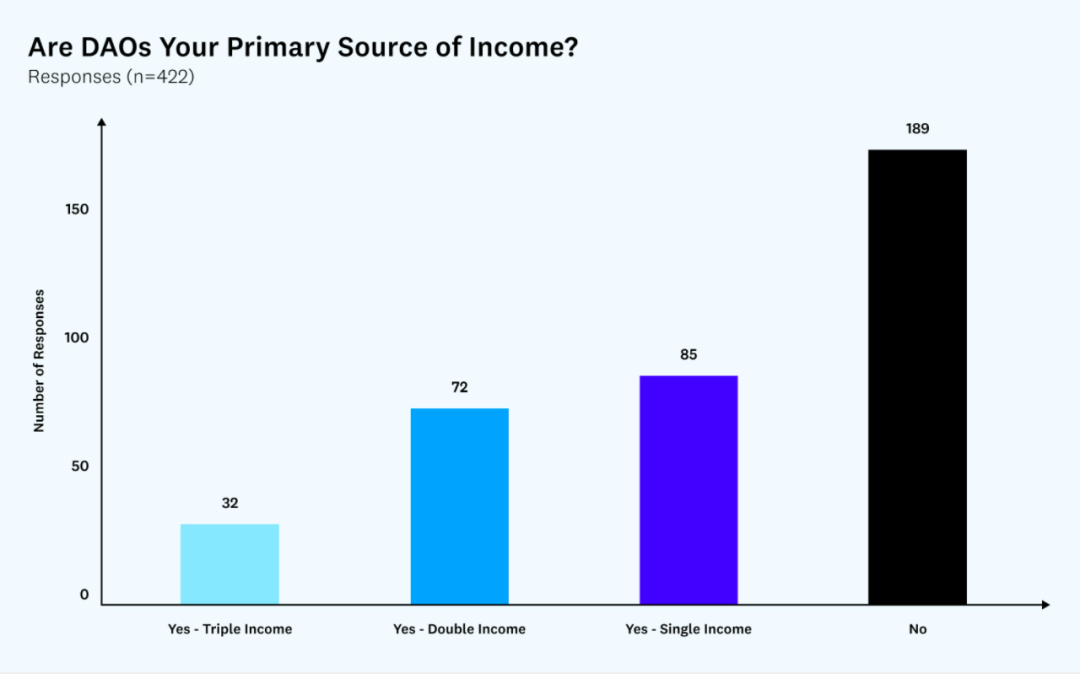
To make the DAO truly central to our efforts, we need to develop the infrastructure, tools, and systems that can support the DAO and its members.
Coordinate tool
Most DAOs currently rely on a combination of Web2 software that was not designed for DAOs, or very young Web3 software. In both cases, the DAO's needs are not fully met.
Daos have incredible potential to harness the power of decentralized networks and the collective intelligence of people, but they need better software tools to coordinate them. DAO will need tools to support governance (e.g., Snapshot, Orca), software collaboration (e.g., Radicle), money management (e.g., Parcel, Multis, Gnosis), discussion (e.g., Discourse), access (e.g., CollabLand), and more.
Of particular relevance to this article, one interesting area that requires new solutions is rewarding contributors. The DAO doesn't have a CEO or HR department to decide who should get paid, so new, decentralized ways are needed to determine how much value a person contributes and how much they should be paid for it. Some early but interesting solutions include having colleagues determine each other's rewards (Coordinape) and using algorithms to create contribution maps and calculate rewards (SourceCred).
Reputation System & NBSP;
Daos are open and permissionless, but new ways are needed to identify who to trust, collaborate with, and reward.
The traditional corporate solution is to have an extensive interview process, but that runs counter to the spirit of the DAO. Further complicating matters, many of the people involved in the DAO are anonymous. In this new world, DAOs need a new way to determine who to assign scarce resources to.
This highlights the need for an on-chain reputation system. On-chain reputation systems capture what happens to us on the blockchain: our contributions to the DAO, our governance voting history, our token holdings, and more. Ultimately, the reputation system will use these on-chain behaviors to predict our future behavior to determine who is trustworthy, credible, and consistent. On-chain reputation will replace the way companies currently use credentials, CVS and interview processes.
However, there are many privacy and security issues in tracking distributed ledgers of public activities associated with personal identity. Currently, blockchain identity is largely around addresses, but to make these reputation systems viable we will need more robust decentralized identifier solutions (e.g. Ceramic/IDX) and identity management.
05
Warning: About creating value and possible pitfalls
It is unclear how much revenue will be generated from these channels in the long run. X-to-earn doesn't mean that everyone can make art and play video games for a living.
X-to-earn is all about rewarding value where it was created. Daos make these non-traditional paths more sustainable and available to more people, but the market won't reward everyone. Market dynamics are still relevant, and to get a return you need to deliver value. Creators need to find an audience, gamers need to produce results, bounty hunters and contributors need to make an impact.
However, the ongoing debate around the sustainability and scale of certain revenue generation opportunities does not detract from the main theme of this article: creating value within the network should be rewarded, and DAOs will coordinate the return on value within the encrypted network to realize new revenue generation opportunities.
More broadly, the future of work will not be perfect. As with any major technology shift, there are usually positives and negatives. The DAO will lead to the same result. Here are some directions to watch:
Competitiveness and gap
Measuring and rewarding all contributions to the network will result in a more meritocratic allocation of resources. The flip side of meritocracy is a world in which the DAO actually adds to the power laws that the Web2 economy previously demonstrated. On Spotify, for example, the top 1.4% of creators earn 90% of royalties. Moreover, a truly global workforce with lower switching costs will only increase these competitive dynamics. If DAOs exacerbate this trend, how will people reconcile the increase in differences in results?
Cognitive overload
The processing power of the human brain is limited. The Dunbar number is a well-known limit on how many social relationships the human brain can manage, but the "DAObar number" is the DAO version of that concept: how many DAOs can one meaningfully participate in? Each subsequent DAO participation adds processing power to keep context and awareness of what is happening. DAO tools for communication and collaboration (discussed above) will try to mitigate this, but people may struggle with the extra overload.
State of separation
On the one hand, DAOs allow people to choose how they work and connect with communities where their values align. On the other hand, by reducing most work to atomic units and purely economic incentives, we risk reducing the meaning of people to purely economic rewards. We run the risk of turning work into discrete, meaningless tasks, in which Labour is reduced to goods and services.
A common metaphor is that the future has arrived, just unevenly distributed. This is certainly the case with DAO and future work. Every day, more and more people are joining DAO and working full-time on Web3. Daos are growing rapidly and are in great need of talent to help them achieve their mission.
The future of work is emerging in unexpected and fascinating directions.
The original link
Welcome to join the official BlockBeats community:
Telegram Subscription Group: https://t.me/theblockbeats
Telegram Discussion Group: https://t.me/BlockBeats_App
Official Twitter Account: https://twitter.com/BlockBeatsAsia

 Related Articles