APY 70,000%, DeFi 2.0 dominated by OHM forks

Article: 0x137@Blockbeats
就算是在币圈,7,000% 的年化收益也不是随处可见的,但你没有看错,它还是比标题里的 APY 少了一个零。自从 DeFi 进入了 OHM(Olympus DAO)引领的 2.0 时代后,以百分之千计位的 APY 似乎已经变得微不足道了。
Yes, APY's 70,000%, 17,000,000, and even 7,000,000,000 DeFi 2.0 protocols are now springing up across the public chain, taking OHM's core philosophy to a daunting level. Such horrific numbers have even the most voracious investors wondering where DeFi 2.0's sustainability comes from. Could they turn out to be Ponzi schemes?

一切的起源
在 2020 年底的 DeFi 夏天,各种去中心化平台用自己的原生Token奖励用户,以换取可支持流动性的资源,也就是我们熟悉的「流动性挖矿」(Liquidity Mining)。这种机制的问题其实很明显,协议通过奖励原生Token换来的流动性往往是不稳定的。头矿们将资源质押到协议中,抢占了绝大部分收益,随后便会撤回他们的资本,并将奖励的原生Token倾销到市场上,引发「矿难」。在短短几个月的时间里,无数新项目一次次地试图说服市场他们找到了不同的解决方案,但最终却割了一波又一波的韭菜。
However, since April this year, OHM has led DeFi into the 2.0 era with the banner of protocol-owned Liquidity. It is called 2.0 because it appears to overcome the liquidity instability of DeFi 1.0. OHM became the master of its own liquidity through a new Stake and Bond mechanism, which, according to statistics on its website, secured over 99% of the liquidity of OHM-DAI's bonds.
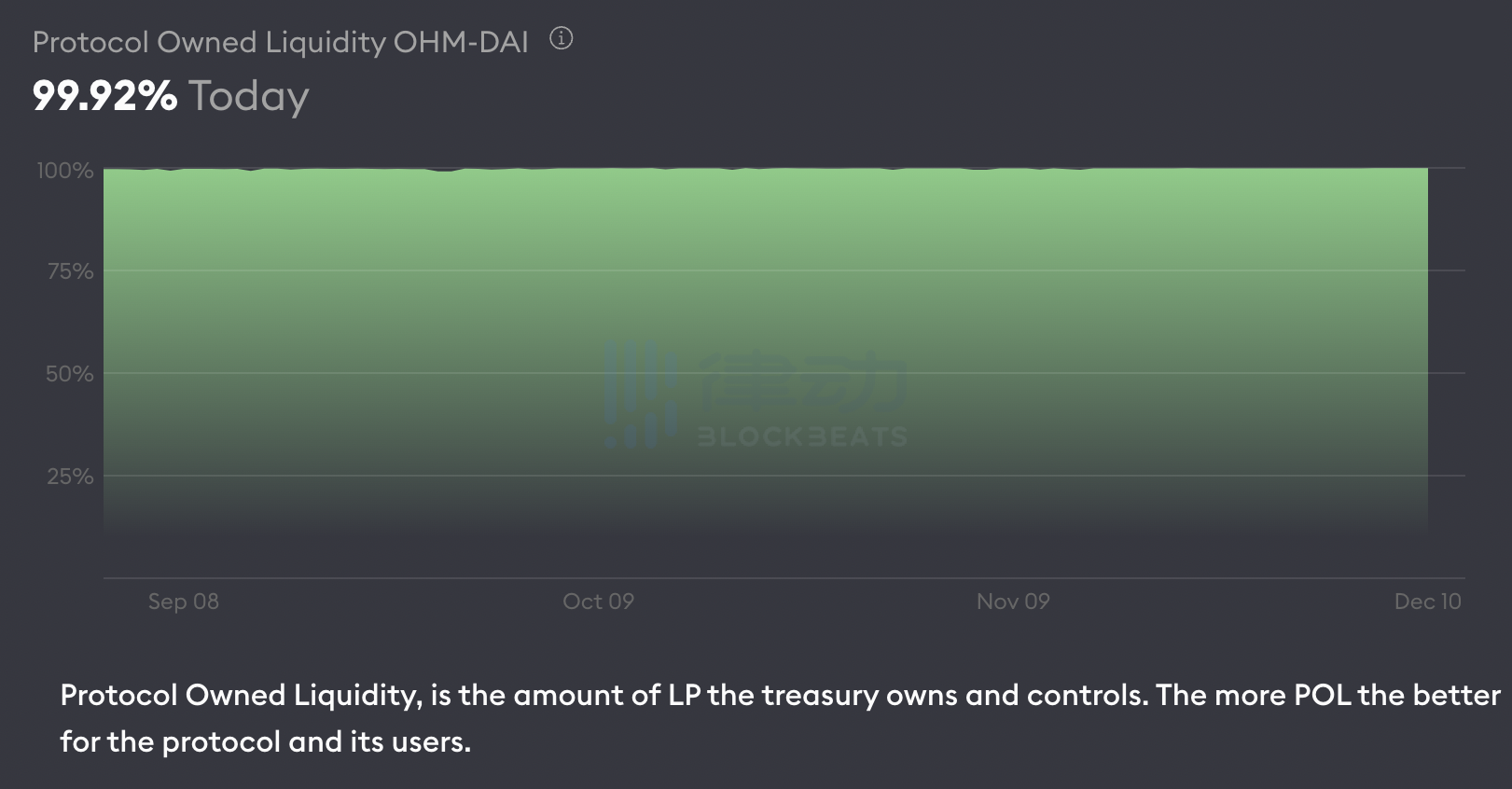
这一点对于 OHM 最终目标的实现极为关键,这个协议想要成为一种新的稳定币,它的价值有背书,但价格却不需要和特定资产挂钩,这时 PCV(Protocol Controlled Value)就显得格外重要,因为协议要有足够的资金实力来保护和稳定Token的价格。为实现这个目标,OHM 团队的策略是先扩张、后稳定:通过 bonding 吸收各种背书资产,同时赚取巨额套利费用(理论上一枚 OHM 只由一枚 DAI 背书,价值 1 美元),再用这些费用铸造新的 OHM,以高 APY 的质押激励分发给协议用户。这样一来就实现了协议的扩张,在协议的金库和社群达到一定规模后,理论上就能实现 OHM 价格的稳定。
The question is, how do you make sure users don't run away and stay on the deal for the long term? The biggest problem with DeFi 1.0 was that mine pool incentives fell quickly and liquidity was withdrawn quickly. But simply imagine that when APY of around 7,000 percent can be sustained for a long time, will there be mass user flight? No, after all, the user who is already staking wants more revenue, and the spectator, seeing APY staking, wants a piece of the action. This allows the user base and the pool of funds owned by the protocol to grow, and by the time the OHM distribution ends, the protocol's coffers will be strong enough to handle runaways and become a veritable new stabocoin.
OHM's mechanism for achieving savings returns while maintaining a high APY is genius, and the team's clever integration of game theory, the "3, 3" meme that's all over Twitter (a set of games in which all players choose mutually beneficial options). The principles and design are so sophisticated that it would take a separate article to explain them, but we'll focus on APY for now, as it's the one that started DeFi 2.0 revelry.
APY 的狂欢
Olympus DAO is now worth about $4 billion, according to DeFi Llama, and in less than a year that fantasy has become incredibly valuable. Like Uniswap in DeFi 1.0, Olympus's success spawned a whole bunch of forks in other corporate chains. By sacrificing part of the return on savings, APY loses its highest, only higher, and "3, 3" becomes "4, 4" or even "9, 9". While the only difference between most OHM forks and the original agreement is their ridiculously high APY, there are still some notable projects.
Wonderland(TIME)
Wonderland is another masterpiece of Daniele Sesta and the first fork of Olympus DAO. Built on the Avalanche public chain, it provides 70, 000% APY and is widely considered the most successful DAO fork to date. Daniele is actually no stranger to many DeFi frogs. He is the founder of cross-chain lending platform Abracadabra, He is also the driving force behind popular Avalanche projects such as Magic Internet Money (MIM) and Popsicle Finance. Like OHM on Ethereum, Wonderland wants to create a currency system controlled by protocol policy on the Avalanche ecosystem.
Wonderland is now part of the growing MIM ecosystem. Users can borrow new memos from Abracadabra using the TIME Token (MEMO) they are earning APY through Wonderland as collateral, essentially without canceling the pledge. The platform will then automatically repledge the MEMO to Wonderland, so that "3, 3" becomes "9, 9". Such a dynamic cycle will drive the expansion of Wonderland and MIM ecology in both directions.
In addition, Daniele announced on his Twitter feed that Wonderland will provide a startup pad for other DAOs, using OHM's allocation and funding model to give them the power to bypass vc funding altogether. It can be predicted that Wonderland will be able to achieve synergies different from OlympusDAO in the gradually mature MIM ecosystem.

Wonderland's strong ecosystem and community appeal is not unproven. The APY provided by the Wonderland protocol has held steady at around 70,000 per cent over the past few months. The deal has also grown rapidly since its launch in September and is now worth $1.8bn.
Klima DAO(KLIMA)
Klima DAO 提供的 APY 虽然「只有」35,000%,但它却是第一个获得 OHM 团队核心批准的"官方"分叉。KLIMA 把「加速碳资产的价格升值」作为既定目标,是一个以应对气候变化为核心的 DAO。一枚 KLIMA Token由一吨碳支持,协议会以购买的碳产品换取 KLIMA,以此「锁定」现实世界里的碳供应额。如果 KLIMA Token的价值增加,生产碳的成本也会增加,激励人们寻找更便宜的替代品。简而言之,Klima DAO 想通过 DeFi 机制对气候变化产生积极影响。
如果协议成功的话,Klima DAO 将在未来的碳经济中扮演"中央银行"的角色,管理着这种碳支持货币的货币政策,通过推动碳经济的增长,围绕 KLIMA 打造出一个新经济。我们可以想到,在一个开源透明的协议上开发和建设一个生态友好的经济体系,很容易得到新能源产业和全球气候专家的欢迎和支持。毕竟在当前注意力高度集中于金融革新的 DeFi 领域,KLIMA 提出的概念还是非常新颖的。
其实 Klima DAO 团队很聪明,他们抓住了投资者一个常有的心态:当投资者赚钱是以慈善事业为目的,或者说以慈善的名义牟利时,风险均衡和理性判断往往就会靠边站了。全球变暖无疑是我们当前急需应对的问题,对于投资者来说,在享受协议高 APY 的同时为气候变化做出贡献,似乎就是一笔很好的投资。这种心态也能从 KLIMA 的社群中反映出来,KLIMA 官方 Discord 成员目前已经超过了 33,000 人,要知道,现在就连 OHM 的社群,也只有 34,000 多人。
Rome DAO(ROME)
Rome DAO 是 Moon River 公链上的一个分叉,它也获得了 OHM 团队的支持,是这些分叉里最有意思的一个。
ROME 同样借用了 OHM 开创的激励机制,但更强调古罗马主题下的游戏化社群。Rome DAO 想要成为一个没有中央团队的 APY 角色扮演类社区游戏(APY RPG):社区成员将共同打造繁荣古罗马和 Rome DAO 的未来。通过投入 ROME 币,社群玩家可以在 ROME 即将开始的第一阶段故事 Campaign 中赚取武器、铠甲等 NFT 战利品,并不断提升等级。Rome DAO 还有几个专注于特定社区任务的"世家",每个「世家」都是 Rome DAO 里的一个子 DAO,玩家可以根据自己的喜好加入:
领事院——由政策制定者和潮流引领者组成,负责 DAO 政策的制定
混沌之屋——由 ROME 的合作伙伴组成,重点是将 ROME 推广到更广泛的各类 meme 生态中
葡萄屋——负责为 Rome DAO 举办各种活动并提供葡萄供应,是一个中立的社群
科克之屋——主要是结合罗马历史文化,为 ROME 创造各种 meme
森普罗尼亚之屋——主要专注于 DAO 产品和各类工程的设计
目前,ROME 协议提供高达 160, 000% 的 APY,在 DeFi 2.0 激励机制的推动下,社群能实现快速的增长,同时游戏化的治理也能保持 DAO 社群的长期活跃。可以说,Rome DAO 的未来还是很值得期待的。
Hector DAO(HEC)
Hector DAO 是 Fantom 公链上的分叉,但团队一直强调该协议是 OHM 的「勺子」(Spoon)而非分叉(Fork)。HEC 计划与 OHM 保持一种「竞争型合作」(coopetition)的特殊关系,在 OHM 的基础上进行创新,以建立一个惠及所有协议的金融体系。
但其实 HEC 唯一新颖的地方就是被团队称为「4, 4」的证券机制。通常来说,OHM 债券(Bond)会有一个锁仓期,协议用户只有在锁仓结束后才能用领取的 OHM 进行下一步操作。但 HEC 的「4, 4」证券机制可以帮用户在领取之前就自动参与抵押,获得额外的收益。
此外,HEC 也在建设和 MIM 类似的生态系统,允许用户借出和借入资产,以参加不同的 DeFi 项目。而协议则可以通过收取费用来扩充金库,并进一步提高协议当前 200, 000% 的 APY。
套索云
我们其实不难看出,这些 OHM 的分叉协议之所以愿意提供如此高的 APY,就是为了吸引更多的流动性和用户,然而过于离谱的 APY 也是绝不可能持久的。美好的 APY 叙事背后,隐藏着一个令人不安的事实:协议金库是用户依赖的最终后备方案,但它几乎没有任何实质意义。至少目前,协议广泛吹捧的「储蓄支持」(Treasury Backing)还没有被真正的触发过。我们假设一下,如果真的出现了银行挤兑或者黑天鹅事件,市场的抛售压力迫使 OHM 的价格低于金库储蓄中无风险稳定币的价值时,社群成员的信仰就很可能会陷入危机。这时协议再通过储蓄介入进行回购,真的就能挽救局面吗?
In fact, the current DeFi 2.0 protocol is like a Lassoing cloud, the value of the Token is the cloud, the vaults and "savings support" of the protocol are the mountain below the cloud, and the protocol devotees exist between the mountain and the cloud, and their belief in the "savings support" of the protocol tethers the cloud to the mountain. Prevent it from drifting into nothingness. The lasso cloud will inevitably disappear into the blue sky if the savings of the agreement are in question, or if users lose faith in the agreement.

这样的情况其实已经发生过了,譬如最近崩盘的 SDOG(SnowDog DAO)。在上链后不到十天的时间里,这个 Avalanche 公链上第一个 meme 币的价值暴跌了近 99%,从上链时的 6000 美元跌到了现在的 40 美元,可以说是雪崩平台上最惨烈的一场「血崩」。这次「拉地毯」行为(Rug Pull)引发了 SDOG 团队和公众之间的「口水战」。大家都认为项目方从一开始就有所隐瞒,而团队则辩解称这是一次「博弈论实验的失误」。
SDOG 是新生 DeFi 2.0 项目 Snow Bank 的储备货币,为此项目在初始阶段设计了一个营销计划:在规定的 8 天时间内,协议允许用户通过购买或质押铸造来积累 SDOG Token,但不能高于市价卖出。作为激励,项目方承诺会在最后一天以大幅超出Token单位估值的价格进行大规模回购。在短短 8 天时间里,项目的金库就迅速增长到了 4400 万美元。但整个回购过程,可以说是彻底的失败。在回购前一天,第一个地址以 10, 000 美元的价格购入了价值超过 180, 000 美元的 SDOG,并将其质押。但就在回购开始几分钟前,这一地址却以约 55, 000 美元的价格(超出市价)将总计 187.8 枚,价值约 1040 万美元的 SDOG 在协议中抛售。另外两个地址以同样的方式,最终让协议金库损失 2000 万美元,瞬间使其失去了回购的能力。
很显然,项目方事后的解释无法掩盖其背后的阴谋,这就是一场精美的骗局。在「协议拥有流动性」的 DeFi 2.0 时代,高 APY 带来了极度的 FOMO 情绪和非理性的行为,用户和协议也互换了位置,协议的承诺和用户彼此之间的信任似乎成为了投资者唯一的依靠。
时代创新还是庞氏骗局?
OHM 起初的设想,包括金库扩张、协议控制流动性、稳定货币价格等,正慢慢成为一场大型经济实验,所有人都希望 OHM 能成为真正的去中心化新型储蓄货币。对于这些 DeFi 2.0 协议,提供持久的高 APY 是迅速扩张、实现稳定的关键法宝,但入如今它陷入了一个生存悖论:唯一能证明自己可以长命百岁的方法,就是一直活下去。而就目前来看,解决这一难题的方法不是更加复杂的工程,而是简单的信念。
我们可以从上文提到的项目中看出,社群基础和信念在 DeFi 2.0 协议持续运转的过程中扮演着极为重要的角色。Token持有者坚持 HODL,社群成员和旁观者信心增加,才会有越来越多的人参与。分叉其实代码很容易,但建立强大的储蓄和社群基础却很难。然而大多数 OHM 分叉彼此之间实际上并没有太大的区别,也没有提供任何创新或附加值。
In the current environment of "metasexes", NFT, DAO and other concepts, DeFi's attention is still being compressed, but it still has a long way to go in the future. Will the DeFi 2.0 wave set off by OHM and its followers eventually become the innovation of The Times, or become a Ponzi scheme? Perhaps only time will tell.
Welcome to join the official BlockBeats community:
Telegram Subscription Group: https://t.me/theblockbeats
Telegram Discussion Group: https://t.me/BlockBeats_App
Official Twitter Account: https://twitter.com/BlockBeatsAsia
 Related Articles