From "Summer of DeFi" to "DeFi 2.0", about the improvement of liquidity incentive scheme
Original title: "DeFi 2.0 and Liquidity Incentivization"
Original author: Chainlink
Original compilation: Yangz, Tao of Yuan Universe
Summary:
· The first "currency Lego" of the DeFi ecosystem, such as LP Token and the decentralized Stablecoin, have created conditions for the further development of DeFi.
· DeFi 2.0 is a new term in the ecosystem, mainly referring to the emerging protocol subset built on the original currency LEGO to advance the current DeFi ecology, mainly based on liquidity supply and motivational forms.
With the addition of these new financial primitives, the entire DeFi economy is rapidly becoming friendlier, safer, and more accessible.
Decentralized finance, commonly referred to as DeFi, is the most influential of blockchain-based innovations Powerful and one of the most successful waves. Driven by blockchains with built-in smart contract capabilities and secure oracle networks such as Chainlink, DeFi refers to a wide range of decentralized applications that disrupt existing traditional financial services and unleash entirely new financial elements.
DeFi protocol, driven by its inherent advantages of permissionless combination and open source development culture, is being Continuously promote and iterate mature models based on financial protocols. The DeFi ecosystem has developed at lightning speed, and in the past few months, the rise of liquidity-focused DeFi projects has brought about a new round of DeFi innovation, namely DeFi 2.0.
DeFi 2.0 is an emerging term within the larger blockchain community that primarily refers to DeFi A subset of the protocol that builds on previous DeFi advances like yield farming, lending, etc. A major focus notable in DeFi 2.0 protocols is overcoming the liquidity constraints faced by many on-chain protocols with native tokens.
This article considers past innovations that created the conditions for the DeFi 2.0 movement and introduces DeFi 2.0 The liquidity problem that the protocol is trying to solve, and then digs into the utility and new financial models introduced by the DeFi 2.0 ecosystem.
1. Early DeFi Development
Early DeFi pioneers, such as Uniswap, Bancor, Aave, Compound, MakerDAO, etc., have built a solid foundation for the developing DeFi economy and provided the ecosystem Introduced many key and composable "currency Lego".
Uniswap and Bancor are the original decentralized automated market makers (AMMs) for users Provides the ability to seamlessly exchange Tokens without giving up dragging. Aave and Compound introduced decentralized lending, providing on-chain income for deposits, and access to working capital in a permissionless manner. MakerDAO enables ecosystem users to hold and trade decentralized Stablecoins, providing a hedge against cryptocurrency volatility.
Through these agreements, users can obtain a reliable trading platform, frictionless lending and stable Linked currency - these are the three core financial elements that widely exist in traditional financial markets. However, the infrastructure behind these familiar DeFi-based services is nothing like centralized organizations in terms of transparency and user control. The various technical implementations behind these decentralized services are the cornerstone of DeFi innovation.
DeFi innovation in series
A central example of blockchain-specific DeFi innovation is the automated market maker (AMM) liquidity provider in a decentralized exchange (DEX) protocol (LP) Token. While DEXs effectively act as an alternative to centralized order book trading platforms, the most popular DEXs employ an AMM model known as a Constant Product Automated Market Maker (CPAMM).
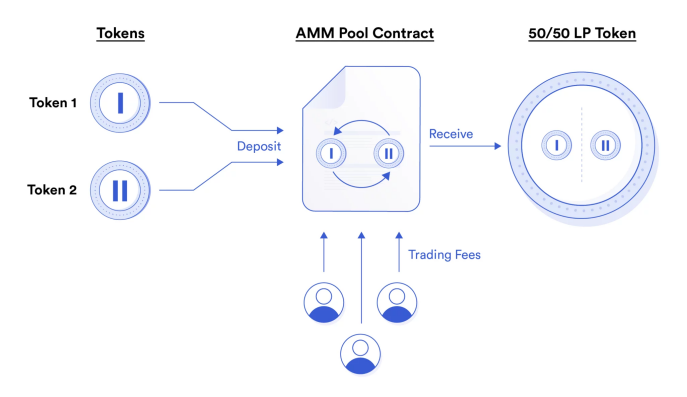
The decentralized liquidity pool in AMM is used to facilitate Token exchange, where individual flows Liquidity providers typically offer an equal amount of each cryptocurrency to contribute to an exchange pair's liquidity pool. In return, they receive an LPToken representing their share of the liquidity pool and fees from facilitating the exchange.
< /p>
LPTokens sparked a cascading flow of DeFi innovations as they were quickly adopted by other DeFi protocols in multiple ways. For example, lending protocols like Aave and Compound iterated on the idea of giving users receipt tokens representing underlying deposits, now known as aTokens and cTokens.
The permissionless nature of AMMs and LPTokens also empowers DeFi startups, which no longer require Launch Token through the listing process of the centralized trading platform. If there is enough liquidity, the newly launched token can be traded on the DEX immediately. However, if there is not enough liquidity, the Token exchange function of DEX will become limited in utility. Due to the existence of slippage, users need to pay astronomical prices for large exchange. This leads to one of the most prominent problems that exist in DeFi right now: the problem of liquidity.
2. Liquidity issues
Since the early days of the DeFi economy, liquidity has been a source of frustration for many emerging DeFi projects. The entire ecosystem is guided by tokens, which serve as a way for teams to align incentives for participants, collect rewards from user fees, and become an integral part of a larger DeFi ecosystem. However, in order to provide users with a strong source of liquidity to trade their tokens on the AMM protocol, DeFi teams need access to a large pool of funds.
Part of the answer to this question is found in the third-party liquidity providers of the AMM protocol , through which any independent person with sufficient funds can provide liquidity for a Token pair, so that the team can obtain sufficient liquidity from others instead of providing liquidity themselves. However, end users have little incentive to bootstrap liquidity for new tokens, since that means exposing themselves to short-lived risk of loss in exchange for minimal fee income on the exchange. They need a solid financial reason to take that risk.
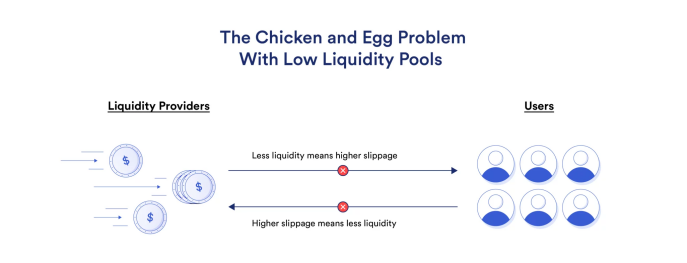
This leads to a chicken and egg problem. Without sufficient liquidity, the slippage caused by swaps can make users reluctant to participate in the ecosystem of DeFi protocols. Without users participating through token transactions, there will not be enough fee volume generated to incentivize third-party actors to pool their tokens and provide liquidity.
And thus, another key DeFi innovation was born. LPToken-based rewards have become the main way for new DeFi protocols to guide liquidity, a process known as yield farming.
Income farming
The emergence of yield farming (also known as liquidity mining) has caused a surge in DeFi activities in the summer of 2020, and has been dubbed "the king of DeFi" by blockchain enthusiasts. summer".
The idea behind yield farming is simple. The user provides liquidity for a trading platform pair on the AMM protocol, and after receiving the LPToken, pledges the LPToken to obtain compensation issued with the original Token of the project. This implementation solves the chicken-and-egg problem, and provides third-party liquidity providers with a convincing economic reason to provide liquidity for Token: more benefits. In addition to generating greater cumulative fees in AMM swaps, under the incentive of deeper liquidity, they can obtain more benefits by staking and obtaining more project native Tokens.

With the introduction of yield farming, new DeFi projects are able to channel enough liquidity to start and maintain operations and reduce slippage for users entering their ecosystems. This has led to an exponential growth in the number of DeFi protocols, which also confirms that yield farming lowers the entry barrier for users and founders of DeFi projects.
Limitations of Yield Farming
Although very effective, it does not completely solve the liquidity problem by itself due to the special limitations of long-term yield farming schemes. Yield farming does an excellent job of bootstrapping initial liquidity, but it must be premised on long-term planning to ensure long-term, sustainable liquidity.
This is because yield farming has an inherent characteristic of supply dilution. The founding team distributes native Tokens to liquidity providers and provides additional revenue sources to encourage liquidity providers to lock their liquidity in the AMM pool. However, as more tokens are allocated to third-party liquidity providers, an increasing proportion of the total token supply is given to leased liquidity, and liquidity providers are able to remove their liquidity at any time, and Sell the LP staking rewards they earn. The DeFi team cannot be sure whether liquidity providers will stay if the staking rewards dissipate, and keeping staking rewards at a high level for a long time will increasingly dilute the supply of native tokens.
As projects increasingly seek to scale to different cross-chain AMMs, or even the same The AMM protocol on the chain needs to take various income farming measures on different trading platforms to establish a deep liquidity pool for each project. This exacerbates the aforementioned constraints, as emerging DeFi projects must finely balance supply expansion to numerous AMM protocols—but they often don’t have the manpower, means, or information to do so effectively.
Third party liquidity providers must be incentivized A certain amount of liquidity is provided. As newly launched tokens tend to have higher volatility, the risk of impermanent losses increases, offsetting the benefits of AMM protocols’ transaction fees and yield farming schemes. This represents an inconsistent incentive structure for third-party liquidity providers who do not have many options to manage the risk of providing liquidity and yield farming.
Yield farming is an influential way to channel liquidity for DeFi projects, but It's not without long-term risks. For most DeFi projects, running yield farming programs and channeling liquidity is necessary and healthy, but project teams must pay attention to their token supply and long-term strategy to avoid negative impacts.
3. DeFi 2.0 and the pursuit of sustainable liquidity
In terms of liquidity, DeFi 2.0 refers to some emerging DeFi projects, which hope to completely solve the problems related to liquidity supply and incentives Frequently asked questions about. They provide an alternative and complement to the yield farming model, giving projects a way to sustain a long-term source of liquidity. However, how exactly does a blockchain-based native Token project maintain healthy liquidity and distribute it in an ideal way?
OlympusDAO and Protocol Owned Liquidity
In 2021, a solution rising in the DeFi community is OlympusDAO's bond (bonding) model, which focuses on protocol-owned liquidity (POL) .
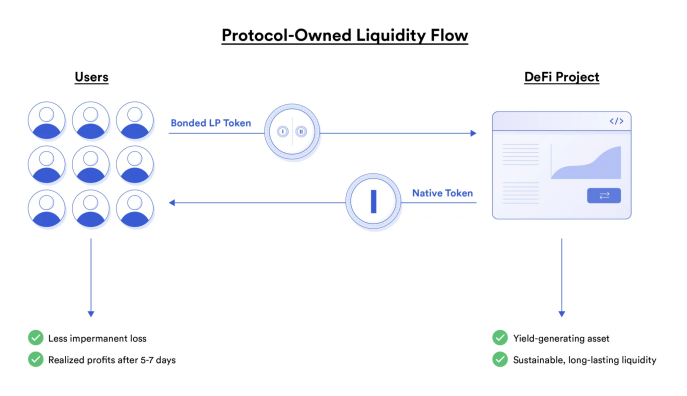
With its Bonding model, OlympusDAO flips the script for yield farming. OlympusDAO did not rent liquidity by expanding the supply, but used bonds to exchange LPTokens at a discounted price from third parties in exchange for the original Tokens of the protocol. This provides advantages to the protocol and any project that uses it (e.g. Bonds-as-a-Service). Through bonds, the agreement can purchase its own liquidity, eliminate the possibility of liquidity exit, and build a durable pool, which can also generate income for the agreement.
< /p>
On the other hand, users are incentivized to exchange their LPTokens via bonds because the protocol provides a discount on the tokens. For example, if the price of TokenX is $500 and the discount is 10%, a user can bond $450 worth of LPTokens to get $500 of TokenX. The result is a net profit of $50, depending on the short vesting timeline (usually around 5 days to a week) to prevent arbitrageurs from extracting value.
Another key aspect of liquidity-focused bonds is that bond prices change dynamically, There can be a hard cap. This serves an important purpose for the protocol, allowing it to control two levers: the speed at which tokens are exchanged for liquidity and the total amount of exchanged liquidity.
As a way to control the Token supply expansion speed of the protocol, if there are too many users Buy bonds, and the discount rate will drop, or even become negative. The protocol can also define its desired amount of liquidity via a hard cap, in which case bonds are no longer available, further controlling supply expansion based on precisely determined parameters.
Realigned Incentives
This multi-faceted model helps realign incentives between third-party liquidity providers and on-chain protocols. Compared with independent third-party liquidity providers, the protocol is better equipped to withstand impermanent losses. While third-party liquidity providers face an opportunity cost on behalf of every other liquidity pool and yield farming protocol in the market, the protocol has additional incentives to maintain liquidity as it helps secure users transacting with its native token low-cost exchange, reducing the cost of entering their respective ecosystems.
Ultimately, OlympusDAO's bond model allows the protocol to better mitigate Risk of Low Liquidity. Combined with yield farming, DeFi protocols now have more tools at their disposal to meticulously plan their growth phases, from initial liquidity bootstrapping to sustainable long-term growth.
Using Tokemak Reactor to Guide Mobility
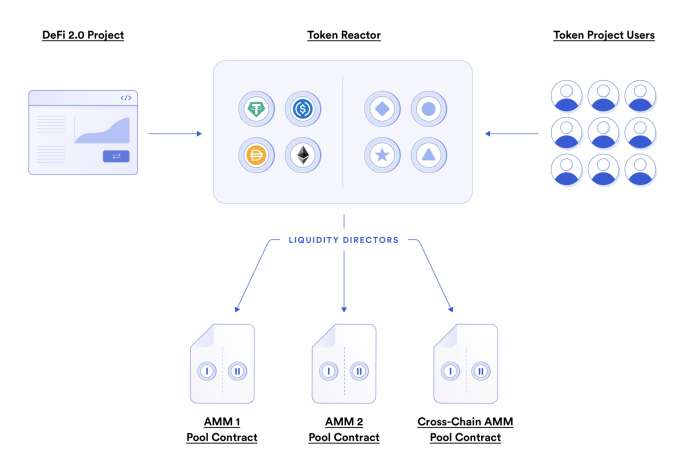
Another liquidity-focused DeFi 2.0 project is Tokemak, a DeFi protocol designed to optimize liquidity and liquidity flow. In short, Tokemak is scaled to facilitate liquidity through two distinct parties - the Tokemak Protocol and Liquidity Providers (LPs) - with the aim of effectively decentralizing liquidity through Liquidity Directors (LDs) sex.
Here's how it works. Consider the contents of the LPToken. Liquidity providers are required to submit equal amounts of both currencies in a given exchange pair, resulting in impermanent losses as weights shift and prices change. To solve this problem, the Tokemak protocol holds reserves of Stablecoins and Layer 1 assets as the base pair for emerging tokens. This forms one aspect of liquidity pairs. For the Token X-ETH liquidity pool on Uniswap, Tokemak reserves contributed ETH.
Then independent third-party liquidity providers and DeFi projects can be brought together to form liquidity Sexual Token X party. At this point, Liquidity Directors (LDs) come into focus. The liquidity director controls the flow of liquidity by staking Tokemak's native Token, uses these two unilateral liquidity pools, and then guides the liquidity to a wide range of AMM protocols.
Balanced fluid flow and direction
The system's The end result is that the liquidity flowing through Tokemak is committed to meeting the goal of efficient and sustainable liquidity direction for the entire DeFi ecosystem.
Liquidity directors move liquidity according to the voting mechanism, while liquidity providers provide unilateral Tokemak's native Token is obtained through liquidity. The variable returns earned by each party are balanced against the other to achieve an optimized ratio between liquidity supervisors and liquidity providers, ensuring that there is an optimal number of supervisors for the amount of liquidity provided.
This could enable emerging DeFi projects - especially those run by DAOs - and Farmers and liquidity providers benefit. At a basic level, Tokemak's unilateral asset allocation allows DeFi projects to use only their native Token Bootstrapping initial liquidity without requiring liquidity from Stablecoins and layer-one assets. Tokemak Reactors can also provide a collective decision-making liquidity structure for DAO-based projects, while providing alternative yield options for third-party liquidity providers and yield farmers with impermanent loss mitigation.
Other DeFi 2.0 progress
Another subset of DeFi 2.0 protocols are building on previous yield generating mechanisms and assets to build new financial instruments.
A prime example of this is Alchemix, a self-repaying lending platform. The protocol lends representative tokens that are 1:1 linked to collateral assets. For example, by posting DAIStablecoin as collateral, users are able to borrow 50% of the amount as alDAI. The associated collateral is then deposited into the yield-generating protocol so that it accrues over time.
By representing the combination of Token and yield-generating collateral, Alchemix can provide a liquidation-free The lending platform enables users to consume and save at the same time, and the loan principal is continuously reduced as the collateral continues to earn income.
Abracadabra, another DeFi 2.0 protocol, uses a similar mechanism, but its system is similar to MakerDAO related. Users can post yielding collateral and receive MIMStablecoin in exchange, maintaining risk on collateral while earning yield and unlocking liquidity for users.
Without the early innovation that initially brought vitality to the decentralized economy - the AMM protocol, Decentralized Stablecoins and oracles - there can be no liquid bonds, liquid flow mechanisms, or yield-generating collateral. From the early days of AMM LPToken and decentralized stablecoins to today’s DeFi 2.0 protocols, every project is a valuable iteration of building a decentralized economy.
4. Currency Lego in DeFi
Money Lego is a useful metaphor when conceptualizing how the DeFi economy moves as a unit. Cutting-edge innovations and new technologies can combine, with each piece building on the other, resulting in the creation of something greater than the sum of its parts.
DEX and LPToken are one of the most prominent currency Lego in the blockchain industry, realizing Token The large-scale on-chain exchange makes income farming possible. The initial wave of decentralized Stablecoins laid the groundwork for newer Stablecoin designs and decentralized lending platforms through an airtight over-collateralization process and risk mitigation. Chainlink’s off-chain data and computing services help enable these innovations by providing the underlying infrastructure required by countless DeFi applications.
None of these currency LEGOs can be considered in isolation but should be considered as an interconnected ecosystem , to support, connect and accentuate other building blocks to create new possibilities. By combining Chainlink Price Feeds and AMM LPTokens, dynamic yield farming becomes feasible. By integrating Stablecoin into an AMM, users gain the stability that is only required for trading on a decentralized exchange.
With the launch of DeFi 2.0, a new generation of currency LEGO is building on its predecessor , to make the decentralized financial environment more efficient, friendly and useful to its participants. The monetary Lego continues to pile up — each additional cube brings new value and opportunity to the DeFi ecosystem.
Original link
a>
Welcome to join the official BlockBeats community:
Telegram Subscription Group: https://t.me/theblockbeats
Telegram Discussion Group: https://t.me/BlockBeats_App
Official Twitter Account: https://twitter.com/BlockBeatsAsia
 Related Articles