Thinking about the future of NFT: "thin" IP, "thick" narrative
Thinking about the Future of NFT
Mario Gabriele
Block unicorn

Actionable insights
If you only have a few minutes to spare, investors, carriers, and founders can learn about it in today's article NFT and intellectual property.
- NFT inspired a disruptive form of IP. We are witnessing the creation of new intellectual property empires. Projects like CryptoPunks, Bored Ape Yacht Club and others aren't just works of art, they're also invaluable IPS that can scale across formats.
- Traditional talent agencies recognize their potential. Others agree with that assessment. The group behind CryptoPunks signed an Agency deal with United Talent Agency, while Bored Ape's creators signed a deal with Madonna's manager Guy Oseary. Niche crypto art is going mainstream.
- NFT IP is thin. While these projects are very popular, the IP they create is very different from traditional creative work. Unlike novels or comics, NFT projects have no knowledge or character depth to draw from. This can present challenges.
- We will see NFT with greater narrative weight. So far, the "Profile Picture" (PFP) NFT has focused on physical features. This makes them visually searchable, but doesn't give the creations real personality. To solve this problem, we might see NFT creators give their characters internal attributes that reflect an identity full of motivations, conflicts, and secrets.
- There's usually a new experiment, Philosophical Foxes trying to add dimension and narrative to NFT. Unlike their physical attributes, foxes are unique because of their philosophy, virtues, baggage and secrets. These are pixels with inner life.
In 1928, Walt Disney released his first film: Oswald the Rabbit. It was the start of a $300 billion empire, fueled by the single most important asset of all: intellectual property.
Mickey Mouse, Donald Duck, Snow White, Alice, Mulan, Luke, Yoda, Thor, Iron Man -- Disney's success proves the power of stories. Not just their appeal and endurance, but the value they create and capture.
We're witnessing the biggest damage to THE IP since Walter's rabbit. The attention generated by irreplaceable tokens (NFT) has inspired a wave of art that could give us multigenerational characters. In a few years, your Netflix account may bear more in common with OpenSea's home page, dotted with toads, punks, apes, robots, and other creatures that started life in a Web3 world.
But while these inventions have become so popular that Even Disney CEO Bob Chapek is sure to notice, they are fundamentally different from Mickey Corporation. Of course, they are right to use blockchain to determine origin and rarity, but also to IP where it is located.
We'll unravel this topic in today's article before uncovering our own IP experiments. I hope you'll like it.
Thin IP
In 2016, Union Square Ventures published a research paper that quickly became the norm in the crypto world. "Fat Protocol," written by Joel Monegro, explains how blockchains capture value in ways that are different from traditional networks, especially in terms of protocols and applications.
Monegro argues that the Internet consists of "thin protocols" and "fat applications". The protocols that make the Internet work -- like HTTP or TCP/IP -- capture little of the value they create. Instead, it's at the top. Apps flourished and became "fat." Google, Facebook, Twitter and many others are part of this thick application layer.
Blockchain reverses the order. Underlying protocols such as Bitcoin, Ethereum, Solana and Terra have reached huge market caps. Meanwhile, while still incredibly valuable, apps -- Coinbase, OpenSea, etc. -- are much smaller. Sure, Coinbase has a market cap of $50 billion, but Bitcoin has a market cap of more than $1 trillion, and the value position is flipped.

While blockchain has contributed to protocol hypertrophy, it has had the opposite effect on intellectual property. We live in the age of "thin" IP -- not necessarily in terms of value capture, but in terms of narrative heft. This is especially true for the "profile pictures" (PFPS) that dominate the NFT space, discussed in last week's OpenSea article.
What does it mean for IP to be "thin" or "fat" in narrative terms?
We can better understand this new wave by comparing it to traditional attributes. Last month, Daniel Craig made his final appearance as James Bond without time to die. It represents the character's 27th film and is expected to contribute significantly to the $7 billion the franchise has made so far. In terms of global box office, it's second only to Star Wars and Marvel, which means the James Bond character is a valuable IP. He has proved dozens of times that he appeals to consumers and their wallets.
But what does this IP actually look like? What is the defensible, defensible nature of Bond?
It's a name, of course, but it's also a rich legend, a story, with his traits, personality, likes and dislikes, flaws and virtues. Bond is a character with an inner life, even if it can be a ruthlessly pragmatic one.
All of this is IP, and in most cases, it's been built into it from the start. The result is that Bond IP extensions are mostly superficial. Of course, Roger Moore's Bond differs in tone from Daniel Craig's, but the main elements remain the same. Bond is always a suave agent at the queen's service. He was always unreasonably good at his job, and he was eternally, absurdly handsome. Inevitably, he will drive a really nice car, meet a beautiful woman and get out of a dangerous situation. (I know, I know.)
Different directors may change the order of these events and emphasize one of them. In some cases, they might even subverted those expectations, as in Skyfall, when Craig's performance chose beer over martinis. It's worth mentioning because it refers to the Canon; For those who understand the world we live in, it's a knowing wink.
Visualized, the architecture might look like this:

Now, a legitimate objection to this framework is that much of Bond's value has been captured by these superficial extensions. After all, bond, the literary character, grosses far less than Bond, the movie star. Fleming's books have sold 100 million copies -- a remarkable number, but certainly not enough to top the $7 billion brought in by Brosnan, Connery and other hard-nosed celebrities.
That's true, but I think it misses the point. The real power of IP is not in these vehicles, but in the source. No doubt they add to bond's mythology and opportunities for evangelism, but the value doesn't come from the actors or the script, car chases or gunfights. It comes from the character Bond. Making the exact same movie but calling the main character "George Stoker" would yield only a fraction of the required number.
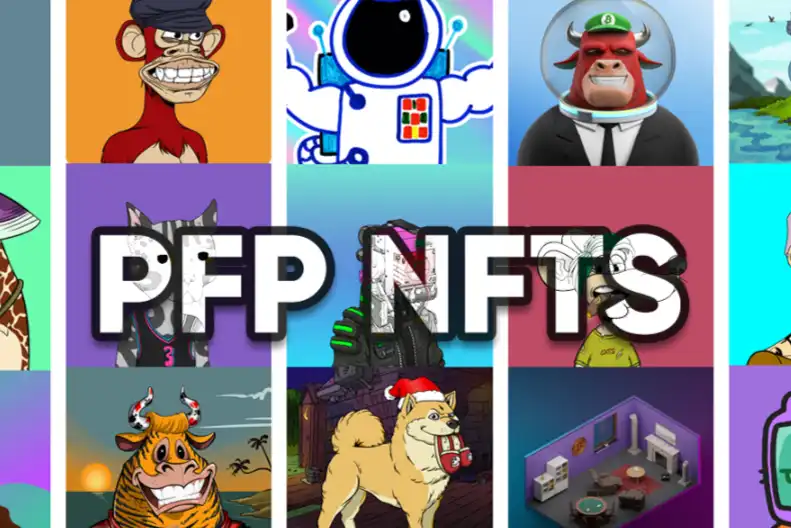
Something different is happening with PFPS. CryptoPunks, Bored Apes, Toadz and other projects are radical, in part because they provide an effective zero-narrative context for their creations. When you buy CryptoPunk #7560, you know nothing about their character, personality, and inner life. There are no legends, or stories attached to them. They reflect intellectual property, but only in their superficial features -- skin tone, hairstyle and accessories.

Cryptopunk #7560
Other projects may make a transition gesture for their characters to a richer universe, but it is sketchy. Boring apes are good, boring, and get into yacht clubs. Cryptoadz comes from a place "formerly known as Uniswamp" and is on the run from the evil King Gremplin. These are pleasant touches, but the narrative range is broad compared to traditional IP, and adds minimal context to the individuality of individual works, beyond aesthetic presentation.
This is not a criticism. In many cases, this flattening is more of a feature than a bug. Perhaps the cleanest example is Loot, which is not a profile picture project but illustrates this point. Instead of creating characters with certain abilities and properties, the project simply provides a list of items in black and white. The expectation is that others will build on this primitive and create narrative value for themselves.
Larva Labs (CryptoPunks) and Yuga Labs (Bored Apes) have taken a different approach to Loot. Instead of leaving this add-on process open, they cycle through traditional talent agencies. Larva signed with UTA in September, and Yuga announced last week that it had teamed up with Madonna's manager Guy Osear.
It is not hard to imagine how such a partnership could develop. Presumably, UTA and Oseary will be responsible for managing a number of creative projects based on a given IP, whether it's movies, TV series, games, or something else.
This sounds simple in theory, but is fraught with challenges in practice. What exactly is there to get used to? What are the core principles, features and parameters of the CryptoPunks film or Bored Ape TV show? Each NFT becomes a kind of protagonist of its master, but one with no definite personality and no depth. Their source material is flat, which may give them broad appeal but is a problem for storytellers.
Even the simplest questions can become difficult. Is CryptoPunk #7560 good or bad? Are they smart or stupid? Are they introverted or extroverted? Are they kind or cruel?
Someone has to fill the narrative vacuum. Will NFT manufacturers do it themselves? While this may preserve the spirit of the project, the skills required to create a compelling PFP are very different from building a traditional narrative.
That leaves outsiders, do film and game studios know enough about crypto culture to explain it effectively? Can they provide storylines and personalities that fit the original spirit of different incarnations (or what they look like)?
Adapting is tricky at the best of times. With shallower raw materials, they seem more difficult. Novels and comics provide the details and context needed for reinterpretation -- but is there a great movie inspired by a video game? If it's hard to find depth when adapting from a high-definition interactive world, how hard is it to find drama in a static 8-bit image?
All of these factors contribute to NFT's radically different IP structure, where narrative weight is placed on top of the original creation, with everything but physical features added afterwards. This is a thin IP.

Since no real boundaries are set, this means that everything is narratively permissible. Should alien CryptoPunks be the villains? Of course. Should zombies be heroes? Why not. Maybe anyone wearing a hat belongs to the same family? Go ahead.
You can change these characters as much as you want, because aside from the preconceptions that have been erased from other narratives (aka aliens = bad), there's no reason to have meaningful emotions about these characters other than their monetary value (aka aliens = valuable).
Can we solve this problem? Can PFPS carry the thickness of other forms of IP? Can the main characters get anything resembling a real backstory?
Over the next few years, I think we'll see NFT incarnations take on even greater dimensions. We'll see pixels with inner life, thinking NFT.
An experiment: the NFT of thinking
I often think of a quote by Gabriel Garcia Marquez: "Everyone has three lives: a public life, a private life and a secret life."
There is no denying that Marquez's observation is intuitively correct. None of us is a single being -- not really. Instead, we live in a series, a series of masks, collapsing into one. Our dispersion is a mirage -- we are fluid rather than solid, and we change with time and circumstance, depending on who is looking at us, or talking to us. These cycles of life and their interplay are an important part of what makes us interesting.
Conflict, deception, heroism, sacrifice; These ideas only make sense within the inner context of the character. We only know that the heroine is contradictory, because we know her heart and environment. We only know that the hero is corrupted because we have seen him as he once was.
Does this nuance fit the form of NFT? Can we capture it within the scope of the profile picture or do we need to set new boundaries? If we do want it to adhere to existing PFP conventions, can we add depth without destroying the analog visual value created by the lead project?
This is an experiment to try to answer these questions, or at least to begin with. Introduce... Philosophical Fox. There were only 100 of them, each one unique not only in image but also in personality.

This is an NFT project that aims to create narrative weights. Each character has a secret depth, although the images produced by two gifted pixel artists, Gordon Zuckhold and Gustavo Pezo, alone may follow some of the conventions of other PFPS. If James Bond is "fat" IP and crypto punk is "thin," then philosophical Fox is "sneaky fat" (which is how most people describe my constitution). They may seem thin, but integrated into their design and metadata are the ingredients needed to create multidimensional characters.
We've done this in five different ways: & NBSP;
1. The fox has an idea
The fox has philosophy
The fox has virtue and burden
The fox has a secret
5. Over time, the fox accumulated a backstory
Let's take a look at these (see some cute foxes).
Foxes have ideas, too.
The philosophical fox is thinking about something.
Every Fox set has something in it. Some deep, some shallow, some jealous, some angry, some romantic. One fox ponders Nietzsche, the other a cunning plot, and a third wants only a slice of bread.

In just a few words, we can add texture to characters and learn about their personalities and motivations. A fox thinking of arsenic is very different from a fox dreaming of Elon in France.
There's a reason this happens: humans are situational creatures. An experiment designed by Russian director Lev Kuleshov nicely demonstrates this, showing that humans create meaning based on the context in which they are presented. Kuleshov did this by making a short film in which the actors' expressionless faces were followed by three different shots: a coffin, a bowl of soup and a woman lying down.
The audience is not aware that Kuleshov uses the same image of the actor every time, but is impressed by the actor's ability to skillfully depict sadness, hunger and desire.
Kuleshov image
We use the same effect here. A line of text gives our minds a narrative spark, helping to turn a still image into a story.
Foxes have philosophy
If you wanted to convey as much information as possible about someone, but could only use one word, which would it be?
Maybe you pay attention to their physical characteristics, whether they are tall or short. Maybe you mention their personality and call them sweet, funny or mean. All of these are reasonable ways to start, but they don't tell us much.
Conversely, what if you describe someone as a "nihilist"? In one sentence, you convey some basic information about that person's worldview and lifestyle, which creates a series of flowing images and provides a glimpse into their inner life.
This is because philosophical descriptors are semantically dense. By definition, they encapsulate a large and complex doctrine into a single label. People portrayed as "transcendentalists" evoked meaningfullydifferent associations than characters seen as "hedonists."
That's why every philosophical fox has a specific ontology that it writes into its code. Some follow ancient schools of thought such as "stoicism" or "manichaeism", while others are in line with modern philosophies such as "the church of tyre" or "r/WallStreetBets".

Image credit: Opensea
Just as CryptoPunks can be searched by their accessories, PhilosophicalFoxes can be filtered by their beliefs.
The fox has virtue and burden
You can find foxes not only through philosophy. As with other items, you can search for a number of surface attributes, including species and fur color. There are 14 species in all, and there are two fur types.

That's interesting, but probably the least interesting way to describe them. (Or so I thought). That's because every fox has certain "virtues" and "baggage." If applying philosophy to foxes gives us a high-level view of their personalities, then these additional features add finer details.
Virtue and burden differ in severity and rarity. Virtues include positive attributes such as "being kind to the elderly," "having a good credit score," "having HBO," and "being able to do mental math without crying." Luggage includes "forgetfulness," "Growing up in the shadow of a golden child," "Bean allergy," and "Big Gary Vinachgaye."

Image credit: Opensea
Tongue-in-cheek, these together create a cloud of identity. Let's take the "will to power" Fox as an example and see what we know about them:

This is the beginning of personality. It doesn't have the nuance or depth of a novel, but it's a feature, a set of guidelines. If you're making a movie about "will to power" Fox, not everything. It's all allowed. For example, it was against the law to make him an innocent, happy-go-lucky fool. Instead of opacity, a shape is emerging.
The fox has some secrets
A small percentage of foxes are what we call "Marquez complete".
They have a public life (their appearance), a private life (their mind) and a secret life -- a secret that only the owner can unlock. For example, this fox is thinking of a (hypothetical?) Collison is hiding something...

Secrets are deliberately rare. Just as in real life, some people may wish to share their secrets with the world, while others may choose to keep them.
In a medium where every attribute and personality trait is recorded on a chain, secrecy is a definite blur. It sounds contradictory, but it's not -- you can tell who has something to hide, but you don't know anything unless they decide to tell you.
Stories need tension; The secret is a subtle introduction to it. Learning everything is usually not fun.
The fox can accumulate narrative weight
One of my favorite words is "Palimpsest."
A copy is something that has been reused but still bears the markings of previous content, like a printed piece of paper with traces of a previously handwritten message.
I think our personalities are duplicates. We don't add so much as we add on top, gently modify, layer by layer. The old self is not erased or forgotten, it is replaced. When Walt Whitman said, "Am I self-contradictory? / Then I am self-contradictory/(I am big, I am many)," he was talking about these layered, competing psychologies.
How do we give NFT the same depth? After all, good stories usually need their characters.
While irreplaceable, the philosophical fox is capable of one kind of change-change by addition. Over time, foxes can enhance themselves, giving them more backstory and greater complexity. They do this by collecting independent ideas. In addition to the 100 foxes, we also published 10 ownerless ideas.

Like the fox, each thought carries a philosophy, a set of virtues, and a bundle of baggage. Anyone can buy an idea and apply it to any fox. This gives foxes new features in addition to their own. Transiently, they develop new depths; Some even learn new secrets.

Through this mechanism, owners can evolve their foxes, giving them greater narrative weight over time. In the process, they effectively turned their fox into the protagonist -- we're always drawn to people with dimension, substance and secret. The fox becomes more and more cunning as the story progresses.
New media creates new art. Without movies, Disney's empire would not have grown. Pixar needed digital animation. Without the CONCEPT of NFT, CrytoPunks, BoredApes, and other leading projects would not have been successful.
Some things never change, though, and humans are drawn to characters with emotions and motivations. Real depth of the main character. These are necessary building blocks, not only for great stories, but also for winning IP. This could be a challenge as the NFT project seeks to make the leap from digital avatars to narrative creatures. In trying to solve it, the artist may delegate the task to an outsider.
It doesn't have to be that way. We can have profile pictures that not only attract visual appreciation but also have unique characteristics and attributes that can grow into meaningful IP subjects. In short, we can have NFT that thinks and feels.
The original link
Welcome to join the official BlockBeats community:
Telegram Subscription Group: https://t.me/theblockbeats
Telegram Discussion Group: https://t.me/BlockBeats_App
Official Twitter Account: https://twitter.com/BlockBeatsAsia
 Related Articles