Explain the rise of Terra's financial empire
The Rise of Terra's Financial Empire
Defieye. IO
At current DeFi lock-ups, Terra has surpassed Matic to become the third largest DeFi public chain behind Ethereum and BSC. From team & AMP; We provide a comprehensive analysis of Terra's investors, technology architecture, products, operational data, risks, and outlook. We also include a video of Terra mining.
Team & amp; investors
Terra is a blockchain-based stabecoin project [1], launched in January 2018 and launched on the main network in April 2019. It was developed by South Korean company Terraform Labs. Two founders are Korean and Do Kwon (https://www.linkedin.com/in/do-kwon/) and Daniel Shin (https://www.linkedin.com/in/danielshin/), He graduated from Stanford University and Wharton School of Business respectively, and has experience in entrepreneurship and working in a large multinational company.
Terraform raised $32 million in 2018 from investors including Polychain, Arrington XRP, Hashed, and three major exchanges, In January 2021, it raised $25 million from Galaxy Digital, Coinbase Ventures, Pantera Capital and others. In July 2021, Arrington XRP, Galaxy Digital, & NBSP; The $180 million Terra Eco-Fund from Pantera Capital and BlockTower Capital, among others, will incentivize projects to develop in Terra Ecology.
The technical architecture
Terra's core system is a blockchain system built on top of Comos SDK [2]. Cosmos was launched back in 2014 with the goal of becoming the Internet of blockchains, addressing the scaling and interaction issues of blockchains. Key features include
- Based on Tendermint's BFT consensus. Building a blockchain system, which typically includes a network layer, a consensus layer, and an application layer, is easy for virtual-based Ethereum to build applications on, but hard to fork its own blockchain. Tendermint-based BFT packages the network layer and consensus layer into a common engine, facilitating the development of blockchain networks for different application scenarios through a modular approach.

Graph: Comos SDK
- Based on POS. Ethereum is currently transitioning from POW to POS for performance reasons, while Comos was designed based on POS from the beginning.
- Link heterogeneous blockchains through IBC(Inter-Blockchain Communication).
Build smart contracts on Terra, supported by CosmWasm technology, using programming languages such as Rust, Go, or Assembly Script.
Core products & NBSP;
Terra's core mechanic is the Staboin system based on Luna and UST, on which core product features such as Chai (Payments), Deposit (Anchor) and Mirror (Transactions) are built.
Luna and UST
Luna is the governance token in the Terra system and serves as a pledge and verification token in the POS system. Revenue from Pledged Luna includes gas fees, taxes (0.1-1% of transaction value, up to 1 TerraSDR) and seigniorage rewards (for prophet participants).
UST is a decentralized algorithm-based staboin anchored to $1. Users can always exchange UST's $1 price with Luna in Terra's system, and its anchoring is mainly done by arbitrage mechanism.
- When the UST price is below $1, users buy UST at a discount on the exchange, exchange it for $1 of UST for Luna in Terra (destroy UST), and sell the Luna for profit
- When the UST price is above $1, users buy Luna on the exchange, convert it into UST (destroy Luna) at the price of $1 in Terra, and sell UST at a premium for profit
This mechanism ensures luna's value capture, which will increase as the system transactions increase and the market demand for UST increases. In contrast, Maker's MKR tokens currently don't have a good value capture mechanism.
Chai
One advantage of Terra's system is that in addition to the on-chain financial system, it has also built the offline UST payment system Chai. Traditional offline merchant systems in Asia often have pain points such as high transaction fees and long delivery times. Terra uses blockchain features to alleviate these problems. Currently, 1,700 merchants in South Korea have integrated Chai, with a total of 2.47 million users and about 50,000 daily users.
Anchor
The positioning of Anchor is a savings account with fixed income of stable currency on blockchain. Users can get 20% annual income by depositing it into UST. Its income sources include two parts, one is the UST interest paid by the borrowers, the other is the income generated by the pledged assets (Luna, ETH, etc.) pledged by the borrowers. In order to stimulate users to pledge borrowing, the system will allocate Anchor token to users who pledge borrowing, and the income of token will exceed the cost of borrowing. Currently, Anchor income cannot fully cover cost (interest paid to deposit users), and the insufficient part can be rigidly redeemed deposit income in the form of reserve.
Anchor recently introduced ETH as a pledge asset through cooperation with Lido Finance, and ETH's mining income in Terra exceeds that in Ethereum, further promoting the soaring volume of lock-up in Terra system.
Mirror
Mirror is positioned as a synthetic asset trading platform on the blockchain, which solves the disadvantages of traditional finance requiring KYC, high threshold, and not being able to trade 24 hours a day. Users can mortgage assets (including deposit certificates in Anchor) to generate synthetic assets (short), such as mTesla, mBTC, mBABA, etc. Users can also directly purchase synthetic stock assets (long). Short and long (both can earn MIR liquidity mining rewards, where long offers a combination of tokens with UST. The figure below shows the benefits of mining some assets.

Figure: Mirror mining revenue display
Operational data
The figure below shows the DeFi lock volume of major public chains. It can be seen that Tera's lock volume currently ranks third among all public chains.

Figure: Main public chain DeFi TVL
risk
Terra system risks include the following:
Not enough decentralization
Terra uses DPOS, and centralization issues can arise if there are too few consignors. Terra currently has only 130 validators, compared to Ethereum's 200,000 validators.
UST lost its anchor to the DOLLAR
The figure below shows the prices of UST in the last six months

Figure: UST price
As can be seen from the figure, UST was unanchored for 2 days in late May because Terra was unable to complete the stablecoin arbitrage request due to the clearing overload [3]. Once the system was restored, UST returned to the $1 anchor. In the long run, the anchoring of UST depends on the value of Luna. As long as Luna is supported by actual value (Chai/Mirror/Anchor, etc.), the risk of UST losing Anchor is relatively low. However, when the market plunges in the short term, THE risk of UST losing Anchor is relatively low.
To hedge against this risk, Terra officially recommends that users purchase Unslashed Finance insurance to protect the anchor of UST.
Can Anchor maintain 20% fixed income
According to the current fund flow of Anchor, it is necessary to rely on the subsidy of reserve pool to maintain 20% fixed income of deposit users. Users will worry about how to guarantee 20% annual returns if the reserve pool runs out of funds. In this regard, [4] analyzed the cash flow of Anchor and predicted that the cash flow of Anchor would start to turn positive in March 2022.
In the author's opinion, whether Anchor's cash flow can become positive depends on the overall crypto market. As an investor, we should first guarantee the security of principal. Besides the UST anchoring risk, smart contract will also bring additional risks.

Photo: Anchor recommended insurance
At present, the annualized insurance cost of Anchor smart contract is about 5% [5], & NBSP; It's also a low risk return of 15% annualized, so you can sleep better at night :)
Mirror the regulated
Mirror's stock synthetic assets, will face a certain regulatory risk, the United States SEC has indicated the chain Of Composite assets of the regulatory position. If Mirror is not primarily marketed to us users (there are currently reports that Mirror's users are mostly from Asia), the impact will be relatively small
Looking forward to
Important events to look forward to in the future development of the Terra system.
Solana asset import
The introduction of ETH asset has led to the explosion of TVL, and the introduction of the recently popular Solana asset will further promote the growth of TVL, and the linkage trend between Solana and Terra has emerged.
Col 5 upgrade
Similar to the EIP1559 update, Luna's value capture mechanism is improved. Better support for multi-chain operation (open UST application scenario) and support for Ozone (low-cost insurance protocol) and Wormhole (better access to Solana) [6].
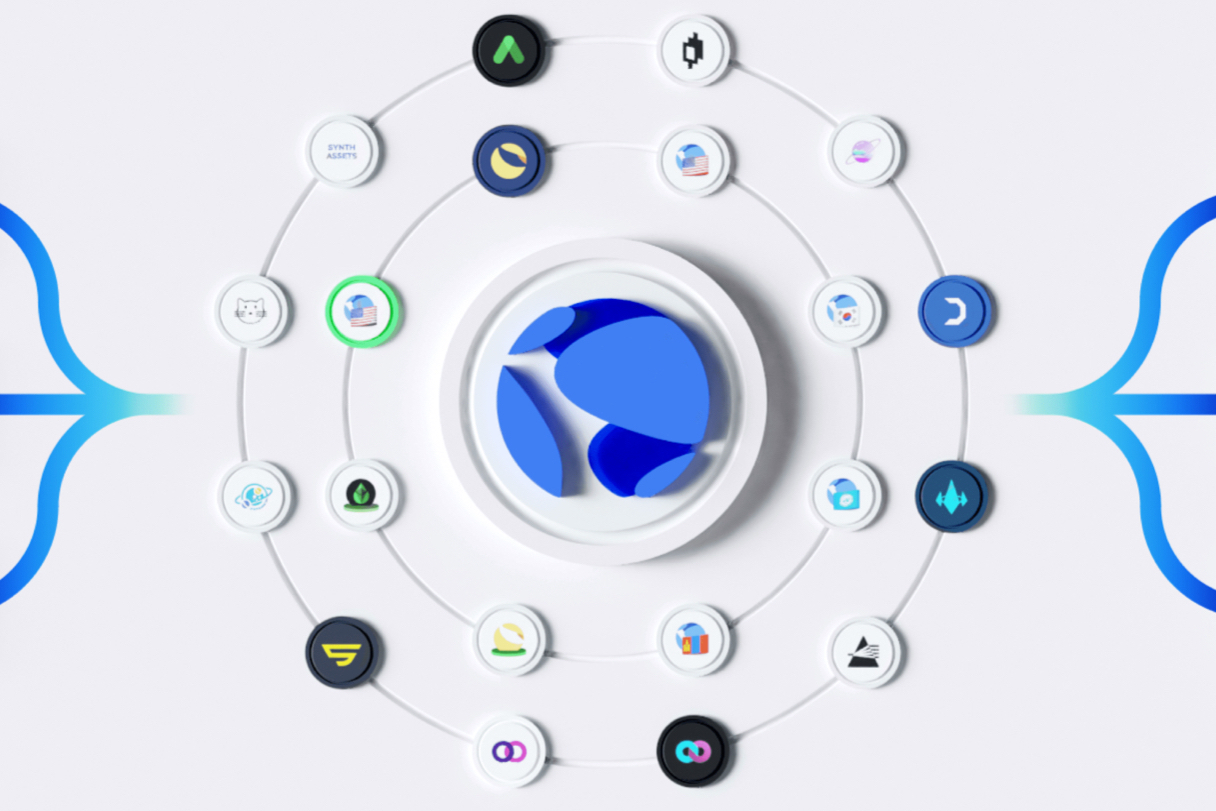
More ecological projects
The following figure shows the important projects in the Terra system

Terra's Ecologically Important Project (twitter @sjpark_tFL)
Mining tutorial
https://www.bilibili.com/video/BV1dL4y1e7xF
reference
https://docs.terra.money/
https://v1.cosmos.network/intro
https://research.thetie.io/the-terra-triforce-rise-of-the-lunatics/
https://medium.com/@cptn3m0x/anchor-protocol-a-52-week-forecast-10970f9b5827
https://worldpokerdeals.com/blog/crypto-investments-for-poker-players-terra-luna-anchor-protocol-and-20-fixed-apr#
https://www.loop.markets/columbus-5-launch-is-it-the-dam-holding-the-flood/
The original link
Welcome to join the official BlockBeats community:
Telegram Subscription Group: https://t.me/theblockbeats
Telegram Discussion Group: https://t.me/BlockBeats_App
Official Twitter Account: https://twitter.com/BlockBeatsAsia
 Related Articles