When the New York Times writer took on a penguin NFT...
I Joined a Penguin NFT Club Because Apparently That's What We Do Now
By Kevin Roose
0x13, 0x29, BlockBeats
In the NFT head market these days, Pudgy Penguins are the absolute leader. The secondary market has seen a surge in sales, and with more penguin heads on Twitter, the price has gone up. There's even another Party Penguins joining the Penguin Fight, competing with Pudgy Penguins for penguin territory.
The development of NFT heads has exceeded everyone's imagination. New York Times writer Kevin Roose, who once made his column NFT and auctioned off 350 ETH, was also attracted to the penguin community and got two fat penguin NFT heads.
Perhaps like many people, he couldn't understand the value of an NFT head until it wasn't there. But when he had the head of the penguin, the head, it was pushing him into the community, feeling the power of the community.
He wrote about his understanding of NFT avatars in the New York Times, and BlockBeats takes you through what it feels like to have a community NFT avatars.
The following is the translation:
Earlier this week, I was "attacked" by penguins.
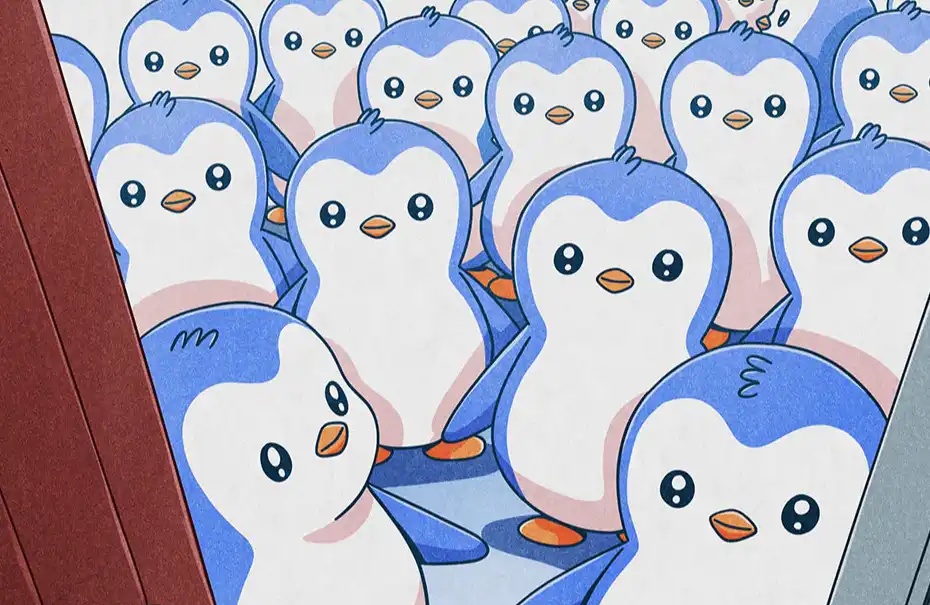
Not real Penguins, of course. It's a project called Pudgy Penguins, and there are a bunch of twitter profiles featuring the cartoon Penguins, with words like "Welcome to Club Penguin" and "Enjoy the party." The number of penguins in sunglasses, sombreros, bow ties and mohawks grew from dozens to hundreds. Soon, I was surrounded by these globular beaks, and everyone was congratulating me.
What have I done to deserve their warm welcome? Well, a few minutes ago, I acquired a Pudgy Penguins, which means I have the most amazing new identity on the Internet.
For months, crypto enthusiasts have been talking about "community NFT," a digital collectible that combines the get-rich-quick appeal of cryptocurrencies with the exclusivity of country club membership.
If you know anything about NFT, you probably know that they are unique digital tokens that are hosted on the Ethereum blockchain and correspond to digital assets, such as an NBA highlight video, or a piece of digital art. Those high-value NFTS attract buyers by the same logic as Renaissance paintings, such as the column I sold this year in NFT form for more than $500,000, because there is only one in the world.
In contrast, the community NFT is a group project. They are published as a unique but thematic set of images that can be purchased and sold separately. Having a community NFT often gives you certain rights, such as membership to a shared Discord server or access to a private Telegram channel. (The best place, though, is to change your social media profile photo to your NFT to let people know you're part of the community.)
I decided to join the Community of Pudgy Penguins because... Okay, it's August, and I'm bored. But I also wanted to explore. For years, technologists have been predicting the rise of the "meta-universe," an all-encompassing digital world that will eventually have its own identity, community and form of governance. Facebook CEO Mark Zuckerberg recently said the company is turning into a "metacosmic company." Fortnite developer Epic Games is also making a big bet on the metauniverse, raising $1 billion to build its own digital reality version.
Metaverse enthusiasts believe that people's digital identities will eventually become as meaningful as our real-life selves, and that we will consume accordingly. In the metauniverse, they predict, we won't put art on the walls of our homes, but NFT in our virtual Zoom background. Instead of buying new clothes, we splurge on skin for our VR avatars.
Pudgy Penguins and similar NFT projects are betting on this digital future.
"When I describe NFT to my family and friends, I say it's like people buying Clothes from Supreme, or buying Rolex," Clayton Patterson, 23, one of the founders of Pudgy, told me in an interview. "There are ways to tell people you're rich, but actually a lot of things can be faked. With NFT, you can't fake it."
Mr. Patterson, who goes by the online name "Mr Tubby," is a computer science major at the University of Central Florida. This summer, after watching NFT rise in other communities, he started Pudgy Penguins with three classmates. They chose penguins as their theme because of their acceptability and decided to use an algorithm to generate 8,888 unique penguins with different combinations of clothing, facial expressions and accessories.
"Fat Penguin has huge MeMe potential and we decided to let nature take its course." 'Said Mr Paterson.
The first NFT project to bring together a community was CryptoPunks, a project consisting of 10,000 pixel avatars that was born in 2017. They have since evolved into a luxury status symbol, with individual NFTS selling for millions of dollars and paving the way for other NFT communities to grow. It was followed by Bored Ape Yacht Club, a project made up of 10,000 Ape heads that now sell for as much as $45,000 each.
Mr. Patterson and his co-founders hope Pudgy Penguins will eventually join the NFT's pantheon. When Pudgy Penguins went on sale, they sold out in just 20 minutes and grossed more than $25 million, according to NFT Stats, a website that analyzes NFT sales data. Earlier this week, Pudgy Penguins were bought for thousands of dollars apiece, but rare features with different background colors or gold MEDALS can sell for much higher prices. The highest bidder was No. 6873 Pudgy Penguin, which fetched a whopping $469,000.
I texted Mr Patterson on Tuesday to ask if there was any way I could get my own Pudgy Penguin without breaking the bank. (Unfortunately, the New York Times won't reimburse me for a penguin picture.)
"Wait a minute, I'll help you." "He replied.
A few minutes later, Pudgy Penguins 3166 and 5763 appeared in my encrypted wallet. One penguin wore a straw hat and sunglasses, while the other wore a baseball cap with an image of an igloo and a jacket. Mr. Paterson said they were a gift to show appreciation for my willingness to reach out to the community. (Though since I am too embarrassed to accept either gift, I will send my penguin back to Mr. Patterson after this column is published.)
Then I joined the Pudgy Penguin Discord channel, where I was greeted by a group of penguins who were all excited to see me, especially as they thought getting the Attention of the New York Times would enhance the value of their own penguins. (After I received these two JPEGs, I received quotes in the thousands of dollars.) The creative team at Pudgy Penguins receives royalties every time a penguin is sold, but other owners only make a profit when they resell the Penguins for more than they paid.
Like other crypto communities, the owners of Pudgy Penguin have developed their own language and customs. Penguins are called Pengus and their owners huddlers, Tufts are rare, more expensive, hatless penguins, and floors are those that are cheaper and more common.
Several owners of Pudgy Penguin told me that while they are hoping to make a profit on the rising price of penguins, they mostly see it as more of an opportunity to socialise. Pudgy Penguins has more than 4,000 owners, and its Discord channel (you can join if you don't have Penguins) is an active community of people who discuss the penguin meme culture, cheer over every new sale, and work together to find ways to get more crypto celebrities into the club. (On Tuesday, Alexis Ohanian, one of the founders of Reddit, took to Twitter to show off his newly purchased Pudgy Penguin, which brought the community even wider attention.)
Christopher Aumuller, 29, owner of Pudgy Penguins from Queens, said: "The community is really nice," he said. "Everyone is vitally talking about Penguins."
Part of the appeal of Pudgy Penguin is that other popular NFT's have become too expensive, says Tiffany Zhong, a cryptocurrency entrepreneur and investor.
"Those items are no longer affordable to the average consumer." "As a result, everyone who comes to NFT is trying to find the next thing to explode," she says.
To outsiders, Pudgy Penguins may seem pointless, and in some ways they are. But I don't put them down for that, just like I don't pay much attention to twitter and Instagram influencers. Humans are status-seeking animals and are always looking for different ways to improve their status. The first iteration of the Internet tended to make status indiscriminating, or at least making people's identities difficult to identify, as it was often said: "Nobody on the Internet knows you're a dog." . But more innovative technologies, such as the NFT, are trying to make people's social status more visible.
Packy McCormick, author of the Not Boring blog, wrote in a recent post ( NFT communities are like social networks, as they allow people to gain social status and connect with others, plus the potential for monetization.
Mr. McCormick wrote, "When you combine money, status and community, there is a powerful force."
Indeed, if the craze passes, people who buy Pudgy Penguins or other NFT's could end up losing a lot of money. But it's also true that, just as Reddit users are ramping up The prices of GameStop and AMC, fans of those projects don't seem to mind the risks. (In fact, there are times when the only thing left on the Internet are NFT traders and meme-coin speculators still having fun.)
While I personally wouldn't invest my retirement money in Pudgy Penguins, I find the most common objection fairly unconvincing.
Is NFT bad for the environment? It does. Running the Ethereum blockchain requires a lot of computing power and energy, and NFT transactions are sure to add to the network's carbon emissions. But they are a tiny fraction of the overall crypto market, and their environmental impact is a drop in the bucket compared to the hundreds of thousands of regular Bitcoin and Ethereum transactions that take place every day.
Are they the playthings of the rich, a waste of money that could be better spent? Sure, but so are supercars and luxury bags.
Does it make sense that people buy and sell blockchain collectibles at many times the median annual income in the US? Maybe, but at least they didn't hurt anyone. (Let's just say, in my opinion, one of the most innocuous things a young, mostly male group of Internet addicts can do in their spare time is trade pictures of cartoon penguins.)
The worst that can be expected of the NFT, which forms the community, is that they encourage people to overpay for virtual collectibles, and that millions of people will be crushed when the bubble bursts.
I said to Ms. Zhong, the cryptocurrency entrepreneur, that I was still puzzled by the appeal of Pudgy Penguins, which still seemed to serve little purpose except to attract attention.
"Nobody really knows anything." "No one really knows what happened, but it was fun," she said.
The original link
Welcome to join the official BlockBeats community:
Telegram Subscription Group: https://t.me/theblockbeats
Telegram Discussion Group: https://t.me/BlockBeats_App
Official Twitter Account: https://twitter.com/BlockBeatsAsia
 Related Articles