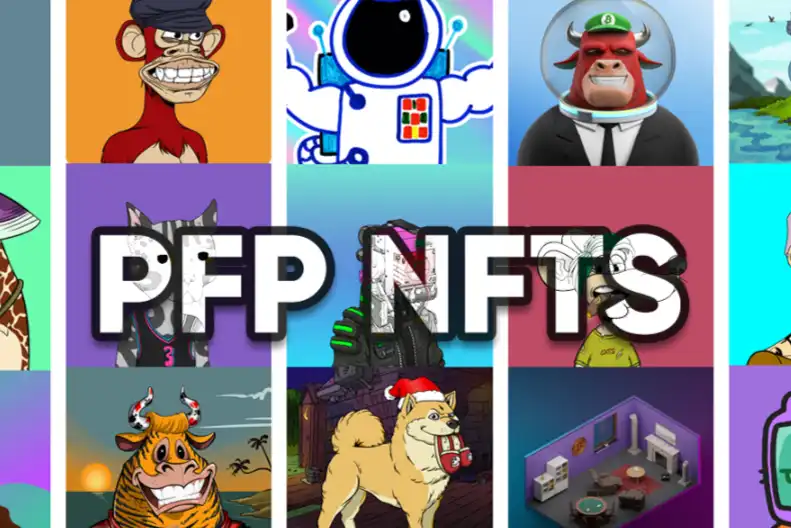
Why are NFT heads so expensive? Animal heads are sweeping the coin circle

Status Monkeys
By Packy McCormick
If you ask what is the hot currency now, NFT head is worthy.
Whether it's CryptoPunk, which costs hundreds of thousands of dollars per unit, Or Bored Ape, which has just announced its upcoming Christie's auction, or OpenSea, the world's largest NFT trading platform, which is seeing record volumes every day, no one seems to understand. Why it looks like a JPEG with the words blockchain can be so crazy.
There is no sign of weakening sentiment, investors who find the wealth effect of NFT flock to it, a penguin that has broken the hair has become a new favorite, with the big KOL put on a cute little penguin head, the NFT of this series is accelerating appreciation.
If you ask why this profile picture is so valuable, no one seems to know.
To find out, Author Packy McCormick examines the recent irrational frenzy surrounding NFT in detail, combining social networking and NFT's usability, entertainment, and social capital attributes. BlockBeats translated the original text:
Zombies have been occupying my social media all weekend, and this avatar keeps popping up to grab my attention:

If you don't know what it is, here's a brief introduction: The green avatar is called CryptoPunk, and it's a 24x24 pixel work of art with only 10,000 of them in total, and that number will never change. This project launched by Larva Labs in June 2017 is the OG of NFT, and in today's world, new NFT projects are born every hour, and CryptoPunk is always scarce and valuable because of its historical status.
The price of each NFT project in the past few weeks have ushered in the surge, CryptoPunks is absolutely the most crazy one. The most expensive, CryptoPunk, was sold for 4,200 ETH and is now worth as much as $7.57 million. Now, if you want to buy a CryptoPunk for yourself, the cheapest one will cost 51.85 ETH. This value is often called "floor price", which means that you can only buy the most common CryptoPunk at this price. And if you want to buy a rare one, such as an ape, an alien or a zombie, like the one above, you'll have to pay much more than the floor price.
Here's what you need to know about CryptoPunks:
- Owning a CryptoPunk has become a status symbol, like owning a limited-edition luxury bag or a Ferrari.
-CryptoPunk owners like to change their social media profile picture to the CrytpoPunk they own.
- Don't change your social media profile picture to CryptoPunk you don't own.
Just this weekend, hundreds of people changed their Twitter profile picture to a zombie CryptoPunk, which sold for the high price of 11,201.725 ETH, or about $3.75 million, on Friday. Although hundreds of people have changed the avatar, no one will argue with it, because they all share the CryptoPunk.
At Friday's auction, a total of 478 people joined "PartyBid," a new project launched by Anish Agnihotri and the PartyDAO team. The project allows people to team up and participate in NFT auctions, pooling resources to fight multimillion-dollar whales. They called themselves the Gang of the Living Dead, and they eventually defeated The Whale.

Credit: Chuck Anderson
PartyBid made NFT more social and really brought people together into "small gangs" where hundreds of ordinary users could buy, own, and manage the expensive NFT. The social atmosphere can be felt on the site, which is like Figma meets Masterworks, with each user's mouse being displayed on the page in real time, and users sending in bullets filling the screen. During Friday's auction, hundreds of people flocked to the site, and the scene of ever-increasing numbers of mouse clicks and bullet martials on the web page is hard to describe in words, but you can experience it either by looking at the picture above or by going directly to the site.
Like zombies, NFT is supposed to be inanimate, but what's going on?
My theory is as follows.
On Thursday night, I joined Sriram Krishnan and Aarthi Ramamurthy in a chat room called "Good Time Show" at Clubhouse, where, I'm with Gabby Dizon (YieldGuild), 3LAU, Donnie Dinch (Bitski), Jarrodd Dicker (The Chernin Group), Jon Lai (A16Z) and Jesse The metauniverse is discussed together.
Readers are already familiar with the concept of the metauniverse, which has been discussed for months, and I have a habit of associating it with almost anything I can imagine.
In the past few weeks, the metauniverse has moved into the mainstream. Matthew Ball has published a series of nine articles on metauniverses, Satya Nadella has talked about the entrepreneurial metauniverses (sounds interesting), Zuck and Co has mentioned countless metauniverses, Ben Thompson has written an article on metauniverses...
There is no doubt that NFT will play an extremely important role in the metauniverse. As the world goes digital, proving that you actually own something and can "take it with you" on the web becomes a key issue. But we're not talking about metauniverses in this post, we're talking about social networks.
In a discussion in the Good Time Show chat room, Jarrodd Dicker talked about the importance of community and social status in Web3, which got me thinking: In Eugene Wei's "Status-as-a-service" standard, NFT can almost be called a full score social network.
Before a complete metauniverse is born, NFT has found more valuable applications than JPG files. The NFT is starting to become a new kind of social network, a network of social networks and communities on top of each other, what we might call the "Superverse," And there is no better framework for evaluating social networks than the one proposed by Eugene Wei in Status-as-a-Service.
Status is service
(Skip this if you've read "Status-as-a-Service" and have a deep understanding.)
Eugene Wei, a former product head at Amazon, Hulu, Flipboard and Oculus, is one of the web's best technology authors. Many of his articles have shocked you, most notably "Status-as-a-Service," published in February 2019.
It's a long article, nearly 20,000 words, and if you haven't read it yet, I strongly suggest you do, but for now I'll summarize some of the core points of the article.
Eugene Wei's article is based on two principles:
- Humans are status-seeking monkeys;
- Humans will always look for the most efficient way to maximize their social capital.
Although none of this is controversial, Eugene Wei argues that we do not analyze social networks in terms of social status or social capital. Money is more analytical because it is a number and can be measured, but Eugene Wei emphasizes:
"Social capital is in many ways a leading indicator of financial capital, so its nature deserves more attention. It's not just good investment or business practice, but analyzing the dynamics of social capital can help explain all kinds of online behavior that may seem irrational."
In less than 1,000 words, Eugene Wei laid the foundation for our analysis of the NFT boom two years later. NFT blurs the line between social capital and financial capital, as the media has often said: It is foolish to pay millions of dollars for a JPG file.
According to Eugene Wei, those who deny the value of NFT make the same mistake that people make when analyzing social networks: they ignore the importance of social capital. The network effects that drive social networks are often explained by Metcalfe's law, which states that "the value of a network is proportional to the square of the number of users connected to it". According to this law, one can conclude that the more users a social network has, the more valuable it is to each new user.
The problem is that Metcalfe's Law doesn't actually explain very well what's going on in the real world. Metcalfe's law is more of a prediction that whichever network develops first will continue to build an increasingly insurmountable lead by creating more value for each new user. But Facebook is still beating MySpace, and Instagram and Snapchat are stealing younger users from Facebook. This proves that people's preferences are not fully and accurately captured.
This is not to say that Metcalfe's law is wrong. It just doesn't make sense of the real reasons people use social networks, beyond sheer utility. That's why Eugene Wei has come up with a new framework for analyzing the power of social networks, including social capital.

Photo by Eugene Wei
Eugene Wei assesses the power of social networks in three areas: social capital, entertainment, and utility. In the article, he focuses on social capital and utility.
Utility is relatively easy to understand. You find an answer to a question on Baidu, or you use Renren to connect with a high school classmate, then these products provide utility for you.
Social capital, on the other hand, is harder to define, relying on "successful status games". To help readers better understand why some new social networks succeed while others fail, Eugene Wei uses cryptocurrencies as an example.
According to him, the new social networks are much like IC0 in four ways:
1. Each new social network issues a new form of social capital, called tokens;
2. You must show proof of employment to receive the token;
3. It gets harder and harder to mine new tokens on each social network over time, creating inherent scarcity;
Many people, especially older people, turn their noses up at both social networks and cryptocurrencies.
It's a neat metaphor, but let's use the Bitcoin network and Twitter as an example:
1. The Bitcoin network issues Bitcoins and Twitter "issues" fans;
2. Miners get BTC for securing the Internet, twitter users get followers for Posting witty, funny or confusing content;
3. Now the cost of digging BTC is higher than before, and the difficulty will continue to increase until all 21 million BTC is dug out. In the early days of Twitter, you could get followers by tweeting what you had for lunch, but today people have started to post long speeches;
It goes without saying.
Fifteen years ago, neither Bitcoin nor Twitter existed, but now both have become unstoppable. They did this from scratch by rewarding early adopters, motivating them to work for the network, and making it harder to mine.
All four are important, but the most useful is the idea of "proof of work" in the status game. If everyone who signs up for Twitter can get a million followers just by signing up, then having a million followers is no longer valuable social capital. Not many people can have a lot of followers, and the scarcity is what makes it valuable, and the need for "proof of work" makes it scarce.
Entertainment aside, Eugene Wei talked about five arcs that social networks can follow, four of which are trade-offs between social capital and utility, over time.

Photo by Eugene Wei
- Utility first, social capital second
"Come for tools, stay for social networks." Instagram first attracted a large number of users as a simple photo-editing tool, then evolved into a photo-sharing based social network to retain users, where people can gain a lot of followers and business.
- Social capital first, utility second
Mr Wei emphasises that Foursquare, Wikipedia, Quora and Reddit all use social capital to get people to do free work before they are regularly used by the general public.
- Focus on utility, but ignore social capital
Apps like SMS are great for communicating with people you know, but they don't really help users build social capital.
- Focus on social capital, but not so much on utility
Eugene Wei puts Facebook in this category, noting that many of his friends have stopped using it and that it hasn't affected their lives.
- Utility is equal to social capital
Eugene Wei cites the example of wechat in this category. It combines Facebook's Moments Feed (social capital) with a wealth of utility, as people use iT to message friends, shop, read news, play games and pay in stores...... Almost anything you can do on your phone, you can do on wechat.
From the start, wechat has created a killer combination of social capital and utility that hasn't really been replicated in the West.
However, Wei points out that even for social networks that do well, two things can limit their growth or cause them to collapse.
Case 1: Problems with the proof of work itself
Not everyone in the world has access to social capital on any given social network, it is restricted. I love swiping TikTok, but I've never posted a short TikTok video because I can't dance, and I'm not willing to put in the effort to find out what TikTok users prefer. TikTok continues to grow at an almost absurd rate, but if even I, a social networkers, are reluctant to use it, it's a sign that it, in effect, has a ceiling.
Case 2: Problems with inflation and deflation of social capital.
The inflation problem is that when a social network is very successful, there are so many people using it that the development team inevitably needs to introduce big data algorithms to deliver it accurately. According to Eugene Wei, it was always likely that Facebook would introduce big data algorithm recommendations because in the colorful digital world, the only scarce resource is users' attention, so users must be provided with what they are most interested in. That makes sense, but it's a tough break for any company that relies on Facebook to expand its user base.
The deflationary problem is that as more and more users join, the social network becomes "not cool at all." A classic example is that when parents start using Facebook, all the young people switch to Instagram and Snapchat. Once the cool kids start to leave, the uncool kids follow in the cool kids' footsteps, group after group of users leave, more and more uncool people continue to join the social network, and the proportion of cool kids will soon become even lower.
"At this point," says Eugene Wei, "it's best for the product or service to be as expansive as possible in terms of utility, or the loss of users will be very rapid and fatal."
Here is the core of the discussion:
- Social networks need to analyze more than just their network effects;
- Analysis should take into account these three perspectives: social capital, utility, and entertainment;
- New social networks are like IC0's, especially because successful social networks will use appropriate difficulty of work proof to create scarcity and social status.
- Social networks have many paths to follow, but the best is to start with high social capital and utility;
- Even successful social networks can run into two big ills: the ceiling of proof of work and inflation/deflation of social capital;
- Networks that start with high social capital need to find ways to build effectiveness before the onset of these ills in order to survive and thrive.
In the rest of the article, Eugene Wei uses examples to make arguments, which adds to the readability of the article. Again, I recommend reading the entire article, but here I will highlight a few points that I think are valuable:
- Social capital can serve as a temporary source of energy. "You can think of this social capital accumulation incentive mechanism as a way to convert the potential energy of social status into whatever form of kinetic energy a firm needs."
- New work proof could extend the life of the "social identity game." Why do social networks need to add new forms of proof of work to prolong the life of the status game, and what can they learn? "Casinos in Las Vegas pay real money and the ROI keeps people engaged; some MMORPGs offer other benefits, such as a sense of community, that are more persistent than mere technical challenges."
- Social capital turns into financial capital, and financial capital can also turn into social capital. "These transactions are a way for us to put a tangible value on social capital, in the same way that people understand the value of intangible assets, such as selling world of Warcraft full-level characters on the secondary market."
- The lack of portability of the social graph frustrates users. It's a very pointed statement that highlights a major difference between traditional social networks and NFT, and I'll quote it here:
"The restrictions on porting the social graph are a positive from the point of view of existing social networks, but frustrating from the point of view of users. Given the dilemma of dealing with social networks under antitrust consumer welfare standards, One option to curb the power of large-scale network effect companies is to demand that users be allowed to bring their social graph to other networks (as many have suggested), which would reduce the power of social networks for social capital and force them to compete more in the direction of utility and entertainment.
If you could get the benefits of social networking in a more convenient, decentralized package, what would you do? It is time to pass the baton to the NFT.
A brief recent history of NFT
As a quick review, NFT (Non-Fungible Token) stands for non-fungible Token. The genius of NFT is that it makes digital assets scarce. Scarcity makes digital assets more valuable, like a bespoke car, fine art or a rare stamp. Beeple's Everydays wouldn't have sold for $69.3 million if the owner couldn't prove they were buying the official version.

Image credit: Beeple
NFT started in 2017 with CryptoKitties, but it really started to take off in early 2021 (I first wrote about NFT in late January). The track was led by Beeple and NBA TopShot while BTC and ETH set all-time highs. The new crypto rich are also, unsurprisingly, doing what other rich people do: buying art. NFT's are controversial. People think they're just toys.

Credit: The New York Times
Then, in April, crypto asset prices plummeted and the NFT track cooled. The NFT sceptics scoffed: "You see, I told you so, it's a big bubble when people are willing to pay millions of dollars for a jPEGS image!"
In June, the crypto site Protos, like many other blogs, cited a 90% drop in NFT transactions:

Image credit: Protos
The second sentence of the article reads: "The NFT track peaked on May 3, when NFT sales reached nearly $102 million." The party is officially over, however: "According to Protos data analysis, NFT sales last week were only $19.4 million."
Then, in the past month or so, a funny thing happened. NFT is making a comeback. In the last 24 hours, just two exchanges -- OpenSea and Axie Infinity -- have closed $106 million worth of deals.
In the past 30 days, the NFT's top 10 exchanges have seen sales of $1.86 billion, according to DappRadar.

Photo credit: DappRadar
This time, instead, it feels as if the NFT is driving up ETH and BTC prices. Despite the SEC's growing interest in the regulatory approach under new chairman Gary Gensler, and the potential damage from the proposed Infrastructure Bill, the prices of these crypto assets have continued to rise.
So why is NFT back, and why is NFT likely to be around for a long, long time? Let's go back to our friend Eugene Wei.
Investing is a status symbol
The best starting point to look at this problem is what Wei himself said: two principles.
- Humans are status-seeking monkeys
- Humans seek the most efficient way to maximize their social capital
We status-seeking monkeys are turning digital, the most efficient way to maximize social capital, and it all seems very meta.
During this NFT summer, "apes" are leading the way.
In the past month, the third NFT series was Bored Ape Yacht Club (BAYC). Like the CryptoPunks, there are only 10,000 "boring apes" in the series.

Photo credit: DappRadar
The BAYC website describes itself as "a limited edition NFT collection where your token count doubles when you become a member of the ape club near the swamp."

Credit: Bored Ape Yacht Club
Unlike CryptoPunks, BAYC is a brand new project released on April 30. However, it has become the third most popular collectible in the NFT series, perhaps thanks to its combination of social capital and its availability. Kyle Chayka of The New Yorker recently wrote a piece called "Why Bored Ape Avatars Are Taking Over Twitter? Twitter). "It's become a status symbol, like wearing a cool watch or limited edition sneakers," XMTP founder Matt Galligan, who also uses BAYC as his Twitter avatar, wrote in a post.
Apes are a theme, even outside of the BAYC scene. Two of the four most expensive CryptoPunks ever made are also apes:

Image credit: Larva Labs
If you think it's ridiculous to spend millions of dollars on pictures of jpegs. orangutans, then "analyzing social capital dynamics may help explain all kinds of online behavior that might otherwise seem ridiculous."
So, instead of ignoring what is becoming a reality, let's dig a little deeper and put NFT in the Wei quadrant. We can even include pure entertainment as a reference.

This is the power of valuable NFT's: these NFT's have high social capital, but they also have high utility, and their entertainment value is increasing. They have achieved a true win-win-win.
Social capital attributes. NFT is social capital with a "Skin in the game" nature. Investment is a status symbol. There are only 10,000 CryptoPunks and apes in the world, and in this limited collection, some of the items are very valuable, so their status is very high. Owning a CryptoPunk or an ape and showing it on your Twitter, Discord or Telegram profile also proves something to you. This proves that either you were an early participant, or you were rich, or you were an early participant and now you're rich. Using high-priced items to fuel social capital is nothing new -- look at fine art, expensive cars, yachts, private jets, handbags, or other rare items that the very wealthy buy to show status. The NFT's role in this regard is more obvious and more widely accepted.
Practicality. An NFT can also be used as an investment, as a ticket to a Discord group, or even to hang on your wall. Later, as the NFT permeates the wider population, it will bring even more privileges to its owners.
As you can see now, buying an ape already gives you access to the BAYC. NFT's like Axies offer real utility: ownership solves the employment problem for thousands of people. From CryptoPunk creator Verla Labs, Meebits are 3D models and animations that act as in-game characters.

Image credit: Meetbits
Entertaining. Although Wei did not address this dimension (until the emergence of TikTok and Sorting Hat), most successful social networks have been very successful at entertainment. TikTok is arguably both a social network and an entertainment network. The same goes for YouTube. People spend hours a day on Twitter just for fun. They don't interact. It's purely passive entertainment. NFT is also entertainment: it's fun to watch deals, and now some people have started to create their own personas to play their apes or CryptoPunks. Attending an auction event like a Party Bid can be as much a social event as an investment event.
For NFT, the entertainment quadrant is just beginning to evolve. Punk Comic Comics is creating 16 Comic books based on CryptoPunks. Similarly, they will soon reach out to the boring ape.

Credit: Punks Comics
This is just the obvious first step. Many NFT bulls believe that any significant cultural event will be commemorated as an NFT, and that the NFT will also play a role IN these events, and that these events may also change with the IRL (IN REAL LIFE).
Therefore, NFT provides social capital, utility and entertainment... So can we look at another of Wei's points: new social networks are similar to IC0? They all belong to the encryption project, which is most obvious, and at the same time:
1. Every new social network issues new social capital, a brand new token.
2. You have to do a "proof of work" to get the token.
3. "Mining" (getting new tokens) becomes more and more difficult in each social network over time, resulting in inherent scarcity.
4. Many people, especially older people, turn their noses up at both social networks and cryptocurrencies.
There are some subtle differences here.
The NFT provides a more direct link between social and financial capital. One way to acquire a treasure NFT is to acquire it very early, to buy it as soon as it is imprinted, and to acquire it before the wider community is interested in it. Another way is to spend a lot of money on one. The former is much like a "proof of work" -- figuring out which projects to support early -- while the latter is more like a "proof of equity" -- using the ETH in your wallet to support and participate in the project.
Of course, they still have a lot in common, and older people still look down their noses at them.
Even I have to admit: as a social network, NFT feels like a bit of a overkill.
They don't look like social networks; If anything, they look more like small communities. Like the local supercar club, they are too small, too small for analysis. NFT is a status symbol that allows social capital to reach global levels. But if Facebook, Snapchat, TikTok, and Twitter are social networks, then NFT feels different.
I think they really are social networks, and that's the right strategy.
In status as a Service, Wei wrote a chapter entitled "Why Copying proof of Work is a terrible strategy for status-driven Networks". Basically, using the core mechanism of proof of work as an existing social network and adding a few other features won't work because the skills required are the same, which will lead people to gravate toward the one with more people. Bitclout, similar to Twitter, but encrypted, rewards people for doing what they do: Posting interesting content. The difference is, if you're successful on Bitclout, your tokens will become more valuable and you'll make money. The direct exchange of social capital with financial capital may be enough to get people to copy content or move content to a new platform, but that can be challenging.
Instead, you need to reward different behaviors. NFT may be different enough to be applicable, and people don't have to leave the social networks they like and are using. In fact, it would be great if everyone could show off and talk about their NFT on their favorite existing social networks. This will create more demand directly and can also create other indirect opportunities. If Netflix executives saw that everyone on Twitter was talking about CryptoPunks, they might turn it into a show to reward the owner. If someone at Christie's sees everyone in Their Discord talking about Art Blocks, they might auction off a Squiggle, thereby giving credibility and influence to the whole collection.

When this happens, each NFT owner (or group of owners) will build strong social capital within the network. If CryptoPunks gets on a Netflix show, the Punk who gets on the show will become a star and build outside social capital that can be used on other networks.
NFT is not a social network in the traditional sense. There is no NFT company in the world. They had no home, no place to gather. Maybe OpenSea is one? Maybe online games/virtual worlds like CryptoVoxels, Decentraland, The Sandbox. Maybe someone has set up an anonymous social network, and the ticket is to have an NFT, like Facebook's @harvard.edu address. Most likely, it is none of the above. This is something entirely new: the superuniverse.
I don't mean super like super, I mean, NFT is probably a social network above all others.
As Wei writes, "From the point of view of existing social networks, the restrictions on portable images are beneficial for them, but from the point of view of users, it is very frustrating." If regulators force social networks to make their images portable, he says, it will "weaken" their strength in the social capital quadrant, forcing them to compete more aggressively in the utility and entertainment quadrant.
So what if a new entrant, not a regulator, proves that portability is important? When I wrote that "cryptocurrencies will be The native asset of The Great Online Game," I was referring to portability. You can acquire social status in one place, own it without platform risk, and transplant that status across the Internet. This is the same for NFT, the rise and fall of platforms is not my business. Any social network with a profile picture (which is to say, all social networks) is fertile ground for NFT spread. The NFT owners have changed their Twitter profile pictures to Punks and also posted their RTFKT sneakers on Instagram.
And it won't be just a few people. Those who collectively own a particular NFT, such as the Party of Living Dead or DAOs who own the NFT, can move in droves to any new platform, using Discord as a concentration camp and then moving on to other platforms. On the new and existing platforms, the organization's members can bring external social capital to the existing treasure NFT and collaborate to build social capital in the form of NFT avatars. The tweet talked about how the fragmented NFT's mini-network turned 10,000 scarce assets into 10,000 scarce assets promoted by thousands of people.

Wei also mentioned Chris Dixon's "come for the tools, stay for the network" philosophy. The NFT has managed to get people to come for the tool and bring the web to wherever it maximizes its social and financial value.
Amid all the debate about NFT, it is important to note that the price of an NFT or the overall demand for NFT can plummet. Even if something doesn't look frothy, it may be. Recently, another 2017 NFT antique collection, Ether Rocks, saw a surge in demand, with some of the stones selling for more than $100,000. Even the project's creators call it a "pet rock on the blockchain." A "fraud" like this seems to be a test of the community's ability to make something valuable.

Image credit: EtherRocks
That said, NFT does seem to have an anti-WEI "asymptote theory" characteristic.
Starting with the first point, proof of work, NFT has the ability to add unlimited new proof of work, which Wei says can extend the half-life of the state game. He cites two examples of games that have successfully extended lives: Casino games in Las Vegas and MMORPGs. This is because they share common characteristics with NFT, which can be "played through ROI" like a Las Vegas casino game, and which, like mMORPGs, can have a sense of community that lasts longer than mere skill challenges. That is to say, NFT will face breakthroughs in the adoption and affordability of encryption technology, NBA Top Shot and Fractional are a step in the right direction, there is no doubt that more innovation will make NFT easier to be accepted by a wider range of people, while retaining the advantage of scarcity, Or replace scarcity with another advantage, like community.
Turning to the second point, social capital inflation and deflation, the NFT has the advantage of decentralization. While some platforms may display NFT in an algorithm stream, NFT itself is portable and can be used and displayed anywhere the owner chooses. They are also less likely to be affected by evaporative cooling because NFT is not a single thing, they are a group of small communities, each with its own standards. There are only 10,000 CryptoPunk in the world, but eventually there could be thousands of DAOs or fractional ownership groups, each with its own standards and rules, forming its own small community. This fractal structure should make them more elastic. Plus, because of the equity certificates and the fact that the owners choose when to sell, it would take a lot of time and money for parents to buy CryptoPunks like they would Facebook.
It's still early. Even I, who like these things, don't own Punk or Ape or any other collectibles. NFT needs to build more infrastructure to connect different NFT projects. But if we're going to build a new set of networks -- let's call it Superverse -- on top of our existing Twitter, Instagram, Snapchat, Discord and TikTok social networks, NFT seems to have something.
New NFT projects can be launched using an efficient mix of social and financial capital. Ownership brings social capital, utility and entertainment. There is evidence of growing work, from identifying the next hot item to creating brand extensions like Punks Comics to marketing specific NFT to raise awareness of the entire collection. The owner of Punk has beenBuy billboards in New York, Miami and London. NFT is part of this "grand online game" and, as a result, the rules and opportunities are always evolving and expanding. Powerful things happen when you combine money, status and community.
As always, I'll be the first to admit that this all sounds crazy. NFT is more like a fad than a new form of social networking. Fortunately, However, Eugene Wei has provided us with a framework for assessing the strength of social networks, and the NFT's performance in this regard is astonishing. There isn't much in the 19,825 words of Status-as-a-Service that can refute the idea of NFT as a social network; in fact, almost every section can support the idea.
The next big thing may look like a toy, the next big social network may start out looking like no social network at all. The future is going to be crazier than we thought, and social networks based on JPEG ownership certainly fit the bill.
So, now that you know this, what are you going to do?
Social networks reward early adopters, and social networks with money can deliver a double whammy to early believers. So, explore, find an NFT that resonates with you, join the party, and get involved. For God's sake, don't be one of those old people who laugh at NFT.
Welcome to join the official BlockBeats community:
Telegram Subscription Group: https://t.me/theblockbeats
Telegram Discussion Group: https://t.me/BlockBeats_App
Official Twitter Account: https://twitter.com/BlockBeatsAsia
 Related Articles