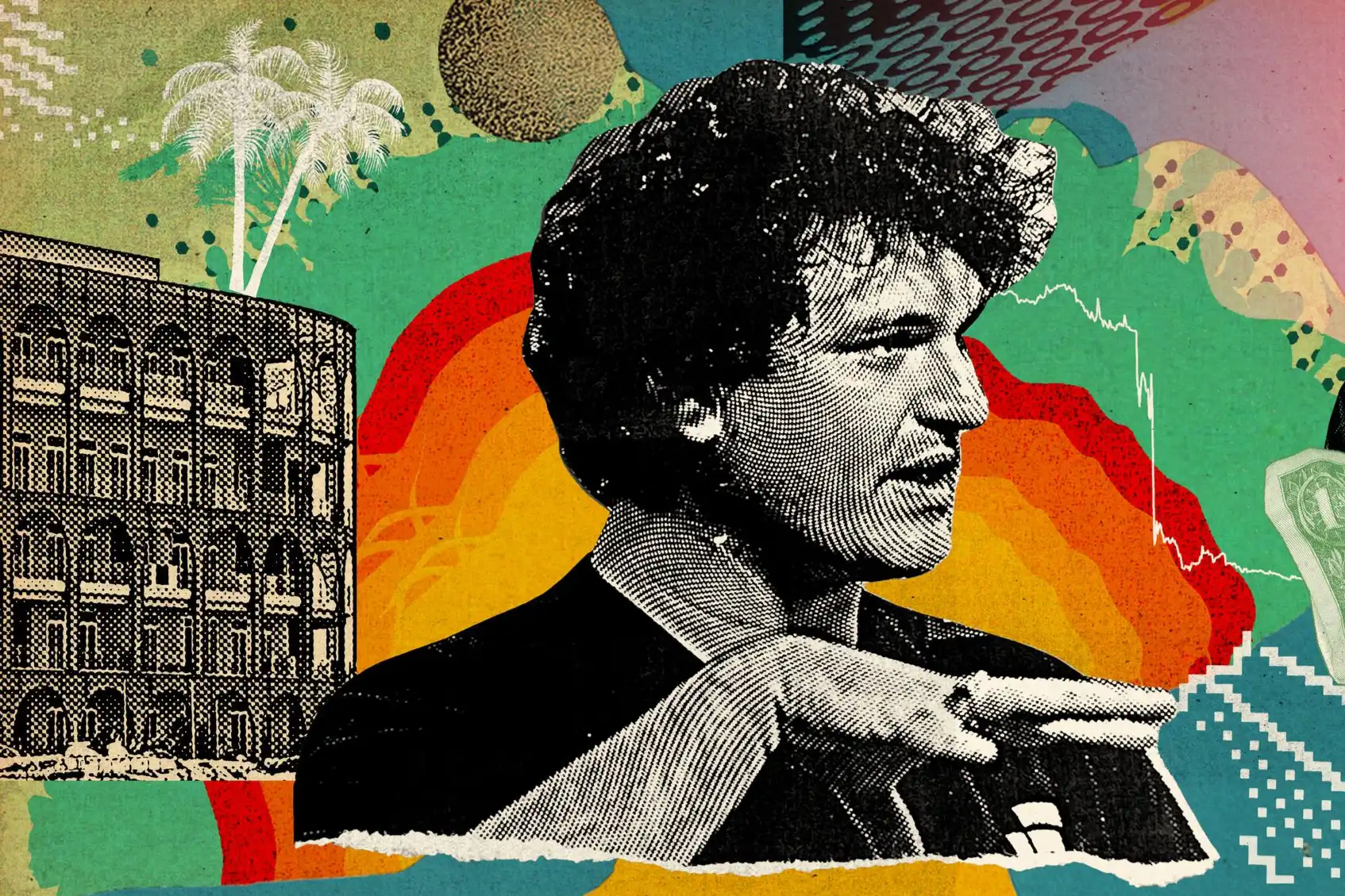
SBF: Assets are tools used to achieve a "greater mission.
原文标题:《 Sam Bankman-Fried and the conscience of a crypto billionaire 》
原文作者: Claire Zillman,Fortune
原文编译: 深潮 TechFlow
This post is part of fortune's special report on key moments for cryptocurrencies.
Sam Bankman-Frie (SBF) is an exception to the few billionaires who openly admit to pursuing money.
But SBF insists he is not after money to make himself rich. The 29-year-old founder and chief executive of FTX, a Hong Kong cryptocurrency derivatives trading platform, is known for his slovenly appearance. In an interview on a Tuesday in July, he fiddled with a pen and cellophane tape as he spoke. His curly hair was too long to hide the knots in his bun, and he was wearing the same gray FTX T-shirt shown in the online photo. His favourite drink is Pure La Croix, which he drinks at least once every weekday at 1pm. He shares an apartment with friends, but often sleeps in a beanbag chair next to his desk. He admitted that his back was not in good shape.
He denies pursuing money to make himself rich, arguing that his net worth is a tool for a "greater mission" -- what he calls doing the most good in the world.
Californian-born SBF is a disciple of Effective Altruism, a philosophical principle that encourages people to maximize their positive social impact. His early college conversion to effective altruism was motivated in part by his distaste for factory farming. He had been a vegetarian for ten years.
In reality, some effective altruists make it their business to raise money for nonprofits or important research. But SBF, who was studying physics at THE Massachusetts Institute of Technology at the time, thought his money-making potential could help humanity more than any charitable work.
SBF's technical background qualifies him for some high-paying jobs. He also told us, "I knew I could hand out fliers, and I wasn't very good at that. So I went to Wall Street after graduation, and my goal was to give away the money I made on Wall Street."
So how much money did he make? According to him, a reasonable estimate is $15 billion, a sevenfold increase over the past year.
Most of SBF's wealth comes from FTX, which is based in Antigua. FTX is known for offering complex derivatives (futures, options and leveraged tokens) that allow users to gain and lose large amounts of money from cryptocurrency price fluctuations, including even short-term derivatives that allow traders to profit in the event of a market crash. FTX also offers tokenized stocks that track the real share prices of Tesla and German biotech companies, digital currency and even more outlandised products -- such as pre-IPO contracts that allow users to bet on the valuation of companies in the pipeline, And products that allow users to bet on prediction markets that track the outcome of an event, such as the US presidential election.
Products such as crypto derivatives and tokenized stocks offered by FTX fall into a grey area of US law. To get around this uncertainty, FTX has adopted measures that are based overseas and prevent US investors from trading in the products. FTX does have a U.S.-based platform dedicated to buying and selling real cryptocurrencies.
SBF has now contributed $35 million. That's a small fraction of his net worth, but it's still a lot of money. The donation went to a number of causes, including OpenAI, a research organization dedicated to ensuring artificial intelligence benefits humans, and several animal welfare organizations. The money also included a contribution to Biden's presidential campaign -- $5 million from SBF to super PACs supporting Biden, making him the second largest CEO donor to the president (after Michael Bloomberg).

It has been about a decade since SBF embraced effective altruism in the "give it away" style, and the income side has been better than he expected. But the cryptocurrency industry that gave him his fortune is now facing new problems that are showing an ugly side. The nature of the boom and bust, the potentially disastrous impact of leveraged bets on digital assets, and the heavily scrutinized carbon footprint that is attracting increasing scrutiny from regulators also raise the question of whether the flaws of the cryptocurrency industry offset the benefits SBF has mined from the industry.
SBF admits he's now starting to reflect on the issue. "It's really hard to do a good deed if it's good in one area but it's seen as doing a lot of bad in other areas."
From MIT to Hong Kong
SBF's first job out of MIT was as a trader at Jane Street Capital. Colleagues at Jane Street Capital, a quantitative trading firm, reacted to his effective altruism with "a mixture of confusion and support". SBF said he enjoyed his work there, but he left in 2017, soon after spotting an even bigger money-making opportunity -- cryptocurrencies.
SBF founded Alameda Research, a crypto trading company he still runs today. He spotted early arbitrage opportunities in South Korea and Japan. Bitcoin trades several times as much in those countries as it does in the United States, meaning traders can buy bitcoins at a lower price in the United States and sell them for a profit in markets in other countries.
These arbitrage opportunities were one result of SBF's efforts to persuade Nishad Singh, now head of engineering at FTX, to leave Facebook and join Alameda Research four years ago. SBF and Nishad Singh went to the same High school in the Bay Area and joined the same circle of effective altruism. According to Mr Singh, it is "quite difficult" to take full advantage of arbitrage in The South Korean and Japanese markets, but they signal that encryption is inefficient and there could be "a lot of easy fruit".
Alameda Research's early journey also exposed the awkwardness of existing trading platforms in the cryptocurrency world at the time. To that end, SBF decided to create a trading platform of its own. (Alameda Research, which also runs FTX and trades through FTX, is not allowed under U.S. law, and he only became free to operate after moving to Hong Kong in 2018.)
Despite being a late entrant, FTX is now the world's leading crypto derivatives trading platform. According to the Coingecko As of Wednesday's data, FTX was in the top 15 spot trades, behind Binance, Huobi Global and Coinbase, with $1 billion traded in 24 hours. In derivatives, it ranked sixth with $870,000.
The speed with which SBF and its team respond to user needs is one of the characteristics of FTX, and it is this characteristic that makes Matt Huang, co-founder and managing partner of Paradigm Ventures, believed he should invest in FTX. Matt "When Sam sees someone complaining or asking for a feature on Twitter, he tends to add it to the platform," Says Huang.
SBF believes FTX "demonstrates the vision of a comprehensive financial experience" -- where users don't have to use "different platforms to trade your cryptocurrency and stocks." He sees products like tokenized stocks as innovative because they allow trading 24/7, rather than the 9:30 a.m. and 4 p.m. workdays of traditional securities trading -- an arrangement he sees as outdated, but critics are quick to point out the risks.
"Casinos are open 24 hours a day," says Lee Reiners, executive director of the Center for Global Financial Markets at Duke University Law School. What traditional stock investors lost on convenience gave them "access to the infrastructure designed to make sure the system works properly, avoiding any kind of catastrophic event.
"Broker-dealers in the United States are bound by the Securities Investor Protection Corporation, and there is a public guarantee," Lee Reiners said. "But the same guarantees don't exist in the world of tokenized stocks."
Binance, the world's largest cryptocurrency trading platform, began issuing equity tokens in April, but announced in July that it was "ending support for these products." On the same day, Hong Kong's Securities and Futures Commission said it believed Binance and other securities tokens had not been registered or licensed to carry out "regulatory activities" in Hong Kong.
SBF said there was no direct impact on FTX's products. "We're excited about the product," he said. "Obviously, we want to work with the regulators." He also said his company's signature shares are licensed.
The SBF recently responded, at least in part, to another criticism of FTX. The high leverage offered by trading platforms -- up to 101 times -- has been criticized for causing wild swings in cryptocurrency prices. He said on Twitter on Sunday that FTX would limit leverage to 20 times, dramatically reducing the size of investors' bets. "While we believe that much of the argument is that high leverage falls short, we also do not believe that it is an important part of the crypto ecosystem. And it is in some cases not a healthy part of the crypto ecosystem," he wrote.
But suspicions about FTX have not dissuade customers and financial backers. In fact, FTX says it has more than a million users and average daily transactions of more than $10 billion. Its latest round of funding, a $900 million Series B round that closed on July 20, attracted more than 60 investors and now values the company at $18 billion. FTX says its revenues have risen more than tenfold in 2021 and 75-fold since mid-2020.
Cryptocurrencies under review
Cryptocurrencies' progress into the mainstream has led to further scrutiny of digital assets. This year's price swings have highlighted their speculative nature. Regulatory crackdowns on cryptocurrency mining, particularly in China, have highlighted the industry's huge carbon footprint. The ransomware attacks on corporate giants have demonstrated how criminals rely on cryptocurrencies to carry out their criminal plans.
SBF admits that these problems only recently began to bother him. None of this has any effect on his two-step goal: First, to make money. Step two: Donate. "From that perspective, enhancing the reputation of cryptocurrencies has never been done before." But, he said, "MORE and more I realized that's not exactly the right way to think about it."
He attributes his Epiphany to the growth of FTX. "Eight months ago, I would never have spoken on behalf of the crypto industry. But we've done a good enough job over the last year that the things I've said and done have affected how people see the industry and changed the landscape."
To address the environmental costs of cryptocurrencies, FTX will buy carbon offsets and use them in research and development for green cryptocurrency mining, he said. "Acknowledging that there is a problem is the right thing to do, but solving it is not difficult, and we should solve it."
He told reporters that regulation is "an important factor" in boosting the reputation of the cryptocurrency industry. He said FTX could "try to get a licence where we can, stay compliant and react as best as we can to what the regulator says and suggests".
Another reality is that anything that improves or makes the crypto trading space more manageable will limit how much SBF can gain from it. But he said he was willing to make trade-offs. "Making a lot of money being bad is not actually a good plan, even if you're using the money to try to do good," he said. "More and more, I think that strategy will eventually fail, and you still have to follow the rules and be a good person while you're making money."
The original link
Welcome to join the official BlockBeats community:
Telegram Subscription Group: https://t.me/theblockbeats
Telegram Discussion Group: https://t.me/BlockBeats_App
Official Twitter Account: https://twitter.com/BlockBeatsAsia

 Related Articles