Reviewing Circle: Financing with the story of Bitcoin and listing with the story of Stablecoin
原文标题:《 多次转型,入华受挫,USDC 发行方背后的资本局 》
Original source: Moon, Deep Tide Techflow

"The greatest blessing a man can have in life is to find his calling in the middle of it, in the prime of life."
Zweig wrote in "When the Stars Shine."
Everyone has to climb several mountains and cross several rivers in his life before he can find his lifelong mission, so does a company.
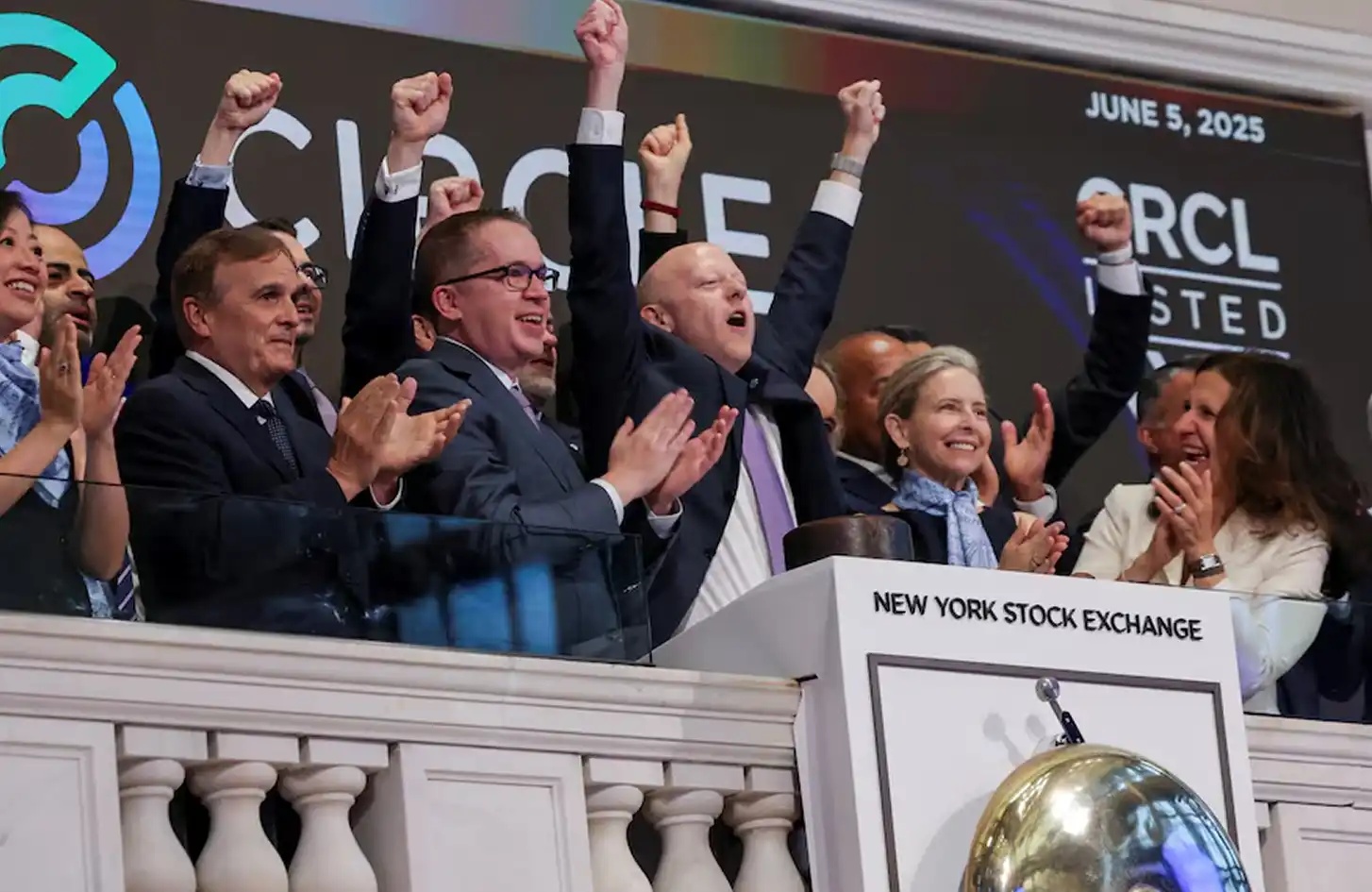
On July 8, 2021, USDC issuer Circle announced that it planned to go public in a merger with a special purpose acquisition company (SPAC) valued at $4.5 billion.
Reviews Circle2013 since the establishment of the development process, all the way bumpy, wallet payment, OTC, cryptocurrency trading platform, stable currency...... After paying a heavy price, the valuation of the bear market fell by 75% at one time, the company drastically laid off employees and sold off its core assets. Finally, it finally found its long-term mission and direction -- USDC.
Circle was fortunate to have people who helped it in times of crisis. Jim Breyer, General Catalyst, and IDG Capital helped make Circle what it is today. This is a story of growth and capital in the blockchain world.
Serial entrepreneurs embrace bitcoin;
Circle, founded in 2013 by Jeremy Allaire and Adobe chief scientist Sean Neville, is based in Boston and is his third official venture. Before that, he founded two publicly traded companies, software company Allaire& NBSP, in 1995 and 2012. And online video platform Brightcove, and accumulated a deep network.
When Circle launched, it raised $9 million in Series A funding, the largest round ever for A cryptocurrency company at the time.
The investors included Jim Breyer, Accel Partners, and General Catalyst, all of whom were investors in Allaire's previous company, Brightcove, rather than in Circle.
At the time, Circle was known as the "American version of Alipay".
The original product form of Circle was a digital currency wallet. It mainly provided cryptocurrency (Bitcoin) storage and fiat exchange services, and used Bitcoin to facilitate the rapid transfer of funds.
For example, international transfers using Swift take three to five business days to confirm, but with Circle, you can move quickly on a cash-bitcoin-cash route, in which Bitcoin acts as an intermediary.
At the time, Allaire was a strong believer in Bitcoin and thought it was only a matter of time before a cross-border payment system was in place. He wanted users to be able to transfer money without too many obstacles, just as they would with email or SMS.
Then Circle sings.
In August 2015, Circle received $50 million in financing led by Goldman Sachs Group and IDG Capital. Since then, IDG Capital has become the "VIP" on Circle's growth path.
Why did IDG Capital participate in the lead investment in Circle?
Circle's early investor, Jim Breyer, best known for his early investments in Facebook, is also IDG's U.S. investment partner. IDG Capital invested in Circle on the recommendation of Jim Breyer.
In September, Circle received its first digital currency license, BitLicense, from New York's Department of Financial Services, which means it can offer digital currency services in the state.
In the same year, China's mobile payment market was in flames. WeChat quickly occupied the market share of Alipay by relying on WeChat Lucky Money. Circle on the other side of the world did not just wait and see, but also launched social payment at the end of the year.
At that time, this was a bold innovation attempt, but now, it may be due to its own unclear positioning, foreshadowing the many transformations later.

In China & have spent
2016 was a year of change for Circle.
In April, Circle received an electronic payments licence from the UK's Financial Services Authority, the first time the UK regulator has granted a licence to a company dealing in cryptocurrencies and digital assets.
In June, when the sun was burning, Circle successfully joined hands with China Capital and announced that it had completed a D round of financing of USD 60 million. IDG Capital, the lead investor of the C round, continued to lead the investment. In addition, Baidu, Everbright, CresiTrust, Wanxiang, Zhongjin Jiazi and other Chinese enterprises also joined in the investment.
Among them, IDG Capital successively led the investment in Circle C and D rounds and joined the board of directors. IDG Capital founder partner Xiong Xiaoge once commented on this investment:
Now domestic investment in Internet companies, basically in the application, rather than technology. A very important reason is that at present, China sees more innovation in business model, but less innovation in technology. The US technologies IDG Capital has invested in, such as Circle's bitcoin blockchain technology, are largely of the "US can do it, China can't do it right now, or not as good as the US" category.
However, although the technology is invested in foreign countries, IDG Capital's original intention is to bring cutting-edge technology to China one day and achieve substantial development on the ground. This is our "China perspective" of investing in an American company. The reason why Circle brought in so much of China's top capital was related to his plans to enter China at the time. At the beginning of 2016, Circle established an independently operated Chinese company -- SKE China, which is mainly composed of Tianjin SKE Technology Co., Ltd., which means "payment that can be used in the whole world". The CEO of the company is Li Tong, the EIR (Entrepreneur in Residency) of IDG Capital at that time, and Xiao Feng of Wanxiang Group is the director.

From left: Tong Li, CEO of Worldco China; Jeremy Allaire, Founder of Circle; and Xiaoge Xiong, Founding Partner of IDG Capital.
Mr Allaire, the founder, said Circle would operate within China's regulatory framework and would not rush to launch products without government approval.
In addition, Circle has been communicating and sharing information with Chinese regulators, banks and other institutions. However, China attaches great importance to financial security, and third-party payment license is required to carry out payment business in China. Therefore, Circle's business in China has been stagnant for a long time with no real name.
According to the enterprise check information, on August 15, 2020, Tianjin Shike Technology Co., Ltd. applied for a simple cancellation, and officially cancelled on September 7, out of China.
Interestingly, Circle, which has no actual presence in China, has been affecting the share prices of A-share listed companies. Perhaps it is because IDG has too much influence on Circle. In 2018, it was once A wild rumor in A-share market that IDG would inject Circle into the listed company it holds, "Sichuan Shuangma". Shenzhen Stock Exchange sent an inquiry, and Sichuan Shuangma had to clarify that this is A speculation without facts and the company has no plan to develop blockchain business.

Transformation: Exchange Platform and Stablecoin & NBSP;
In 2016, as the debate over bitcoin's fork and expansion intensified, Allaire became frustrated with bitcoin's stagnant growth,"Three years on, Bitcoin's growth has slowed down a lot."", Allaire previously said in an interview.
On Dec. 7, Circle announced that it would "abandon Bitcoin" and retain the transfer of bitcoins and fiat currencies such as U.S. dollars, but that users would not be able to buy and sell bitcoins, and that "Circle will shift its focus to social payments."
But in fact, the whole idea was to move away from payments and toward transactions. "Allaire downplayed the role that Bitcoin (payments) played in Circle's business and started doing more about making money," CoinDesk reported.
What is the most profitable business in the cryptocurrency space? Trading platform.
In 2017, Circle announced that although it had removed the ability to buy and sell bitcoin directly from its APP, it would still make markets for large trading platforms and launch Circle Trade, which provides institutional clients with OTC services for large crypto assets.
In February 2018, Circle announced the acquisition of Poloniex, a crypto asset trading platform, for $400 million, formally entering the crypto trading platform space. The financing for the acquisition was led by its major shareholder IDG Capital.
In May, Circle continued to announce financing news, announcing that it had obtained $110 million in financing, which was led by Bitmain and followed by IDG Capital, Breyer Capital and other old shareholders.
It's worth noting that Bitmain, which led the investment, is also backed by IDG Capital, and according to Techflow,It was IDG Capital, already Circle's largest institutional shareholder, that made Bitmain lead the investment.
The investment is unusual for Circle in that it was financed at a lofty post-investment valuation of $3bn, which has fallen 75 per cent less than a year later.
Second, the money helped Circle to ride out the big bear market that was coming up in the second half of the year, which was a life-or-death test for both Circle and Bitmain.
Armed with an injection of capital, Circle has gone out of its way to try to blossom.
In July 2018, Circle launched the USDC, a stablecoin anchored to the US dollar. In retrospect, it was an historic moment and one of the most important decisions Circle made for itself. In addition to its core trading platform and stablecoin business, Circle has also begun to expand its footprint. In October 2018, Circle acquired equity-based crowdfunding platform SeedInvest and set up Circle Reseach to outsource cryptocurrency industry news and reports.
So far, Circle has become a diversified cryptocurrency group, fuelled by capital: Circle Pay provides money transfers; SeedInvest is used to raise funds; Circle Trade offers over-the-counter services; Poloniex provides trading services; USDC is the US dollar stablecoin.
Everything looks beautiful, but the cold winter has arrived.
Grey 2019, Survival with an Arm & NBSP;
2019 is the year of Circle Grey.
In February, Cointelegraph Japan was the first to reveal that Circle had been valued at $705 million on SharesPost's stock exchange. Nine months ago, Circle was valued at $3bn after receiving a $110m investment from Bitmain. In less than a year, its valuation has fallen by 75 per cent.
In May, CoinDesk reported that Circle had laid off 30 people, or about 10 per cent of its workforce, and then three more executives.
But perhaps the biggest headache for Allaire is the failure of Poloniex, the company he bought with a lot of money.
On May 13, 2019, Poloniex announced that it would remove nine cryptocurrencies from its users' pages in the US. Because these tokens are close to the concept of a security under U.S. law, they are not registered with the SEC and pose a risk of violation. In October, it took another six cryptocurrencies off the market, losing a lot of profits.
As a result, Allair publicly complained about US regulators several times, but had no choice but to move Poloniex's main operations to Bermuda, where the regulatory environment was more relaxed. On July 23, Circle announced that P Net will be licensed for its digital assets business in Bermuda.
But that hasn't stopped Poloniex from losing market share, from nearly 60 per cent in 2017 (among compliance trading platforms) to just 1 per cent in September 2019.

Plunging valuations, core business setbacks, brain drain... Circle stands at a crossroads again. At a critical moment, Circle has chosen to disarm itself, divesting non-core businesses from the second half of 2019 to focus on the stablecoin USDC.
In June, Circle announced that it would phase out support for user payments and charges starting July 8, and eventually eliminate all support for Circle Pay entirely on September 30.
On September 25, Circle announced that it was suspending Circle Research.
In October, to much consternation, Circle sold Poloniex, its trading platform business, as part of "Polo Digital Assets" run by an Asian investment firm backed by Sun Yuchen, TRON's founder.
Circle lost more than $156 million in its acquisition and subsequent sale of Poloniex, according to the latest SPAC filing.
On December 17, Circle sold its OTC service desk, Circle Trade, to exchange Kraken.
By 2020, Circle's crypto investment trading app Circle Invest was sold to Voyager Digital for an equity stake. After a series of slimming down, Circle went from a diversified cryptocurrency group to a USDC-focused stables issuer, facing the challenge of Tether.
Finding the Mission -- USDC 
In the stablecoin world, USDT has always been the unchallenged king, but by 2021, things are starting to change a bit.
Year-to-date, the overall stablecoin market has grown more than $28.9 billion to $109.4 billion, according to TheBlock.
Among them, USDT's total issuance increased 296% to $64.2 billion from $21.6 billion, while USDC's total issuance increased 614% to $25.8 billion from $4.2 billion.
Under the impact of USDC, USDT's stablecoin market capitalization share has decreased from 74% at the beginning of the year to 58% today, while USDC's market capitalization share has increased from 15% to 23%.

From the market's point of view, this is a victory for compliance and DEFI.
According to cryptocurrency expert Ryan Watkins, one of the main reasons for Tether's decline is that due to the increasing use of USDC by the DEFI protocol, users can earn high profits by using USDC to interact with the DEFI protocol.
This year, CIRCE introduced the DEFI API, which provides institutional users with access to the API to access various DEFI protocols, thus serving as a bridge between traditional financial markets and DEFI.
Compound and Coinbase have successively launched USDC deposit yield products with a yield of around 4%, far higher than the yield of US dollars in the traditional financial market.
This, in turn, is thanks to USDC's compliance and transparency, which founder Allaire is proud of.
The USDC is both regulated and audited. This is important to ensure that the stablecoin is pegged to the dollar. As a result, we have monthly statements from the largest accounting firms in the world, which ensures that the funds in circulation are held in dollar reserves, one to one, and we store these dollar assets in a separate account with one of the largest dollar banking institutions in the world. Therefore, it can give USDC holders a great deal of confidence. The other difference is that you can go to Circle and Coinbase and convert it into dollars at any time.
More than $25 billion of USDCs are already in circulation, and Allaire believes there will be $190 billion in USDCs by the end of 2023.
The stablecoin issue is only the first step. Circle's ambition is to use the popularity of USDCs to build a financial service system that uses USDCs. To this end, USDC will be more active in the future.
(1) Multi-chain extension.
On June 30, Circle announced in a draft announcement that it expects to launch USDC on Avalanche, Celo, Flow, Hedera, Kava, Nervos, Polkadot, Stacks, Tezos, and Tron in the coming months, This will greatly improve the efficiency of USDC's transfers while reducing costs.
(2) Expand commercial applications.
According to Allaire, the fastest growing use of USDCs is as a lending asset. In addition, USDCs are also being used in digital games, online games, e-commerce and other markets. In March 2021, the credit card company Visa said it would allow the use of USDCs to settle transactions on its payment network, and USDCs are on their way out.
In May 2021, Circle announced it had closed a $440 million financing round, Attracted investors from Fidelity, FTX, DCG, Marshall Wace, Valor Capital Group, Pillar VC, Intersection Fintech Ventures, Atlas Merchant Capital and Willett Advisors, among others.
By this time Circle was already preparing for the SPAC IPO, waiting for the bell to ring.
Summary & have spent
Unlike Coinbase, which was firm in its mission and direction from the very beginning, Circle has gone through a series of explorations in the world of digital finance, made a detour, paid a heavy price, and was on the verge of a life-or-death decision. Finally, it found its mission in the "prime of life".
Circle has its rich people to thank for its thorn-strewn quest.
Jim Breyer, Accel Partners and General Catalyst supported Jeremy Allaire and Circle throughout. It was also Jim Breyer's recommendation that led IDG Capital to marry Circle and become a staunch supporter of the company's growth.
IDG Capital has made multiple bets and not only become the largest institutional shareholder of Circle, but also helped it to acquire Poloniex and attract investment from Chinese capital at critical times. To some extent, without IDG, Circle would not be where it is today.
Of course, all of this may be inseparable from Jeremy Allaire's track record of business success and personality, after all, the end of investment, or investment.
The original link
Welcome to join the official BlockBeats community:
Telegram Subscription Group: https://t.me/theblockbeats
Telegram Discussion Group: https://t.me/BlockBeats_App
Official Twitter Account: https://twitter.com/BlockBeatsAsia
 Related Articles