Can the algorithm stablecoin OlympusDAO solve the problem of death spiral?
Original title: "Interpretation of the most FOMO algorithm stable coin OlympusDAO, why attract the mine jump"
Original source: Panews
Olympus is the Greek mythology of Zeus and his brothers and sisters live connected to the divine and human world of the sacred mountain. In the field of cryptocurrency, a project called OlympusDAO wants to bridge the mountain between traditional currency and cryptocurrency. He believes that a perfect currency should have the same purchasing power as before. The price of cryptocurrency such as Bitcoin or Ethereum is not stable, and should be considered as an asset rather than a currency. As a result, an algorithmic stablecoin was created that contained at least a dollar of backing.
Like FEI and Float, the assets in OlympusDAO are also controlled by the protocol. Users cannot directly use the protocol to create an OHM, nor can they destroy the OHM and redeem the corresponding assets.
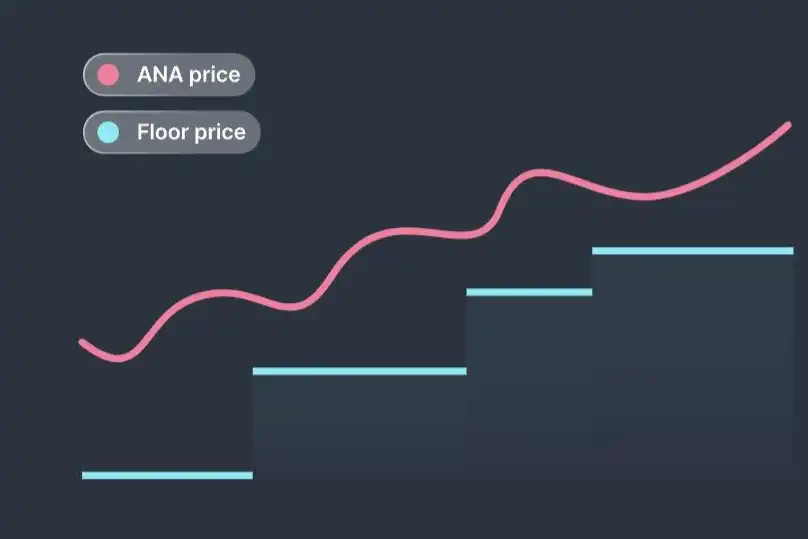
Olympus uses DAI as a reserve and agreements to cast and sell new OHMs when the OHM price is higher than 1 DAI; When the OHM price is below 1 DAI, the OHM is purchased from the market and destroyed. This gives the agreement a source of revenue:
All OHMs sold are higher than 1 DAI, and every 1 OHM in circulation contains at least 1 DAI in reserve.
If the OHM price is lower than 1 DAI, the OHM can be purchased and destroyed indefinitely until no one is willing to sell the OHM for less than 1 DAI.
Earn revenue from the revenue aggregator. Even if OHM prices collapse, the agreement needs to reserve only a small amount of the money used to buy back OHMs from the secondary market, with the rest put into aggregators such as YFI to generate revenue.
Based on the above ideas, in the long run, OHM will not be lower than its intrinsic value, and there is a sound logic that can support its long-term operation. When Olympus finally reaches a plateau, where the OHM's time-weighted average price is equal to its intrinsic value, the agreement will continue to benefit from these channels.
The most FOMO inflation
What really made Olympus controversial was its inflation/deflation and income distribution. When the Time-Weighted Average Price (TWAP) of the OHM is greater than its intrinsic value (IV), the Treasury will issue a new OHM to finance the sales contract, with an initial IV of 1 DAI. In order to reduce the sales pressure of the protocol, OlympusDAO introduced the inflation control variable (ICV), the higher the ICV, the higher the proportion of each change. If TWAP is less than IV, then the percentage of DAI used to purchase the OHM is determined based on the contraction control variable (DCV).
The sale or purchase of the agreement is first made through a sales contract, into which the user can inject DAI to buy the OHM generated by inflation at a discount, or sell the OHM to the agreement through a sales contract in the event of deflation. The agreement may not be able to satisfy all orders in the sales contract, in which case the transaction will be conducted directly on Sushiswap.
Profits generated through the sales contract will be recasts 1:1 as OHM, with 90% to the pledger and 10% to the DAO.
The benefits of pledging OHMs largely depend on how many subsequent users are willing to buy OHMs at a high price. This will lead people to believe that the earlier they buy, the higher the benefits they can get, thus generating serious FOMO emotions.

The launch OlympusDAO
Olympusdao was initially distributed fairly through the Initial Discord Offering. Users who join the official Discord before March 3 will be whitelist and can purchase OHM from March 12 to 14 at a price of $4, with a quota of $600 per user.
After several delays, on March 23, OlympusDAO injected DAI and OHM liquidity into Sushiswap's liquidity pool. A robot in a mine trades most of the OHM in the flow pool for 150 ETH, and the Gas fee for this transaction is 0. Since then, the robot has sold the OHM to subsequent users at a high price, and as of the afternoon of March 26, it has all been sold.

Miner Extractable Value (MEV) has become a fundamental concept in crypto economics. Block packers have the right to determine which transactions will be packaged. Typically, users bid to qualify for the package, with the higher the Gas Price paid, the earlier the deal will be packaged. But as more and more miners and even mines participate, they can carry out a risk-free arbitrage, buying before the user buys and selling after the user buys, all three transactions taking place in one block or being canceled altogether if they don't happen at the same time. As the referee of the mine to join the competition, damaging the rights and interests of users. The impact of this incident was even worse, as the mines directly bought up more than half of the entire pool of tokens, leaving many users unable to participate.
bond
To give OHM liquidity providers an incentive, Olympusdao introduced bonds that give liquidity providers the option to buy OHM at a discount in the future. The agreement refers to a certain number of OHM and vesting periods, after which the user will have the option to exchange his LP Token of OHM/ETH for OHM at a discounted price if he accepts the quotation. Although the agreement casts additional OHMs at this time, it also gets more DAI from LP Tokens as a reserve.
Bonds are an important part of OlympusDAO. A higher OHM price will encourage users to buy bonds. Although the OHM in the LP Token is measured by value in the agreement, LP will sell the LP Token to the agreement at a lower price than the market price, but it also demands OHM from the agreement at a lower price than the market price.

The risks and opportunities of OlympusDAO
Although the Initial Initial Discord Offering price is $4, there is no risk whatsoever in the Initial Discord Offering price. At this time, OHM's market value in circulation is equal to the reserve in the agreement. After the inflation pledge, the number of OHMs grew enough to cover the fall in prices.
When OHM falls to $1, there is little risk in buying OHM in the long run because DAI has reserves behind OHM. Then there is the arbitrage and the return on mining with reserves.
The market value of OHM may be separated from its reserves, especially in the early stage, and it risks losing money if it buys at too high a price.
OlympusDAO compared with other projects
The various mechanisms of OlympusDAO are much like a combination of various stablecoins.
The reward system is similar to ESD. Both stablecoins have only one token, in which the person pledging the stablecoin receives an inflation return.
The repurchase mechanism is similar to the FEI Protocol. In OlympusDAO, if OHM's TWAP is less than IV, it will be repurchased by the reserve. In FEI Protocol, if FEI is lower than the peg price, FEI Protocol will withdraw liquidity, purchase FEI with ETH, and destroy the surplus FEI.
After the final TWAP=IV, the agreement will gain revenue through aggregated mining and other ways. The rights and interests of SOHM are close to those of YDAI, but they are not transferable. The number of SOHM will grow just like AToken in Aave.
conclusion
The design of OLYMPUSDAO is quite ingenious. Although OHM has no less than 1 DAI as support, the ratio of pre-stage reserve and market value of OHM is less than 10%, and the reserve is negligible, which is conducive to the rapid expansion of OHM scale. Finally, the price of the OHM is stable around the internal value, and if the internal value remains 1 DAI, it may become a practical stablecoin.
The original link
Welcome to join the official BlockBeats community:
Telegram Subscription Group: https://t.me/theblockbeats
Telegram Discussion Group: https://t.me/BlockBeats_App
Official Twitter Account: https://twitter.com/BlockBeatsAsia
 Related Articles