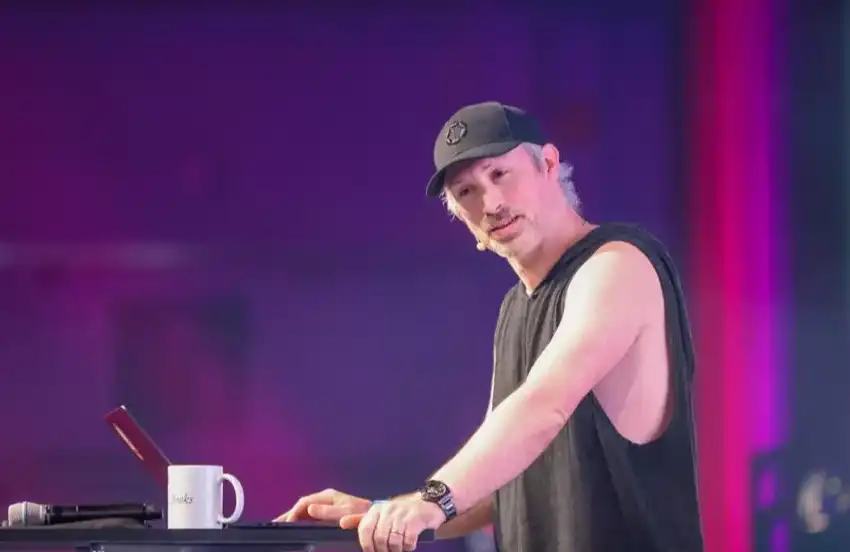
Gavin Wood: Poca's tentative goal is to have Parallel Chain released by the end of this quarter
Gavin Wood: Our Tentative Goal to Have Parallel Chain Launched by the End of the Quarter
Original source: PolkaWorld
Late last month, Boca founder Dr. Gavin Wood had an in-depth conversation with Sebastian Moonjava, deputy editor of blockchain investment media Real Vision, for more than an hour, to talk in depth about various topics related to Boca.
Due to the long content of the talk and the high information density, Polkaworld is divided into five parts to publish. Today's is the fifth and last part, which mainly discusses:
Boca was a crusade against monopolism
When does the parallel chain go online?
What else is Poka/Kusama planning for this year?
Views on the Boca Ecosystem: Now is a good time to get in.
Sebastian Moonjava: I've heard you say before that Polkadot is a bet against blockchain maximalism? Could you elaborate on that further?
GAVIN WOOD:Yes. We certainly don't know what the best is. I think even if we don't know what is best, there is no best. For a particular application, there may be one best; For a particular industry or field, there may be the best. But I don't think there is a "best".
I think Ethereum is a good chain for experimental prototypes of blockchain. If I'm doing, for example, a supply chain infrastructure, why would I want to build a smart contract in a metering system that has to be metered and is very inefficient? I know what these contracts are. I know how long this is going to take. Why do I have to re-evaluate how long it takes every time a user uses them?
Now, of course, if there are many different contracts, and you can't predict ahead of time which one is going to be used, and anyone can move into any contract at any time, like a very general purpose, a very prototypical heavy system. Of course, metering may be the only way, but for many domain-specific applications, it is not needed. It's too onerous. It's actually much better to create a domain-specific blockchain. But the problem is that creating a domain-specific blockchain is time-consuming.
Because they only exist as blockchains, they cannot easily talk to other blockchains. They don't integrate well. You can't put them together easily. That's where Polkadot comes in. It's like Substrate, which is our blockchain development kit and makes it very easy to build your own blockchain. We can now see some great press articles based on Substrate building their own blockchains in different industries.
One I read about recently was a Korean music publisher that's building a blockchain, NFT, for K-pop bands. That's a great idea. We're seeing these domain-specific blockchains emerge because they're much more efficient and perform better than doing things in a generic environment. Of course, Polkadot allows these domain-specific blockchains to be deployed to Polkadot, communicating with each other and sharing security, so you don't need to motivate your validators or other centralized authorities.
This is where the really interesting performance advantage comes in. It's not just about all the parallelization (which is good enough), but each chain is a different blockchain and each is processing transactions at the same time. Each chain, each shard, is domain specific. It is optimized for specific domains to achieve high performance. This is you can't in a typical isomorphism shard system can be implemented, such as Ethernet 2.0, although it could be 64 fragmentation, or how many quantity, but each of them is doing the same thing, each is a common purpose, which means there's no a shard will handle them in dealing with a very high performance of any task.
Sebastian Moonjava: I see. Very interesting. I'd love to hear your thoughts on what's happening in the area of Polkadot and Kusama, especially over the next year or so. What are your expectations? You mentioned the release of these parallel chains, is that going to happen soon? Talk to us about the future of Polkadot and Kusama.
GAVIN WOOD:Yes. As I mentioned Rococo, the Parallel Chain Testing Network was launched two months ago and is slowly being integrated into the Parallel Chain team. I think we had 15 or so, 15 or 20, and they were ready, their software, their parallel chains, and they were ready to put it on the Rococo test network. Once we were satisfied with how the code worked, we put it online on the Kusama network, along with Kusama Auction, which is a slot auction and crowdlending system. This allows people to support their favorite parallel chain through the Kusama Stake Holding Ecosystem, and perhaps receive some rewards from the parallel chain team for their support.
That could happen in the next month or two. Once everything works as we expect on Kusama, and then the external audit is done, we've hired an external audit firm to tweak all the new code as we develop it, and once they feel secure, we'll deploy it on Polkadot. Our tentative goal is to finish by the end of this quarter, so hopefully we can get it done.
Once this is done, there will be. Initial version of XCMP, which is a cross-chain messaging protocol. This is a way for these parallel chains to send information to each other, they can communicate, and as I mentioned, every six seconds, they can send information. Hopefully this will also be able to make the first delivery before the end of the first quarter. In the first half of this year, we will more or less optimize an off-chain version of XCMP, which will basically dramatically improve efficiency, increase the number of messages that parallel chains can send to each other, reduce the costs associated with that, and so on.
There are other techniques. One of them is called The SPREE. This is a very exciting technology. It stands for Secure Protected Runtime Execution Enclaves. And what it basically means is that you can have little programs running in these parallel chains. They all run separately, they all run in parallel with the parallel chain, it's like you're managing 100 copies of programs, and they all run within the scope of the parallel chain, but they're the same program. It's the best of both worlds. You get different domain-specific, industry-specific shards of blockchain, but you also get computer programs that are the same across all shards.
It can handle things like token balances, and you can send something like tokens or assets between shards, and make sure that the code on the other side of the message is executed correctly, as you expect. A token, a very simple execution, reducing the balance of one account, increasing the same balance of another account, a very simple transfer operation, but we can imagine that there might be several different little pieces of code that have their own protected store, so that they can keep the balance.
This is very important, so those parallel chains that don't trust each other's logic may believe that Polkadot is correctly executing their logic because they will meet the same verifiers, but they don't necessarily believe that the logic itself is doing what they expect it to do. When they say, hey, please transfer this asset, it actually reduces the balance of one account and increases the balance of the other. What Spree does is give them reassurance. It has two advantages: isomorphic sharding and heterogeneous sharding.
Sebastian Moonjava: Can we see that in the near future? When do you expect that SPREE to come?
GAVIN WOOD:All I'm saying is, I expect a Q3 release. Probably the third quarter of this year.
Sebastian Moonjava: Do you think most of your labor will be done by the end of the year? You say this SPREE, all these parallel chains, that you think defi will exist at the end of the year on Polkadot?
GAVIN WOOD:Yes, I hope so. There are already many defi chains. We have some great teams, some very talented people working on parallel chains. For me, I think the great thing is that it's out of my control. Our job was to develop Polkadot and deliver parallel chains while making it as efficient and stable as possible. When that's done, we'll probably start trying to develop some of our own parallel chains, and maybe some of the core technologies on top of that parallel chain, but basically, our job is to deliver Polkadot as an application platform.
As I said, it's a great ecosystem, with about 340 projects developing Layer1 for these platforms. Polkadot is a platform of platforms, or the platform itself, providing the infrastructure to do things like decentralized finance, supply chains, registration tracking, NFT and all that crazy imagination. Some of them are going to change a lot. That's good, and I have a lot of confidence in a lot of them.
Sebastian Moonjava: Thank you very much! Is there anything else you would like to say to the audience about Polkadot? Or what do you think about the future and the entire ecosystem?
GAVIN WOOD:I think it's an interesting time for ecosystems, especially Polkadot. Obviously, most of my time and energy was focused on Polkadot. I rarely get a chance to look around and see what's going on in the rest of the world. This is especially true in the absence of last year's conference. I really think it's a good time to get into this ecosystem. We are slowly but surely moving into Blockchain 3.0.
It's important to look behind these claims to figure out where the real actors of this golden age are, the ones who may not be in Blockchain 3.0 yet, and they're still in the 2.5 era, because I think on the surface, it's not always easy to tell apart. If you want to make any judgments and assessments, it's important to do a proper, sophisticated assessment of cutting-edge technology, an assessment of where the protocols are, and perhaps a proper game theory assessment of what the protocols are doing, rather than get caught up in a lot of hype.
The other thing I want to say is to pay attention to the difference between evolution and revolution. I know that after doing Ethereum, we brought a new architecture to the world with Ethereum -- the idea of Ethereum virtual machines, the idea of smart contracts. I'm very proud that this technology is now six or seven years old. We're still seeing blockchain clinging to this architecture, clinging to this smart contract, gas consuming, dynamic metering architecture that we introduced in Ethereum at the time.
That's all good, and you'll see it evolve. You'll see people improving performance. You're going to see some changes to trade promotion and things like that, just trying to eke out an improved transaction throughput level. In the end, if it uses the same architecture, it may not make a revolutionary difference in a revolutionary innovation. You have to look beyond this structure to find the gems of the golden age.
The original link
Welcome to join the official BlockBeats community:
Telegram Subscription Group: https://t.me/theblockbeats
Telegram Discussion Group: https://t.me/BlockBeats_App
Official Twitter Account: https://twitter.com/BlockBeatsAsia

 Related Articles